Chapter 3: Incorporating the Anti-Establishment—Siddhas and Universities
One loose end hung in the register of counterexamples in Part V, Chapter 3. The songs of realization mocked the paṇḍitas; protest became a genre, but the protesters were not adopted as a corrective. They were classified as another track. This chapter follows that track from beginning to end. It starts as anti-establishment revolt and ends as an advanced curriculum. The operations in between deserve inspection one by one.
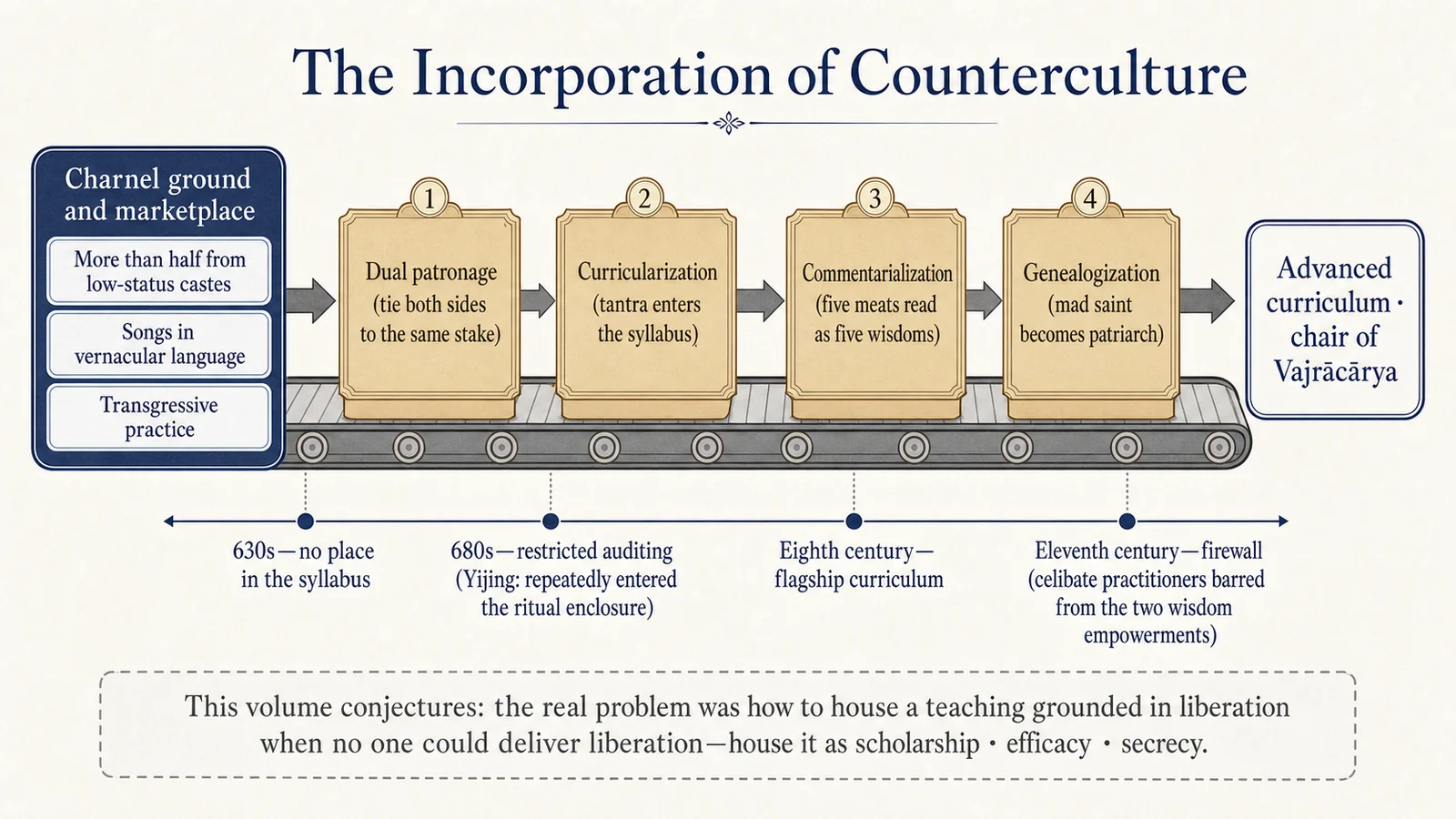
Begin with the portrait. The traditional list of eighty-four mahāsiddhas reads like an anti-Nālandā manifesto: weavers, fishers, hunters, cobblers, brewers, kings, and courtesans, more than half of them low-caste or outside institutions. Their settings were charnel grounds and markets, not lecture halls. Their language was vernacular song, not Sanskrit commentary. Their practices deliberately crossed lines: the five meats and five nectars, consorts, and skull vessels. Their posture was ridicule. Saraha laughed at paṇḍitas who did not know their own minds, as Part V, Chapter 3 quoted, while the songs laughed in turn at meditation, moral discipline, recitation, and pilgrimage. Read the institutional inventory of Part V backward and one obtains the siddhas' self-definition: degrees, rank, number of treatises, victory in debate—they wanted none of it.1
There was nothing romantic about the movement's sociology; state the plain facts first. The Nālandā system's filter excluded people by caste, literacy, and the cost of a curriculum measured in years. They accumulated outside the institution. Drift in criteria made refugees of people who could practice but could not debate; within the institution they had no stair, as the judgment of Part V, Chapter 3 looks when translated into human lives. Add religious entrepreneurs from the borderlands. Talent and demand sedimented outside a system will eventually find their own form. The best-known file is Nāropa. A gatekeeper-scholar of Nālandā rank and the highest debating credentials, his sacred biography says that one day an old woman confronted him: you understand the words, but do you understand the meaning? He abandoned his post, entered the forest, followed Tilopa, and endured twelve ordeals. Sacred biography must, as always, be read at half weight. Yet the tradition's repeated celebration of the story is itself a hard record. People inside the institution were circulating a parable in which degrees fail at the decisive moment. The institution had already supplied its own candid acknowledgment in support of Part V's critique of criteria.2
Before listing the operations, note where their craft came from. The university did not invent these techniques for the siddhas. It had perfected them earlier while handling the flood of scriptures. Part IV showed that no Indian institution possessed authority to close the open canon. Nālandā's solution was never to lock the gate but to compile a catalogue. Courses were organized around treatises. Monks studied Nāgārjuna, Asaṅga, and Dignāga without having to confront the sea of sutras directly. Compendia compressed the corpus into a syllabus. The Abhisamayālaṃkāra, organizing the enormous Prajñāpāramitā corpus into eight topics and seventy points, was the most successful example. The grammar of doctrinal classification (definitive and provisional meaning, the three turnings) allowed everything to remain the Buddha's speech while the syllabus decided what carried weight. If you cannot control admission to the canon, control the curriculum. Locking the gate would lock yourself out; cataloguing leaves it open while selling the map.3 Thus when a flood of spells and charnel-ground holy madmen reached the entrance, the university did not need to invent anything. It merely ran its familiar procedure again: a syllabus for the flood of sutras, levels of empowerment for the flood of spells, and teaching posts for the flood of people.
Incorporation proceeded through four operations. First, dual-track patronage. The Pāla dynasty supported universities and siddhas at the same time, turning institution and anti-institution alike into recipients of its gifts; money tied both to the same stake. Second, curricularization. Vikramaśīla made tantra an advanced subject, the vajrācārya became a faculty post, and esoteric practice entered the sequence of study. A graded path of exoteric practice first and esoteric practice later placed rebellion on the timetable; Part XII's Tibetan synthesis is this operation in its finished form. Third, exegetical conversion. Literal transgression was systematically made symbolic. The five meats became the five wisdoms; the consort became insight and the nature of reality; the charnel ground became the burial ground of attachment to self. Line-crossing language was placed in an interpretive safe. Wedemeyer argues that antinomian language originally had a semiotic function, while the commentary tradition thoroughly domesticated it.4 Fourth, genealogization. Holy madmen were retrospectively recognized as patriarchs, their songs collected into the canon, and the memory of the charnel ground turned into classroom material. When the four operations closed, anti-establishment revolt became the institution's highest curriculum. The agreement used on its own rebels was the one used against Śiva: trample, incorporate, and install in the maṇḍala.
This process left milestones that can be dated. In the 630s, Xuanzang's account of the Nālandā curriculum was entirely exoteric; esoteric practice had no place in the flagship timetable, although he himself translated dhāraṇīs and spells remained alive at the service level. In the 680s, Yijing inserted a discussion of the Vidyādhara spell collection into Daolin's biography in his Biographies of Eminent Monks Who Sought the Dharma in the Western Regions. Esoteric mantra was by then a subject on campus. Its Sanskrit corpus was said to contain one hundred thousand verses, and transmission was strictly restricted to qualified recipients. Most precious is Yijing's first-person record. At Nālandā he had “repeatedly entered the ritual ground, hoping for this essential teaching,” but “as achievement did not follow, I abandoned the wish.” An orthodox monk known for Vinaya scholarship could openly attempt it without scandal, showing that incorporation was halfway complete. His inability to gain entry is itself the sound of the chain lock from Chapter 1 engaging on site. In the eighth century, Pāla dual patronage and curricularization at Vikramaśīla promoted a restricted elective into a flagship course. In the eleventh century, Atiśa's Lamp for the Path to Awakening, written for Tibet, expressly barred celibate practitioners from secret and wisdom empowerments. The institution had swallowed esoteric Buddhism and then installed a firewall around its ordained core.5 Read the four stations together: from no seat, to restricted auditing, to flagship curriculum, to orthodoxy with a firewall. Incorporation was not a single decision but a staircase with a landing every half-century.
The transaction ran in both directions, and each party recorded gains. The university purchased vitality and a new market, distribution rights over charisma (empowerment required a queue, the queue required qualifications, and the monastery issued them), and final disposal of a dangerous competitor. Writing a challenger into the syllabus is more thorough than expelling one from the gate. The siddhas purchased registration, becoming lineage-bearing patriarchs rather than suspicious charnel-ground sorcerers. They also purchased survival. Their songs endured because they entered the canon. Of those who refused incorporation, today we know only names—or not even names. Survivor bias has been counted once more. There was one loser: verification. In the siddhas' original form, testing at least remained immediate. Sacred biographies abound with contests of supernatural power and face-to-face examination. Even read at half weight, they show that the imagination of verification was alive. After curricularization, siddhi receded into signs of attainment, and authority to interpret the signs belonged to the guru. No one beyond master and disciple was present. Volume II's judgment on “signs of attainment and the guru's authority” here receives its institutional half. The guru's authority was not simply a doctrinal preference of esoteric Buddhism; it was a structural product of incorporation. Once transgression was locked in the safe, the key could hang only at the master's waist.6
Take inventory through the four questions. What changed? The third replacement of the criterion of practice was complete: cessation at baseline, debating skill in Part V, and siddhi and signs of attainment in this part. This time the criterion was fully privatized. Victory in debate was still public; signs of attainment were known only to master and disciple. The silence recorded in the Interlude reached its final form here: nothing could be examined. What force pushed the change? Pāla dual-track patronage, the markets and technologies of the preceding two chapters, and an institution's instinct for self-repair. Suppression is costly; incorporation is cheap. Who benefited? Both sides of the transaction, as inventoried above. Record two costs. First, the address of protest was cancelled. Tradition thereafter had no position outside the institution from which a critic could stand; later dissenters could only return to lay life or convert. Second, inflation in transgression. Once transgression became a course, it lost its signaling value. The next generation needed a more extreme transgression to distinguish itself—the escalation among the four classes of tantra recorded in Volume I. The whole community paid the social cost of that inflation with its reputation.
Under the rules, what follows is explicitly this volume's conjecture, in two layers. The shallower layer closes this chapter. Incorporation was reciprocal: the university acquired vitality and the siddhas orthodoxy; the loser was “verification,” which lost its place on both sides. If siddhi after incorporation can be shown still to have undergone institutionalized public examination (a normal procedure with third parties present who could overrule the guru's interpretation), this layer fails. If anti-establishment lineages can be shown to have survived independently and for long periods within India while refusing incorporation, the claim that their address was cancelled should be discounted.
The deeper layer closes this part. By this point what liberation had become within Buddhism is the elephant in the room: everyone could see it, and no one touched it. The eyes of a visitor are the most candid. In the early eighth century, the Chinese monk Huiri traveled through India for more than ten years, asking scholars wherever he went the same questions: “In what country and direction is there bliss without suffering? What teaching and practice can bring a swift vision of the Buddha?” The answer was unanimous: the Pure Land. When the masters of the land where debate flourished most were asked for a way to settle birth and death in this life, they pointed to another land after death. No one gave him a path that could be walked here and now. After returning to China he became a master of one Pure Land lineage; Chengyuan, counted as the third patriarch of the Pure Land school, was his student.7 Under this volume's rules, give the record half weight. It survives in a Pure Land biographical system with a motive to establish the school. Yet the outline cannot be discounted away: someone who traveled ten thousand miles seeking the Dharma asked “how can birth and death be ended?” on this soil and could not obtain an operational answer. The outline fits the institutional history of this part's three chapters exactly. As for the siddhas, this book must state its skepticism in the same terms used when the Interlude audited the inventory of arahants. Signs of siddhi admitted no third-party examination (the institutional cause has just been shown), and little remains from miraculous narratives after sacred biography is read at half weight. “What did the siddhas actually accomplish?” is a question the system itself designed so that no one could answer. This volume therefore conjectures that the real problem within Buddhism in these centuries was no longer “how to attain liberation,” but “how to house a teaching founded upon liberation when no one could redeem the promise of liberation.” The debate track housed it as learning, the service track as efficacy, and the siddha track as secrecy. The three did not challenge one another because overturning any one would expose the elephant for all. If mainstream traditions of the period can be shown to have conducted open audits of “whether liberation is still occurring,” rather than apologetics that presupposed it, or if verifiable records of siddha attainments can be found, this conjecture fails.
The three chapters close, and the accounts of the part can be read together. Buddhism filled the three squares of service, technology, and personnel and received in exchange its final period of prosperity in India. Pāla esoteric Buddhism was a genuine success. Yet the same small print appears on all three receipts: Buddhism's recognizability against Śaivism fell to its lowest point in history. Only the monastery walls still recognized which religion stood within them. In late Kālacakra literature the enemy even acquired a name; the opponent in the war at the end of the Dharma was called the “mleccha.”8 When a religion can recognize itself only inside its walls, the walls are its entire life. The next part turns to the death of Indian Buddhism.
References
References
-
For the lineages and portraits of the eighty-four siddhas, see the Tibetan Lives of the Eighty-Four Mahāsiddhas in the version attributed to Abhayadatta; English translation in Keith Dowman, Masters of Mahāmudrā (Albany: SUNY Press, 1985). For the literature of songs of realization, see Jackson 2004, cited in Part V, Chapter 3. For an overview of the siddha tradition, see Volume I, Part VIII, Chapter 4. ↩
-
On Nāropa leaving his post and following Tilopa, see Herbert Guenther, The Life and Teaching of Nāropa (Oxford: Clarendon Press, 1963). This volume reads the sacred biography at half weight and treats only the tradition's celebration of the story as archival evidence. ↩
-
On Yijing's account of a Nālandā curriculum organized by treatises, see the chapter “Learning the Dharma in the West” in his Record of Buddhist Practices Sent Home from the Southern Sea, cited in Part V, Chapter 2. The Abhisamayālaṃkāra, one of the five works of Maitreya, organizes the Prajñāpāramitā material into eight topics and seventy points; see Volume I, Part VI. ↩
-
Christian K. Wedemeyer, Making Sense of Tantric Buddhism: History, Semiology, and Transgression in the Indian Traditions (New York: Columbia University Press, 2013), on the semiotic function of antinomian language and its domestication in commentary traditions. ↩
-
For the curriculum Xuanzang records, see fascicle 9 of the Great Tang Records on the Western Regions and fascicle 3 of the Biography of the Tripiṭaka Master of the Great Ci'en Monastery, cited in Part V, Chapter 2. Yijing's discussion of the Vidyādhara spell collection appears within Daolin's biography in the second fascicle of Biographies of Eminent Monks Who Sought the Dharma in the Western Regions (T51 no. 2066): “At Nālandā I too repeatedly entered the ritual ground, hoping for this essential teaching; as achievement did not follow, I abandoned the wish.” The same discussion says the spell collection had “a Sanskrit original of one hundred thousand verses” and that “unless personally transmitted by mouth, understanding truly has no cause.” The passages have been checked against the text. Atiśa's Lamp for the Path to Awakening states that celibate practitioners should not receive secret and wisdom empowerments; Part XII examines the institutional consequences in Tibet. ↩
-
On the guru's prior authority to interpret signs of attainment, see Volume II, Part V, second half, Chapter 3, “Verification: Signs of Attainment and the Guru's Authority.” On the three functions of the warning about “a snake in a bamboo tube” (advertisement of efficacy, failure absorber, and charter of control), see the same part, first half, Chapter 1. ↩
-
For Huiri, also known as the Tripiṭaka Master Cimin (680–748), see his biography in fascicle 29 of the Song Biographies of Eminent Monks (T50 no. 2061). It records travels through more than seventy countries over eighteen years; his questions, “In what country and direction is there bliss without suffering? What teaching and practice can bring a swift vision of the Buddha?”; unanimous praise of the Pure Land; and Avalokiteśvara's declaration in Gandhāra that the Pure Land gate surpasses other practices. The passages have been checked against the text. Chengyuan's study under Huiri appears in the biographical tradition represented by Lü Wen's stele inscription. ↩
-
On the “mleccha” and the end-time war narrative of the Kālacakra Tantra, see John Newman, “Islam in the Kālacakra Tantra,” Journal of the International Association of Buddhist Studies 21.2 (1998). ↩