Chapter 1: The Gravity of Brahmanization—The Gupta-Age Market
The preceding part ended with a demand. The debate arena forged lack of intrinsic nature into its strongest solvent, while customers in the market wanted something indestructible and reliable. This part follows supply arriving. From the third through fifth centuries, new scriptures appeared in sequence. The Tathāgatagarbha Sūtra used nine similes to say that a tathāgata lives within beings—a buddha inside a withered flower, rice within husk, a wheel-turning king in a poor woman's womb. The Śrīmālā Sūtra established an intrinsically pure mind. The Mahāparinirvāṇa Sūtra stated the matter fully: permanence, bliss, self, and purity; all beings possess buddha-nature; "self is the meaning of tathāgatagarbha." Such words had been almost prohibited in earlier Buddhism. Volume I, Part VII assembled the textual and doctrinal case.1 Volume II, Part IV passed the soteriological judgment: a guarantee and attachment to eternity.2 This volume does not retry them, but asks the four questions: What changed? What force pushed it? Who benefited? Where was the cost recorded?
What changed was grammar. Early teaching described the endpoint negatively: exhaustion of greed, hatred, and delusion; a lamp extinguished; not to be declared. True-and-eternal teaching made positive predications: permanent, blissful, self, pure—four words that reverse impermanence, suffering, no-self, and emptiness term by term. Volume II recorded the soteriological consequences; here is the market meaning. A product that had said only what the endpoint was not acquired a positive specification sheet. A hierarchy of teachings immediately followed. Sūtras teaching emptiness were classified as provisional, expedients for the timid; true-and-eternal teaching alone was definitive and revealed the Buddha's hidden intent. In the mechanism of Part IV, Chapter 1, this is the ratchet's third operation: capture the standard. The new text no longer merely passes verification but takes control of it and places itself at the center. Once grammar and standard changed, no-self fell from doctrinal foundation to pedagogical stair.
Part V, Chapter 2 already described half the board on which the move occurred. The centuries around the Gupta period saw a systematic Brahmanical return. Purāṇas were compiled, Dharmaśāstra fixed, temples built, and the major flow of royal patronage changed direction. The avatāra register stood open and the Buddha himself had been entered. No-self now occupied a different position. Brahman-ātman was the subcontinent's default grammar; "you are that" was the rival shelf's oldest promise. Buddhism paid two extra taxes for no-self: a translation tax (every new listener had first to be persuaded that "no self" did not mean "nothing exists"), and a fear tax—when persuasion failed, listeners left with the chill of annihilation. In weak competition, distinctiveness was a selling point. When the rival returned at full strength, distinctiveness became a liability. "Gravity" in the title means no order to convert was needed. If each audience voted with its feet, lecture platforms drifted inch by inch toward lower taxation.
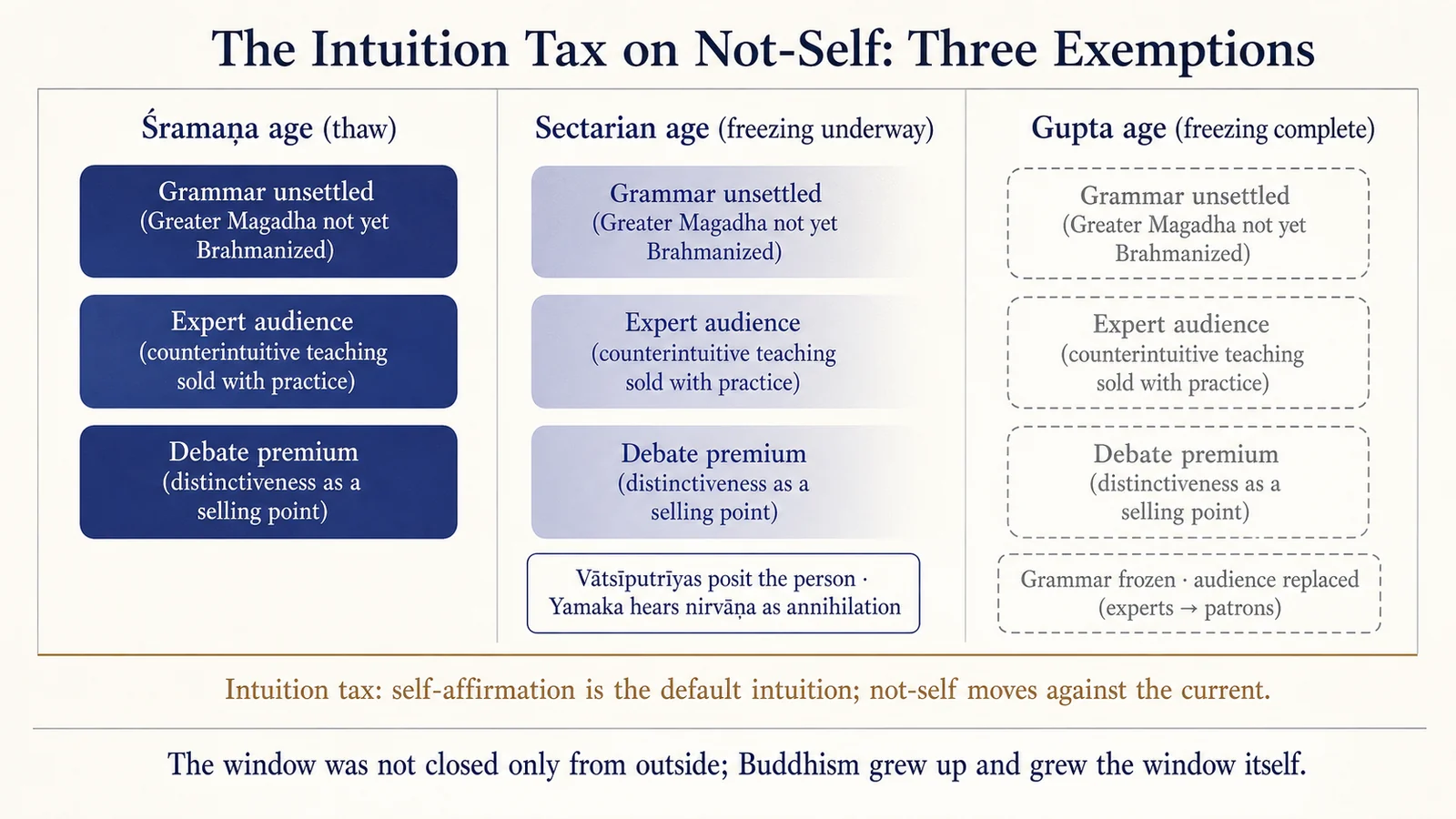
The history of that tax deserves a separate paragraph, because it answers a more basic question: how could no-self ever be sold? Self-affirmation is the cross-cultural default intuition. The Upaniṣads say "you are that"; Descartes retrieves "I think, therefore I am" as the first land from universal doubt; the voice in Exodus identifies itself as "I am that I am." Ordinary people handle self and existence through immediate feeling and emotion. No-self moves against the current and pays an intuition tax in every age. The renunciant era was special not because the tax disappeared but because three exemptions were issued. First, grammar was unsettled. The second urbanization had disrupted the old order. Karma and rebirth were still being constructed; Greater Magadha, the Buddha's region, was not yet Brahmanized, and Brahman-ātman was another group's esoteric new claim, not the environmental default. In an unsettled market, counterintuitive and intuitive propositions competed at almost equal price. Ajita openly taught annihilation and Sañjaya agnosticism; everything could reach the platform.3 Second, the audience was expert. The renunciant market served professional introspectors, and no-self was sold with practices capable of producing first-person counterintuitive experience. Even in the Buddha's life, gradual teaching began with generosity, ethics, and heaven; ordinary followers received karma and merit, while no-self was advanced coursework. The window was viability in an elite niche, never mass acceptance. Third, debate gave counterintuition a premium. New classes and kings outside Vedic legitimacy paid for non-Brahmanical options; distinctiveness was itself a product. During the school period, the exemptions began to expire, as internal files confess. Pudgalavāda established a person; Yamaka heard nirvāṇa as annihilation. Even at the height of exemptions, insiders failed compliance. By the Gupta age all three had expired. Grammar had frozen and covered the subcontinent. Debate rewarded counterintuition only inside the arena, while bhakti ruled outside. Most important, the audience changed. The move "from elite to mass" in Part IV meant Buddhism itself replaced the median listener, a practiced observer, with a village patron. The natural clientele of no-self is a fixed-size niche; the community's audience grew beyond it. The window did not close only from outside. Buddhism grew and outgrew it.
This is not a later accusation. Tradition left two records of awareness. The Laṅkāvatāra writes the charge into the scripture. Mahāmati asks: outsiders too speak of a permanent creator; why does the Blessed One likewise teach a self? The Buddha answers without evasion: tathāgatagarbha is taught to "draw in outsiders attached to self," giving those afraid of no-self an entrance; after entering, they should depend on "the tathāgatagarbha of no-self."4 The Nirvāṇa Sūtra supplies the second record through the simile of milk medicine. An old doctor prohibited milk because quacks misused it; a new doctor prescribed it again because the prohibition had been therapeutic. No-self was formerly taught to cure attachment to self; when the illness changed, true self was taught.5 The two files admit pressure as the premise of defense. A reply was prepared before the accusation because the authors knew how closely the product resembled the rival shelf. The confession of "skillful means" was a ticket of entry and a permanent management cost. The teaching would always need to explain, internally and externally, why it was not ātman. Modern Critical Buddhism repeats the question from the Laṅkāvatāra assembly: "tathāgatagarbha thought is not Buddhism."6
The plain half must be stated fully. The true-and-eternal was not an imported object dropped from the sky. Internal seeds existed. The Aṅguttara Nikāya speaks of the luminous mind stained by adventitious defilements. Mahāsāṃghika taught intrinsic purity of mind. Pudgalavāda supplied a person to answer "who transmigrates," a first-generation product for the need for something indestructible. Subtle mind and bhavaṅga led toward Yogācāra's storehouse, a second generation.7 Demand remained; each generation supplied more boldly. Tathāgatagarbha was the third and fullest. Brahmanizing gravity does not explain where the seed came from (it was internal), but which seed received water. Resources that could remain quiet in a market without ātman pressure became a flagship in the Gupta market.
The list omitted the most direct seed, and it divides this chapter's conjecture into two layers. First establish chronology. Tathāgatagarbha scriptures as a group precede the Gupta period. The Tathāgatagarbha Sūtra dates approximately 200–350. More recent specialized research argues strongly that the Mahāparinirvāṇa Sūtra may be earlier and is the oldest extant tathāgatagarbha text.89 More important is the earliest layer's character. The nine similes are devotional images appealing to imagination, without philosophical development. The Tathāgatagarbha Sūtra never uses the word "emptiness" and contains no defense managing resemblance to an outsider's self. The Laṅkāvatāra's confession of expediency, the Nirvāṇa Sūtra's label "self," and permanence, bliss, self, and purity belong to fourth- and fifth-century or later strata of expansion.10 From what root did the earliest seed sprout? Recent research provides an answer corroborating Part IV, Chapter 3: buddha-body theory. Texts elevating the Buddha into a Dharma-body also faced a question. How could an unborn and undying Buddha enter a womb of flesh? Tathāgatagarbha, a "womb of the Tathāgata," was initially a pure womb substituted for the Buddha. Once constructed, reversal required only one step: all beings are wombs containing the Tathāgata. When the external Buddha's elevation was complete, the internal womb acquired a use.
Following the rules, the next statement is explicitly this volume's conjecture, with jurisdiction narrowed by the evidence above. Tathāgatagarbha was born as an extension of buddha-body theory, not as a response to Brahman-ātman. Brahmanizing gravity governs three later matters: why this seed rather than other internal seeds was watered; why the mature form installed the label "self" and the four qualities, which the original nine similes did not require; and why success required a full defense through expediency and doctrinal classification. The places of anxiety are precisely those where gravity is strongest. The compromise was real, but what was compromised was not the seed; it was the order of watering and the size of the label. In a market longing for ātman, selling no-self requires courage; selling true self requires packaging. No one signed the compromise. It was an equilibrium accumulated across thousands of sermons. Terminological engineering made each local step defensible; doctrinal classification made the whole immune to accusation. Both appear in mature layers, not the earliest, matching the gravity's jurisdiction. Two counterexamples are recorded. If the earliest texts prove substantively designed to offset ātman, the layers collapse and gravity moves back to birth. If the chronology and geography of maturation and victory systematically fail to align with the Brahmanizing market (the place of origin remains unresolved), gravity falls to a factor only in circulation. Reduced, not eliminated: the market it ultimately won was Sanskritic.
Who benefited? Preachers received a product they could finally advertise positively. The community received a matched competitor: you have ātman, we have buddha-nature—and ours is more equal, for all beings possess it. What believers received is the next chapter's subject, for that is the demand side. Record two costs now. First, boundary maintenance became a permanent expense. From the Laṅkāvatāra's self-defense through repeated distinctions between the true-and-eternal and ātman in later classifications, every generation had to prove the teaching was not what it most resembled. Parts VII and VIII show what happened when the boundary could not be maintained. Second, the foundation changed. Once true eternity entered the center of definitive meaning, the powder for every later dispute over classification (emptiness versus true eternity, Part X's subject) was loaded.
The supply-side story is complete. Supply without demand is only literature. The return of the true and eternal was purchased. The next chapter turns to the business of annihilation fear.
References
References
-
For the tathāgatagarbha scriptures (the nine similes of the Tathāgatagarbha Sūtra, the Śrīmālā, Nirvāṇa, and Laṅkāvatāra), systematization in the Ratnagotravibhāga, relations with Madhyamaka and Yogācāra, and later influence, see all four chapters of Volume I, Part VII. ↩
-
For Volume II's structural judgment of Tathāgatagarbha soteriology ("originally pure, stained by adventitious defilements," three arrangements of a guarantee, attachment to eternity, and the balanced "two registers"), see Volume II, Part IV; for the term-by-term reversal of the three characteristics, its Part II, Chapter 2. ↩
-
For the social soil of the second urbanization and renunciant movements, see Volume I, Part I and social history cited there, including Gombrich. On Greater Magadha, the lack of Brahmanization in the Buddha's region and renunciant origins of karma-rebirth grammar, see Johannes Bronkhorst, Greater Magadha: Studies in the Culture of Early India (Leiden: Brill, 2007). For Ajita's annihilationism and Sañjaya's agnosticism, see Dīgha Nikāya 2, the Sāmaññaphala Sutta. ↩
-
Laṅkāvatāra Sūtra, fascicle 2, translated by Guṇabhadra, T16 no. 670: Mahāmati asks how tathāgatagarbha differs from the outsiders' self; the Buddha says it is taught "to draw in outsiders who conceive a self" and instructs reliance on "the tathāgatagarbha of no-self." ↩
-
Mahāparinirvāṇa Sūtra, northern version translated by Dharmakṣema, T12 no. 374: the milk-medicine simile appears in the “Longevity” chapter, separated out as the “Lamentation” chapter in the southern recension; “self is the meaning of tathāgatagarbha, and all beings possess buddha-nature” appears in the chapter on Tathāgata nature. ↩
-
On Critical Buddhism, including Hakamaya Noriaki and Matsumoto Shirō's declaration that tathāgatagarbha thought is not Buddhist and the international response, see Jamie Hubbard and Paul Swanson, eds., Pruning the Bodhi Tree: The Storm over Critical Buddhism (Honolulu: University of Hawai'i Press, 1997). This volume does not adopt their doctrinal judgment but treats it as a modern form of the Brahmanization charge. ↩
-
For the luminous mind stained by adventitious defilements, see the Ones in the Aṅguttara Nikāya. For Mahāsāṃghika intrinsic purity of mind, see the Samayabhedoparacanacakra. For Pudgalavāda's person, subtle mind, and bhavaṅga, see Volume I, Part III; for the storehouse succession, see Volume I, Part VI. ↩
-
Michael Zimmermann, A Buddha Within: The Tathāgatagarbhasūtra (Tokyo: International Research Institute for Advanced Buddhology, Soka University, 2002), dates it approximately 200–350, reads the nine similes as devotional images rather than philosophical argument, and notes the absence of the word "emptiness." ↩
-
Michael Radich, The Mahāparinirvāṇa-mahāsūtra and the Emergence of Tathāgatagarbha Doctrine (Hamburg: Hamburg University Press, 2015), argues that the Mahāparinirvāṇa Sūtra is the earliest extant tathāgatagarbha text and that the doctrine arose from docetic buddha-body theory (a buddha should not have a fleshly womb, so tathāgatagarbha supplied a pure substitute) rather than from opposition to ātman. This volume takes it as a strong hypothesis corroborating the elevation line of Part IV, Chapter 3. ↩
-
For the textual history and geography of the Nirvāṇa Sūtra, including Central Asian origin hypotheses, see Shimoda Masahiro, Nehangyō no kenkyū (Tokyo: Shunjūsha, 1997). For periodization of the tathāgatagarbha corpus, see Takasaki Jikidō's studies cited in Volume I, Part VII. For a southern, Āndhra and Mahāsāṃghika geographical connection, see Yinshun, A Study of Tathāgatagarbha (1981); this volume treats it as one hypothesis. ↩