Chapter 2: The Business of Annihilation Fear—The Demand Side of the True and Eternal
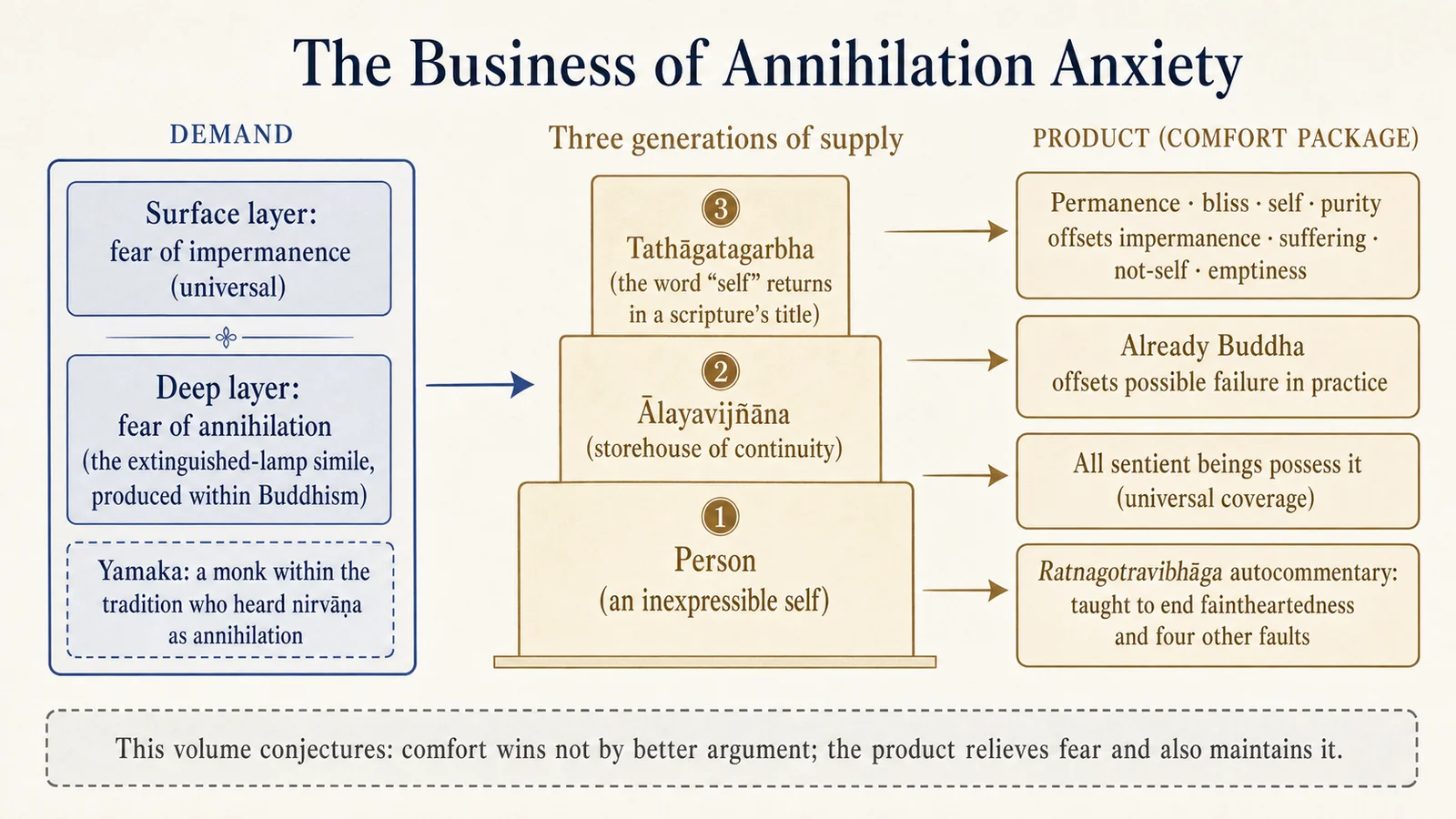
The preceding chapter examined supply; this one examines demand. Volume II dissected that demand into two layers. The shallower one is universal: impermanence itself is unsettling, and people seek a destination that will not decay. Buddhism shares this demand with every religion that promises eternity. The deeper layer is Buddhism's own product. To one who has not attained it, the simile of an extinguished lamp, the refusal to describe what follows death, and an endpoint beyond words all sound at every turn like annihilation. The more strictly the silence is maintained, the less room there is to put this fear. Volume II also recorded one achievement: among the five systems, only the true-and-eternal tradition answered that fear head-on.1 This volume now asks the historical questions. How early was the demand present? Why did transactions peak in the centuries after the turn of the Common Era? And what structure develops when consolation becomes a business's primary line?
The archives of demand predate the true-and-eternal scriptures by several centuries. Within the community during the Buddha's lifetime, the monk Yamaka firmly maintained that “when an arahant whose taints are exhausted dies with the breakup of the body, he is annihilated and no longer exists.” Sāriputta corrected him directly: even here and now the Tathāgata cannot be apprehended, so how could existence or nonexistence after death be asserted?2 The crucial point in this file is not the correction but the person corrected. The one who heard nirvāṇa as annihilation was not an outsider but a fully ordained monk. Canonical passages repeatedly say that foolish ordinary people become frightened on hearing no-self, in effect acknowledging that the course always had a high failure rate. The institutional evidence is harder still. To answer “who transmigrates and who receives karmic results,” the Pudgalavādins established a person. They endured attacks from other schools for centuries without disappearing; Volume I recorded them as the school period's largest minority. Subtle mind, bhavaṅga, and storehouse consciousness supplied, generation after generation, the intuition that “something must continue.” Lay the sequence out: the person was the first generation, the storehouse the second, and tathāgatagarbha the third. Demand never ceased. Only the boldness of supply changed. The first generation dared posit only an “indescribable self”; the third wrote the word “self” straight back into scripture. The preceding chapter amended the third generation's birth certificate under buddha-body theory. From the demand side, it had another relation: the longing engine in Part IV, Chapter 3 created an undying Buddha, and the womb installed that Buddha within every person. The farther the external Buddha rose, the more valuable the internal Buddha became.
Why did transactions surge precisely from the third through sixth centuries? First state the external factors plainly. Between the Kushan collapse and the establishment of Gupta rule, northwestern and northern India underwent a period of political turmoil. From the late fifth century, the Hephthalites moved south, and the Buddhism of Gandhāra was devastated by war, as Part V, Chapter 2 noted. Across the same long period, cities declined, merchant guilds contracted, and the old world of patronage disintegrated. Troubled times raise the market price of consolation (a near-constant in religious history), and China provides the ready comparison. True-and-eternal scriptures were translated amid China's own age of turmoil and became bestsellers in that market, the subject of Part IX. Under the rules of the Introduction, however, this line must be explicitly weighted as conjecture. The relation between the corpus's window of composition and political disorder is loose, while the Gupta age itself was a time of peace. This volume adopts only the weak form, “turmoil amplifies existing demand,” not the strong form, “turmoil creates demand.” If the curves of composition and transmission can be shown systematically not to align with disturbed regions and periods, this line should be downgraded.3
The product specifications best reveal that it was manufactured from a demand sheet. First, a direct hedge: permanence, bliss, self, and purity against impermanence, suffering, no-self, and emptiness. Originally the Buddha was set against the possibility that practice might fail; every medicine precisely matched a fear. Second, universal coverage: all beings possess it, without a single exception. The recruitment drive of Part IV, Chapter 2 reached its logical limit—the wholesale version of a prediction of buddhahood, a guaranteed floor. Third, immediate effect: there was no need to wait through a construction period of three incalculable eons. You were not merely going to become a buddha; you were originally a buddha. Practice was rewritten from construction into polishing. Fourth and most important, these functions are not later guesses. They are printed on the product instructions. The Ratnagotravibhāga asks itself: if it has already been said that everything is empty, why teach buddha-nature as well? It answers: to eliminate five faults—timidity, contempt for beings, attachment to the false, slander of the true Dharma, and conception of a self in the body.4 Teaching it to cure timidity is a functional declaration entered into the tradition's own records. The Śrīmālā Sūtra is more direct: without tathāgatagarbha, beings could not grow weary of suffering and delight in seeking nirvāṇa, thus making it a prerequisite in the psychology of liberation.5 Volume II judged the price of this grammar from the side of soteriology. Market history adds only this: the designers of a product whose functions are printed on the package knew precisely what their customers feared.
How free were the designers' hands? The supply-side archives testify. By the centuries in which true-and-eternal scriptures appeared in batches, sutra production was a mature craft—and a vertically integrated craft. Writing a scripture, preaching it, and vouching for it belonged to the same occupation. Specialized research on circles of dharmabhāṇakas indicates not only that Mahāyāna sutras emerged from this profession, but that the profession wrote its employment contract into the product. Sutras established their own clauses: the Dharma preacher was the Tathāgata's envoy; supporting a preacher was like supporting the Buddha; grave offenses followed from disparaging or harming one. Producers wrote their own compensation and personal protection into the sacred speech they produced. On the side of verification there was a total vacancy. The quantifier in the four great authorities had long since been reversed, as Part IV, Chapter 1 showed. No Indian institution thereafter tried to close an open canon. The market was the only remaining judge, and texts that no one copied died naturally. Thus “anything could be made” was true; “anything made could survive” was the scarce achievement. The hardest craft record comes from the Mahāparinirvāṇa Sūtra itself. During its expansion, it reversed a core doctrine in full view. Earlier layers declared that an icchantika could never become a buddha; later continuations declared that icchantikas, too, possessed buddha-nature. One scripture, one claim of “the Buddha said,” and two answers. That an update could occur shows that copyright rested in living hands. That the update moved toward a wider promise of salvation shows the market's hand on the steering wheel. In China, Daosheng had access only to the earlier version excluding icchantikas, yet inferred that they too must attain buddhahood. He was expelled from the community for saying so. When the continuation arrived in translation, he was vindicated. This is the most famous reception record of that update.6
Who benefited? Believers obtained Buddhism's first native product to answer “what happens to me after I die” affirmatively. Dharma preachers benefited most concretely. Before this, the tradition had the least to say at the two moments when people most need religion: the sickbed and the funeral. Impermanence, no-self, and indescribability—every sentence was true, and every sentence moved toward the cold. The true-and-eternal opened both settings for business. The dead were not annihilated but returned to the Dharma-body; the sick need not despair, for buddha-nature remained intact. Part V recorded four reasons for zero effect in the debate arena. Here is their opposite. The true-and-eternal never dominated that arena, but it took full effect at the scenes of life. The community benefited from matching its competitor. The other shelf sold “you are Brahman”; Buddhism now had something to sell at its own counter, with more egalitarian terms. Export markets benefited longest. This product remained a tributary in its place of origin. Madhyamaka and Yogācāra remained the Indian academy's mainstream, while the Ratnagotravibhāga lineage was nearly absent from indigenous debate for centuries. Yet in East Asia it became the foundation of the entire Mahāyāna structure: Tiantai, Huayan, Chan, and Pure Land all stood upon it, as Volume II's balanced assessment recorded. A tributary at home became the mainstream abroad. Half of Parts IX and X will be devoted to explaining this inversion.7
Under the rules, what follows is explicitly this volume's conjecture, as is the measured sense of “business” in the chapter title. On the demographic scoreboard, doctrinal competition is fundamentally competition in consolation. The true-and-eternal prevailed not because its argument was better, but because its consolation was more immediate. Corroboration lies in the divergence between two scoreboards. Glory in the debate arena belonged to Madhyamaka and epistemology, while the mass of population and exports flowed toward the true-and-eternal and Pure Land. The most winnable doctrine and the most marketable doctrine barely overlapped. To take the conjecture one step further reaches the deepest structure of the business. Fear is demand here. The product relieves fear and also preserves it. Early teaching took a therapeutic route toward annihilation anxiety: direct observation in the manner of the four establishments of mindfulness, taking the fear of death itself apart as an object of observation. The true-and-eternal took the route of reassurance, giving the person afraid of death something that cannot die. Reassurance is immediate; treatment is long. A system whose primary business is reassurance no longer has a structural incentive to cure the fear at its root, for the day the customer recovers is the day the shop closes. Under the Introduction's rules, this statement stops at structure. No one designed a scheme and no one was insincere. The geometry of incentives acquired this form on its own over centuries. If central texts and institutions of mainstream true-and-eternal traditions can be shown to dismantle the fear of death directly through contemplative practice, and to define success as “no longer needing consolation,” this conjecture should be discounted.
Now the costs close. No-self fell from doctrinal foundation to pedagogical stair in the preceding chapter. Fear changed from an illness to be treated into permanent demand in this one. From this point, Buddhism and its closest rival were divided only by a terminological boundary requiring permanent guards. The cost of guarding it rose year by year, while the register of incarnations next door remained open. The debate arena gave Buddhism its most precise minds. The true-and-eternal gave it its most reassuring promise. The market still lacked one thing: efficacy that could be seen. The next part examines the ritual takeover.
A theoretical cross-section closes this part. The true-and-eternal filled two intuitive gaps left by no-self: transmigration without a subject and buddhahood without a basis. Tathāgatagarbha performed two functions with one object (buddha-nature supplied the basis, and the garbha-consciousness approximated a subject), reducing the tax on intuition in a single payment. The new gaps were written into the contract as well. How could tathāgatagarbha be compatible with no-self? The Laṅkāvatāra's milk-medicine simile is the system's own disclosure file, already quoted in the main text. Deeper still, though no one yet minded: if beings were originally complete, what was practice for? In India this question remained a footnote. We will see it grow into the chronic anxiety of doctrinal classification in China and the foundation of an entire simplifying revolution in Japan. The consolation sold in this part accrued its interest on other continents.
References
References
-
For the two layers of fear (universal anxiety about impermanence and Buddhism's self-produced anxiety about annihilation), the true-and-eternal system's direct handling of them, and the judgment “record this achievement,” see Volume II, Part IV, second half, Chapters 1 and 5. The judgments “suffering becomes the customer,” “the paradox of polishing the mirror,” and “a path with nothing to verify” appear in the same half. ↩
-
For Yamaka, see Saṃyutta Nikāya 22.85, the Yamaka Sutta, and its Chinese parallel in the Saṃyukta Āgama. Sāriputta dismantles his annihilationist view by showing that “even in the present life the Tathāgata cannot be apprehended.” ↩
-
For political disorder after the Kushans and devastation by the Hephthalites, see the sources cited in Part V, Chapter 2, and Volume I, Part VIII, Chapter 6. For de-urbanization and the contraction of merchant guilds, see R. S. Sharma, cited in Part V, Chapter 2. For disorder and the Buddhist market in China, see Part IX of this volume. ↩
-
Ratnagotravibhāga, translated by Ratnamati, T31 no. 1611: “Because there are timid minds, contempt for beings, attachment to false dharmas, slander of true suchness and buddha-nature, and conception of a spirit-self in the body, buddha-nature is taught so that such people may be freed from these five faults.” ↩
-
Śrīmālādevī Siṃhanāda Sūtra, translated by Guṇabhadra, T12 no. 353: “If there were no tathāgatagarbha, beings could not become weary of suffering and delight in seeking nirvāṇa.” ↩
-
On circles of dharmabhāṇakas as agents of the production and circulation of Mahāyāna sutras and on the self-serving clauses in the texts, see David Drewes, “Dharmabhāṇakas in Early Mahāyāna,” Indo-Iranian Journal 54 (2011), and Part IV, Chapter 4. On the reversal of icchantika doctrine between layers of the Mahāparinirvāṇa Sūtra, see Ming-Wood Liu, “The Problem of the Icchantika in the Mahāyāna Mahāparinirvāṇa Sūtra,” Journal of the International Association of Buddhist Studies 7.1 (1984), and Shimoda Masahiro's study of its expansion cited in the preceding chapter. For Daosheng's expulsion and vindication, see his biography in fascicle 7 of the Gaoseng zhuan. ↩
-
On the marginal position of the Ratnagotravibhāga and related tathāgatagarbha thought in Indian debate, and their late reappearance around the eleventh century, see the line of research represented by Jikidō Takasaki, A Study on the Ratnagotravibhāga (Rome: IsMEO, 1966), and Volume I, Part VII. On their foundational role in East Asia, see the balanced assessment in Volume II, Part IV, second half, Chapter 5. ↩