Chapter 1: Two Imports and Samye—The Route by Royal Decree
When Part VIII closed its case, it called Tibet a vault for Indian Buddhism. Before the buildings burned, a scholastic tradition crossed the mountains institutionally and the data were backed up off-site. Yet the image of a vault was only half right. The material imported did not lie in storage. On the plateau it became a new headquarters and assumed a form found in neither India nor China. The death report of Part VIII still holds an old case invalidating a single cause: the same esoteric Buddhism formed the last page of the medical record in India but lives in Tibet today, having remade the religious life of a civilization. One variable, two lands, two outcomes. This part supplies the missing half of the explanation. The method is unchanged: see how it entered, who pushed, who benefited, and where the cost was recorded.
Begin with a broad contrast to China. Part IX showed Buddhism entering China through merchants and monks; ordinary people and literati believed first, and four centuries later the state incorporated the religion—bottom-up. Tibet was the reverse. Buddhism was a royal procurement project, top-down. Marriages in the seventh century brought the earliest Buddhist chapels. Later religious histories made Songtsen Gampo a Dharma king and his two queens emanations of Tārā. Compared with contemporary Old Tibetan documents from Dunhuang, however, Buddhism left far thinner traces in Tibetan society. Much of the Dharma-king narrative was written back into the imperial period during the later dissemination. The later the archive, the more detailed it became; Bodhidharma's rule applies equally on the plateau, and the record is read at half weight.1 The substantive beginning came under Tri Songdetsen. Samye Monastery was completed around 779 and the first Tibetan clergy ordained, traditionally the “seven men on probation.” Śāntarakṣita, the leading Nālandā scholar invited from India, presided. Part V, Chapter 2 said that Nālandā defined the export list. China received it through secondhand Central Asian transmission; Tibet purchased directly from the flagship and acquired textbook, faculty, and curriculum at once. The court established a support law under which monks did no productive labor and designated households supported them. Under Ralpachen, seven households were assigned to each monk, and the clerical register entered royal law.2 Press the contrast with China. Chinese communities lived through a market of patrons, repentance rites, and estates, while the state merely issued credentials. The Tibetan Saṅgha was a budget category from birth. Top-down construction was fast, covering China's four-century road in thirty years. The weakness follows below: a budget category shares the dynasty's life.
There was more than one import route, producing a rare scene in Buddhist history: Buddhisms from two civilizations confronted one another face to face. At the end of the eighth century, the Chinese Chan monk Moheyan taught the sudden gate in Tibet and gathered followers. Tri Songdetsen ordered a debate, with Śāntarakṣita's disciple Kamalaśīla arguing for the Indian gradual gate. The result survives in two battle reports. Tibetan tradition says the Indian party won, the king established gradual practice as orthodoxy, and the Chinese monk was courteously escorted from the country. The Chinese Dunhuang document Ratification of the True Principle of Sudden Awakening in the Mahāyāna says instead that the Chinese side won and the king praised the sudden gate.3 Each battle report claims victory, an old scene from Part V. This volume does not adjudicate the doctrinal winner and recognizes only the institutional fact: the king initiated the debate, announced the result, and legislated orthodoxy. Thereafter gradual sequence was constitutional in Tibetan curricula and the sudden gate an inherited memory of heresy to guard against. Political decision settled the route. This was Samye's first provision for Tibetan Buddhism. Under the rules, what follows is explicitly this volume's conjecture. Samye's judgment was less doctrinal victory than a double choice of diplomacy and engineering. Diplomatically, Tang and Tibet had fought for half a century and Tibetan troops briefly occupied Chang'an in 763. Adopting the enemy state's religious route made little sense at court. Choosing India rather than China first meant choosing an ally. In engineering, the king wanted a religion capable of legislation. The gradual gate brought a complete transplantable institution: curriculum, Vinaya lineage, translation protocol, and sequence, all writable into royal law. The sudden gate possessed only master, disciple, and dark room. Part X, Chapter 3 called Chan a Buddhism optimized for catastrophe. A state project wanted Buddhism optimized for audit. Choosing gradualism was choosing an ally and a set of inspectable blueprints.
Once the route was decided, language came next. In the early ninth century the court promulgated fixed translation terminology. The Mahāvyutpatti served as an official glossary and the Two-Fascicle Principles of Translation as an official translation manual. Older translations had to be revised under the new rules; translators could not invent equivalents, and new terms required court approval.4 The Chinese translation bureau received royal funding while the chief translator decided. The Tibetan bureau went further and made language itself a public instrument. The consequences were deep. China translated Buddhist scripture into an existing language and struggled for centuries with the legacy of matching concepts. Tibet reshaped its language into a language of scripture—coining terms, fixing rules, and establishing correspondences. A literary language was nearly recast for translation. Local expression yielded, while precision gained. Tibetan translations can be rendered word by word back into Sanskrit and became a mirror for later Indology. A customs gate stood here too: no text without a traceable Sanskrit original was translated, and the court compiled the translation list. The black market in doubtful and apocryphal scriptures that flourished in China had no corresponding door in the Tibetan system. The guard later loosened and the ratchet entered at another address, to which the chapter returns.
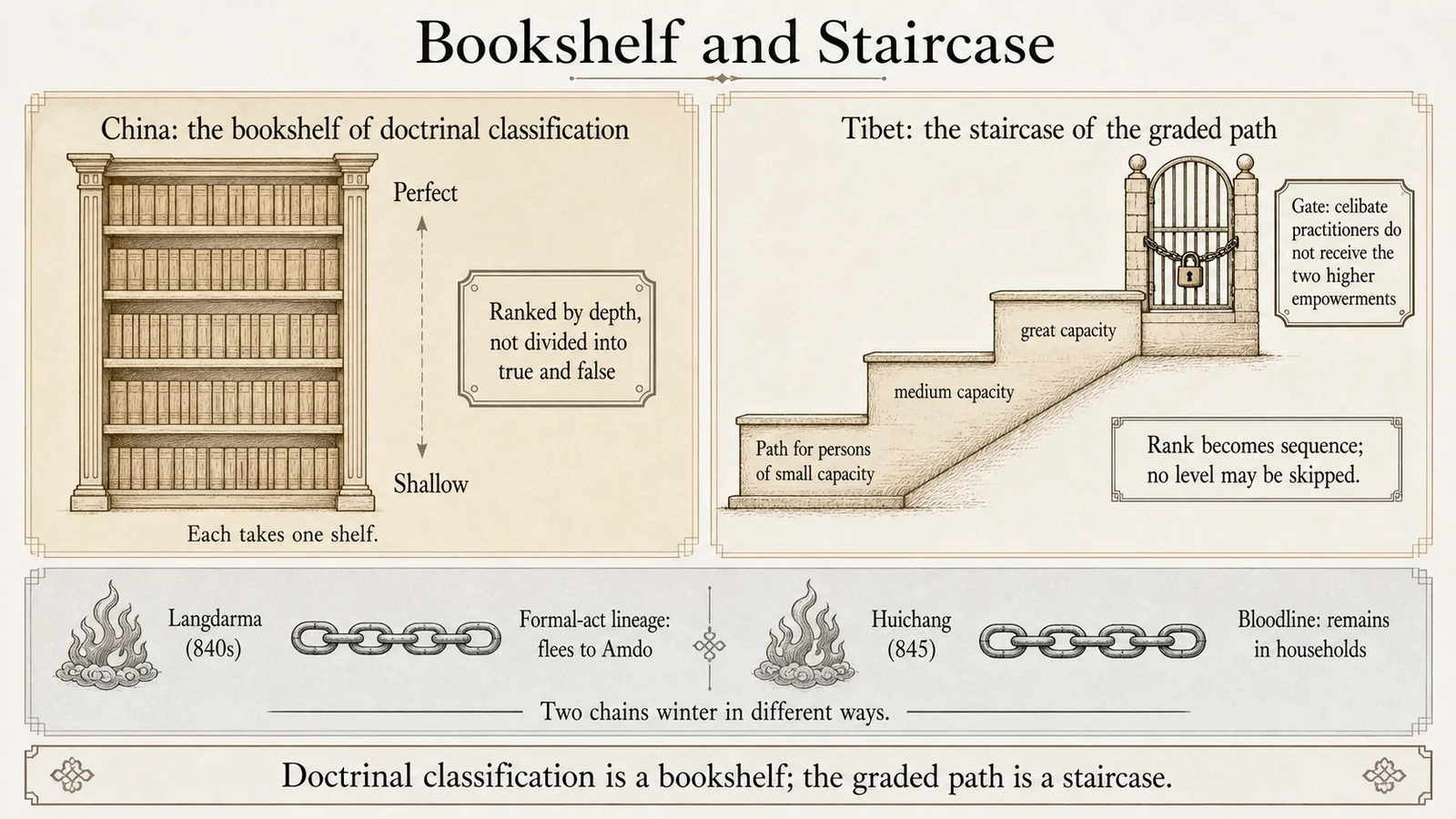
The budget category then expired. In the middle of the ninth century, Ralpachen was assassinated and Langdarma succeeded him. Buddhism was suppressed, monasteries closed, monks laicized, and translation bureaus dissolved. A few years later a monk assassinated Langdarma and the empire disintegrated, sending Tibet into more than a century of division. Place the calendars side by side. Langdarma's suppression came in the early 840s and Huichang in 845, within five years on opposite sides of the Himalayas. The structures and outcomes differed. In China the state suppressed Buddhism and survived; two years later the same state restored it. In Tibet suppression and collapse of the state belonged to the same drama, and afterward no state existed to restore anything. Tibetan Buddhism therefore underwent a more complete roots test than Huichang: the institutional layer reset to zero, and the question was what remained alive. The answer was two chains. One was the formal-act chain. Three monks carried Vinaya texts into Amdo and kept the ordination lineage alight on the frontier. When Lachen Gongpa Rabsel received full ordination, two Chinese monks helped make up the required quorum; the traditions joined hands in that rite. A century later ten men from Ü-Tsang traveled east to receive ordination. The common account treats their return to Ü-Tsang in 978 as the first year of the later dissemination. Buddhism's restoration in Tibet began not with a scripture but with ten people's lawful qualification for ordination. Part II said councils guarded a roll, while Part III said the Vinaya's second status was a chain. Tibet turned both sentences into history. Books can be translated again and monasteries rebuilt; only a broken living chain cannot renew itself.5 The other was a bloodline: households of ngakpa ritualists in Ü-Tsang. Transmitted from father to son, their services of guiding the dead, averting disaster, and casting spells remained beyond suppression's reach and later converged into Nyingma. The judgment established in Part VIII received literal confirmation on the plateau: fire breaks a manufactured chain but not a chain that is born. The formal-act chain escaped; the bloodline remained. Each wintered separately, and together they carried the entire tradition.6
The period of division did not end Buddhism; it produced a second import. The western Guge court paid in money and people. Rinchen Zangpo studied in Kashmir, returned, and made new translations, establishing the division between old and new translations. In 1042, Atiśa entered Tibet after two generations, Yeshe Ö and Jangchub Ö, spent heavily to invite him. Religious histories say Yeshe Ö died in prison after refusing to use ransom for himself and told his followers to spend it on the invitation; read the episode at half weight as sacred biography, while the court's great expense remains certain.7 Atiśa brought not a new scripture but a blueprint. His Lamp for the Path to Awakening arranged the entire Dharma as paths for three kinds of person: lower people sought fortunate rebirth, intermediate people liberation, and superior people buddhahood; everyone climbed from the beginning. The advanced level had a firewall: celibate practitioners did not receive secret and wisdom empowerments. Part VII, Chapter 3 recorded the rule, and Tibet turned it into constitutional order. Set the stages of the path beside Chinese doctrinal classification: two solutions to the same synchronic warehouse. Both lands faced exoteric and esoteric scriptures and spells arriving together within centuries on one table. China shelved scriptures horizontally, ranking high and low without dividing true and false; everyone could take one level. Tibet placed practices vertically in a line, a mountain path every person had to traverse. High and low became before and after. Again it did not ask true or false, only which stage a person had reached. Doctrinal classification is a bookshelf; the stages of the path are a staircase. One may read a single book on the shelf, but no stair may be skipped. The “synthesis” in this part's title means precisely this operation: disordered imports became numbered units. Sequence formed the ranks and schools the unit numbers. Uniform and headquarters appear in the next two chapters.
Ranks require an inventory. In the fourteenth century Butön compiled a catalogue of the canon, placing the Buddha's speech in the Kangyur and commentaries in the Tengyur and requiring traceable Sanskrit provenance. He stopped a group of old-translation tantras at the gate; old and new schools argued over them for centuries.8 The gate was real, and so was the side entrance. Nyingma opened a route outside it through treasure revelation. Tertöns continuously extracted new teachings attributed to Padmasambhava from cliffs, lakes, and their own minds. They did not enter the Kangyur but circulated in independent collections. The ratchet of Part IV did not die in Tibet; it changed address and genre. New Chinese scriptures claimed to have been spoken by the Buddha and had to pass translation customs. New Tibetan teachings claimed to have been hidden by Padmasambhava, bypassed translation, and emerged directly from holy places. The stricter the customs gate, the more business the side door receives. Two civilizations supplied independent evidence for the rule.
Synthesis gave Buddhism a skeleton and ordinary society flesh. The form of this layer deserves attention because it shares a source with the Chinese popular layer but differs structurally. The surface consisted of merit technologies for everyone. The six-syllable mantra lowered recitation's threshold to zero, the same design as one name in China. Tibet went a step further and handed recitation to machinery and natural forces. One turn of a prayer wheel counted as one recitation; a prayer flag hung in the wind counted each gust; water-driven wheels ran day and night. The Uṣṇīṣavijayā pillars of Part XI saved people through dust and shadow. Tibet in effect installed bearings in the pillar. Anyone could turn it; wind and water practiced on behalf of people, and merit became mechanized. The middle layer was ritual service. Village ngakpas averted calamity, stopped hail, and drove off spirits; monastic clergy divined, blessed, and diagnosed causes of illness. Death was most important. Phowa transferred consciousness, rituals were recited through the forty-nine days of the intermediate state, and the sky-burial ground possessed its own liturgy; the Saṅgha and ritualists held the whole package. The Liberation through Hearing in the Intermediate State, later Tibet's most famous book in the West, was itself a fourteenth-century treasure revelation—the side entrance in the preceding paragraph supplied exactly this kind of bestseller. At the bottom lay an older foundation incorporated into Buddhism. Smoke offerings, wind horses, and mountain gods, older Bön customs, entered the protector system. Stories of Padmasambhava subduing local gods continued on the plateau the iconographic battle report of Part VII. Bön in turn Buddhistized itself and compiled its own canon, replaying the moment in Part IX, Chapter 2 when Daoism borrowed Buddhism's shelf. Yet one structural difference separated Tibet from China. China's popular layer could operate without a Saṅgha: dhāraṇī pillars stood by roads and lay associations conducted funerals, surviving Huichang without the monasteries. Tibet's popular layer connected everywhere to monasteries. Blessing required a lama, divination a monk, and rites for the dead a monastery. In each valley the monastery was also school, clinic, and lender. The popular layer was not a backup outside Buddhism but capillaries within its body. Chapter 3 weighs the difference again.9
This chapter ends with the first-level answer to the divergence. The same esoteric Buddhism formed an additional story atop the roof in India: roots were already lost, and only courts and the efficacy market remained, as Part VIII tested. In Tibet it was the foundation. A state project poured the institutional layer from above; ritualist households spread a service layer from below; the two connected during the later dissemination, after which exoteric and esoteric, monastic and lay, monastery and household shared one skeleton. Indian esoteric Buddhism was Buddhism's last tenant; Tibetan esoteric Buddhism was the house. The old top-down problem was not solved but delayed. With the dynasty gone, who would patronize? With the Dharma present, who would inherit? The next chapter shows Tibet giving Buddhist history's oldest problem its most thorough answer.
References
References
-
For the later accretion of Songtsen Gampo's Dharma-king image and the reality of the imperial dissemination, see Volume I, Part XI, Chapter 1, and the studies cited there. On the gap between the religion of the early empire in Old Tibetan Dunhuang documents and later Dharma histories, see Matthew T. Kapstein, The Tibetan Assimilation of Buddhism (Oxford: Oxford University Press, 2000), and Rolf A. Stein, Tibetan Civilization. ↩
-
For Samye, the seven men on probation, and Śāntarakṣita's role, see Volume I, Part XI, Chapter 1. The system under Ralpachen in which seven households supported one monk is recorded in the Dharma histories; summarized here. ↩
-
The Tibetan side appears in Butön's History of Buddhism and versions of the Testament of Ba. The Chinese side is Wang Xi's Dunhuang manuscript Ratification of the True Principle of Sudden Awakening in the Mahāyāna. For comparison, see Paul Demiéville, Le concile de Lhasa (Paris: Imprimerie nationale, 1952). For doctrinal analysis, see Volume I, Part XI, Chapter 1, and Volume II's Madhyamaka discussion. ↩
-
The Mahāvyutpatti and Two-Fascicle Principles of Translation were promulgated in the early ninth century to establish terminology and official translation rules. See Volume I, Part XI, Chapter 1, and studies cited there; summarized here. ↩
-
For Langdarma's suppression, the three wise men traveling to Amdo, Lachen Gongpa Rabsel's full ordination with two Chinese monks completing the quorum, and the ten men of Ü-Tsang traveling east for ordination, see Gö Lotsawa Zhönnu Pel, The Blue Annals, and Volume I, Part XI, Chapter 2. Dates for the later dissemination vary; the common account uses their return in 978. ↩
-
For the survival of ritualist households during division and the formation of Nyingma, see Volume I, Part XI, Chapter 3. “Fire can break a manufactured chain but not a chain that is born” comes from Part VIII, Chapter 2. ↩
-
For Rinchen Zangpo and the division between old and new translations, the invitations by Yeshe Ö and Jangchub Ö, the ransom legend read as sacred biography, Atiśa's three paths, and the restriction on two empowerments, see Volume I, Part XI, Chapter 2. The firewall provision also appears in Part VII, Chapter 3. ↩
-
For Butön's compilation of the Kangyur and Tengyur, controversy over old-translation tantras, and Nyingma treasure traditions, see Volume I, Part XI, Chapters 2 and 3, and the studies cited there; summarized here. ↩
-
On prayer wheels, prayer flags, mani stones, popular forms of the six-syllable mantra, and ritualists' work averting calamity and hail, see Rolf A. Stein, Tibetan Civilization, and the relevant chapters of Volume I, Part XI. The Liberation through Hearing in the Intermediate State is a fourteenth-century treasure revealed by Karma Lingpa. On the Buddhistization of Bön and its independent canon, see Per Kvaerne's studies; summarized here. ↩