Chapter 1: Borrowing a Shell—Matching Concepts and the Vogue for Xuanxue
The preceding part ended with one sentence: India was no longer Buddhism's address; from then on, Buddhist history was the history of its copies. The second half begins with the largest copy. Part III, Chapter 2 established the first law of transmission: sowing is easy in empty ground and difficult in a city full of temples. By that law, China was the hardest host in Buddhist history: a self-sufficient literate civilization with its own canon, ritual system, historians, and literati class. Classical learning had monopolized the market in meaning for four centuries, and a foreign teaching paid an additional tariff at the boundary between Chinese and barbarian. Sri Lanka was open ground; China was the city with the most temples. Buddhism should not have won, yet it did. This part asks how it entered, how it built a factory, and how it made its first fortune. This chapter begins with the entry operation. Later business history has a ready name for it: borrowing a shell.
Timing came before technique. Buddhism entered China at scale during the century in which the order of the Han empire disintegrated: the partisan prohibitions, the Yellow Turbans, Dong Zhuo, and then the Three Kingdoms. The collapse broke more than cities. It broke the credit of classical learning. The doctrine of resonance between Heaven and humanity went bankrupt with the dynasty, opening a vacuum in the literati's market for meaning. Xuanxue rose immediately, using Laozi and Zhuangzi to explain the world and pure conversation as its currency. Volume I, Part X already recorded the fit between this intellectual vacuum and Buddhism's arrival.1 In this volume's language: the host's immune system was at its lowest point, and customs stood unattended.
Two early files both bear the shell’s imprint. On the level of legend, Emperor Ming’s dream and scriptures carried by white horses are retrospective foundation myths and should be treated as after-the-fact narratives. The apologetic record is more revealing. The Mouzi Lihuolun belongs among the earliest extant Chinese defenses of Buddhism. It consists throughout of challenges from Confucian and Daoist positions: shaving violates filial piety, exposed clothing violates ritual, celibacy terminates the ancestral line, and the teaching belongs to barbarians. Mouzi answers by citing Laozi and Zhuangzi to establish Buddhist principles, matching sage against sage and classic against classic. Scholars have dated the work anywhere from the late Han and Three Kingdoms to the Eastern Jin or Liu-Song; this chapter does not use a precise date as evidence. On any of those datings, its question-and-answer form shows Buddhism defending itself in the language of local classics.2
Put the earliest people under the microscope and begin with names. An Shigao was a Parthian prince, Lokakṣema a Yuezhi, An Xuan a Parthian merchant, Zhi Qian of Yuezhi descent, Kang Senghui of Sogdian descent and born in Jiaozhi, and Dharmarakṣa of Yuezhi descent and born at Dunhuang. The surnames An, Zhi, Kang, and Zhu marked Parthia, the Yuezhi, Sogdia, and India. The community's roll during its first century or more reads like a map of Silk Road trading stations. Buddhism entered China first as an immigrant religion nested within mercantile communities. Chinese participation was slow. Yan Fotiao was the earliest Chinese renunciant, while Zhu Shixing is traditionally remembered as the first Chinese monk fully ordained according to the rules. Only during the Eastern Jin did aristocrats and commoners enter institutionally. Dao'an came from a declining Confucian family. Huiyuan was originally a Confucian student; hearing Dao'an teach Prajñāpāramitā, he exclaimed that “the nine schools of Confucianism and Daoism are all chaff.” Sengzhao was poor and copied books for a living; the copyist read his way into philosophy. Dao'an closed this line with one action. He abolished foreign-origin surnames for Dharma surnames and declared that “renunciants within the four seas should all bear the surname Śākya.” Taking Śākya as surname was the immigrant religion's declaration of independence as a local community. The later arrival of an Ekottarika Āgama passage stating that members of all four castes are called descendants of Śākya after renouncing retroactively recognized the declaration.3
Now examine ordination, where a two-century scandal lies. For roughly 180 years after the legendary white horse carried scripture, China's “monks” had only shaved their heads. There were no formal acts, no ordination lineage, and no lawful Saṅgha. During the Jiaping era of Cao Wei, around 250, Dharmakāla arrived at Luoyang, saw that monks had not received proper refuges and precepts, translated an extract of the Mahāsāṃghika discipline, gathered foreign monks, and established formal acts. The Biographies of Eminent Monks records that “the discipline of the Central Lands began from this point.” Yet this was only an extract from a code. Complete Vinayas arrived in a crowd only in the fifth century: the Sarvāstivāda Ten Recitations, Dharmaguptaka, Mahāsāṃghika, and Mahīśāsaka Vinayas all appeared within twenty years. The dual-Saṅgha ordination of nuns came later still. Two groups of Sri Lankan nuns led by Tissarā crossed the sea to assemble the required ten; in 434, at Nanlin Monastery in Jiankang, Chinese nuns received ordination again, finally connecting their lineage lawfully. Faxian's own stated reason for traveling west was that he “lamented the incompleteness of the Vinaya collection.” China's first pilgrimage in search of the Dharma sought discipline, not sutras. During the period without a Vinaya, Dao'an composed Standards for Monks and Nuns, effectively a provisional constitution for the community.4 Returned to Part II's mechanism, the audit yields a hard conclusion. In India the Saṅgha preceded scriptures; in China scriptures preceded the Saṅgha, which was installed two centuries later. The construction sequence was fully inverted: Buddhist learning first, Buddhism afterward. The Chinese formal-act chain was, in its entirety, a fifth-century import.
Volume I already examined the operation itself in detail: matching concepts, explaining foreign ideas through local ones—emptiness by nonbeing, nirvāṇa by nonaction, bodhi by the Way. The six houses and seven schools were the adaptive radiation of a xuanxue-inflected Prajñāpāramitā. This chapter adds the angle of a history of transformation. Consider Zhi Daolin. A monk became famous among the literati for a new commentary on the “Free and Easy Wandering” chapter of the Zhuangzi, sat as an equal among celebrities in pure-conversation gatherings, and then, incidentally, taught his doctrine of form as emptiness. He sold Zhuangzi before selling the Dharma, and sold Zhuangzi so that people would buy the Dharma. That order was the business model of the whole matched-concept era. Aristocrats did not need a foreign religion; they needed a subtler xuanxue. Buddhism therefore declared itself at customs as “a subtler xuanxue” and entered at a zero tariff.
Volume I diagnosed the disease of matching concepts. To interpret emptiness through being and nonbeing was a systematic displacement, not a few mistranslated terms. A history of transformation must read the same event from the other direction. Under the rules, the following is explicitly this volume's conjecture: displacement in translation was not an obstacle but an admission ticket. Being misread as xuanxue was precisely Buddhism's lowest-cost route into China. Had the first generation of translators insisted on full transliteration and rejected conceptual pairing, Buddhism would have appeared to aristocrats as another barbarian cult of gods and techniques. It would never have gained a seat at pure conversation and therefore never entered the civilization's intellectual core. A control arrived two centuries late. The Church of the East entered Tang China dressed in Buddhist and Daoist vocabulary, filling its texts with terms such as “World-Honored One,” “subtle being,” and “ship of compassion.” It still failed to enter the literati's world of meaning and never recovered after being swept away with other foreign religions in the Huichang suppression.5 A shell was necessary, and its quality determined survival. Buddhism borrowed the most valuable shell of the age.
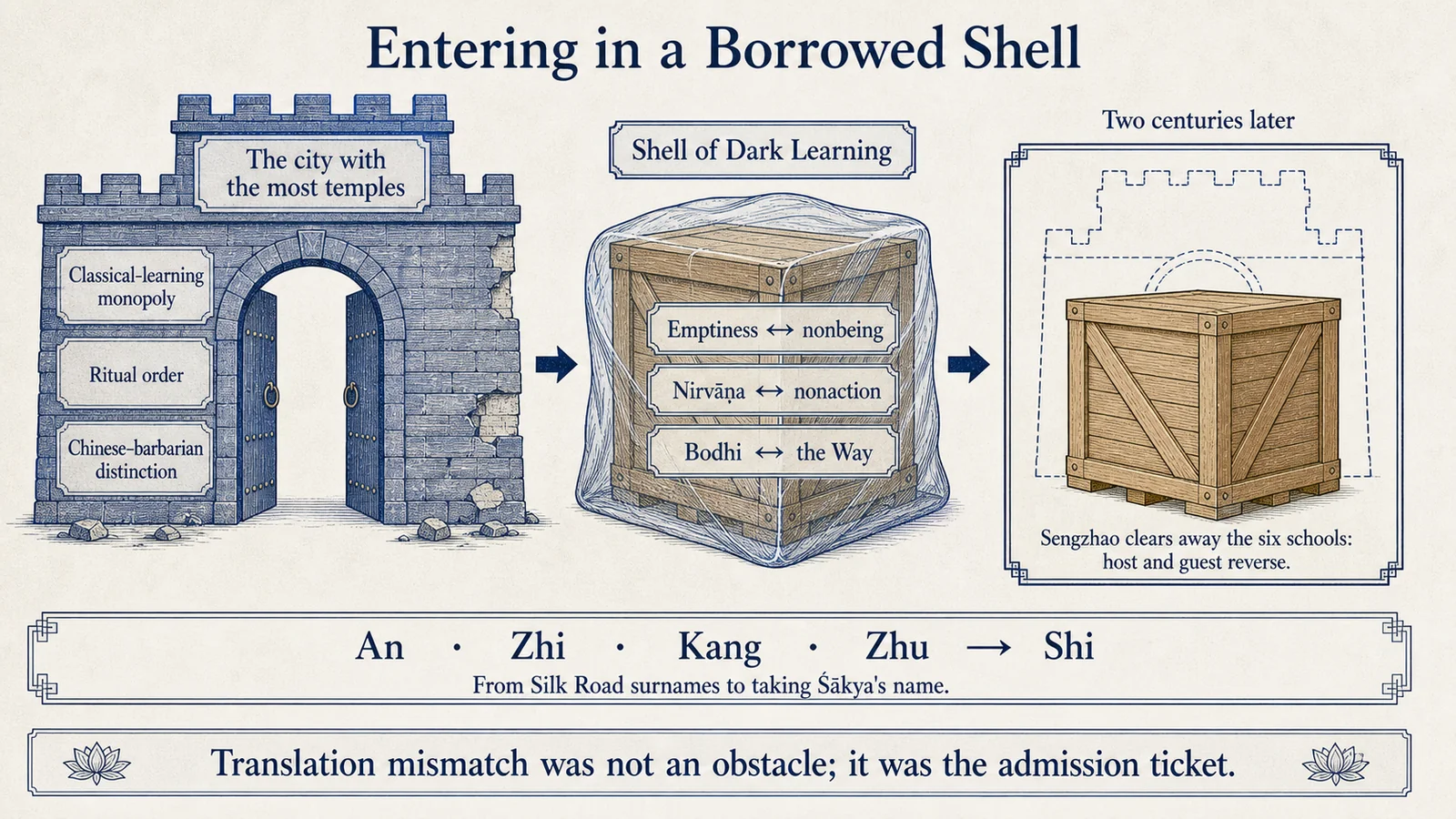
There was of course a cost, and it ran both ways. The guest entered the shell and the shell grew into the guest. Chinese Buddhism thereafter spoke with the accent of Laozi and Zhuangzi. Roots such as substance and function, root and branch, and spontaneity entered the foundation of its translated vocabulary. The whole temper of later Tiantai, Huayan, and Chan (sudden awakening, original awakening, and “this very moment is it”) carries that local accent, the subject of Part X. The reversal of host and guest was remarkably fast. Among Kumārajīva's students, Sengzhao wrote treatises naming and clearing away the six houses and seven schools one by one, using a standard Madhyamaka blade. Buddhism took about two centuries to move from dependence on xuanxue vocabulary to command of the xuanxue agenda. The conceptual guest became host; Buddhism thereafter set the examination questions for aristocratic metaphysics.6
Two areas remained exposed by the shell, and both wounds were painful: filiality and loyalty. Confucians read shaved-headed renunciation as injury to the body and termination of ancestral rites; the court read refusal to bow to the ruler as defiance of ritual order. Indigenous apocrypha on filial piety later dressed the first wound. On the black market's bestseller list in the next chapter, the Sūtra on the Profound Kindness of Parents always occupies first place. Huiyuan fought an honorable defense of the second in his Treatise on Why Monks Do Not Bow to Kings. He preserved the posture but not the long-term trend; after Sui and Tang, the community was incorporated into imperial law as a whole, as Part XI shows. Borrowing a shell solved the conceptual problem of entry but not sovereignty over ritual. One wound was staunched with counterfeit goods; the other scarred over with time.7
Under the microscope, examine two final things: motive and the quality of penetration. On the side of motive, evidence of devotion is priced in bodies. Zhu Shixing remained and died in Khotan. Faxian was over sixty when he embarked on a route that killed more than half its travelers. Huiyuan did not let his shadow leave his mountain for over thirty years. Conversion in the late Han and early Wei brought no profit; faith from that age is the most credible. Channels to fame and wealth opened only after the market succeeded: exemption from labor and tax, posts as imperial preceptor, donations of residences, and the celebrity-monk lifestyle. Zhi Dun bought a mountain for retreat, kept horses, and released cranes; when challenged, he replied only that “this poor monk values their spirited excellence.” Repeated decrees to purge the clergy were contemporary quality-control reports. It was not that bad people infiltrated Buddhism; Buddhism had grown things worth infiltrating. On the side of quality, penetration followed two unequal tracks. Upward, elite readers needed more than two centuries, from Lokakṣema's Prajñāpāramitā translations to Sengzhao's treatises, to assimilate Madhyamaka. The six houses and seven schools were the tuition. Scriptures can be mailed; interpretation cannot. Understanding reached shore with the living person of Kumārajīva, and doctrinal learning had its own chain. Downward, popular Buddhism was a religion of efficacy from the first day: miracle tales, Avalokiteśvara's rescues, vegetarian feasts, and image-making penetrated directly without passing through doctrinal learning. The White Lotus Society on Mount Lu in 402 was a rare intersection of the two tracks; thereafter they went their separate ways. Upward movement was slow but eventually deep; downward movement was fast and permanently shallow. This asymmetry is the basal geology of the next fifteen hundred years of Chinese Buddhism, examined on separate tracks in Parts X and XI.8
Gather the four questions. What changed? Buddhism's language became Chinese, and Chinese acquired an entire new stratum of vocabulary. What force pushed it? The host's collapse and vacuum. Who benefited? The aristocracy acquired a subtler xuanxue and Buddhism an admission ticket. Record two costs. Doctrinal displacements had to be redeemed slowly over centuries, through the two corrections by Kumārajīva and Xuanzang recorded in Volume I, while some displacements remained forever in the foundation. The shell solved entry but not the supply chain: where did scriptures come from, who had authority to translate them, and what counted as a translation? The next chapter enters the translation bureau.
References
References
-
For the routes and dates of transmission, the fit between disorder and intellectual vacuum, and the earliest lines represented by An Shigao and Lokakṣema, see Volume I, Part X, Chapter 1. For the mechanism of matching concepts, its xuanxue soil, the six houses and seven schools, and Zhi Daolin, see Chapter 2 of the same part. This chapter directly adopts its factual layer and diagnosis. ↩
-
The Mouzi Lihuolun is preserved in fascicle 1 of the Hongming ji (T52, no. 2102). Its date and textual layers remain disputed, with proposals ranging from the late Han and Three Kingdoms to the Eastern Jin and Liu-Song; “most scholars now date it to the late Han–Three Kingdoms” is too definite. For an English translation and introduction, see John P. Keenan, How Master Mou Removes Our Doubts: A Reader-Response Study and Translation of the Mou-tzu Li-huo-lun. Albany: State University of New York Press, 1994. For the historical setting of early Chinese Buddhism, see Erik Zürcher, The Buddhist Conquest of China, 3rd ed. Leiden: Brill, 2007. The body uses only the argumentative structure of its thirty-seven questions and does not make chronology depend on a contested date. ↩
-
For the places of origin of the early translators from An Shigao through Dharmarakṣa, see prefaces and biographies in the Chu sanzang jiji and fascicle 1 of the Biographies of Eminent Monks. The same sources record Yan Fotiao and Zhu Shixing. For Dao'an's adoption of Śākya as the common monastic surname and his later confirmation from the Ekottarika Āgama that “the four castes, on renouncing, are all called descendants of Śākya,” see his biography in fascicle 5 of the Biographies of Eminent Monks. ↩
-
For Dharmakāla's establishment of formal acts and the statement that “the discipline of the Central Lands began from this point,” see his biography in fascicle 1 of the Biographies of Eminent Monks. For the dates of the four complete Vinaya translations, see Volume I, Part X, Chapter 4. For Tissarā and dual-Saṅgha reordination at Nanlin Monastery in 434, see fascicle 2 of the Biographies of Nuns (T50 no. 2063). “Lamenting the incompleteness of the Vinaya collection” appears at the start of Faxian's travel record. For the three provisions of Dao'an's Standards for Monks and Nuns, see his biography in fascicle 5 of the Biographies of Eminent Monks. ↩
-
For the Church of the East's borrowing of Buddhist and Daoist vocabulary in Tang China, see the inscription of the Stele on the Diffusion of the Luminous Religion of Daqin in China, erected in 781, and the Dunhuang Christian texts. For the Huichang suppression's indiscriminate effect on foreign religions, see Part XI, Chapter 1. ↩
-
For Sengzhao's reckoning with the six houses and seven schools, see the works of the Zhaolun. The Treatise on the Emptiness of the Unreal names the three positions of emptiness of mind, form as emptiness, and original nonbeing. Volume I, Part X, Chapter 3 gives the full account. The “two corrections” are Kumārajīva's and Xuanzang's new translations; see Chapter 4 of the same part. ↩
-
Huiyuan's Treatise on Why Monks Do Not Bow to Kings is preserved in fascicle 5 of the Hongming ji and was written during Huan Xuan's purge of the clergy around 404. For apocryphal scriptures on filial piety, see Makita Tairyō cited in the next chapter. ↩
-
For Zhi Dun's horses, cranes, and purchase of a mountain, see the “Speech and Conversation” and “Ridicule and Teasing” sections of A New Account of Tales of the World and his biography in fascicle 4 of the Biographies of Eminent Monks. Collections of Avalokiteśvara miracle tales descended through works by Fu Liang, Zhang Yan, and Lu Gao and provide textual evidence for popular penetration in the Southern Dynasties. For the White Lotus Society's vow in 402, see Huiyuan's biography in fascicle 6 of the Biographies of Eminent Monks. For repeated dynastic purges, see Chapter 3 of this part and Part XI. ↩