Chapter 2: The Translation Bureau—The Politics of the Translation Movement
Borrowing a shell solved identity. Next came the supply chain. Chinese Buddhism possessed an institution Indian Buddhism never had: the translation bureau. It was not a private study but a state project. Dao'an directed translation work in Fu Jian's Chang'an. Kumārajīva opened a thousand-person bureau at Yao Xing's Xiaoyao Garden, with separate roles for chief translator, recorder, doctrinal verifier, and stylistic editor. Under Xuanzang, the courts of Taizong and Gaozong fully funded the operation; the translation bureau was a government office.1 Volume I, Part X already periodized the translation movement and described its major figures. This chapter asks only one question: when translation became a state project, what was produced together with power?
The weight of the state project can be measured through a negative control: Paramārtha. He possessed learning of the same rank but no stable translation bureau. After the Hou Jing rebellion, he wandered through the Southern Dynasties for the rest of his life; translation began and stopped, and he repeatedly wished to sail home. His translation of the Mahāyānasaṃgraha had to wait decades before a northern scholastic lineage took it up and established a school. What was translated, how much, and whether it counted never depended only on a translator's ability. It depended first on whether the court beneath his seat remained standing.2
Kingship had a stack of motives rather than one, and the proportions differed in times of order and disorder. Count here the motives of ordered times. At the top was civil culture. An official translation bureau belonged to the same series as court historiography and imperial compilation—a standard cultural project of peaceful emperors. Its product was less a particular scripture than the genre of an “official state edition.” The second layer was the wheel-turning king model. During the Renshou era, Emperor Wen of Sui issued three edicts distributing relics and building pagodas in more than a hundred prefectures, a self-conscious imitation of Aśoka's eighty-four thousand stupas and China's signing ceremony for the contract of the Dharma-protecting king described in Part III, Chapter 2. Scripture translation was the cultural clause of the same contract.3 The third layer was most concrete: capture authority. Since popular scripture production could not be prohibited, the state monopolized the source; the customs gate and catalogues below were projects in this layer. The customer structure must also be counted. Aristocratic preferences shaped the list during the age of private translation in the Eastern Jin and Southern Dynasties: Prajñāpāramitā, Vimalakīrti, and Nirvāṇa matched pure conversation. By the Sui-Tang age of official translation, metaphysical conversation had declined. The real customers of the bureau were the court itself and the scholastic Saṅgha. Popular preferences did not pass through the bureau at all; they used the black market and religious assemblies. Remember this: the scriptures translated by the bureau were neither quoted in pure conversation nor recited in villages. The six hundred fascicles of the Mahāprajñāpāramitā Sūtra and eighty fascicles of the Avataṃsaka Sūtra were throne-room texts. Merit was priced by the fascicle and bulk itself conveyed dignity. The extreme case of political use appeared under the Zhou empress Wu Zetian. A commentary on the Mahāmegha Sūtra used Maitreya's descent to validate a woman ruler. In 693, Bodhiruci and colleagues translated the Ratnamegha Sūtra and inserted a passage in which Prince Moonlight appears as a woman and rules in Mahācīna. Royal preference left physical evidence of rewriting scripture.4
The first product was one this volume has awaited for a long time: a lock. Part IV, Chapter 1 recorded that India's gate of scripture was a soft gate based on content verification. Anyone could submit a text to the corpus, and no institution possessed authority to close the canon. Part VII, Chapter 3 recorded Nālandā's response: catalogue without locking the gate. China rebuilt the entrance in another form. Dao'an compiled a Comprehensive Catalogue of the Scriptures with a separate list of doubtful works. Its criterion was not whether doctrine fit but whether provenance was clear. Works without a named translator or traceable Sanskrit original were classified as doubtful. Sengyou continued the project in his Collection of Records Concerning the Translation of the Tripiṭaka, establishing a “newly compiled miscellaneous register of doubtful and falsely composed scriptures.” This was Buddhist history's first chain lock installed on texts: trace the place of origin and name the translator, much as Islam later equipped hadith with chains of transmission.5 India locked persons but not texts, the judgment of Part II. China added a textual lock. Translation bureaus monopolized the production of legitimate text and catalogues governed the status of admission to the canon. For the first time in China, “spoken by the Buddha” had a customs gate.
The lock leaked, and the pattern of leakage is revealing. Indigenous doubtful and apocryphal scriptures continued to appear and became bestsellers: the Sūtra on the Profound Kindness of Parents taught filial piety, the Ten Kings corpus taught judgment in hell, and many works promised long life or the averting of calamity. Chinese demand sheets wrote these scriptures for themselves.6 Returned to Part IV, the phenomenon is the Mahāyāna sutra movement in miniature. A gate can govern status but not demand. When demand is sufficiently hard, the market manufactures its own goods. The difference is that China's lock kept this inventory outside the official canon and stamped it doubtful or apocryphal. It could circulate among ordinary people but not enter the foundation of scholastic learning. Faced with the same demand, India's system allowed new products to rewrite the canon; China's sent them to a separate black market. The lock did not end scripture production. It decided its address.
The lock's report card must be read in two lines at once, because two items did not remain on the black market. They passed customs, entered the official canon, and both later became beams in the main hall. The first was the Brahmā's Net Sūtra. No Sanskrit text survives. Its earliest provenance is an anonymous Postface to the Bodhisattva Prātimokṣa, claiming that Kumārajīva recited it. Sengyou preserved the postface without trusting it and listed the precept text as having lost its translator. Fajing's catalogue classified it among doubtful works. Three years later the Record of the Three Treasures through the Successive Dynasties accepted the postface as evidence and expressly recorded Kumārajīva translating it at Caotang Monastery in the eighth Hongshi year. One undefended catalogue cleared it. Later catalogues copied that catalogue's paperwork, and the Kaiyuan Catalogue of Buddhist Teachings granted final entry. The preface attributed to Sengzhao at the head of the text is an even later fabricated credential. Modern scholarship dates its composition to the second half of the fifth century in the Southern Dynasties and shows that its second fascicle drew on the Bodhisattvabhūmi Sūtra translated by Dharmakṣema.7 The second was the Śūraṅgama Sūtra. Its own birth certificate is itself a customs story: an Indian king prohibited the scripture's export; a foreign monk cut open his arm, hid the text within, and sailed east. A book allegedly smuggled into the Chinese canon narrates its own smuggling out through Indian customs. The translation account bypassed the official bureaus of both capitals. In 705, at a private monastery in Guangzhou, a foreign monk recited it and the demoted chancellor Fang Rong recorded the translation; after finishing, the chief translator immediately returned home to accept punishment. If customs wished to summon the witness, the witness had voluntarily disappeared. By the time Zhisheng compiled the Kaiyuan Catalogue, the scripture had circulated for twenty-five years and its prose had captivated court and country. Zhisheng's own two records contradict each other: one says that Huaidi translated it with an unnamed foreign monk in Guangzhou, the other names Paramiti and Fang Rong. The invoices did not match, but the shipment passed.8
Read together, the two cases expose the entire logic of customs inspection. First, a customs service inspecting provenance taught forgers to forge provenance. Once the criteria were origin and translator, the attack surface was fully specified. Ordinary apocrypha lacked paperwork; these two carried paperwork more complete than genuine imports. Second, both used weak ports. Brahmā's Net exploited a weakness in time, during the childhood of bibliography: one unguarded catalogue stamped it, and stricter catalogues inherited the old invoice. Śūraṅgama exploited a weakness in space, the empire's southern gate: privately translated and already circulating widely, it arrived at customs as a fait accompli. No successful apocryphon entered through the front door. Third and most important, demand itself was a permit. Both texts filled holes that authorized goods could not. Brahmā's Net supplied a bodhisattva precept code spoken by the Buddha, receivable by clergy and laity alike, and writing loyalty and filiality into the rules. It made filiality a precept, forbade slandering the ruler, prohibited meat, and prescribed vegetarianism. India did not manufacture such goods because India had no such order, while the market for the bodhisattva-precept emperor described in Part IV, Chapter 2 had an empty shelf. Śūraṅgama supplied a one-stop compendium: tathāgatagarbha, meditation, divine spell, precepts, and fifty demonic states, with a built-in progression from refuting delusion to distinguishing demons. Throughout, it was Tang prose written for Tang readers; style itself served as a permit. Customs could stop smugglers but not the customers placing the order. Fourth, ratchet lock-in: once admitted to the Kaiyuan Catalogue, a work could only enter and never leave. By the time later skeptics gathered evidence, the texts were no longer books on a shelf but bricks in a wall—one the bodhisattva-precept code used at Chinese ordination platforms for a millennium, the other the opening spell of the monastic morning liturgy. The controversy over doubtful or apocryphal status began less than a century after the translation, with the Tang layman Faxiang's report that the text was forged, brought to Japan by the Japanese monk Tokusei. Japan had earlier commissioned the Three Treatise and Dharma Characteristics schools to determine that it was genuine, and Genei recorded the affair. Later came Zhu Xi's remark about Fang Rong and the modern One Hundred Proofs That the Śūraṅgama Is Apocryphal. The evidence grew thicker without loosening a single brick. The archive of that modern battle belongs to Part XIV.
Now glance down the black market's bestseller list: the Awakening of Faith, Sūtra of Perfect Awakening, Śūraṅgama, and Brahmā's Net. Their degrees of doubtful provenance differ, but their true-and-eternal coloring is uniform. Goods manufactured from local orders usually supplied what local intuition most desired, a layer already explained in Part VI. The judgment of the customs section therefore needs an added sentence. The lock stopped hundreds or thousands of crude products and admitted two masterpieces. Those two shaped Chinese Buddhism more deeply than all the rejected inventory together. The lock decided the address of scripture production; demand decided which counterfeit deserved the main hall.
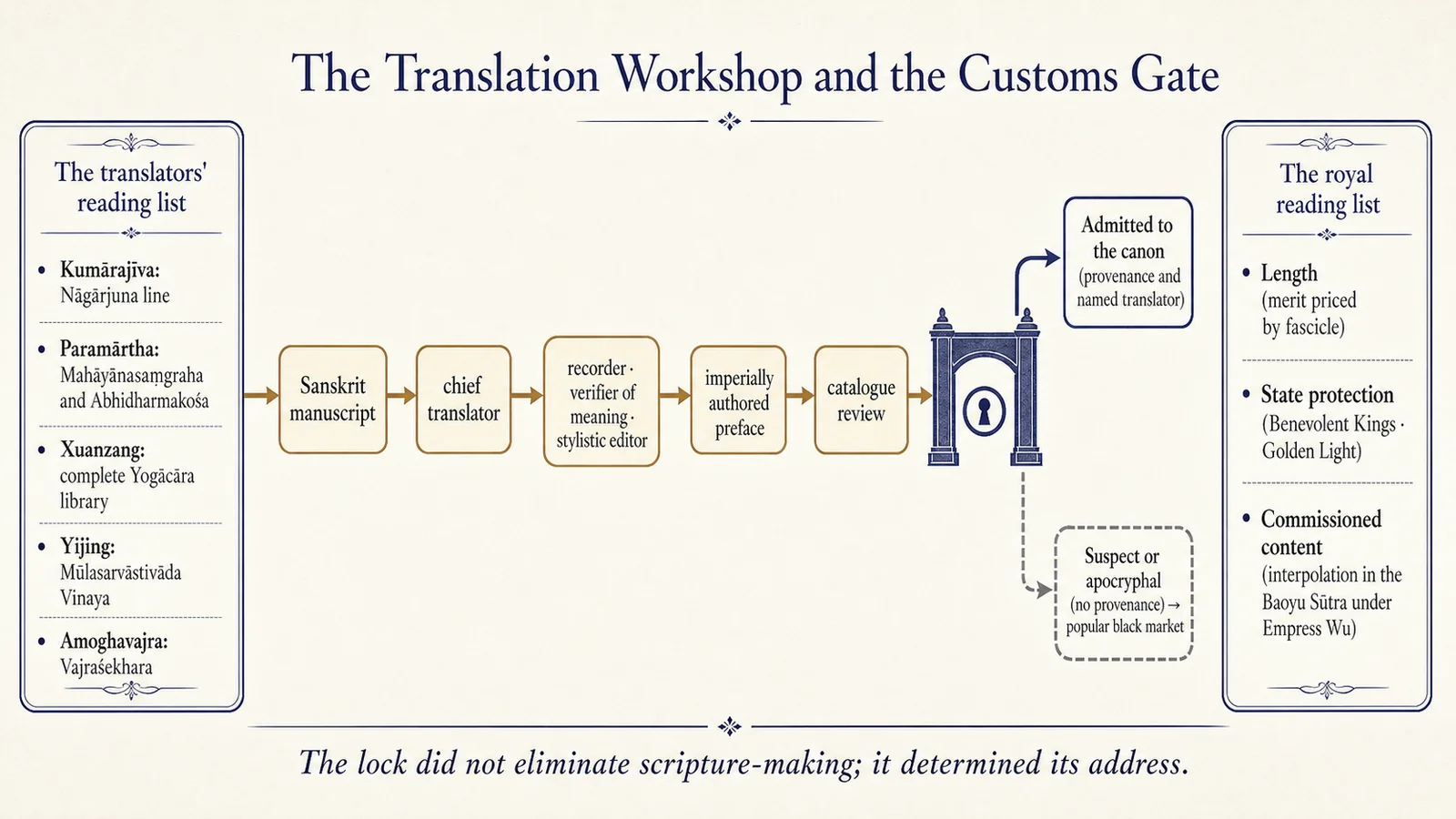
The second product was terminology, and behind terminology, legislative authority. Dao'an's “five departures from the original and three difficulties” first elevated translation from craft into a consciously theorized enterprise. Kumārajīva's new versions replaced matched-concept vocabulary in batches and set the basic lexicon for the next thousand years. Xuanzang established “five categories not to translate,” launched a new translation movement, and publicly judged older versions “erroneous.”9 Every retranslation was more than scholarship. Old versions were already the foundations of schools; doctrinal masters of the Northern and Southern Dynasties built entirely on them. Changing a single term meant moving the foundation under a lineage. Whoever fixed the terminology table defined the range within which doctrine could be spoken. The hand standardizing vocabulary simultaneously standardized who was qualified to establish a school.
One night in the new translation movement deserves separate record. While translating the Mahāprajñāpāramitā Sūtra, Xuanzang found six hundred fascicles unwieldy and wanted to abridge them following Kumārajīva's precedent. That night he suffered evil dreams, climbing dangerous cliffs or fighting wild beasts. The next morning he announced that the dream forbade abridgment and that he would omit not one word; the following night he dreamed auspiciously. The record came from disciples and should be read at half weight as sacred biography. Yet the psychological fact it preserves is hard: by the seventh century, the corpus itself was so sacred that even the chief translator dared not cut it. The ratchet of Part IV engaged in another civilization exactly as before—only in, never out.10
To see what was translated, end with two preference lists. The translators' list is obvious: chief translators rendered their own scholastic traditions. Kumārajīva translated the full Nāgārjuna family; Paramārtha translated the Mahāyānasaṃgraha and Abhidharmakośa; Xuanzang traveled for the Yogācārabhūmi, then brought back the full Yogācāra library; Yijing sought the Sarvāstivāda Vinaya; and Amoghavajra translated the Vajraśekhara esoteric corpus. Part V, Chapter 2 said that the Indian Buddhism known to China and Tibet was an export list. From the import side the image is more exact: China's India was the overprinting of a few chief translators' private reading lists. Translators also debated plainness and refinement. Dao'an formulated his five departures from the original to warn of loss; Kumārajīva lamented that translating scripture was “like chewing food and giving it to another—not only is the flavor lost, it makes the recipient retch.”11 The royal list had three items: bulk, for dignity and the counting of merit; state protection, with the Humane Kings and Golden Light sutras repeatedly retranslated as perennial sellers, and Amoghavajra adding esoteric spells to his new Humane Kings; and customization, represented above by the Zhou empress Wu. Two files show the collision of the lists, one soft and one hard. The soft file: Taizong twice urged Xuanzang to leave the robe and help govern. The court wanted the person, not the Dharma. Xuanzang used translation as a shield and negotiated for the rest of his life.12 The hard file lies outside the hall. Wang Fu of the Western Jin forged the Sūtra of Laozi Converting the Barbarians, incorporating the Buddha as one whom Laozi traveled west to transform. Buddhists answered with the apocryphal Sūtra on the Pure Practice of the Dharma, appointing Confucius as the Bodhisattva Learned Youth, Yan Hui as the Bodhisattva Pure Radiance, and Laozi as one transformed by Mahākāśyapa. On the Chinese battlefield of assimilative exclusion, both sides used black-market weapons. Viṣṇu incorporated the Buddha through the avatāra register; Laozi did so through a conversion scripture; Buddhism answered with the eastward transformation by three sages. The war of apocrypha continued intermittently for nearly a thousand years and ended only when Khubilai Khan burned the Daoist scriptures.13
This produces the chapter's conjecture, explicitly marked under the rules. Every retranslation is a renegotiation of doctrine. Xuanzang's movement was half scholarship and half a replacement of the authority of older translation. The result corroborates the claim. Xuanzang's versions were universally acknowledged as more precise, yet the Dharma Characteristics school founded upon them declined within decades. Tiantai, Huayan, and Chan, built on older translations, remained green for a millennium. The market ultimately selected not the more accurate text but the more useful foundation. A translation bureau could unify vocabulary but not preference. The kind of Buddhism China wanted had already been chosen by buyers amid the disorder of the next chapter.
One question hangs over the translation movement. China was no religious wasteland; a family of Daoist products already stood on the local shelf. Why did buyers nevertheless turn toward Buddhism, and so thoroughly? First display the rival inventory. There was the search for immortality of occult specialists in the Qin and Han, serving individual rulers such as the First Emperor and Emperor Wu; the talismans, confession of faults, and libationer system of the Way of Great Peace and Way of the Celestial Masters in the late Han; Ge Hong's alchemical theory, “my destiny lies in me, not in Heaven”; visualization in the Shangqing tradition; and the Lingbao rites of purification. Both theory and practice were present. Structurally, however, there were three fatal weaknesses. First, the maturity of the promise was mismatched. Immortality came due in this world, and emperors died one after another; the record of default grew ever longer. Buddhism's promise came due after death and never had to be refunded—the Chinese version of the inspection-exempt product in Part VI. The search for immortality was a luxury of orderly times, pursued by the First Emperor and Emperor Wu at imperial peaks. Amid disorder, claims to longevity collapsed in value while services for death became necessities, as the next chapter shows. Second, there was a generational equipment gap. Buddhism arrived with an integrated system accumulated over a thousand years: canon, doctrine, renunciant institution, and discipline. Daoism then had no renunciant order, no catalogue of scriptures, and no complete doctrinal system. It modernized under pressure. Lingbao adopted frameworks of cosmic calamity, rebirth, and universal salvation in batches; Lu Xiujing imitated Buddhist catalogues in the Three Caverns bibliography; Daoist monasteries imitated Buddhist monasteries; and Daoist ordination imitated full Buddhist ordination. Indian Buddhism borrowed the Śaivite shelf in Part VII, Chapter 2; Chinese Daoism borrowed the Buddhist shelf. Third stood the shadow of the Yellow Turbans. In court memory, organized Daoism meant rebellion. Buddhism entered as an immigrant religion and initially looked safe. The limits of the turn must also be drawn. Daoism held its ground in royal genealogical narrative (the Tang Li clan claimed Laozi as ancestor and fought over whether Daoism or Buddhism ranked first) as well as in techniques of longevity and indigenous identity. Buddhism decisively won only high doctrine and services for death, precisely the two ends of the shelf.14
The four questions can be brief here; the stack of motives and customer structure have already been counted. Add only the most important piece of domestically manufactured equipment: paper. China's other native technology lowered the reproduction cost of the manuscript age by another order of magnitude. Scripture-copying workshops and copying for merit made the incentive clauses of Part IV, Chapter 1 run at full power in China. Medium, customs, and legislation of terminology—the infrastructure of Chinese Buddhism was ready. Capacity existed; where was the market? The next chapter turns to disorder.
References
References
-
For the organization and periods of the translation bureau (Dao'an's work, Kumārajīva's bureau at Xiaoyao Garden and its division of labor, and Xuanzang's official system), see Volume I, Part X, Chapters 1, 3, and 4, and the prefaces collected in the Chu sanzang jiji. This chapter adopts that account directly. ↩
-
For Paramārtha's wandering translation work and the delayed lineage of the Mahāyānasaṃgraha, see Volume I, Part X, Chapter 4. This chapter uses it as a negative control for the dependence of translation on kingship. ↩
-
For the three Renshou-era edicts distributing relics and building pagodas in the first, second, and fourth years, along with records of responses from the prefectures, see Wang Shao's Record of Responses to the Relics and the edicts collected in fascicle 17 of the Guang hongming ji. The edicts consciously invoked Aśoka's model. ↩
-
On the Commentary on the Mahāmegha Sūtra's Prophecy of the Divine Sovereign, Dunhuang manuscript S.6502, and the interpolated prophecy of a woman ruler in the Ratnamegha Sūtra translated by Bodhiruci and others in 693, see Antonino Forte, Political Propaganda and Ideology in China at the End of the Seventh Century (Naples: Istituto Universitario Orientale, 1976; 2nd ed., Kyoto: ISEAS, 2005). ↩
-
Dao'an's Comprehensive Catalogue of the Scriptures, compiled around 374, survives through the “newly compiled catalogue of doubtful scriptures by Master An” in fascicle 5 of Sengyou's Chu sanzang jiji, which also established a “newly compiled miscellaneous register of doubtful and falsely composed scriptures.” Provenance and named translators served as criteria. ↩
-
On the scale and types of Chinese doubtful and apocryphal scriptures (filial piety, hell, and disaster-aversion corpora), see Makita Tairyō, Gikyō kenkyū (Institute for Research in Humanities, Kyoto University, 1976). For the Ten Kings corpus, see Part XI, Chapter 1. ↩
-
The Postface to the Bodhisattva Prātimokṣa appears in fascicle 11 of the Chu sanzang jiji, while Sengyou himself lists the precept text as having lost its translator. The Fajing lu places it among doubtful works; fascicle 8 of the Lidai sanbao ji first assigns it to Kumārajīva at Caotang Monastery in the eighth Hongshi year. The Sengzhao preface is a later false attribution. Ōno Hōdō dates the text between 431 and the Jianyun era of Southern Qi; since Mochizuki Shinkō, scholarship has commonly accepted that the second fascicle drew on the Bodhisattvabhūmi Sūtra. See also Funayama Tōru's studies of the Brahmā's Net Sūtra and bodhisattva precepts. ↩
-
For the conflicting records in Zhisheng, see the Huaidi entry in the Kaiyuan Catalogue of Buddhist Teachings and the Paramiti entry in the Continuation of the Illustrated Record of Translated Scriptures Past and Present. The story of hiding the scripture in a cut arm appears in biographical prefaces from the Song onward and, as sacred narrative, is read here at half weight. The earliest archive of the long authenticity debate appears in fascicle 3 of Genei's Dasheng sanlun dayi chao (T70 no. 2296), checked against the text. It records that Fushō brought a copy east; the Shōmu court summoned the Three Treatise and Dharma Characteristics schools and determined that “this is a genuine Buddhist scripture and may not be slandered or destroyed.” During the Hōki era, Tokusei traveled to Tang China and brought home the layman Faxiang's claim that “Fang Rong forged it and Zhisheng mistakenly entered it in the official catalogue without investigating.” Genei dismissed the claim as “extremely ridiculous” and vigorously defended the scripture. Zhu Xi's suspicion of Fang Rong appears in fascicle 126 of the Classified Conversations of Master Zhu. In the modern period, Lü Cheng's One Hundred Proofs That the Śūraṅgama Is Apocryphal listed more than one hundred internal arguments, and Buddhist writers such as Minsheng replied. The abundance of commentaries (more than a hundred from the mid-Tang to the late Qing, over sixty in the Ming alone) is a measure of the text's market performance. ↩
-
Dao'an's “five departures from the original and three difficulties” appears in his preface to an abridgment of the Mahāprajñāpāramitā Sūtra, preserved in fascicle 8 of the Chu sanzang jiji. For Xuanzang's “five categories not to translate,” the conflict of old and new translations, and the rapid rise and decline of the Dharma Characteristics school, see Volume I, Part X, Chapter 4. ↩
-
Xuanzang's proposed abridgment of the Mahāprajñāpāramitā Sūtra and the dream warning appear in fascicle 10 of the Biography of the Tripiṭaka Master of the Great Ci'en Monastery, in the account of the Yuhua Palace bureau. This volume reads the sacred biography at half weight and takes the institutional psychology of “daring not to cut” as the archive. ↩
-
Kumārajīva's lament about chewing food appears in his biography in fascicle 2 of the Biographies of Eminent Monks. For the five departures from the original, see the preceding note. ↩
-
For Taizong urging Xuanzang to leave the religious life and assist in government, and Xuanzang's firm refusal, see fascicle 6 of the Biography of the Tripiṭaka Master of the Great Ci'en Monastery. ↩
-
For Wang Fu's composition of the Sūtra of Laozi Converting the Barbarians and his dispute with Bo Yuan, see Bo Yuan's biography in fascicle 1 of the Biographies of Eminent Monks. The story of three sages transforming the east in the Sūtra on the Pure Practice of the Dharma was classified as doubtful or apocryphal in successive catalogues; see Makita Tairyō cited above. For the Yuan debates and the burning of Daoist scriptures in 1281, see the Zhiyuan Record of Distinguishing the False. ↩
-
For the stages of Daoism (from occult specialists, Celestial Masters, and Ge Hong through Shangqing and Lingbao to the syntheses of Kou Qianzhi and Lu Xiujing) and its systematic institutional borrowing from Buddhism, see Isabelle Robinet, Taoism: Growth of a Religion (Stanford: Stanford University Press, 1997). The view that the Three Caverns catalogue modeled itself on Buddhist catalogues is standard in scholarship. ↩