Chapter 3: The Market of Disorder—Why Buddhism Prevailed in an Age of Division
Part VI, Chapter 2 left a sentence for later: true-and-eternal scriptures were translated during China's great age of disorder and became bestsellers in that market; Part IX would explain the mechanism. The moment has arrived. From the Disaster of Yongjia to Sui reunification, China experienced almost three centuries of division: regimes came and went, epidemics recurred, and refugees filled the roads. During its first two Han centuries Buddhism had been only a companion to magical arts, with Buddha and Yellow-Lao worshiped at the same shrines, and made little impression. Its explosion began after disorder. This chapter asks: what did the age of division supply that allowed a foreign guest religion to become an empire-scale institution within decades?
Begin by separating demand. The first layer was an explanation of suffering. The Mandate of Heaven was a product for orderly times. It explained order but not the bones in Luoyang. Karma and rebirth supplied portable justice; good and evil bore fruit without requiring a dynasty to be present, perfectly suited to an age when the dynasty was absent. The second layer was service for death. During centuries of epidemic and war, death was the largest category of daily life. Confucian funerals governed protocol but not destination, while Daoism itself was still taking shape. What Buddhism brought to China was precisely the half of the ecological niche it had failed to hold in India: rites for the dead, vegetarian assemblies, and the Ullambana festival. In China, death services faced almost no incumbent competitor. This perfectly replicated the law from Part III, Chapter 2: sowing is easy in empty ground and difficult in a city full of temples. Buddhism died in India where positions were full and lived in China where one was empty. The fate of the same Buddhism depended on the host's vacancy table. The third layer was a product for the next life. Disorder made narratives of the end of the Dharma credible; decline of the Dharma made an easy path reasonable. The Pure Land theories of Tanluan and Daochuo bear the annual rings of war, as Volume II's Pure Land part recorded, while Huisi's vow text turned awareness of the Dharma's decline into a timetable.1 The fourth layer was refuge. Monasteries were exempt from tax and labor service. In waves of renunciation during disorder, faith and survival cannot be separated; the Saṅgha became a sheltering institution in itself.
On the supply side, disorder exerted equal force and produced an elegant structural echo. Non-Chinese regimes found the door of Confucian Mandate theory closed. The distinction between Chinese and barbarian locked the language of legitimacy within Chinese blood, and a Jie emperor found no seat in classical learning. When Shi Hu's court debated whether Chinese subjects should worship the Buddha, his answer became famous: I was born in the borderlands and “the Buddha is a barbarian god,” so I should of course honor him.2 Return the sentence to Part III, Chapter 2. Aśoka valued a Dharma indifferent to birth and distributable along the imperial roads; Shi Hu valued the same quality. The Buddha did not distinguish Chinese and barbarian. Legitimating language that crosses bloodlines is always an urgent need for a nonorthodox regime. Fotudeng entered Later Zhao as imperial preceptor, Dao'an received Fu Jian's honors, and two dynasties fought with armies to possess Kumārajīva. The imperial-preceptor chain and translation-bureau chain were two ends of one supply line. The Southern Dynasties followed a different route with the same structure. Aristocrats wanted the xuanxue-inflected Buddhism of the preceding chapters; emperors wanted the crown of a bodhisattva king, reaching its synthesis under Emperor Wu of Liang, to which Part X returns.
Northern Wei also left an institutional invention that wrote the service niche directly into the state establishment. The superintendent of the Saṅgha, Tanyao, petitioned to create “Saṅgha households” and “Buddha households.” Victims of famine and government slaves were assigned to the monastic office, delivered grain annually to the Saṅgha administration, and supported famine relief. Relief was outsourced to the community, while the community entered the fiscal bureaucracy. This was Buddhism's first “position within the imperial order” in China. It was also the first seed of every later entanglement. The monastic economy now competed with state household registration for people and land; Huichang liquidation in Part XI begins its accounting here.3
Growth offers numerical readings. In the Western Jin, the two capitals contained little more than one hundred monasteries. By the end of Northern Wei, Luoyang contained more than one thousand monasteries inside and outside the walls; the country had more than thirty thousand monasteries and two million monks and nuns. Yang Xuanzhi devoted an entire book to Luoyang's monasteries, and two sentences from its preface annotate the whole curve: “princes and eminent ministers gave away elephants and horses as if casting off old shoes; ordinary officials and wealthy houses abandoned wealth as if leaving no trace.”4 What did two million mean? Roughly one person in fifteen in the registered Northern Wei population wore monastic robes. The steepest period of growth was precisely the period of fiercest killing. Both Northern Wei Emperor Taiwu's and Northern Zhou Emperor Wu's suppressions of Buddhism occurred when regimes consolidated power and resumed projects of Confucian orthodoxy. Buddhism rose during collapse and was restrained during reconstruction. Its curve followed the tightening and loosening of order.
Extend the readings to the end of the imperial age and the curve becomes clearer.
| Period | Number of monks and nuns | Basis and source |
|---|---|---|
| Western Jin | About 3,700 | Retrospective apologetic literature, fascicle 3 of the Bianzheng lun |
| Eastern Jin | About 24,000 | Same source |
| Liu-Song, Southern Qi, Liang, and Chen | About 32,000–83,000 | Same source; peak under Liang |
| Northern Wei, around 423 | About 77,000 | “Treatise on Buddhism and Daoism” in the Book of Wei |
| End of Northern Wei, early sixth century | About 2 million; over 30,000 monasteries | “Treatise on Buddhism and Daoism” in the Book of Wei; peak of the age of disorder |
| Northern Qi | Reported 2–3 million | Apologetic literature; scholars often suspect exaggeration |
| Sui | About 236,000 | Tradition represented by the Record of the Three Treasures through the Successive Dynasties |
| Tang, 736 | 126,100 | Official register of the Court of State Ceremonial under a certificate quota |
| Tang, Huichang fifth year, 845 | 260,500 laicized; 4,600 monasteries destroyed | “Annals of Emperor Wuzong,” Old Book of Tang |
| Northern Song, 1021 | 458,854 | Court register, fascicle 44 of the Chronicle of the Buddhas and Patriarchs |
| Yuan, 1291 | 213,148 | “Annals of Shizu,” History of Yuan |
| Ming, Hongwu era | About 53,000 registered | Veritable Records of the Ming; sale of certificates escaped control after Chenghua and later figures are unavailable |
| Qing, 1667 | 118,907 | Official register; figures were lost after Qianlong abolished certificates, and late-Qing estimates range through several hundred thousand |
The figures use mixed criteria. Northern and Southern Dynasties totals are retrospective counts in apologetic texts; Tang and Song figures are official registers of ordination certificates and the Court of State Ceremonial; both ends of the Ming-Qing period lose count. Only the order of magnitude and shape are required.5 The shape speaks loudly enough. In a century of Northern Wei, the clergy rose from seventy-seven thousand to two million, a twenty-six-fold increase. The official register of High Tang permitted only 126,000. The peaks all stand in centuries of division and the troughs in flourishing eras of a strong center. Huichang laicized 260,000 in a single action—precisely an inventory operation during reconstruction. Orderly times were not winter for Buddhism but the season of quotas. The ordination certificate, a Tang invention, converted the uncontrolled clergy of disorder into numbers licensed by the state. Renunciation changed from refuge into permit. The curve retains the shape of this chapter's judgment all the way to the end of empire.
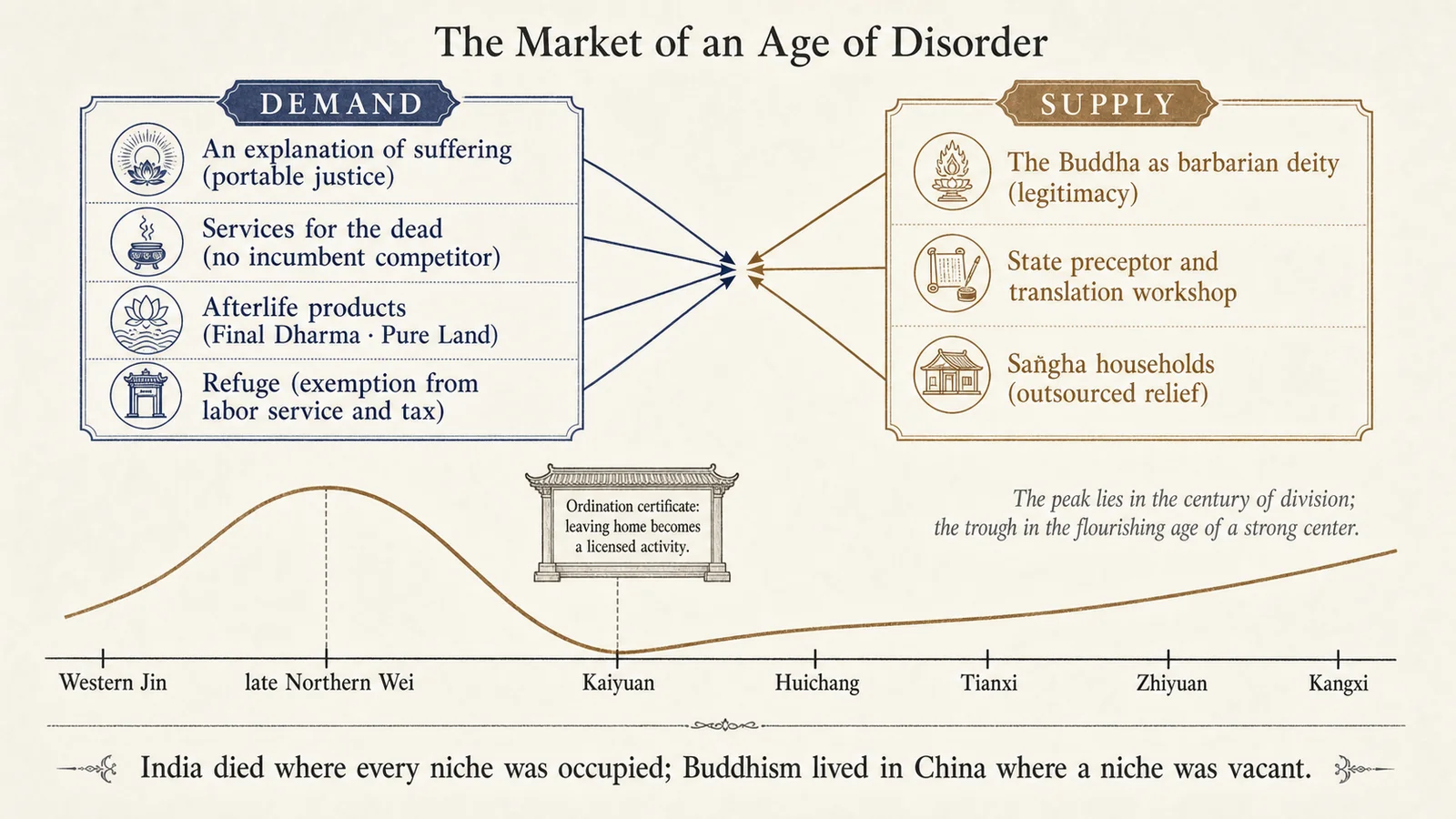
Under the rules, what follows is explicitly this volume's conjecture. Buddhism did not manufacture demand; disorder manufactured demand. The speed of Buddhism's Sinicization was directly proportional to the degree of social suffering. The strong form is stated because the Chinese evidence is unusually complete. All four layers of demand were supplied by disorder; both sides of supply were strengthened by it; the growth curve moved with war; and suppression moved with the reconstruction of order. Retreat to the cautious weak form (disorder amplifies existing demand rather than creates it from nothing) remains available, following the precedent of Part VI, Chapter 2. But in the Chinese case, the strong form stands.
Now close and disclose what comes next. Three centuries of disorder purchased Buddhism, but note what the buyers ordered: consolation, efficacy, salvation of the dead, a better next life, and a crown of legitimacy. No one ordered the precision of Madhyamaka. Part VI said that a tributary in the place of origin became the mainstream abroad. The mechanism has now landed. Export markets are governed by buyers' taste, and China's buyers lived amid disorder. The true-and-eternal and Pure Land were the primary products, and doctrinal learning an add-on. This order determined Chinese Buddhism's basic coloring. Then disorder ended. What would a reunified empire do when it looked upon a two-million-person religious community and thirty thousand tax-exempt monasteries within its borders? It would count, regulate, and demand that the community specify its position in imperial order. The community would answer through an unprecedented intellectual project. The next part examines China's reconstruction of Buddhism.
A theoretical cross-section closes the part. Upon entering China, doctrine encountered danger before institutions did: no-self collided with the soul. In Chinese common sense, the dead possessed a spirit and sacrifice had a recipient. If rebirth had no subject, who received karmic retribution? First-generation Chinese Buddhism answered with a theory that spirit does not perish. Huiyuan said that the form ends while spirit does not, as fire passes on after one piece of fuel is exhausted. Fan Zhen attacked with a theory that spirit perishes: body is substance and spirit function, like blade and sharpness. Both sides were intelligent, and neither stood on the original ground of Indian doctrine. To make rebirth intelligible in China, Buddhism first placed no-self beneath the counter. In the same period, matching concepts explained emptiness through Laozi and Zhuangzi; the six houses and seven schools each held a different position. Only after Kumārajīva and Sengzhao entered Chang'an did the Treatise on the Emptiness of the Unreal correct the xuanxue-inflected reading of emptiness.6 The judgment of this note: the first lesson of translation concerns not vocabulary but which doctrines may yield to a market. Chinese scholasticism never fully redeemed the no-self it surrendered.
References
References
-
For the wartime background of Tanluan and Daochuo and their Pure Land classifications, see Volume II, Part VI. See Huisi's Vow Text of the Great Meditation Master of Southern Yue (T46 no. 1933) for a chronology of the Dharma's decline. For consciousness of decline during the Northern and Southern Dynasties and the stone-carving movement, see the relevant chapters of Volume I, Part X. ↩
-
For Wang Du's memorial and Shi Hu's reply that “the Buddha is a barbarian god,” see Fotudeng's biography in fascicle 9 of the Biographies of Eminent Monks (T50 no. 2059). For the imperial-preceptor line represented by Fotudeng, Dao'an, and Kumārajīva, see Volume I, Part X, Chapters 1 and 3. ↩
-
For Tanyao's petition establishing Saṅgha households and Buddha households, see the “Treatise on Buddhism and Daoism” in the Book of Wei. On its role at the beginning of competition between the monastic economy and state household registration, see Part XI, Chapter 1. ↩
-
The late-Northern Wei figures of “more than thirty thousand monasteries and a multitude of two million monks and nuns” appear in the “Treatise on Buddhism and Daoism” in the Book of Wei. The statement that “inside and outside the capital there were altogether more than one thousand monasteries” appears in the preface to Yang Xuanzhi's Record of Buddhist Monasteries in Luoyang. For the Western Jin count and periods of growth, see the studies cited in Volume I, Part X, Chapter 1. ↩
-
The dynastic figures appear in fascicle 3 of the Bianzheng lun, “Ten Dynasties Honoring the Buddha”; the “Treatise on Buddhism and Daoism” in the Book of Wei; fascicle 4 of the Six Statutes of the Tang and the entry for the Court of State Ceremonial in the New Book of Tang; the “Annals of Emperor Wuzong” in the Old Book of Tang; fascicle 44 of the Chronicle of the Buddhas and Patriarchs; the “Annals of Shizu” in the History of Yuan; and official registers in Ming and Qing veritable records. See Bai Wengu, A Study of the Number of Monks and Daoists through the Dynasties, for a synthesis. The ordination-certificate system was institutionalized under Tang and abolished in the Qianlong era. ↩
-
See the section on the persistence of spirit after the exhaustion of form in Huiyuan's Treatise on Why Monks Do Not Bow to Kings, preserved in fascicle 5 of the Hongming ji. Fan Zhen's Treatise on the Destruction of the Spirit appears in full in fascicle 48 of the Book of Liang, while the Hongming ji preserves the replies. Sengzhao's Treatise on the Emptiness of the Unreal critiques the six houses in the Zhaolun. For details, see the first three chapters of Volume I, Part X. ↩