Chapter 2: The Nālandā System—The Ecology of Scholar-Monks
Once the arms race became standardized, individual genius among wandering teachers no longer sufficed. Someone had to mass-produce weapons, train soldiers, and hold the front year-round. From the fifth century, Nālandā in Magadha gradually assumed that role. Volume I established the facts: successive Gupta kings built it; it flourished for seven centuries; housed several thousand to nearly ten thousand; taught the three baskets and logic together with grammar, medicine, Vedic and other systems; made debate central to instruction; left first-hand records through Xuanzang and Yijing; acquired the additional Pāla monasteries, including Vikramaśīla; and was destroyed around 1193.1 This chapter does not repeat those facts. It asks the four questions, especially the first: once Nālandā stood, what changed in the religion?
The first change was the community's shape. Buddhism began as a distributed network: wanderers gathered for the rains, village monasteries faced one another, none was a center, and the death of one node could not kill the network. Scholasticization in Part III enlarged the nodes. The Nālandā system made large nodes into headquarters. For the first time, the tradition's best minds, fullest libraries, and highest authority of certification gathered in one red-brick complex. Concentration produced something impossible elsewhere: critical mass. Dignāga- and Dharmakīrti-level precision required an environment dense with opponents, books, and debaters. A village monastery could not provide it. Xuanzang traveled ten thousand miles for one Yogācārabhūmi, toward precisely this irreplaceable concentration. The same shape stated another way becomes something else: a network had gathered into a building, and buildings can burn.
The second change was the spectrum of monastic professions. Debate became an occupation. Gatekeepers tested applicants with hard questions and rejected most.2 Courses lasted years. The five sciences included the opponents' classics as required study, so students could recognize their weapons in combat.3 Advancement came through lectureships and victories; reputation was measurable and degrees followed it. Returned to the background of the interlude and Part III, Chapter 1, this supplied the system's missing element: authentication. Attainment had no court and realization could not be examined, while learning could be examined everywhere. A gatekeeper's challenge was an entrance test, lecture rank an academic title, victory at court a lifetime achievement. A religion with a vacuum of authentication finally filled the vacancy with academic certification. Nālandā invented less a university than the religion's degree system.
The third change lay in the route of money. In the alms age, a monk reported daily to one village; in the endowed-village age, a monastery reported to one ruler. Xuanzang's biography says more than a hundred villages supported Nālandā, each with two hundred households, supplying hundreds of measures of rice, ghee, and milk per day. Yijing gives more than two hundred endowed villages.4 The two figures depict one change: millions of small offerings became one fiscal allocation. The economy of visibility from Part III matured here. Scholarship was no longer displayed to a donor at the village gate but to the court. Scenes of King Harṣa receiving Xuanzang and rulers competing to support him must be discounted as victor narrative, yet the scale is credible. They were the market's premier roadshow.5 Part III, Chapter 2 said half the language of merit addressed the court. Here the report had only one reader.
Who benefited? Kingship bought what it wanted: an international flagship of prestige. A network of foreign students was diplomacy without ambassadors. Elite monks bought fully supported scholarship and transnational fame. One hidden beneficiary was the Mahāyāna scholastic tradition. Part IV, Chapter 4 showed that mainstream schools still dominated the seventh-century population census, while Mahāyāna won the lecture platform and export market. Nālandā owned that platform. It defined what counted as advanced Buddhism and the catalog of export goods. Xuanzang carried home Nālandā's booklist; the teachers later invited to Tibet mostly came from these monasteries. What Chinese and Tibetan traditions knew as "Indian Buddhism" was chiefly the product of great monasteries. Volume I warned of survivor bias between literature and inscriptions; Part IV just applied the warning. Here is the institutional cause: whoever monopolizes the lecture platform writes exported orthodoxy.
Three changes have been described, but a fourth must be recorded. It occurred outside the building at the same time: the network itself was decaying. This is not rhetorical symmetry but a condition verifiable in layers. The most direct layer again is Xuanzang. Outside Magadha, his record repeatedly uses formulations like Gandhāra's "more than a thousand monasteries, ruined and abandoned, overgrown and desolate" and other regions where monasteries had collapsed and monks were few. In the same book, Nālandā flourished.6 The periphery declined while headquarters grew; a seventh-century field record draws the cross-section. An epigraphic layer shows the same. Early cult sites recorded thousands of small donors—monks, nuns, and ordinary householders whose names filled Sanchi's railings. Later, donation records increasingly concentrated in kings and large gifts. The shift from ten thousand households to one king was recorded above on its dignified side; read in the other direction, the ten thousand households were being lost.7 External causes can be named. In the northwest, trade routes shifted after the Kuṣāṇas, and Hephthalite warfare swept across in the early sixth century; Xuanzang still heard stories of Mihirakula's destruction of Buddhism. The larger foundation was urban decline. Across the post-Gupta centuries, the subcontinent underwent deurbanization, fewer coins, and shrinking merchant guilds—precisely the urban guilds that had formed Buddhism's base for centuries. Wealth changed from trade into land, and the largest beneficiaries of land grants were not monks but brahmins.8
Internal causes must be recorded separately because they reveal something different. First, siphoning. The occupational spectrum and financial route were themselves pumps. Talent, reputation, and money all moved toward headquarters; village monasteries could not retain their best young people. Second, and most important, Buddhism in India never took possession of life-cycle ritual. Birth, aging, illness, death, marriage, and funeral remained Brahmanical business from beginning to end. Village Buddhist monasteries had no irreplaceable daily function. Support was affection, not necessity. Third, laypeople had no membrane. Buddhist householders did not form a hereditary social identity and had no personal law of their own; marriage, property, and caste remained governed by Dharmaśāstra. While a monastery stood, a buddha was available to worship; when it fell, the family had nothing to attach to and automatically flowed back. Together, the three meant that the popular niche could wither without an enemy. The structure slowly bled on its own.
Turn the lens toward the competitor and a precise mirror program appears. During the same centuries, Brahmanism performed Buddhism's reverse operation. Land grants planted priestly families institutionally in agricultural frontiers. They wrote deeds, controlled calendars, and supplied royal legitimacy. The great compilation of Purāṇas wrote an operating system of temple, pilgrimage, and festival religion; the avatāra protocol was the formal article of displacement through absorption, whose use against the Buddha appeared in Part III, Chapter 2. Dharmaśāstra took charge of the entire household life cycle. Temple construction expanded after the Gupta period and regional dynasties entered a competition. From the sixth to twelfth centuries, the greater share of royal patronage flowed to Śaivism; late Buddhism borrowed its ritual templates from it, the subject of Part VII.9 One side gathered every asset into headquarters; the other spread assets into villages. Buddhism built canopy; Brahmanism built roots. In peaceful times each occupied its place. The stress test comes in Part VIII. For now, note the difference between their transmission chains. The Saṅgha's chain was a formal-act chain, manufactured, requiring a monastery, a quorum, and uninterrupted ordination. The priest's was a bloodline, born and growing inside households. Which chain could be burned through appears in the death report of Part VIII.
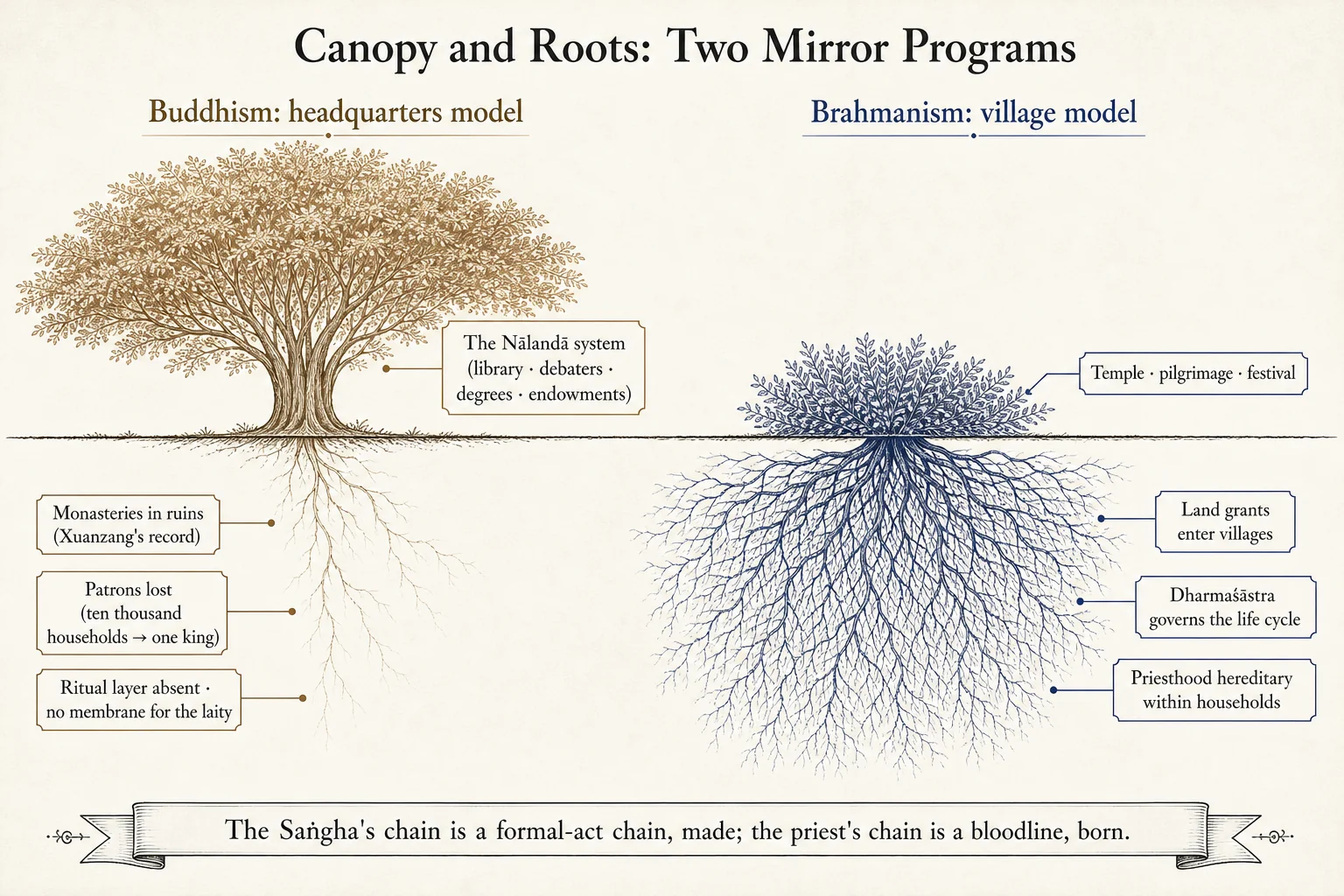
Following the rules, the next claim is explicitly this volume's conjecture. Nālandā was Buddhism's pride and its single point of failure. These are not two coexisting qualities but two readings of one structure. Volume I, Part VIII, Chapter 5 listed three vulnerabilities: dependence on royal finance economically, detachment from ordinary society socially, and concentration of knowledge in burnable buildings. This volume adds dynamics. No one made a mistake. Kings wanted prestige and therefore flagships, not diffuse networks. Monks wanted armament and therefore scale, not frugality. Rational choices by both sides in a competitive market gathered the whole tradition's eggs into a few baskets. The evidence above shows the changing relation of canopy and roots. What must be marked conjectural is the causal link: this volume regards siphoning not as an accompaniment but as one mechanism. Headquarters formation itself participated in popular decline. If grassroots communities were already declining at the same speed before the great monasteries rose, or headquarters consistently nourished village monasteries and decline had a complete separate cause, the siphoning link would lose weight. Comparison groups are visible. Sri Lanka had no Nālandā and sustained Buddhism to the present through a distributed network of village monasteries and ordination lineage, as Part III showed. China's Huichang persecution could burn the great monasteries of two capitals but not scattered Chan communities, as Part XI will show. Distributed systems survived; this concentrated branch receives its death report in Part VIII.
Record two costs now and leave the rest to Part VIII. One was distance from society. Stipendiaries no longer needed to report to villages, narrowing contact between Saṅgha and populace. Popular religious demand did not disappear but found another supplier. Part VII gives a surprising answer to who filled the vacant market. The other cost was evaluation. Once highest honor, best support, and deepest certification were tied to debate and commentary, no person needed to press the scale. It sank by itself toward the examinable side. This cost needs a separate chapter. Volume II already judged it philosophically; the present volume owes the historical mechanism. The next chapter turns to the cost of debate.
References
References
-
For Nālandā's founding, scale, curriculum, debate culture, Xuanzang and Yijing's records, the Pāla monasteries and Vikramaśīla, the system's three vulnerabilities, and destruction around 1193, see Volume I, Part VIII, Chapter 5 and Sukumar Dutt, Buddhist Monks and Monasteries of India (London: Allen and Unwin, 1962), cited there. This chapter adopts its factual layer. ↩
-
For gatekeepers questioning applicants and most students being unable to enter, see Xuanzang's Great Tang Records on the Western Regions, fascicle 9. As in Volume I, this volume judges that despite literary exaggeration it represents self-positioning through a threshold of academic reputation. ↩
-
For the curriculum and five sciences, see Yijing's chapter on studying in India in Record of Buddhist Practices Sent Home from the Southern Sea and Volume I, Part VIII, Chapter 5. ↩
-
On endowed villages, see Biography of the Tripiṭaka Master of the Great Ci'en Monastery, fascicle 3, which gives more than one hundred villages of two hundred households each; Yijing gives more than two hundred villages in his biographies of pilgrims associated with Nālandā. Both figures are reported. ↩
-
For King Harṣa's reception of Xuanzang and scale of patronage, see the Ci'en Biography, fascicle 5. The Kanyākubja assembly is discounted as victor narrative, as explained in Part IV, Chapter 4. ↩
-
For the Gandhāra passage, "more than a thousand monasteries, ruined and abandoned," see Great Tang Records on the Western Regions, fascicle 2. Similar records of ruined monasteries and few monks coexist in the work with flourishing great monasteries in Magadha. Volume I, Part VIII, Chapter 6 inventoried regional rise and decline; this chapter uses the structural contrast. For Mihirakula's destruction of Buddhism, see the Ṭakka country section in fascicle 4. ↩
-
For the contrast between collective small donations at early stūpa sites (monks, nuns, and householders in inscriptions at Sanchi and Bharhut) and later concentration in large royal gifts, see standard epigraphic and archaeological inventories, including Schopen's studies and Lars Fogelin, An Archaeological History of Indian Buddhism (New York: Oxford University Press, 2015). Volume I, Part IV used the early evidence in its discussion of inscriptions. ↩
-
For deurbanization, decreased coinage, and shrinking guilds in the post-Gupta centuries, see R. S. Sharma, Urban Decay in India (c. 300–c. 1000) (New Delhi: Munshiram Manoharlal, 1987). ↩
-
For the early medieval ruralization and institutional expansion of Brahmanism through land grants, Dharmaśāstra, Purāṇas, and temple economy, and its contrasting wager with Buddhism, see Johannes Bronkhorst, Buddhism in the Shadow of Brahmanism (Leiden: Brill, 2011). For Śaivism's dominance in royal patronage from the sixth to twelfth centuries and Buddhist borrowing of ritual templates, see Alexis Sanderson, "The Śaiva Age," in Shingo Einoo, ed., Genesis and Development of Tantrism (Tokyo: Institute of Oriental Culture, 2009), 41–350. ↩