Chapter 3: The Mindfulness Industry—The Final Incorporation
The exported luggage opened after the war. Chan reached the shelf first. D. T. Suzuki's writing met a disillusioned generation, and “Zen” entered everyday English. Shunryu Suzuki established the San Francisco Zen Center; after 1959, Tibetan teachers scattered into the West and founded centers. Insight meditation followed. Beginning with Ledi Sayadaw, the Burmese line remade calming and insight formerly reserved for monastic elites into courses for laypeople. The Mahasi and U Ba Khin branches emerged, while Goenka standardized a ten-day course for worldwide replication. Scholarship pours its customary cold water on the story. Mass lay meditation was not the restoration of an ancient method but a modern invention under Burma's colonial crisis. The narrative of an insight revival is itself a modernist product; the oldest technique is its youngest packaging.1 In 1979, Jon Kabat-Zinn opened a mindfulness-based stress reduction course in a basement at the University of Massachusetts Medical Center: eight weeks per session and Buddhist identity expressly removed. Mindfulness then entered hospitals, schools, corporations, and armies. Apps placed meditation in phones, while the anxiety economy gave tranquility a price. Meditation had entered barracks and balance sheets—the farthest external assignment in Buddhist history.2
This volume's line of verification receives its epilogue here, in ironic form. For 2,500 years, the tradition never built public inspection for its central promise. Attainments were self-reported, followed by the Interlude's silence, signs interpreted by masters, authorization in a dark room, rebirth at death, reincarnation questions written by the labrang, and Humanistic Buddhism withdrawing the subject entirely. The mindfulness industry succeeded. An eight-week course had pre- and post-test scales, randomized controls, double-blind review, and results published in peer-reviewed journals. Verification was finally public. There was only one cost: the object being verified changed. What entered inspection was stress reduction, not cessation; sustainability under performance demands, not renunciation; symptom relief, not liberation. Volume II's two ledgers now acquired separate owners. Science took over the ledger of present-world efficacy and filled ever more pages; no one submitted the ledger of cessation, so no one signed for it.3 The problem of verification waited 2,500 years and received this answer: change the examination question and the exam can be passed.
Under the rules, what follows is explicitly this volume's conjecture and gives the chapter its name. The mindfulness industry completed the latest incorporation in Buddhist history. This time the incorporating party was not another religion but capital and clinical psychology. None of the four operations from Part VII, Chapter 3 was absent. Dual-track patronage: universities and clinics supported meditation teachers and scientists at once; money tied them to one stake. Curricularization: the eight-week stress-reduction course became a new stages-of-the-path system, with syllabus, teacher credentialing, and tuition. Exegetical conversion: Buddhist language was systematically translated into neuroscience. No-self became downregulation of the default mode network; lovingkindness became cultivation of prosocial emotion; unruly metaphysics was locked inside the safe of measurement scales. Genealogization: a transmission story from Burmese meditation hall to clinical trial became a new Dharma lineage. Buddhism used this agreement on Śaivism, Vikramaśīla used it on siddhas, Hinduism on Buddhism, and Neo-Confucianism on Buddhism, as Part XI, Chapter 2 showed. This time Buddhism stood on the incorporated side, and the incorporating party was not religious for the first time. Record the half-weight qualification. Buddhism was not a pure victim. Religious communities eagerly supplied goods and meditation teachers endorsed brands. Incorporation is always a two-way exchange, and Part VII's judgment applies verbatim.4
A reverse development in the same modern world closes the Vinaya line of this volume. The Theravāda bhikkhunī ordination lineage broke in the eleventh century and was never fully transmitted to Tibet. At the end of the twentieth century it was reconnected through the Dharmaguptaka nuns' lineage of Chinese Buddhism. In major ordinations at Sarnath in 1996 and Bodh Gaya in 1998, Chinese Buddhist nuns served as witnessing teachers. The Sri Lankan bhikkhunī community was thereby reestablished, while full ordination for women in Thailand and Tibetan Buddhism entered their respective agendas. The origin of the Chinese lineage was audited in Part IX, Chapter 1. During the 430s, two groups of Sri Lankan nuns crossed the sea to Liu-Song and supplied the required number for dual-Saṅgha ordination. Fifteen hundred years later, the chain flowed backward. The island that once lent the chain reseeded itself from the same chain.5 Record the controversy. Opponents hold the chain interpretation: different schools' Vinayas cannot connect. Supporters hold the provision interpretation: substantially identical rules permit shared ordination. The two meanings of orthodoxy established in Part III have returned to trial at a global conference table. This time no royal command can decide. The judge's seat itself remains vacant as scholars, Saṅgha councils, national ecclesiastical administrations, and markets all attempt to occupy it. The meaning of orthodoxy is rewritten simultaneously at two ends: one turns Buddhism into a downloadable technology; the other stitches a chain broken for a thousand years.
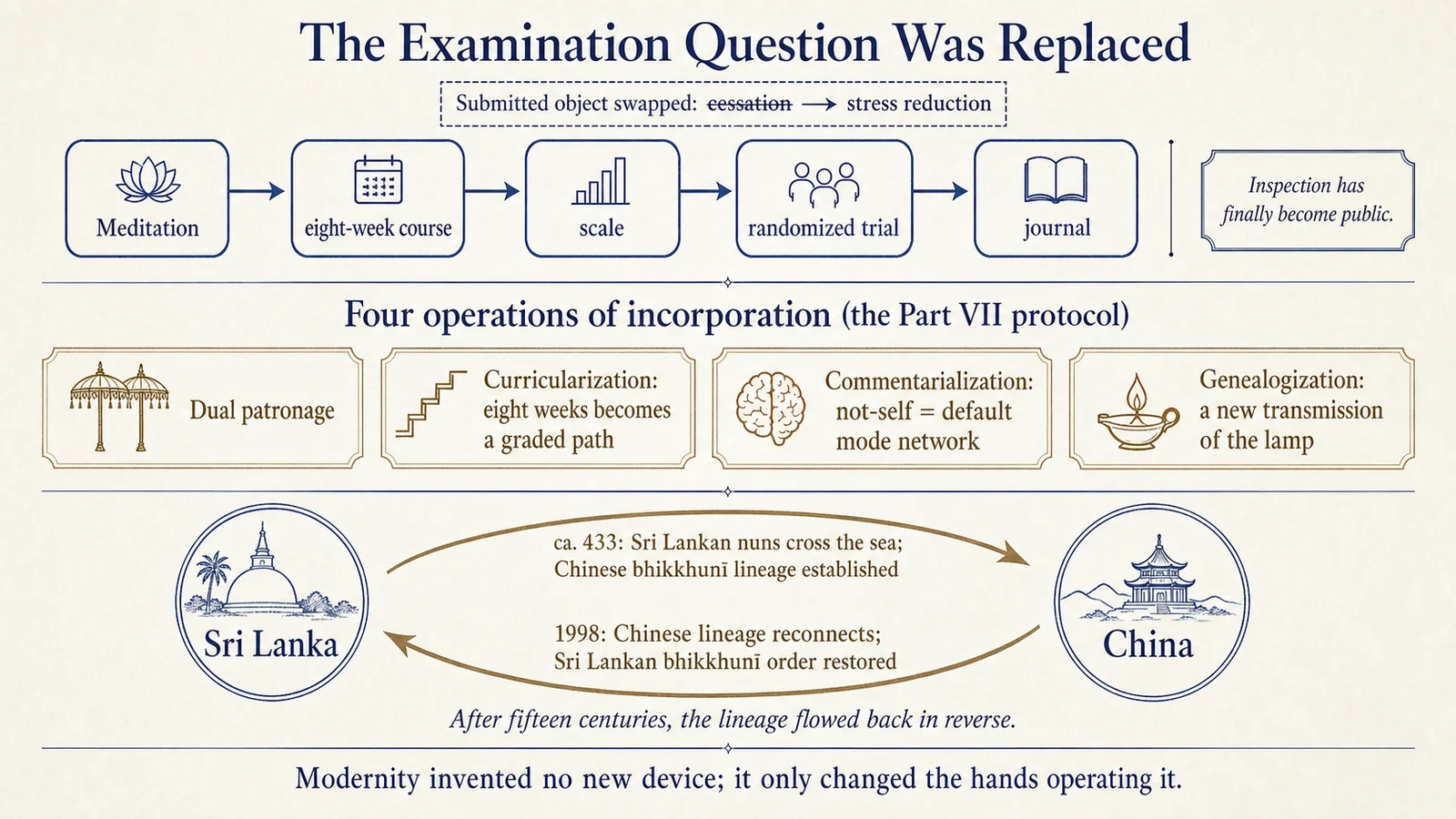
Close the part. Place the four rewritings together: the examiner's criterion, the human-world agenda, industrial extraction, and reconnection of the chain. Every act modernity performed on Buddhism used an old mechanism from this history of transformation. Replacing criteria was doctrinal classification, extraction was incorporation, textualism was customs, and reconnection was a formal act. Modernity invented no new apparatus; it only changed the hand operating it. The next part inventories all the mechanisms and examines the shape of transformation.
A theoretical cross-section closes the part. The doctrinal vacuum modernity left that is least discussed is cosmology. Mount Sumeru and four continents could not withstand geology and astronomy. Traditions changed their language together: the mountain was a metaphor and the world a state of mind. The revision was an old craft, a modern application of the reflex of doctrinal classification, writing “wrong” as “metaphorical.” The larger change concerned status. Once the criterion was ceded, doctrine as a whole entered a condition of awaiting inspection. Dependent arising was translated as relativity and karma as psychological causation; what could be translated entered the shelf and what could not went into storage, the same warehouse as Humanistic Buddhism's. The theoretical note converges with the main text. The part records surrender of the criterion; the note records that, afterward, doctrinal history for the first time possessed no ground of its own.
References
References
-
On mass lay insight meditation as a modern construction under colonial crisis, see Erik Braun, The Birth of Insight: Meditation, Modern Buddhism, and the Burmese Monk Ledi Sayadaw (Chicago: University of Chicago Press, 2013). For the Mahasi, U Ba Khin, and Goenka lines, see Volume I, Part XII. ↩
-
On Jon Kabat-Zinn, mindfulness-based stress reduction in 1979, its intentionally secular design, mindfulness-based cognitive therapy in public health, apps, corporations, and military mindfulness, see David L. McMahan cited in this part and Volume I, Part XII; summarized here. ↩
-
For the full sequence of privatized criteria, see the Interlude and Parts VII, X, and XII of this volume. For the two ledgers, see Volume II. ↩
-
For the four operations of incorporation, see Part VII, Chapter 3. For criticism of the mindfulness industry in the line of “McMindfulness,” see Ronald Purser, McMindfulness: How Mindfulness Became the New Capitalist Spirituality (London: Repeater, 2019); summarized here. ↩
-
On the ordinations at Sarnath in 1996 and Bodh Gaya in 1998 and reconstruction of the Sri Lankan bhikkhunī community, see Bhikkhu Anālayo's writings on bhikkhunī full ordination. For Tissarā and other Sri Lankan nuns crossing the sea and dual-Saṅgha ordination in China, see the Biographies of Nuns and Part IX, Chapter 1; summarized here. ↩