Chapter 3: The Meiji Shock—After the Destruction of Buddhism
In 1868, the Restoration government issued successive orders separating kami and buddhas, forcing shrines and temples apart. Shrine-temples were abolished, shrine monks returned to lay life, and Buddhist images and ritual implements were removed from before the kami. The text of the policy prescribed separation; implementation became liquidation. The intensity of haibutsu kishaku, “abolish Buddhism and destroy Śākyamuni,” varied by domain. In Satsuma, the most extreme case, more than a thousand temples were abolished and every monk laicized. The later order confiscating temple lands removed estates, while the Jinshin household register transferred registration to the state.1 Overnight Buddhism lost everything Tokugawa had provided: department, land, and legally assigned customers. Placed within this volume's sequence of suppression, the shock made another demand. Wuzong wanted Buddhist assets, Nobunaga its sovereignty, Meiji its position. The new state intended to build the national polity on Shinto; a narrative of an imperial line eternal through all ages could not accommodate a foreign community that had just served as the shogunate's household-registration office. This was not fiscal but identitarian. The old law of roots tests held again. The state could recover the registration office but not the graveyard. Legal danka obligations ended while funerary habits remained. Temples survived the worst years through graves and services. Huichang's judgment (real estate can be seized, habits cannot) repeated word for word in Meiji Japan.2
In 1872, Grand Council of State Proclamation No. 133 declared that monks could eat meat, marry, and grow their hair at their own discretion. The state withdrew all endorsement from discipline; renunciation changed from status back into occupation. Within decades clerical marriage and hereditary succession spread from the Shin exception into the norm across schools, turning temples into family businesses.3 Return the proclamation to the long duration. It was the last domino. In 818 Saichō cut the formal-act chain and kept the provisions of an apocryphon. In the thirteenth century Shinran called himself neither monk nor lay and installed the bloodline within Pure Land. In 1872 the state released the remaining provisions to individual discretion. Three copies treated the Vinaya differently: Sri Lanka froze it into a fossil, Tibet locked it into government, and China continues reciting it on ordination platforms. Japan completed the fourth road: cut the chain, withdraw the provisions, and leave an occupation shaped like a robe. Part III said the Vinaya's second status was chain. Across a millennium, Japan demonstrated what remained when that chain was dismantled section by section. What remained was not a Saṅgha but a religious denomination.
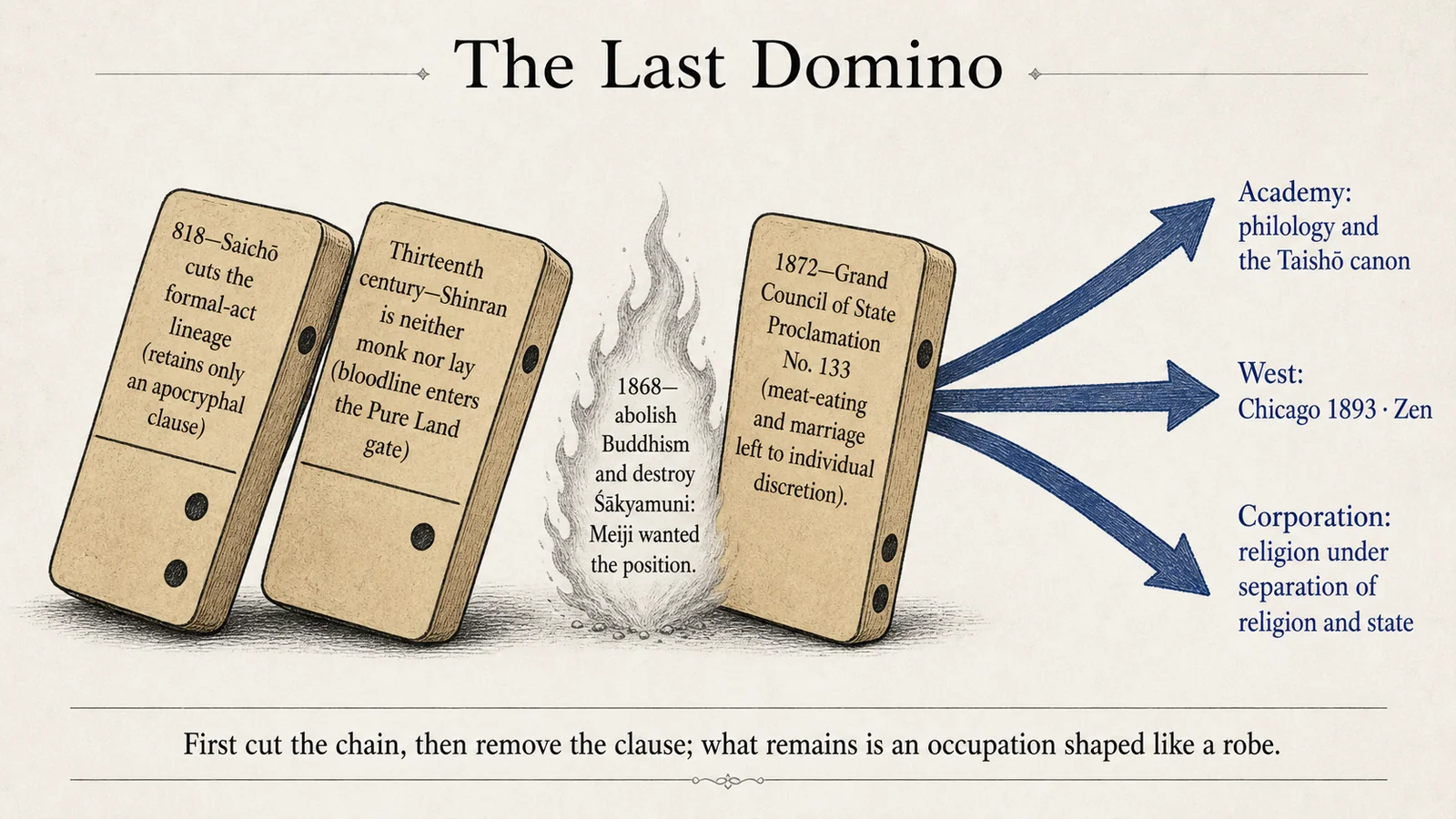
Self-rescue after the shock followed three roads, together creating something no one expected. The first was academicization. Nanjō Bun'yū traveled west and learned Sanskrit from Max Müller; Takakusu Junjirō followed, and Buddhist philology entered Japan through monks themselves. In 1901 Murakami Senshō declared on historical grounds that Mahāyāna was not spoken by the Buddha and left the Shin clerical register that year. Within a generation, his two-line position (“not the Buddha's speech, yet Buddhism”) became scholarly common sense. Another generation later, Takakusu and Watanabe Kaigyoku supervised the compilation of the Taishō Revised Tripiṭaka. Every T-number in footnotes around the world today, including this book's, descends from Meiji Buddhism's movement of self-rescue.4 The second road was political-religious negotiation. Shimaji Mokurai brought the vocabulary of freedom of religion and separation of religion and state from Europe, gaining Buddhism the position of a religious corporation in the gaps of State Shinto. Buddhism learned to exist as a religion in modern society rather than as a department of the establishment.5 The third road was export. Shaku Sōen spoke at the World's Parliament of Religions in Chicago in 1893. His disciple D. T. Suzuki presented Chan to Western audiences for the next half-century, while Kiyozawa Manshi turned inward toward spiritualism. Expelled from the establishment, Buddhism had to enter two new markets: Western audiences and the modern academy. To gain shelf space, it repackaged the product as scientific, philosophical, non-superstitious, and experientially verifiable through meditation.6
Under the rules, what follows is explicitly this volume's conjecture. The Meiji shock became an unexpected source of today's global Buddhism. The Buddhism the West received around the turn of the twentieth century came chiefly from this Japanese Buddhism expelled from its own establishment and urgently seeking new markets. The Sri Lankan line was similar: colonial shock and Meiji shock had the same structure. Their combined history belongs to the next part. The shock was accidental, the packaging self-rescue, and the bestseller the greatest accident. Yet translating Buddhism into the languages of science and philosophy became irreversible.
The three chapters close and submit the fourth examination paper. Kamakura reduced Buddhism to one piece of carry-on luggage. Tokugawa locked luggage and carrier into a household-registration office. Meiji smashed the lock, and Buddhism carried the luggage into a free market. The market's grade was unexpected: the lightest luggage traveled farthest. Chan and Buddha-recitation crossed the sea and became the Buddhism known to Westerners; none of the three older copies completed such an export. The three pieces of evidence for the large hypothesis are now assembled: India's diversity of separate houses, China's diversity under one roof, and Japan's membership-based exclusive practice. Three societies, three shapes of knowledge. The final comparison waits for Part XV. The next part examines modernity's rewriting.
A theoretical cross-section closes the part. The simplifying revolution had a theoretical foundation rarely named: Tendai original-awakening thought. The Mount Hiei curriculum taught that awakening was original and cultivation followed realization; beings in their present form were buddhas, and grasses, trees, lands, and soil all attained buddhahood. If awakening is original, one gate suffices. One name or one posture is the operation of the whole. The four pieces of luggage were light because the foundation had first declared that luggage could be entirely unnecessary. The problem planted in Part VI's closing note (if originally complete, what is practice for?) ceased to be a problem in Japan and became an axiom. Its critics waited until the twentieth century, when Critical Buddhism challenged original-awakening thought as not Buddhist; Volume II recorded the case. This history of transformation adds only one sentence: the foundation that enabled a millennium of simplification and the modern critique that expelled it from Buddhism concerned the same object.
References
References
-
On the 1868 orders separating kami and buddhas, haibutsu kishaku, complete abolition in Satsuma, confiscation of temple lands, and the Jinshin household register of 1872 taking over temple certification, see James E. Ketelaar, Of Heretics and Martyrs in Meiji Japan: Buddhism and Its Persecution (Princeton: Princeton University Press, 1990), and Sueki Fumihiko, A History of Japanese Buddhism; summarized here. ↩
-
On the persistence of funeral habits after legal danka obligations ended, see Tamamuro Taijō, Funeral Buddhism, and Sueki cited above; summarized here. ↩
-
Grand Council of State Proclamation No. 133 of 1872. The subsequent spread of clerical marriage and hereditary succession is standard in modern Japanese Buddhist history; summarized here. ↩
-
Nanjō Bun'yū studied Sanskrit under Max Müller and compiled the catalogue of the Ming canon. See Murakami Senshō, A Treatise on the Unity of Buddhism (1901), and the record of his departure from clerical status. Takakusu Junjirō and Watanabe Kaigyoku supervised the Taishō Revised Tripiṭaka of 1924–1934. ↩
-
For Shimaji Mokurai's memorials on freedom of religion and separation of religion and state, see Ketelaar cited above. ↩
-
Shaku Sōen attended the World's Parliament of Religions in Chicago in 1893. D. T. Suzuki's Western transmission and Kiyozawa Manshi's spiritualism belong to the genealogy of “Buddhist modernism” examined in Part XIV. ↩