Chapter 2: Tokugawa Household Registration—The Terauke System
The new schools grew into a form found in no other Buddhist copy: religious communities became Warring States lords. Rennyo rebuilt Shin Buddhism through associations of ordinary followers and letters in plain language, and the Honganji network snowballed. The Kaga Ikkō uprising expelled its military governor; for nearly a century afterward contemporaries called it “a country held by peasants.” Ishiyama Honganji controlled the strategic center of Osaka and fought Oda Nobunaga for ten full years.1 A Lotus uprising briefly controlled the townspeople's autonomous government in lower Kyoto. Return the scene to this volume's sequence. Indian Buddhism never possessed an army; Chinese Buddhism sometimes had warrior monks but never a state; Tibetan Buddhism borrowed another's army to establish its own state; Japanese Buddhism was itself an army and itself ruled a country. Exclusive membership revealed its other face amid disorder. The same one-gate, one-lord loyalty that made followers of Buddha-recitation into an army. The people who ended it struck precisely. Nobunaga burned Mount Hiei and besieged Ishiyama; Hideyoshi confiscated weapons. They seized neither scripture nor image but arms and territorial sovereignty. Japan's Huichang did not burn texts or force monks to return to lay life. It did one thing: disarmament.2 The state here wanted something different from Wuzong. Wuzong wanted Buddhist assets; Nobunaga and Hideyoshi wanted Buddhist sovereignty. Buddhism could keep every asset but not one inch of sovereignty.
Tokugawa put the disarmed communities to another use. Prohibition of Christianity was fixed shogunate policy and tightened after the Shimabara rebellion. The instruments of enforcement were temples: religious investigation and the terauke system. Every household had to affiliate with a supporting temple, which issued a certificate proving it was not Christian. Annual registers of religious affiliation and population were compiled; travel, relocation, marriage, and service depended on temple certification.3 Buddhism became the household-registration office of the bakuhan system. Part XII, Chapter 3 said Tibetan Buddhism opened the office that assigned positions. Japanese Buddhism received a department within the shogunate's office. The direction of registration also deserves comparison. In China the state registered monks; an ordination certificate determined who could renounce. In Japan monks registered the population; temple certificates determined who was not Christian. The same superior and subordinate reversed the direction of the pen.
Household-registration work came bundled with a legally assigned market. A danka household owed obligations to its mortuary temple. Funerals had to use that temple; memorial offerings continued from the seventh day through the thirty-third anniversary; posthumous names were purchased by grade. To change temples, one first had to move one's household register, making departure nearly impossible. The head-and-branch system then organized schools as pyramids. The shogunate needed only control each headquarters; one body of monastery regulations reached the country.4 The death niche of Part XI, Chapter 3 reached its logical endpoint in Japan. China's monopoly of repentance and death rites was won in a market; Japan's funeral monopoly was licensed by the shogunate. Chinese bereaved families could compare suppliers; Japanese danka households belonged to one from birth through death. The later insult “funeral Buddhism” was poured onto this institutional foundation.5
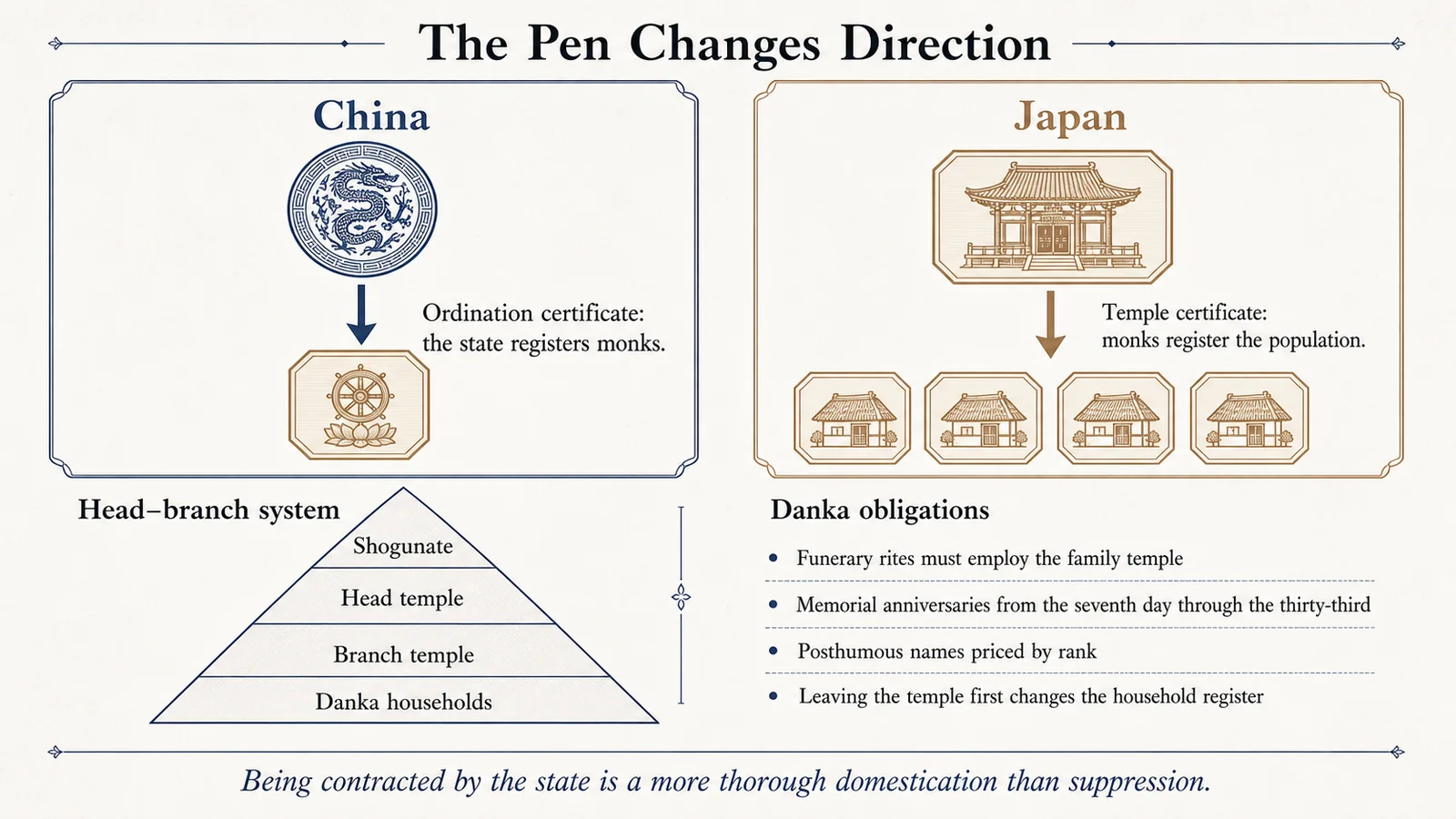
Under the rules, what follows is explicitly this volume's conjecture and the chapter's judgment. Being contracted by the state is a more thorough domestication than suppression. Suppression leaves martyrs and an underground market; contracting cancels the market itself. Law assigns customers and obligation guarantees revenue, so the community no longer needs to persuade anyone to believe anything. The muscle of propagation quietly atrophied over 250 years. This was no one's corruption but the normal operation of incentives. Part XI, Chapter 1 said the state learned after Huichang that regulating Buddhism was more valuable than dismantling it. Tokugawa completed the course perfectly, regulating Buddhism until it lost even the qualification to be dismantled. Record the plain half. Edo was not an intellectual famine for Buddhism. Precisely because schools did not need to proselytize outward, intelligence turned inward. Academies and seminaries flourished and sectarian scholarship achieved unprecedented textual precision. Hakuin remade kōan Chan among ordinary people; Tetsugen raised funds to carve the full canon; Bankei taught the Unborn to merchants and laborers. Outside the joint flourishing of learning and institution stood a warning. A merchant in Osaka read the entire canon beyond the lecture seats of Kaitokudō and wrote Words after Emerging from Meditation. Through his theory of successive additions, he announced that Mahāyāna was not spoken by the Buddha. The first person to dissect the canon through textual criticism belonged to no school's seminary, because everyone inside a seminary possessed membership. The full echo of that shot from 1745 lands in Part XIV.6
Close the chapter. Edo's 250 years brought peace no old copy had enjoyed: no risk of suppression, no labor of conversion, no anxiety about food and clothing. Sri Lanka lived under colonizers, China through dynastic cycles, Tibet amid the risks of ruling itself, while Japanese Buddhism lay within the shogunate's establishment. The cost was invisible at the time. When all a religion's customers are legally assigned, its relation with believers need not be faith but only administration. No one practiced surviving in a free market for 250 years. In the next chapter, the market returns overnight.
References
References
-
On Rennyo's associations and letters, the Kaga Ikkō uprising, and the ten-year Ishiyama war, see Sueki Fumihiko, A History of Japanese Buddhism, pp. 130 and 132. The phrase “a country held by peasants” comes from Jitsugo, Jitsugoki shūi, in Shinshū zensho, continued series, vol. 18, p. 130, where it reads in katakana: “近年ハ百姓ノ持タル國ノヤウニナリ行キ候コトニテ候”. ↩
-
For Nobunaga's burning of Mount Hiei in 1571, Ishiyama's capitulation in 1580, and Hideyoshi's sword hunt of 1588, see general histories. This volume reads their structure as “disarmament without extermination.” ↩
-
On religious investigation, temple certificates, and annual religious and population registers, see Tamamuro Fumio, “The Development of the Temple-Parishioner System,” Japanese Journal of Religious Studies 36, no. 1 (2009): 11–26, where the three appear as shūmon aratame, terauke seido, and shūshi ninbetsu aratamechō. Sueki, cited above, treats the topic only in passing; his chronology dates the office of religious investigation to 1640. ↩
-
On parishioner obligations, the difficulty of leaving a temple, the head-and-branch system, and monastery regulations, see the same sources; summarized here. ↩
-
The term “funeral Buddhism” was popularized by Tamamuro Taijō, Funeral Buddhism (Tokyo: Daihōrinkaku, 1963). Its institutional origin lies in the system described in this chapter. ↩
-
Tominaga Nakamoto, Words after Emerging from Meditation (1745), and his theory of successive additions emerged from the merchant scholarship of Osaka's Kaitokudō environment. Internal Buddhist replies, including Mujaku Bunyū's A Refutation of Words after Emerging from Meditation, and the case's Japanese reception belong to Part XIV. ↩