Chapter 2: Printing and the Literati—Chinese Buddhism's Position after Song
Huichang and the warfare of the late Tang and Five Dynasties broke the last two links of the three-level dependency: lecture seats dispersed and peace disappeared. Song gave Chinese Buddhism new supports—three new things: a carved woodblock, a group of new patrons, and a neighbor adept at taking over its business. This chapter asks, in order, what each restored, selected out, and seized.
In the twelfth year after the dynasty's foundation, Emperor Taizu of Song ordered Zhang Congxin to Yizhou to carve blocks for the Buddhist canon. Twelve years later, 130,000 blocks were complete. This was the Kaibao Canon, the first printed Buddhist canon in Chinese.1 Its weight must be measured against the three-level dependency. Previously every scripture survived through copying; copying depended on people gathered at lecture seats, and lecture seats depended on peace. One Huichang followed by one Huang Chao could burn Tiantai's commentaries until backups had to be sought in Goryeo. Woodblocks freed the first link from human hands. If the blocks survived, fire destroyed only one batch of paper. The two Fuzhou canons, Huzhou's Sixi Canon, and Pingjiang's Qisha Canon followed, state and private carving succeeding one another. Text could no longer be burned out.2 The control of Part VIII gains another line. Indian Buddhism stored its life in manuscript libraries at a few great monasteries; one fire at Vikramaśīla sent unique copies into smoke. At the end of the tenth century, China acquired something Indian Buddhism never had: an immortal body for texts. The first link of the three-level dependency became almost inspection-exempt.
Yet woodblocks could restore only the first link. Interpretation is a craft and the craft lives in people rather than paper, the case established in Part X, Chapter 2. Wuyue recovered all the letters of Tiantai's texts, but people capable of lecturing still had to be raised anew. The result illustrates the problem. Within only two generations of Siming Zhili's Tiantai revival, the Home-Mountain and Off-Mountain dispute began. Part X, Chapter 2 noted that interior renovation could consume the building's entire intelligence. Add one observation from printing history. Both sides held exactly the same newly printed texts; disagreement arose precisely where text could not govern, in orally transmitted approaches to contemplating the mind.3 Printing guarantees that everyone has a book, not that two people read the same meaning. Once paper was solved, the problem of the lecture seat remained in place. The recovery of doctrinal schools under Song therefore stopped at a half-revival. Tiantai continued through internal dispute; Huayan lectured as an adjunct within Chan monasteries; Yogācāra nearly became a lost discipline. Blocks could save texts but not scholastic lineages. Only people save lineages, and the market for talent now had a different buyer.
That new buyer was the second new thing. The patronage structure of the medieval aristocracy was physically broken at the end of Tang and replaced by mobile bureaucratic literati recruited through the civil examinations. New patrons gave differently from old lineages. Old patrons gave land; new patrons gave words. A stele inscription, a preface to recorded sayings, or an exchange of verse with a monk was the Song literatus's merit. In 1004, Daoyuan presented a history of Chan to court. Emperor Zhenzong ordered Yang Yi and other scholars to edit it, titled it the Jingde Record of the Transmission of the Lamp, and admitted it to the canon.4 The school “not established in words” was polished by Hanlin scholars and distributed in a state canon. The image is Song Buddhism in miniature, and confirms the paradox recorded in Part X, Chapter 3. The school not established in words became the largest producer of words because its new patrons were the best writers under heaven.
The literati's reach can be tested at three depths. The shallowest was genre. Recorded sayings, lamp histories, verses on old cases, and prose commentaries (the full equipment of Song Chan literature) were cut to literati reading habits. Literary penetration ran both directions. The Recorded Sayings of the Cheng Brothers and Classified Conversations of Master Zhu themselves transplanted the Chan genre of recorded sayings; Confucianism and Buddhism first converged in literary form. The second layer entered design of the path. Of thirty fascicles in the Recorded Sayings of Dahui, fascicles 19–24 consist entirely of teachings for literati, while fascicles 25–30 consist almost entirely of letters answering their questions. Half the collection was written for officials. Dozens of high officials had personally recognized experiences with Dahui, including Zhang Jiucheng, Lü Benzhong, and Li Bing. Dahui expressly said that Chan lay neither in quiet nor commotion and that learning the Way did not prevent one from holding office or managing a livelihood. One “no” critical phrase could be carried into the government office. The form of critical-phrase Chan was cut to the literati schedule. This was more than patrons influencing a school; customers had entered product design.5 At the deepest layer, literati did not enter the core production of doctrine during Tang and Song. Among authors of doctrinal classifications and commentaries, the layman Li Tongxuan remained the famous exception, as Part X, Chapter 2 noted. That gate failed by stages in later centuries. At the end of Ming, the layman Qu Rujiao compiled the Record of Pointing at the Moon and became an editor of lamp history. Yuan Hongdao wrote the Combined Treatise on the Western Land, later incorporated by Zhixu into the Ten Essentials of Pure Land. By the late Qing and Republic, Yang Wenhui and Ouyang Jingwu's Chinese Inner Studies Institute transferred the transmission of doctrinal learning entirely into lay hands. The Japanese return planted in the preceding chapter ended there, the subject of Part XIV.6 The order of the three layers matters: literati first rewrote Chan's exterior, then its method, and finally took over its lecture seat. Each deeper step required several more centuries.
When patrons changed, the filter changed with them. Part VII watched esoteric Buddhism rearrange its shelf for courtly tastes. The same rule acquired a different taste in China. Here the client did not desire empowerment and ceremonial dignity but calligraphy and sharp exchanges. Encounter dialogues, verses on old cases, and commentaries therefore proliferated, and recorded sayings became a genre shelved beside poetry and collected prose. Pure Land associations also fit the taste, for literati already had a culture of societies. Shengchang established a Pure Practice Society at Zhaoqing Monastery in Hangzhou with the chief minister Wang Dan as its head, reenacting the old alliance of lay elites and eminent monks.7 Forms that received no literati ink quietly thinned. Dense commentarial learning lacked interest for a study's amusements; the details of Vinaya offered nothing for verse exchange. The surface of assimilative displacement was now the literati desk. Nothing was drowned; some things simply were not rescued.
The third development occurred on the side of the state and supplies two pieces of evidence for the preceding chapter's conjecture. Song turned ordination certificates into negotiable securities. In 1067 the court began selling blank certificates. Under Xining each cost around 120 strings of cash; by 1212 the official price had risen to 1,500 strings. The government sold batches for famine relief, military finance, river control, and city walls. Overissue in Southern Song made prices fluctuate like notes and salt certificates.8
Who bought them? Song commentators answered directly: buyers were all wealthy and powerful households accumulating property.9 Under Northern Song's service system, a rich family rotated into charge of transport and stores and risked ruin; one ordination certificate exempted the holder's taxable person from service. In Southern Song, an exemption fee for monks was imposed and the tax advantage shrank. Certificates then became purely financial goods—for preserving value, payment, stockpiling, and speculation. When Su Shi requested a grant of certificates, he calculated that three hundred were worth more than fifty thousand strings. Prices behaved like finance: about five hundred strings under Shaoxing, rising to twelve hundred during the Kaixi wars and falling after peace. Most importantly, buyers of expensive certificates often never shaved their heads. Certificate and person separated. What was traded was never renunciation but exemption and preserved value. Poor people who genuinely wished to ordain could not afford one; they entered illicitly or waited for a court-granted ordination. The exemption fee must also be understood: it did not abolish privilege but purchased and monetized it. The state converted every exemption into a charge.
It is easy to condemn the sale of religious qualification by the state; it is more important to understand it. This was the written form of the Huichang settlement. The state no longer dismantled monasteries because clerical quotas themselves yielded annual revenue. Buddhism no longer expanded beyond its boundary because every position required payment to the treasury. The quota season of Part IX, Chapter 3 bore fruit: the quota itself became a commodity. The hand that could withdraw credentials now sold them instead. Suppression and certificate sales were two actions of the same hand; the first collected once, the second forever. From a fiscal perspective, Song was more sophisticated than Wuzong.
The second piece of evidence was tax. Huichang recovered more than land; it recovered taxation power, which Song turned into routine. Monastic and Daoist fields paid the two taxes like ordinary land; the tax-exempt monastery ceased institutionally to exist. Under Shaoxing, Southern Song went further and imposed the clerical exemption fee, also called the leisure fee, paid annually by grade. A renunciant's personal charge could exceed that of a registered lay subject. Only two openings remained: fields bestowed by the emperor and literati “merit grave-monasteries.” The latter promptly became shelters through which powerful families avoided tax, despite repeated but ineffective prohibitions. Ming and Qing fixed the rule in one formula: imperially bestowed fields were exempt from grain tax; all other monastic fields were assessed like ordinary fields.10 Read the line from start to finish. Early Tang monasteries stood outside taxation. After the two-tax system, privilege contracted. Huichang reset it to zero. After Song, monasteries belonged to the tax base. Before Huichang, the state asked why monasteries paid no tax. After Huichang no one asked again, because tax-exempt monasteries had disappeared while tax-paying ones remained forever. The preceding chapter called Huichang and Xiande a pricing event; here is the full price list.
The third new thing was most profound: a neighbor adept at taking business. Tang opponents attacked Buddhist traces. Han Yu argued against the Buddha's relic, while Ouyang Xiu's “Essay on Fundamentals” spoke of Chinese and barbarian, resources, and ritual morality; the attack remained outside the door.11 Han Yu nevertheless already held a Chan product. Chen Yinke determined that his theory of succession was superficially inspired by the final chapter of the Mencius but actually formed through Chan's “special transmission outside the teachings.” The person attacking the traces first took a weapon from the rival arsenal.12 Buddhism knew how to answer attacks from outside. Qisong opened his Collection in Support of the Teaching with an “Essay on Filial Piety,” placing filiality before the precepts. In the centuries-old litigation over whether monks should bow to lay authority, introduced in Part IX, Chapter 1, Buddhism voluntarily submitted its homework.13 The dangerous move came later, when Neo-Confucianism changed tactics and entered the house. The Cheng brothers and Zhu Xi rebuilt Confucianism. The Supreme Ultimate and pattern and material force supplied metaphysics; reverent attentiveness and quiet-sitting supplied disciplined practice; academies and lecture societies supplied lecture institutions; and succession of the Way supplied lineage. “Sit quietly for half the day and read for half the day”—the arrangement is familiar.14
The judgment need not be registered as conjecture because evidence exists in three layers. First, the participants' own accounts. Cheng Yi wrote Cheng Hao's route into the latter's biography: ranging widely among traditions, entering and leaving Laozi and Buddhism for decades, then returning to seek the six classics and finding the Way. Entry first, return afterward; the route of practice was recorded by its traveler. Zhu Xi's archive is fuller. At fifteen or sixteen he asked the Chan master Daoqian about meditation; Daoqian belonged to Dahui Zonggao's lineage. At eighteen Zhu Xi went to the provincial examination carrying only one volume, the Recorded Sayings of Dahui, and passed the next year through an essay using Chan. Only at twenty-four, after meeting Li Tong, did he temporarily “set Chan aside.” The greatest customer cultivated by Dahui's product line for literati grew up to manufacture a competing product.15 Second, every transplanted form is visible: recorded sayings as genre, lecture society as institution, quiet-sitting as practice, and succession of the Way as genealogy. Third, both litigants identified the transfer. Qing Confucians mocked Song thinkers as outwardly Confucian and inwardly Buddhist—the opposing party's testimony. Late-Ming Buddhists said Song Confucians secretly appropriated Buddhist principles—the original manufacturer's testimony.
Together the three layers support a judgment: Neo-Confucianism was the doctrinal classification Buddhism encountered in China, run in reverse. Buddhist doctrinal classification incorporated an opponent as a preparatory school. Neo-Confucianism incorporated Buddhist mind-and-practice disciplines into the succession of the Way and then declared Confucius and Mencius orthodox and Buddhism and Laozi deviations: everything you teach is already ours, and ours is earlier and more correct. Absorb a competitor's core assets into one's own system, then announce that the competitor is unnecessary. India supplied an original form of the surgery. The avatāra theory put the Buddha into Viṣṇu's genealogy; Advaita laid emptiness into the foundation of Vedānta, and the market ceased needing the original manufacturer. Neo-Confucianism was China's assimilative displacement, the Confucian Advaita. The phrase belongs to this volume and does not constitute a new factual claim; the facts lie in the three layers above. The effect was similar. After Song, the title to the intellectual high ground changed names. First-rate discussion of mind and nature occurred in academies rather than Buddhist lecture halls. Buddhism changed from the literati's philosophy into the literati's vacation; engaging Chan became an elegant leisure pursuit rather than the work of grounding life. Yet the outcome differed from India. Buddhism in India was absorbed to death; in China only its intellectual high ground was absorbed. The reason returns to Part VIII's judgment. Hinduism took over Buddhism's death services as well; Confucianism specifically refused to do so. “The Master did not speak of anomalies, violence, disorder, or spirits.” Mourning ritual expressed grief and reverence without discussing destination. Neo-Confucianism did not operate the dead person's destination, salvation rites, or offerings to hungry ghosts. Assimilative displacement pushed upstairs Buddhism away; the shop downstairs had no competitor. Buddhism withdrew into it and remodeled the storefront into the form of the next chapter.
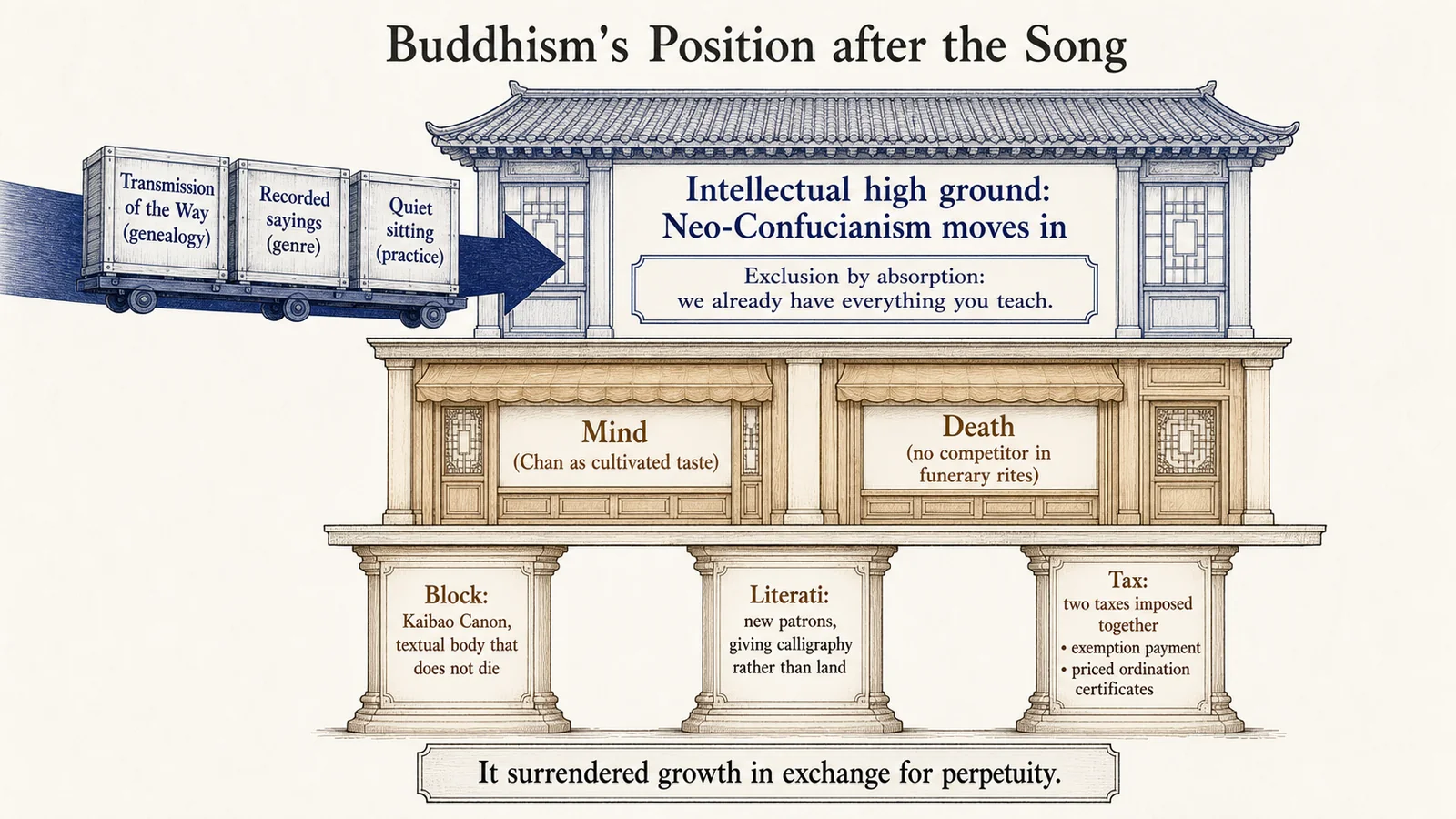
With the three things in place, Chinese Buddhism's position after Song can be stated in one sentence. Woodblocks restored paper, literati restored half the life of lecture seats, and fiscal linkage to the treasury insured peace; Neo-Confucianism took the intellectual high ground while leaving Buddhism the shops of mind and death. Tang had given Buddhism the empire's main hall, with chancellors supervising translation bureaus and national preceptors entering the palace. Song gave it one seat in the establishment. The seat was not high, but its legs were iron. For the next millennium, Chinese Buddhism had no opportunity to become the state religion and no risk of being exterminated. It surrendered growth in exchange for perpetuity. The next chapter asks how the two surviving schools merged while occupying this seat.
References
References
-
In the fourth Kaibao year, Emperor Taizu ordered Zhang Congxin to Yizhou to carve blocks for the Buddhist canon; the completed blocks were presented in the eighth Taiping Xingguo year. See fascicle 43 of the Chronicle of the Buddhas and Patriarchs. For the Kaibao Canon, see Li Fuhua and He Mei, A Study of Chinese Buddhist Canons (Beijing: Religious Culture Press, 2003). ↩
-
On the sequence of state and private canons under Northern and Southern Song (the Chongning Canon of Dongchan Dengjue Monastery, Pilu Canon of Kaiyuan Monastery, Sixi Canon, and Qisha Canon), see Li and He cited above; summarized here. ↩
-
For the Home-Mountain and Off-Mountain dispute and its texts, see the biographies in fascicle 8 of the Chronicle of the Buddhas and Patriarchs. The controversy concerned whether the contemplated mind was true or deluded and approaches to contemplation; see also the last section of Volume I, Part X, Chapter 5. ↩
-
On Daoyuan's presentation of the book and Emperor Zhenzong ordering Yang Yi and other scholars to edit and canonize it, see Yang Yi's preface to the Jingde Record of the Transmission of the Lamp (T51 no. 2076). ↩
-
The thirty-fascicle Recorded Sayings of Dahui Pujue (T47 no. 1998A) devotes fascicles 19–24 to teachings for literati and fascicles 25–30 to answers to their letters. For the scale of his contacts, see the chronological biography of Dahui Pujue. See also Miriam Levering's studies of Dahui and lay followers. ↩
-
Qu Rujiao completed the Record of Pointing at the Moon in the Wanli era. Yuan Hongdao's Combined Treatise on the Western Land was later included in Zhixu's Ten Essentials of Pure Land. For a general history, see Pan Guiming, A History of Lay Buddhism in China (Beijing: China Social Sciences Press, 2000). Part XIV examines Yang Wenhui and the Chinese Inner Studies Institute. ↩
-
For Shengchang's Pure Practice Society, Wang Dan as its head, and participation by more than one hundred court officials, see Shengchang's biography and the “Record of the Establishment of Pure Land Teaching” in fascicle 26 of the Chronicle of the Buddhas and Patriarchs. ↩
-
Blank ordination certificates were first sold in 1067 and became a regular revenue source for famine relief, military spending, and river works. The official price was around 120 strings under Xining and reached 1,500 strings in 1212, with fluctuations amid overissue. See Huang Minzhi, Collected Studies in the Social and Economic History of Buddhism under Song (Taipei: Student Book, 1989); summarized here. ↩
-
For wealthy buyers and prices (around five hundred strings under Shaoxing, rising to twelve hundred during the Kaixi wars and falling after peace), see the fiscal sections of the Collected Drafts of Important Documents of Song and Song memorials assembled by Huang Minzhi. For Su Shi's requests for certificates to fund the restoration of West Lake and the valuation of three hundred at more than fifty thousand strings, see Cheng Minsheng's collected price data. The main text paraphrases Song criticism of “powerful consolidating households”; its exact original source remains to be identified and is therefore not quoted. ↩
-
On the two taxes paid equally by monastic, Daoist, and ordinary fields under Song and the privilege of merit grave-monasteries, which powerful families exploited, see Huang Minzhi cited above. On the clerical exemption fee, also called the leisure fee, see You Biao, A Draft Economic History of Monasteries under Song (Baoding: Hebei University Press, 2003). For the Ming-Qing rule exempting imperially bestowed land and taxing other monastic fields like ordinary land, see the sections on land and clergy in the Collected Statutes of the Great Ming; summarized here. ↩
-
Ouyang Xiu's “Essay on Fundamentals,” in his collected works, says Buddhism had troubled China for more than a thousand years and should be overcome by restoring fundamentals and prevailing through ritual and righteousness rather than direct attack; summarized here. ↩
-
Chen Yinke, “On Han Yu,” first published in Historical Research in 1954 and collected in Preliminary Collection from the Jinming Studio: Han Yu's theory of succession “was superficially inspired by the closing words of Mencius but was actually formed through Chan's doctrine of a special transmission outside the teachings.” Chen also notes that Han Yu spent his youth with an exiled elder brother in Shaozhou, precisely when the new Chan movement arose and was intensely promoted there. ↩
-
Qisong's “Essay on Filial Piety,” fascicle 3 of his Collection of Tanjin (T52 no. 2115), expressly places filiality before the precepts. It was written amid anti-Buddhist argument under Emperor Renzong. ↩
-
Song-Ming Neo-Confucianism's appropriation and rejection of Buddhist metaphysics and disciplined practice is a standard scholarly conclusion. “Sit quietly for half the day and read for half the day” appears among teachings recorded in the Classified Conversations of Master Zhu. Qing Confucians' charge that Song Confucians were “outwardly Confucian and inwardly Buddhist” is itself a reverse reading of that appropriation. For overviews, see Qian Mu and Wing-tsit Chan on Neo-Confucianism and Buddhism. ↩
-
Cheng Yi's “Account of the Conduct of Master Mingdao,” in the collected works of the Cheng brothers, says Cheng Hao “ranged widely among the traditions, entered and left Laozi and Buddhism for decades, then returned to seek the six classics and obtained it.” For Zhu Xi asking Daoqian, an heir of Dahui Zonggao, about Chan at fifteen or sixteen; carrying only the Recorded Sayings of Dahui to the examination at eighteen; and later “temporarily setting Chan aside” after meeting Li Tong, see the Classified Conversations of Master Zhu and chronological biographies. See also Wu Chanliang, “Practice and Knowledge: An Analysis of Zhu Xi's Early Academic Orientation.” ↩