Chapter 4: The Formation of Pure Land—Buddhism for the People
Part IX, Chapter 3 counted the orders placed by an age of disorder: consolation, salvation of the dead, and a better next life. This chapter examines the order's final productization. Part IV, Chapter 2 issued its birth certificate in the chapter on easy practice in the Daśabhūmika-vibhāṣā. After rebuking the “weak and cowardly,” the text still supplied a method. China turned that page into a complete institution in three steps. Tanluan distinguished self-power and other-power, elevating an easy practice from expedient route to main gate; Volume II recorded the years of disorder in his life. Daochuo personally experienced Northern Zhou suppression and added a diagnosis of the age: in the current decline of the Dharma and world of five corruptions, “only the single gate of the Pure Land provides a road of entry.” The holy-path gate belonged to those of superior capacity; the Pure Land gate belonged to the age. Shandao completed the work. Ordinary beings could enter the reward land; recitation of the name was the rightly established practice; all nine grades consisted of ordinary beings. He dismantled the last elite threshold.1 The Pure Land “school's” patriarchal succession was a later retrospective construction whose sources Volume I criticized. China's two great inventions were twins in this respect: Chan and Pure Land both built genealogies after the fact.2
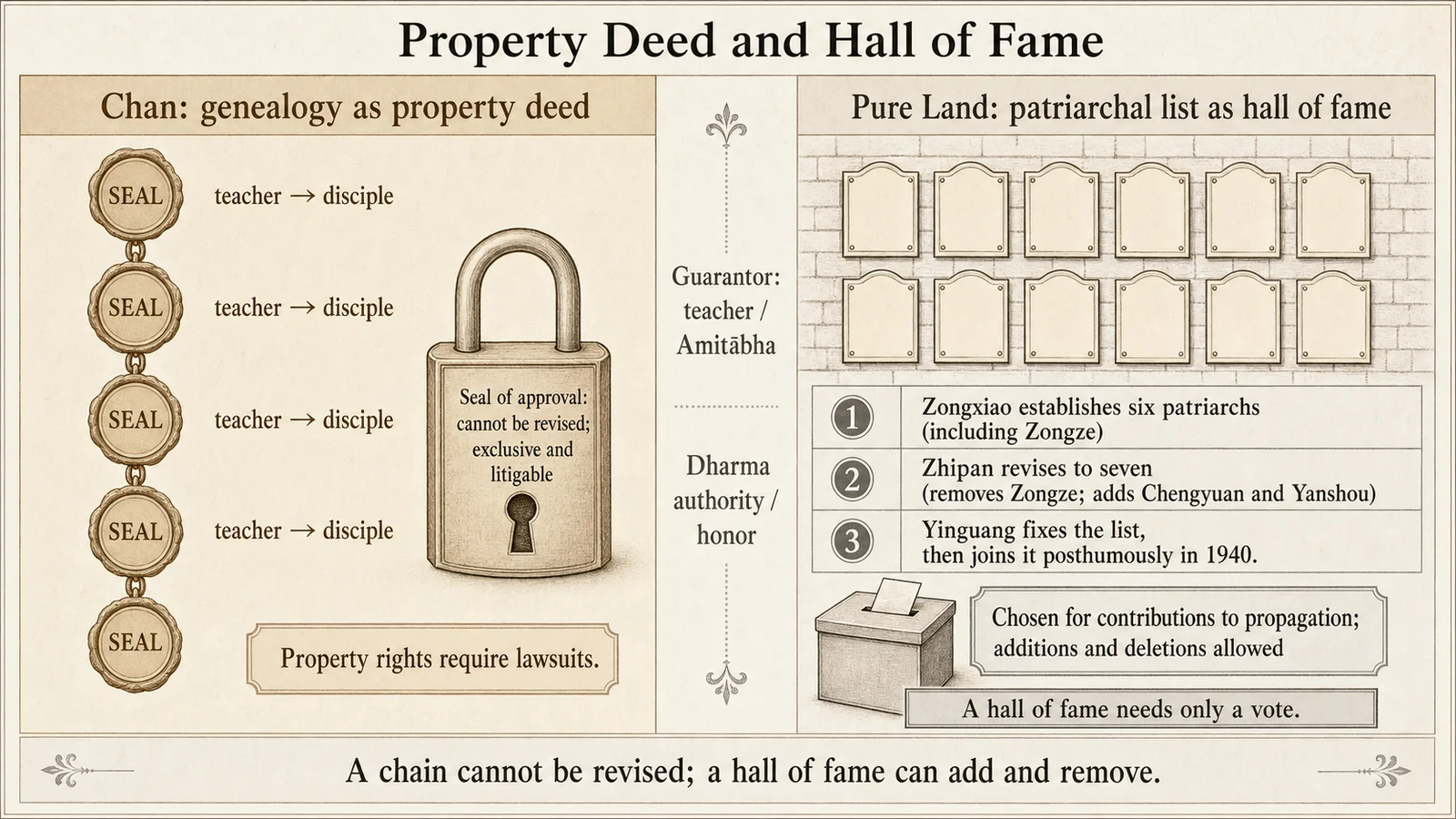
The editorial record of that genealogy is well preserved and worth opening, because it is a document of a different kind from Chan's. The claim of a succession began in Southern Song, and the first editors were Tiantai historians. Zongxiao's Classified Documents of the Land of Bliss established six Lotus Society patriarchs: Huiyuan, Shandao, Fazhao, Shaokang, Shengchang, and Zongze. Zhipan's Chronicle of the Buddhas and Patriarchs revised the list to seven, removing Zongze and adding Chengyuan and Yanshou. Ming and Qing lists successively added Zhuhong, Zhixu, and others. While Yinguang was alive, the list was revised again (Xingce was his addition), and after his death disciples publicly voted him the thirteenth patriarch. The list closed only within living memory.3 Place three facts side by side. The editors did not belong to the school; Tiantai historians compiled the Pure Land genealogy. The patriarchs did not transmit from master to disciple. Zhipan expressly selected them for their achievement in propagation; Huiyuan and Shandao lived two centuries apart and never met. The list remained editable: deletion, addition, and retrospective recognition all occurred. A chain cannot be edited backward; a hall of fame can. Why could a list without transmission win recognition? Because it carried no legal authority over Dharma. Pure Land's guarantor was Amitābha, not a master. There was no authorization to bestow and no empowerment to monopolize. Patriarchal status was an honor, not a license. Chan's genealogy was a title deed; Pure Land's was a hall of fame. Title deeds produce lawsuits; halls of fame require only votes. One piece of corroboration: Tanluan and Daochuo, the tradition's actual founders, are absent from the Chinese list, while Japanese Shin Buddhism includes them among its seven eminent monks. Two communities edited two lists from the same history; genealogy is an editor's doctrinal classification. A hall of fame also need not contain doctrinally consistent members. Huiyuan, first on the list, practiced visualization in the Pratyutpanna Samādhi, joined a collective vow, and retained a strong self-power coloring. Doctrinally he did not belong to the Shandao line defining the school. The first member's method differs from the founder's, yet the list stands—the best evidence that it is not a chain.
Place all thirteen figures back into their times and another table must be established; its purpose follows below.
| Patriarch | Life | Historical and personal ordeals experienced | Form of practice |
|---|---|---|---|
| Huiyuan | 334–416 | Northern disorder after Yongjia; fled war with Dao'an; teacher and disciples scattered when Xiangyang fell; Huan Xuan's purge of monks; Lu Xun's army passed Mount Lu | Pratyutpanna visualization, collective vow, strong self-power coloring |
| Shandao | 613–681 | Born in the year of late-Sui upheaval; experienced dynastic change, war, and famine in childhood | Name-recitation as rightly established practice; ordinary beings enter the reward land; thorough other-power |
| Chengyuan | 712–802 | An Lushan rebellion and refugees in Hunan; asceticism on Mount Heng: “if people gave him food, he ate; if not, he ate earth and mud” | Pratyutpanna asceticism and teaching exclusive recollection |
| Fazhao | Active ca. 766–820 | Regional wars after the An Lushan rebellion | Five-tempo Buddha recitation, gathering crowds through sound |
| Shaokang | ?–805 | Mid-Tang military regions | Marketplace recitation; used coins to induce children until the practice became customary |
| Yanshou | 904–976 | Born at the fall of Tang, lived in Wuyue during the Five Dynasties; as a treasury clerk diverted state money to release animals and received a pardon at execution | Return of myriad good acts to one goal; joint cultivation of Chan and Pure Land |
| Shengchang | 959–1020 | Peace of early Song, an exceptional row | Formed a Pure Practice Society modeled on Mount Lu |
| Zhuhong | 1535–1615 | Late-Ming political disorder and coastal raids; lost both parents early amid repeated family disaster | Gathered Chan into Pure Land; divided one mind into principle and phenomena |
| Zhixu | 1599–1655 | Personally experienced the Ming-Qing transition; chronically ill and left extensive records from sickness | Faith, vows, and holding the name within a Tiantai framework |
| Xingce | 1628–1682 | Born amid dynastic overturn, orphaned early | Institutionalized seven-day intensive Buddha-recitation retreats |
| Shixian | 1686–1734 | Peace of the Kangxi era, a second exception; orphaned young and practiced austerities | Formed societies, encouraged bodhicitta, and spoke urgently of Dharma decline |
| Jixing | 1741–1810 | Turn of the Qianlong and Jiaqing eras; late life overlapped the White Lotus rebellions in Sichuan, Hubei, and neighboring regions | Abandoned Chan for Pure Land |
| Yinguang | 1861–1940 | As a youth endured the Dingwu famine; lived through the Boxer crisis, 1911 Revolution, warlord conflicts, and the war against Japan; died in occupied Suzhou | Honest Buddha-recitation, moral causality and ordinary ethics, rejection of metaphysical display |
Read the table in two sentences. First, the judgment of a world of five corruptions had an experiential source. Most of the view of this land as defiled was read from corpses, famines, and execution grounds rather than copied from scriptures. Shandao's childhood was immersed in late-Sui disorder, Chengyuan ate earth and mud on Mount Heng, Yanshou stood at an execution ground, and Yinguang's youth unfolded amid the Dingwu famine in Shaanxi. Volume II judged the doctrinal function of the decline-of-the-Dharma narrative. This volume supplies its experiential base. The narrative was initially credible because it described the view outside the window. Second, record the honest qualification. Shengchang and Shixian lived in peaceful ages and spoke of decline no less urgently. Once the judgment entered the liturgy, peaceful ages recited it too. The weak form of Part IX, Chapter 3 and the ratchet of Part IV, Chapter 1 each placed a fingerprint on this table.4
The product itself deserves examination as design. Ten recitations of the name constituted the first Buddhist method of liberation to make “illiterate and without time” its design assumptions. Doctrinal learning required literacy, Chan required leisure and capacity, and calming-and-contemplation required full-time practice. A single name required no prior capital. The history of thresholds from Part IV, Chapter 2 reached its endpoint here. From the rhetoric that even gathering sand into a stupa has already established the path to buddhahood, to the operating procedure of ten recitations and rebirth, the final step on the millennium-long slope “from elite to mass” was laid in China. The decline of the Dharma supplied the design's legitimacy, while Volume II recorded the complete internal defense through two paths, two gates, and the age of decline. We did not lower the standard; the age lowered beings' capacities. The memory of suppression was the finest advertisement for Dharma decline. Daochuo wrote his classification in the ashes of Northern Zhou destruction, and persecution earned its credibility for him.5
The problem of verification reached its final form here. Volume II's judgment was “verification from which no one returns alive”: the promise of rebirth is redeemed after death and no one can return to challenge it. China supplied a corresponding genre: biographies of rebirth. Auspicious signs at death, unusual fragrance, celestial music, and transformed buddhas arriving to receive the dying were witnessed by those present and collected into biographies from Tang and Song through Ming and Qing. Place the genre in this volume's sequence: the Interlude's silence about attainment, signs of attainment assigned to the master in Part VII, authorization without third-party review in Chan, and Pure Land rebirth verified at death. The four privatizations of criteria now found their final type, and this one was most ingenious. Verification was not absent; it moved to a place no witness could follow, while people remaining behind supplied eyewitness records. Part XI returns to the genre's sense of immediacy and function when examining the institutionalization of death services.6
Under the rules, what follows is explicitly this volume's conjecture, presented in two readings. Pure Land's victory can be read as soteriology's surrender to demographic structure. Baseline self-power, verification in this life, and direct treatment of affliction were almost wholly ceded; Volume II's critique occupies an entire volume and this chapter retracts none of it. The same victory can also be read as Buddhism's first serious encounter with the fact of “most people.” For a thousand years, the tradition's principal product assumed a full-time practitioner as its default user; the majority appeared only as providers of support. Pure Land was the first path designed with the majority as users. This volume favors the second reading for reasons found in its own archives. All the evidence from the Interlude through Part VII shows that no one could inspect the redemption rate of the difficult path, while the concentration of claimants fell steadily. In a world where no one could prove where the narrow gate led, building a traversable road for the majority is better called honest product positioning than surrender. The two ledgers remain side by side. Volume II finished the soteriological ledger; this history of transformation records that Pure Land saved Chinese Buddhism's demographic base. Which ledger matters more remains the reader's own doctrinal classification.
The four chapters close and China's reconstruction is complete. Doctrinal classification supplied the frame, systems the building, Chan the mountains, and Pure Land the human sea. All four shared one foundation (the true-and-eternal) and one roof—all were the Buddha's speech. This four-beamed structure must now undergo a state-level stress test named Huichang. The next part examines the forms in which Chinese Buddhism survived.
References
References
-
For Tanluan's distinction between the two powers, see his Commentary on the Treatise on Rebirth. Daochuo's statement that “only the single gate of the Pure Land provides a road of entry” appears in the first fascicle of the Collection on the Land of Peace and Bliss (T47 no. 1958). For Shandao's teaching that ordinary beings enter the reward land and name-recitation is the rightly established practice, see his four-fascicle commentary on the Contemplation Sūtra. For the wartime and persecution backgrounds of all three, see Volume II, Part VI. ↩
-
For Pure Land's textual foundation, the White Lotus Society, the later construction of the patriarchal chronology, Daochuo's and Shandao's foundational roles, and Yanshou's convergence of Chan and Pure Land, see Volume I, Part X, Chapter 9. This chapter directly adopts that account. ↩
-
Zongxiao established six patriarchs in the Classified Documents of the Land of Bliss. Zhipan revised the list to seven and explicitly said that it represented achievement in propagation rather than master-disciple succession in fascicle 26, “Record of the Establishment of Pure Land Teaching,” of the Chronicle of the Buddhas and Patriarchs. For Yinguang's revision and posthumous inclusion, see modern collections of the sources establishing the thirteen patriarchs. Shinran's line of seven eminent monks in Japanese Shin Buddhism (Nāgārjuna, Vasubandhu, Tanluan, Daochuo, Shandao, Genshin, and Hōnen) comes through the tradition of the Hymn of True Faith in the Nembutsu. ↩
-
The patriarchs' lives appear across Huiyuan's biography in the Biographies of Eminent Monks, the Continued Biographies of Eminent Monks, the Song Biographies of Eminent Monks, the Chronicle of the Buddhas and Patriarchs, and Peng Xisu's Record of the Sages and Worthies of the Pure Land. Chengyuan's line that “if people gave him food, he ate; if not, he ate earth and mud” appears in Lü Wen's inscription for Master Chengyuan of Amitābha Monastery on Southern Peak. Yanshou's service as treasury clerk and pardon at execution appear in his biography in fascicle 28 of the Song Biographies of Eminent Monks. For Yinguang, see biographical material appended to his collected writings. Historical events follow standard dynastic histories. ↩
-
For the structure of the tradition's internal defense (two paths, two gates, and the decline of the Dharma) and the soteriological judgment (other-power's guarantee, verification from which no one returns alive, and attachment to salvation), see both halves of Volume II, Part VI. ↩
-
Biographies of rebirth continued from Tang and Song collections such as Jiezhu's Biographies of Rebirth in the Pure Land and Wang Rixiu's Longshu Pure Land Anthology. This volume reads them as a genre accompanying “verification moved to the moment of death.” Part XI examines the institutional setting. ↩