Chapter 3: The Formation of Chan—Rebellion against Scholasticism
By the middle Tang, the textual economy of Chinese Buddhism had overheated. The canon contained thousands of fascicles, doctrinal classifications bid for the apex, translation bureaus were run by the state, lecture seats filled the skyline, and commentaries themselves acquired commentaries upon commentaries. Then the An Lushan rebellion of 755 shattered the northern economic base of doctrinal learning. Lecture culture in the two capitals declined amid disorder. In southern forests under regional military regimes, another Buddhism grew. Its banner consisted of four short phrases: a special transmission outside the teachings, not established in words, directly pointing to the human mind, seeing one's nature and becoming a buddha. Volume I gave the full history of lineage legends, Huineng and the Southern school, encounter dialogues, and the five houses.1 This chapter reads them only as a history of transformation. This was the second overturned table in Buddhist history. The first occurred in India when Nāgārjuna refused the judgment seat of epistemology, as Part V, Chapter 1 showed. This time in China, Chan refused the judgment seat of text; sudden awakening kicked away every stair arranged by doctrinal classification. Both revolts ended alike: the table-turner became the house.
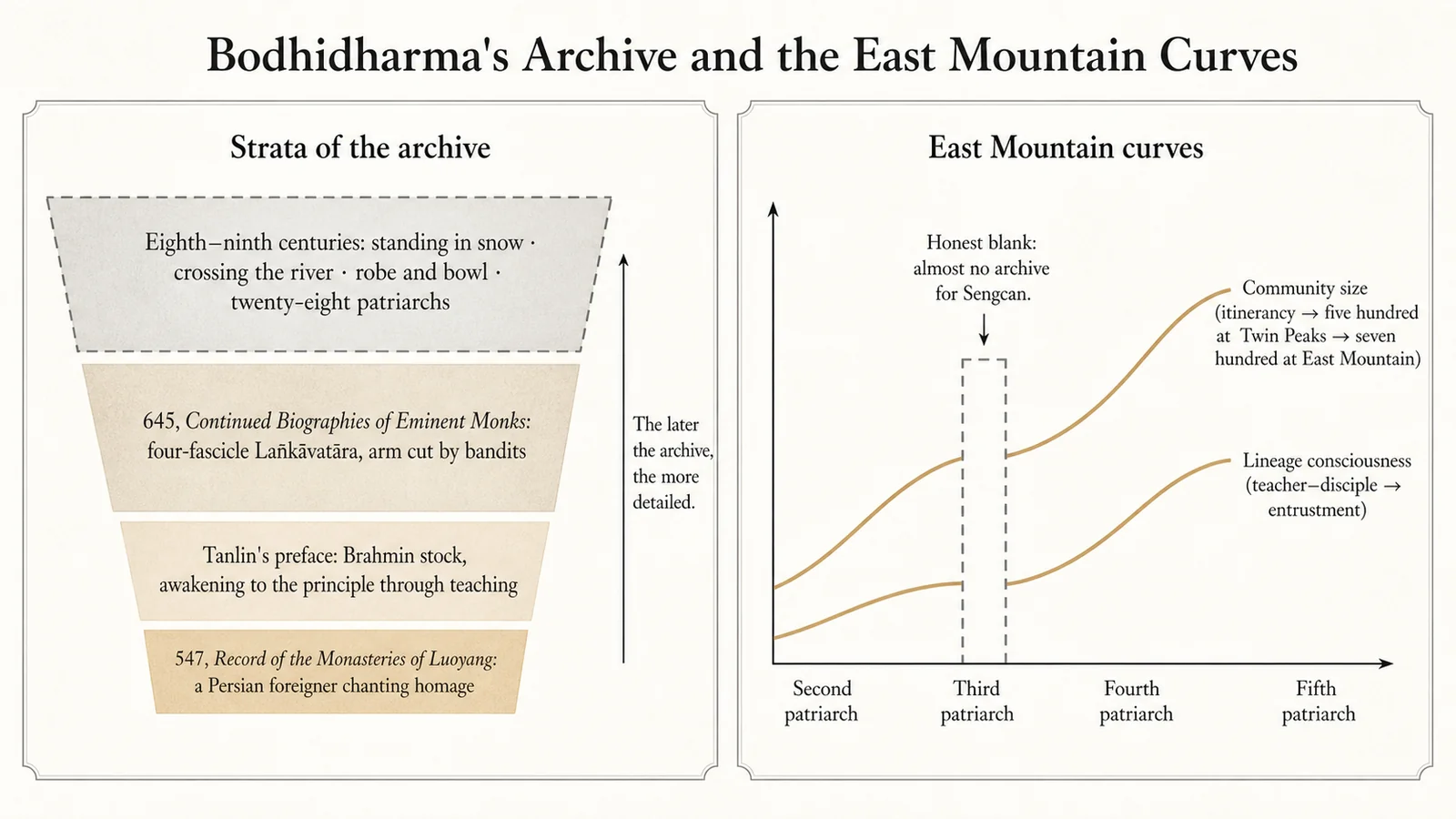
The chain's anchor deserves a separate inspection, because it is a textbook case of the judgment that “the later the archive, the more detailed it becomes.” Bodhidharma's archive has three layers. The earliest, the Record of Buddhist Monasteries in Luoyang of 547, describes beneath the Yongning Monastery pagoda a “barbarian from the Persian country” named Bodhidharma, who claimed to be 150 years old. Seeing golden plates glitter in the sun, he “chanted homage with joined palms for days.” There is no Chan teaching, no wall-gazing, and no emperor. The second layer is Tanlin's preface to the Treatise on the Two Entrances and Four Practices. Bodhidharma becomes “a Brahmin from southern India,” and teaches two entrances and four practices. The original text of entrance through principle says to “rely on the teaching to awaken to the principle.” The earliest Bodhidharma literature teaches reliance on scripture, the exact opposite of the later banner. The third layer is Daoxuan's Continued Biographies of Eminent Monks of 645. Bodhidharma reaches China by sea, transmits the four-fascicle Laṅkāvatāra to Huike, and teaches “wall contemplation” as the name of a meditation method rather than a stone cave. Daoxuan says that bandits cut off Huike's arm. The story of standing in snow to request the Dharma, the exchange with Emperor Wu of Liang, crossing the Yangtze on a reed, returning west with one sandal, and the jeweled genealogy of twenty-eight Indian patriarchs all come from the eighth- and ninth-century Record of the Dharma-Jewel through the Generations and Baolin Transmission, precisely the age when lineage warfare was fiercest. Biography grew thicker in step with the demand for patriarchal succession. What remains on the historical layer is a meditation master, active in northern China in the early sixth century, from southern India (or in one source Persia), who taught the two entrances and four practices and valued the Laṅkāvatāra.2
From the second through fifth patriarchs, four curves moved together. Scriptural basis: Huike inherited the Laṅkāvatāra and its self-realized wisdom of the tathāgatagarbha line. Daoxin's Essential Expedient Means for Entering the Way and Pacifying the Mind joined the Laṅkāvatāra to the one-practice samādhi of the Prajñāpāramitā Sūtra Spoken by Mañjuśrī; Laṅkāvatāra and Prajñāpāramitā converged from then on. Among Hongren's students, the Diamond Sūtra gradually replaced the Laṅkāvatāra. The foundation of the true-and-eternal combined with the grammar of Prajñāpāramitā, and Chan's doctrinal skeleton was complete. Form of life: Huike's line wandered as ascetics, dwelling as conditions allowed with a robe and bowl. Daoxin remained thirty years at Mount Shuangfeng with five hundred followers; meditators became a settled community for the first time. Hongren's East Mountain community contained seven hundred. “All four postures are places of practice and all three actions are Buddha-work.” Hongren himself mingled with labor and provisioning by day and sat in concentration until dawn by night—work by day, meditation by night. Method: from contemplating that body and Buddha do not differ, through one-practice samādhi of recollecting the Buddha and purifying the mind, to guarding the original true mind. Every step simplified; in the end there was one entrance and one sentence to transmit. Credentialing: a loose succession of Laṅkāvatāra masters gradually acquired an awareness of entrustment under East Mountain, while the consciousness of a chain grew with the community. In the middle lies an honest blank. Almost no archive survives for the third patriarch Sengcan, and the Inscription on Trust in Mind is a later attribution. The chain's darkest link lies exactly at its center, while a lineage narrative cannot tolerate a dark link. Later generations worked hardest to illuminate that one.3
How did the rebel become the house? Through a chain. Chan manufactured an authority structure not of higher doctrinal classification but of genealogy: twenty-eight patriarchs in India, six generations in China, robe and bowl transmitted from hand to hand, mind sealed by mind. The first half of the chain was retrospectively made; the two archival layers above show the craft. The retrospective act itself is the material for this volume. Shenhui went north to the Huatai assembly to contest succession on behalf of the Southern school and made transmission of the robe as proof into the central case. The decisive move lay not in doctrine but monopoly over genealogy.4 Return the operation to Part II's mechanism and it is instantly recognizable. A chain is the only asset that cannot be copied. Anyone can read a sutra and anyone can construct a doctrinal classification; only “this branch alone was transmitted from the Buddha and patriarchs” cannot be reproduced. China's gates of scripture and classification were both soft. Chan reinvented a hard lock. Its mirror with Part VII is exact. Esoteric Buddhism locked Dharma inside empowerment, Chan inside authorization. Each placed the criterion back at the master's belt. They are two scripts for the same privatization of credentials.
The seed of the economic base has already appeared. The Huangmei community worked its fields by day. Baizhang made this a rule: “a day without work is a day without food.” Combining agriculture and Chan formally changed the community from a patronage economy to a self-supporting one. The original code is lost and the received Baizhang Monastic Regulations was compiled under Yuan, but the institutional reality of agricultural Chan is secure.5 The meaning of self-support in the mountains appears only against doctrinal schools. Scholastic lineages lived in capitals; their property belonged to state monasteries, revenue came from imperial grants, and life depended entirely on government. Chan communities lived in forests, tilled and ate for themselves, and remained beyond the state's easy reach and seizure. At this moment the difference was only style. When Huichang arrived in the next part, it became life and death.
Under the rules, what follows is explicitly this volume's conjecture. “Not established in words” was a risk strategy for an age of disorder. Scriptures can be burned, translation bureaus dispersed, and lecture seats prohibited. A mind transmitted from master to disciple cannot be carried away or burned. Chan was a Buddhism optimized for catastrophe. Establish the plain half first. Chan's doctrinal core has a real genealogy: the convergence of true-and-eternal mind theory with the apophatic language of Prajñāpāramitā, detailed in Volume I. Survival instinct did not invent that doctrine. The conjecture concerns selection rather than invention. Disorder does not invent doctrine; disorder selects it. The ninety years from the An Lushan rebellion to Huichang were precisely the ninety years in which Chan grew from tributary to mainstream, and the Huichang fire immediately tested the design's superiority, the subject of Part XI. The design existed first; disaster announced the winner.
One demographic piece can be added to the conjecture following the precedent of the preceding chapter. Chan's members must be stratified. Its leadership was literate and often highly educated. Shenxiu was broadly learned, Shenhui could wage a lineage war, and early Chan masters produced abundant writing. Scholarship has long noted the irony that no school wrote more than the school “not established in words.”6 Recruitment at the base, however, moved downward with settlement and agricultural Chan. Five to seven hundred gathered in rural Huangmei, and monasteries organized around communal labor recruited from surrounding villages. Their literacy cannot have exceeded the rural baseline. The simplification curve of method thus fits the literacy curve of membership exactly: an increasingly nonliterate community received an increasingly literacy-free method. Whatever the historical proportion in the story that Huineng could not read, its function was to cast the absence of textual capital as a badge of honor. Pure Land substituted recitation for literacy; Chan substituted guarding the mind for commentaries. China's two great inventions made the same move at the same threshold. “Not established in words” brilliantly served both ends. Downward, it removed the literacy tax; upward, it removed the commentary tax and appealed equally to literati tired of scholastic annotation. Doctrinal learning was squeezed between them. Disaster-readiness was Chan's survival advantage and literacy its recruitment advantage; both favored the same design.
Record three costs. First, the criterion. Spontaneous exchange became the social form of awakening. Volume II already named it as the Chinese variant when diagnosing drift in criteria. Authorization admitted no third party and the master's authority no appeal. The judgment of Part VII, Chapter 3 applies equally in the Chan hall: nothing can be examined. Second, paradox. The school not established in words produced Chinese Buddhism's largest body of writing—transmission records, recorded sayings, and commentaries extending through thousands of fascicles. Those who demolished the staircase later opened a shop printing blueprints of staircases. Song “observing the critical phrase” Chan used a single phrase to treat inflation in encounter dialogues, prescribing another medicine for its own textual illness. Third, the internal cost of lineage warfare. Monopoly over succession was worth precisely the cost of fighting for it; the struggle between Northern and Southern schools was only the first battle.
Chan took the elites and the mountains. Yet most members of a two-million-person community lived neither in mountains nor among elites. Where was their exit? The next chapter turns to Pure Land.
References
References
-
For the accretion of Bodhidharma legends, Huineng and the Platform Sūtra, Shenhui and the Southern school's succession movement, the five houses and seven schools, encounter dialogues, and observing the critical phrase, see Volume I, Part X, Chapter 8. This chapter directly adopts its conclusions. ↩
-
See the Yongning Monastery section in fascicle 1 of the Record of Buddhist Monasteries in Luoyang. Tanlin's preface survives through the Record of the Masters and Disciples of the Laṅkāvatāra and Dunhuang manuscripts of the Treatise on the Two Entrances and Four Practices. See Bodhidharma's and Huike's biographies in fascicle 16 of Daoxuan's Continued Biographies of Eminent Monks. The exchange with Emperor Wu and later episodes appear from the Record of the Dharma-Jewel through the Generations and Baolin Transmission onward. For source criticism, see Volume I, Part X, Chapter 8. ↩
-
Daoxin's Essential Expedient Means for Entering the Way and Pacifying the Mind survives through Jingjue's Record of the Masters and Disciples of the Laṅkāvatāra and cites the one-practice samādhi of the Prajñāpāramitā Sūtra Spoken by Mañjuśrī. The statement that Hongren “mingled with labor and provisioning by day and sat in concentration until dawn by night” appears in Du Fei's Record of the Transmission of the Dharma-Jewel. The Treatise on the Essentials of Cultivating the Mind, teaching the guarding of the original true mind, is transmitted as a record of Hongren's school. For the later attribution of the Inscription on Trust in Mind and an overview of the East Mountain teaching, see Volume I, Part X, Chapter 8. ↩
-
For the Huatai assembly and the Southern school's succession movement, see Volume I, Part X, Chapter 8, and the research on Dunhuang records of Shenhui cited there. This volume treats the episode as institutional material on the contest for genealogy. ↩
-
“A day without work is a day without food” appears in the Baizhang Huaihai entry in fascicle 6 of the Jingde Record of the Transmission of the Lamp. The received Imperially Revised Baizhang Monastic Regulations was recompiled under Yuan and the original code is lost, but the reality of institutional agricultural Chan is accepted in scholarship. ↩
-
For Shenxiu's background and textual production by the Northern school, see Volume I, Part X, Chapter 8, and John McRae, The Northern School and the Formation of Early Ch'an Buddhism (Honolulu: University of Hawai'i Press, 1986). The abundance of early Chan literature is a standard conclusion in Chan scholarship. ↩