Chapter 2: Chinese Systems—Tiantai and Huayan
Doctrinal classification erected the frame; next came the building. Something without precedent in Indian Buddhist history now occurred: the unit of system-building changed. Indian doctrinal learning used the treatise as its unit. Nāgārjuna, Asaṅga, and Dharmakīrti founded traditions through treatises; sutras were repositories of authoritative citation, while treatises were the architecture of thought. China initially worked the same way during the age of translation: Abhidharma, Mahāyānasaṃgraha, and Satyasiddhi masters were all masters of treatises. Tiantai and Huayan removed that intermediate step. Zhiyi built directly on the Lotus, Fazang directly on the Avataṃsaka. Without the mediation of an Indian commentator, Chinese Buddhists became architects rather than annotators for the first time. Part IX, Chapter 2 said the unit of the translation bureau was the treatise; the unit of China's own creation was the sutra.
Volume I described the buildings' forms: Tiantai's perfect interfusion of the three truths, three thousand worlds in one thought, and inherent inclusion of both nature and evil; Huayan's four Dharma-realms, ten mysteries and six characteristics, and nature-origination of the Dharma-realm.1 This volume identifies only two structural facts. First, their common foundation was the true-and-eternal. Whether the first principle was one thought containing three thousand worlds or the one true Dharma-realm, both were upgraded versions of the product from Part VI. Volume II judged that tathāgatagarbha was a tributary in India but the common foundation of all East Asian Mahāyāna architecture—Tiantai, Huayan, Chan, and Pure Land. Several of the most load-bearing bricks were fired in local kilns: the Awakening of Faith, Śūraṅgama, and Perfect Awakening, varying in doubtful or apocryphal status but uniformly indigenous in character, whose files appeared in Part IX, Chapter 2. The inverted export pattern of Part VI was now topped out. Second, perfect interfusion was the metaphysical extension of doctrinal classification. Classification placed scriptures into a sequence; the perfect teaching placed all dharmas into the Dharma-realm. Classification called contradiction a stage; perfect interfusion called contradiction a level. The same surgical blade first cut the canon, then the world.
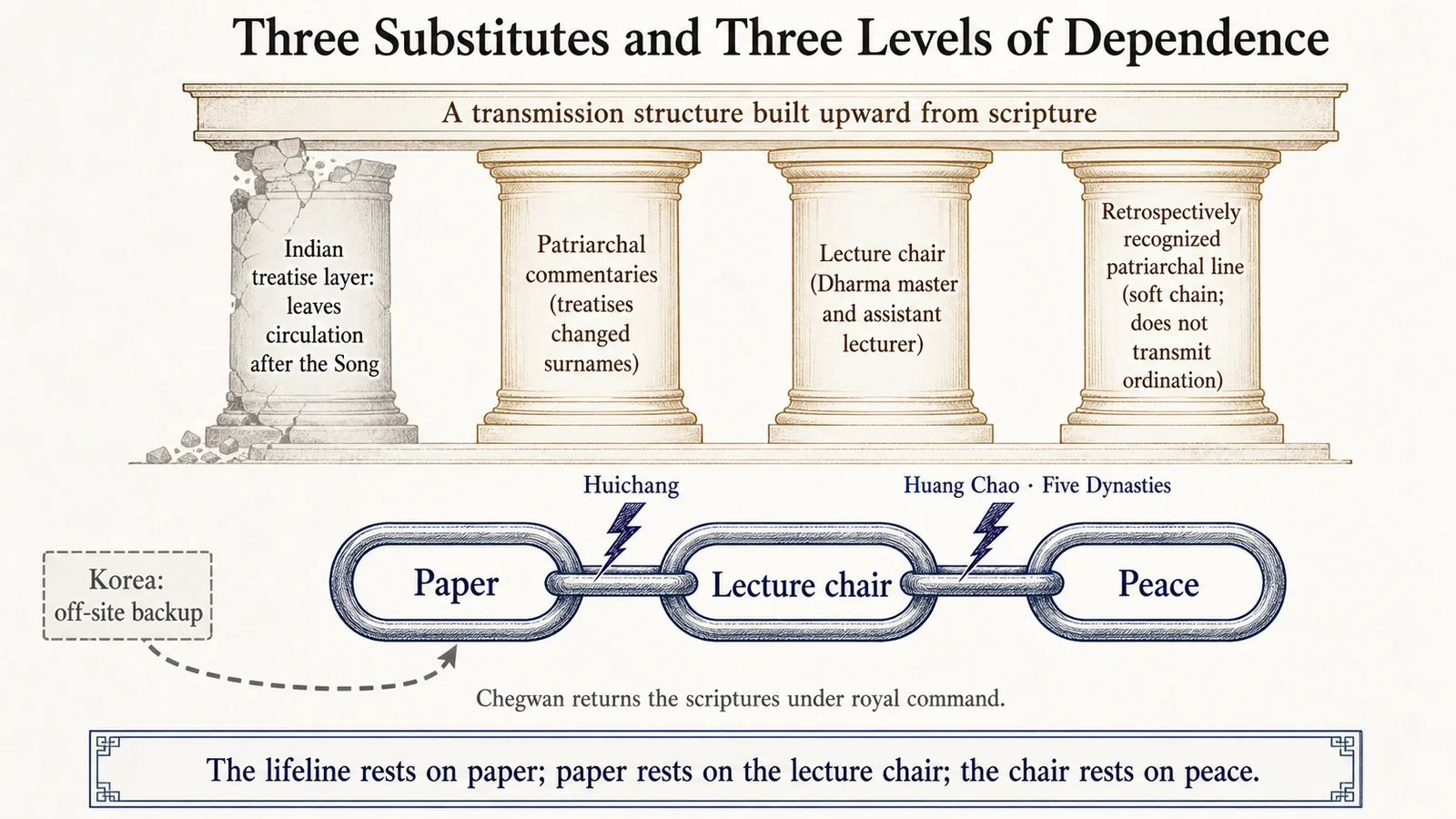
How could a building erected from a sutra be transmitted? The Indian unit of transmission was the treatise. China replaced that layer with three things. First, patriarchal commentaries functioned as an Abhidharma. The “treatises” Tiantai read for the next millennium were Zhiyi's three great works: Profound Meaning of the Lotus Sūtra, Words and Phrases of the Lotus Sūtra, and Great Calming and Contemplation. Huayan read Fazang's and Chengguan's commentaries and subcommentaries. Zhanran alone wrote an annotation on each of the three Tiantai works—the Annotations on the Profound Meaning, Commentary on the Words and Phrases, and Supplementary Decisions for Assisting the Transmission of Great Calming and Contemplation. Comment was added to comment and subcommentary grew beyond subcommentary. Indian commentators annotated the Buddha's scriptures; Chinese doctrinal learning annotated patriarchs. The function of “treatise” did not disappear; it changed surname. This is also the institutional premise of the Home-Mountain and Off-Mountain controversy: the dispute concerned not the scriptures but authority over patriarchal texts. Second, the lecture seat substituted for the academy. Its institution placed a Dharma master and chief discussant opposite one another, one reciting and the other interpreting. Audiences were clearly stratified. Monastic doctrinal students inside the monastery took the formal course; palace lecture halls and literati occupied the boxes; Huayan under Tang was especially a philosophy of the literati, with the layman Li Tongxuan's Avataṃsaka commentary as a marker. Ordinary people followed another road: popular preaching. Tang popular preachers turned scriptures into stories; audiences of famous figures such as Wensu “choked the monasteries,” and Dunhuang transformation texts preserve their lecture notes. But popular preaching explained narratives and similes, not doctrine. The two tracks of Part IX, Chapter 1 reappeared unchanged in the lecture system: doctrine moved through a commentary chain among a small circle; the public received narrated sermons.2 Third, retrospectively recognized patriarchal succession substituted for a chain. The Tiantai lineage of Huiwen and Huisi and Huayan's first patriarch Dushun were largely completed by later generations, by the same genealogy-making process used for Chan and Pure Land in the next two chapters. But this chain had no formal-act force. It transmitted neither ordination nor empowerment and depended only on the survival of lecture seats and patriarchal texts.
The common feature of the three substitutes was softness, and a stress test came quickly. Who read treatises? From beginning to end, very few people. The Abhidharma, Satyasiddhi, Dilun, and Shelun masters of the Six Dynasties formed small lineages around single treatises, later absorbed respectively into Huayan and Yogācāra—an early demonstration of doctrinal classification incorporating its losers. Under Tang, readers of Indian treatises concentrated in a few state monasteries of the two capitals. After Song, apart from residual courses in Abhidharmakośa and Yogācāra, the Indian treatise layer largely left circulation in China. The unit of doctrinal learning had fully changed into patriarchal commentary. The stress test arrived at the end of Tang. After Huichang suppression and the wars of the Five Dynasties, Tiantai's commentaries nearly vanished from China. At Yiji's request, the Wuyue king Qian Chu sent envoys to Goryeo; the Korean monk Ch'egwan brought the Tiantai scriptures and commentaries back to China, allowing a Song revival.3 Part VIII said that Indian scholastic learning was backed up off-site in Tibet before the buildings burned. After China's own buildings burned, Chinese doctrine likewise depended on a backup returning from abroad. Its doctrinal lifeline depended on paper, paper on metropolitan lecture seats, and lecture seats on peace. This three-level dependency explains why scholastic schools suffered the heaviest losses in the Huichang inventory of the next part. Chinese Buddhism's intellectual building had imported foundations in scripture, a domestically produced structure in commentaries, and always few residents.
Who paid? Again, emperors and literati. Zhiyi and the future Emperor Yang of Sui received one another as disciples: one received the bodhisattva precepts and the other the title “Wise One,” a perfect specimen of the political-religious honeymoon. Fazang taught Empress Wu using a golden lion before the palace as his simile; the Treatise on the Golden Lion turned the ten mysteries into an accelerated court course.4 Literati tastes were equally well matched. The aesthetics of interfusion corresponded structurally to the imagination of universal imperial order. Myriad dharmas each rested in their place and together made one realm. To the literati of a newly reunified empire, the picture was persuasive beyond metaphysics.
The preceding chapter advanced one of this volume's largest hypotheses: the organization of knowledge replicates the organization of society. The perfect teaching adds another piece of evidence without becoming a separate conjecture. India's intellectual virtue was demolition. The debate arena honored dismantling opponents, as Part V showed, because the subcontinent was a market in which multiple states competed. China's intellectual virtue was inclusion. The perfect teaching took pride in giving everything a place because the imperial market had one buyer and that buyer wanted order. Contending states produce debate; unity produces interfusion. Those eight words are the metaphysical reading of the preceding chapter's comparison. Keep the same boundary. Zhiyi's principal work was completed around the transition from Chen to Sui. The claim about temperament explains why the perfect teaching was selected and honored, not the source of its doctrine.
The plain half is that Tiantai was not pure speculation. The Great Calming and Contemplation is a complete engineering of meditation. Its design combining calm and insight maintained a balance between doctrine and practice unusual in Chinese Buddhist history, whose details Volume I recorded. Huayan leaned more toward pure architecture; its contemplative methods were later and thinner. The costs are recorded in this difference. First was the problem of criteria in perfect interfusion, judged in Volume II's integrated critique. When all dharmas are originally perfectly present, the need for practice requires extra explanation. If the map paints every place as the destination, the reason to travel becomes the problem. Second was the system's own weight. A precise structure such as three thousand worlds in one thought required generations of annotation to maintain. The Home-Mountain and Off-Mountain dispute under Song shows how interior renovation could consume a school's entire intellectual life. The arms race of doctrine assumed a new form in China. The question was no longer who could dismantle most, but who could contain most.
At this height, reaction was inevitable. Someone would ask: the building is so tall, but where is the door? In the next chapter, someone overturns the table.
References
References
-
For Tiantai's three truths, three thousand worlds in one thought, inherent inclusion, and the Great Calming and Contemplation, see Volume I, Part X, Chapter 5. For Huayan's four Dharma-realms, ten mysteries, and nature-origination, see Chapter 6 of the same part. For the Home-Mountain and Off-Mountain dispute, see the final section of Chapter 5. ↩
-
For the institution of Dharma master and chief discussant, see monastic histories of lecture ritual and Dunhuang manuscripts of preaching ceremonies. On Li Tongxuan's lay commentary on the Avataṃsaka, see Volume I, Part X, Chapter 6. For popular preaching and transformation texts, including accounts that Wensu's audiences “choked the monasteries,” see Zhao Lin's Yin hua lu, Duan Chengshi's Miscellaneous Morsels from Youyang, and the Dunhuang manuscripts; for scholarship, see Xiang Da, “A Study of Popular Preaching under Tang,” in Tang Chang'an and Western Regions Civilization (Beijing: Sanlian, 1957). ↩
-
For Yiji's request for texts, Qian Chu's mission to Goryeo, and Ch'egwan bringing Tiantai scriptures and commentaries to China, see their biographies in the Chronicle of the Buddhas and Patriarchs. Tiantai's early-Song revival depended on this mission. ↩
-
For Zhiyi administering precepts to Prince Yang Guang of Jin and receiving his title, see Guanding's Separate Biography of the Great Master Zhizhe of Sui, cited in Volume I, Part X, Chapter 5. For Fazang teaching Empress Wu through the Treatise on the Golden Lion, see his biography in fascicle 5 of the Song Biographies of Eminent Monks. ↩