Chapter 3: Freezing on an Island—The Formation of Theravāda
In the middle of the third century BCE, Mahinda led a mission to Sri Lanka and established the Mahāvihāra at Anurādhapura. For the first time, Buddhism left the subcontinent as a complete institution. The island supplied a combination of conditions the mainland had never known: one kingdom and dynasty, one patron whose favor or decline was immediately visible; limited scale, with too few monastics and laypeople to sustain a hundred contending schools; and distance from the mainland, which delayed and could intercept new movements crossing the sea. The combination meant that island Buddhism faced a different question. The mainland asked, "How do we win in competition?" The island asked, "How do we preserve intact what we have already received?"
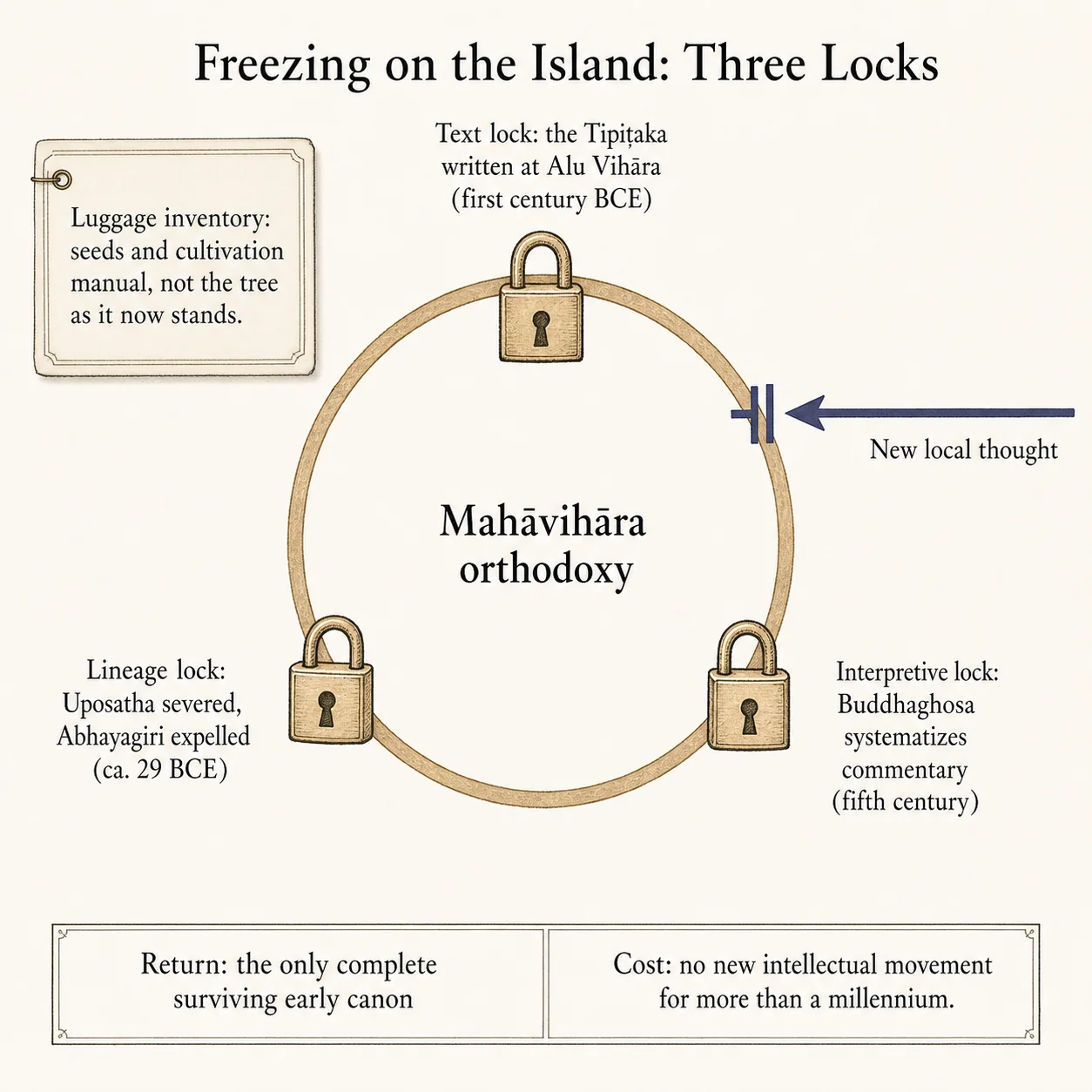
Begin by inventorying the baggage. What exactly did Mahinda bring? Tradition answers: everything—the three baskets authorized by the Third Council, together with their commentaries. Buddhaghosa later claimed that he only translated the old Sinhala commentaries brought by Mahinda back into Pāli. Critical analysis must distinguish layers. What can safely be said is that he brought the core oral collection of a Vibhajyavāda lineage: the main body of the Vinaya; the main body of the four Nikāyas, the layer cross-checkable against the Chinese Āgamas by the comparative method of Volume I; the mātikā tradition and early Abhidhamma texts; and older strata of the Khuddaka collection. The "Pāli Tipiṭaka as it exists now" was the result of two or three further centuries of addition and formation on the island. By the tradition's own account, the Kathāvatthu was new in Aśoka's time, meaning the canon itself contains one officially recognized late work. The Parivāra is widely judged an island supplement. Reciters of the Dīgha and Majjhima collections had still not agreed in the commentarial age on which books belonged to the Khuddaka. Even Pāli itself was a stabilized ecclesiastical language, not the dialect spoken by Mahinda. In one sentence: Mahinda brought seed and cultivation manual, not the tree that stands today.1
The island's answer was freezing, completed through three operations with distinct dates. First, seal the text. After famine and war in the first century BCE, the Tipiṭaka was written at Aluvihāra. The interlude noted the event as a vote of no confidence; here record its other face. Writing fixes and freezes. One particular oral recension became the master copy. Later additions and deletions could enter only as commentary. What palm leaves sealed was the baggage above after centuries of island formation. Who possessed authority to interpret it immediately became the next battleground, as Volume I, Part IX, recorded.2 Second, seal the lineage. Abhayagiri was founded around 29 BCE when the king granted a monastery to a monk expelled by the Mahāvihāra. The Mahāvihāra categorically refused to hold the observance with it. Under the Vinaya, a break in common observance declares that the other party does not belong to the same Saṅgha. Part II described the procedural definition of schism; the Mahāvihāra used it as a tool. No doctrinal argument was needed; recognition of formal acts could simply be cut. Third, seal interpretation. In the fifth century, Buddhaghosa compiled a commentarial system under the rule that it not depart from the Mahāvihāra's old commentaries. The commentarial layer too was fixed in writing. The three operations converged into three locks on island orthodoxy: text, lineage, and interpretation.
This volume will not retell the nearly thousand-year rivalry between the two monasteries. Volume I, Part IX, Chapter 1 already addressed the partisan character of Mahāvihāra chronicles, Faxian's observation that Abhayagiri was larger, and the two institutions as distinct strategies. Restated under this volume's question: the dispute was whether to weld the gate shut. Abhayagiri remained open to importing new sūtras and teachings from the mainland, including Vaipulya scriptures. The Mahāvihāra rejected them and twice used royal power to burn books and expel monks. These episodes come from chronicles of the Mahāvihāra line (a victor's proud self-record), and are credible in direction. In the twelfth century, Parākramabāhu I used royal command to combine three communities into one, absorbing Abhayagiri's thousand-year lineage under the Mahāvihāra charter.3 The final victory of freezing came through another royal order. The island form of the Dharma-protecting king model redeemed the last installment of the previous chapter's contract.
Following the rules, the next claim is explicitly this volume's conjecture. The Mahāvihāra's conservatism was not inertia but a chosen identity strategy. The community's greatest and almost only asset was orthodoxy. Away from the mainland, it could not produce the original authority of new movements. What it guarded was the name "the original Buddha-Dharma" and the two things that carried that name: a written Tipiṭaka and an unbroken ordination lineage. For such an asset, variation was self-destruction. Accept one new sūtra and the brand of originality loses a corner; share one observance and the lineage loses a measure of exclusivity. Welding the gate was not fear of the new but protection of property. Two facts corroborate the conjecture. First, during centuries in which kingship favored Abhayagiri, the Mahāvihāra preferred lost influence to compromise. Short-term interest cannot explain it; it guarded a long-term asset. Second, its self-description consistently placed unmixed transmission above victory in doctrine.
Part II left one sentence: councils guarded not so much rules as rolls. The island's freezing institutionalized it. At the level of articles, the schools' Vinayas were already largely identical, as Part II, Chapter 3 showed, and the Mahāvihāra had no unique Vinaya invention. Its exclusive asset was the lineage—an ordination genealogy extending from Mahinda to the Buddha without borrowing a single link. That lineage later became the foundation of orthodoxy across the Theravāda world. Whenever Myanmar or Thailand reorganized its Saṅgha, rulers repeatedly imported an ordination line from Sri Lanka or an island-derived lineage. There is a remarkable coda: the island's own bhikkhu line was later broken and imported back from Siam in the eighteenth century. Part XIV returns to this and the case of the bhikkhunī lineage. Lineage logic has a price. It authenticates status, not attainment. Once the vote recorded in the interlude (learning is the foundation) joined lineage logic, the island's orthodox triad was complete: text, commentary, and ordination line. Every item was checkable; none concerned realization. A community whose highest mission was preservation removed everything unverifiable from the definition of orthodoxy.
Record one item on each side of the account. Return: the Pāli canon is the only complete early Buddhist collection surviving in the world. The texts used as a baseline in the first two volumes are products of this freezing machine. Its critics, including this book, are beneficiaries. That sentence must stand in the main text. Cost: once the outlet for innovation was welded shut, the island produced no new intellectual movement for more than a millennium. Vitality became preservation, and preservation sometimes hardened into an allergy to "mixture." Freezing is a civilizational tradeoff, neither virtue nor defect. What it secured and what it abandoned are both visible.
The mainland moved in the opposite direction. During the very centuries in which the island sealed its collection, manuscript culture on the continent opened the sūtra gate as widely as possible. The next part follows what poured through it.
A theoretical cross-section belongs in a closing note. Scholasticization gave Buddhism its first system: lists of dharmas, streams of moments, conversations rewritten as entries and entries assembled into an edifice. All three questions that no one recognized in the last part's note became visible as holes in the system. How could no-self coexist with memory and responsibility? The Pudgalavādins answered with a person and were attacked from all sides; the question stayed. Through what did karmic results travel? The schools supplied different accounts of continuity, and the eve of seed theory had arrived. What was the Buddha? Sthavira and Mahāsāṃghika each held one half, as the human teacher and supramundane saint began to part. The cost of systematization was already visible: sayings tolerate ambiguity, systems do not. The day everything must be stated completely is the day every hole becomes exposed.
References
References
-
Buddhaghosa's claim to translate old Sinhala commentaries appears in the prefaces to his works; see Volume I, Part IX, Chapter 2. The southern tradition itself dates the Kathāvatthu to Aśoka's time in Mahāvaṃsa chapter 5, cited in Part II above. For the late Parivāra and disagreement over the Khuddaka list, see K. R. Norman, Pāli Literature (Wiesbaden: Harrassowitz, 1983). For the comparative method of the four Nikāyas and Chinese Āgamas, see Volume I, Part II, Chapter 2. ↩
-
For the transmission to Sri Lanka; textual criticism of the Mahāvihāra-Abhayagiri dispute, including the chronicles' partisanship and outside testimony from Faxian and Yijing; the writing at Aluvihāra; Buddhaghosa; and the commentarial tradition, see Volume I, Part IX, Chapters 1 and 2. This chapter directly adopts those conclusions. ↩
-
For Parākramabāhu I's twelfth-century unification and reform of the Saṅgha, see Cūḷavaṃsa chapter 78, with chapter 73, and W. Geiger's English translation, Part II; see also Volume I, Part IX. For collected katikāvata monastic law documents, see Nandasena Ratanapala, The Katikāvatas: Laws of the Buddhist Order of Ceylon (Munich, 1971). ↩