Chapter 2: The First Encounter with Kingship—The Aśokan Model
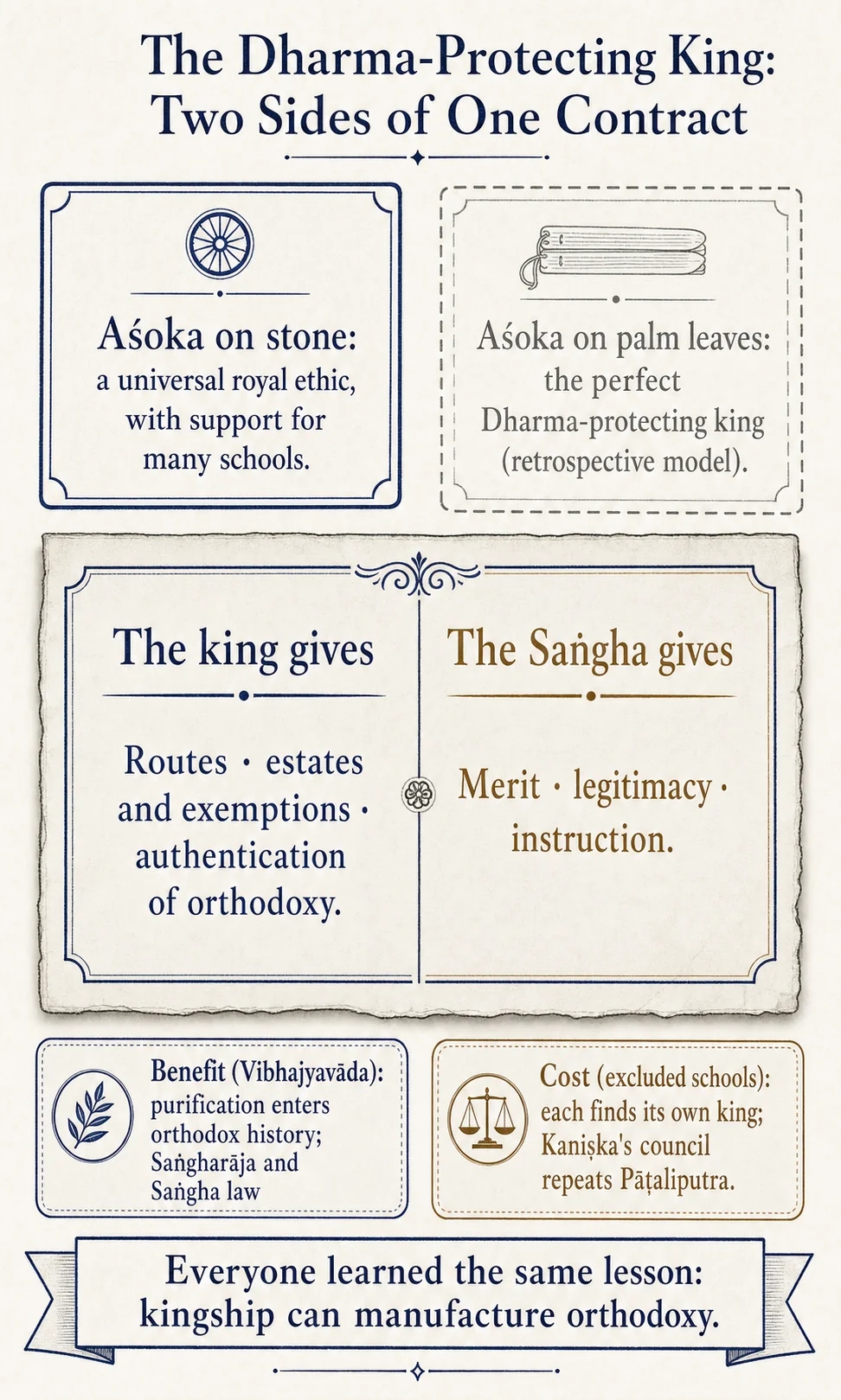
In the middle of the third century BCE, Buddhism encountered its first empire. It had dealt with kings for a century (Bimbisāra's Bamboo Grove, Ajātasattu's provisions, the Kosambī patrons' withdrawal of support), but these were relations between one city and one community. Aśoka supplied something of another order: the routes, tax system, and legitimacy of an entire subcontinent. The structure established in that encounter was filed in the introduction as the Dharma-protecting king model: the king supplies land, tax exemption, and certification of orthodoxy; the Saṅgha supplies merit, legitimacy, and moral instruction. This chapter examines the contract's first signing. Its details foreshadow the next two thousand years.
Following this volume's method of reading archives, begin by separating two Aśokas: the one on stone and the one on palm leaves. Aśoka on stone is the ruler of the inscriptions: remorse after the war in Kaliṅga, then rock edicts throughout the realm urging Dharma. Yet his "Dharma" in the inscriptions consists mostly of universal royal virtues (respect for parents, honesty, limited killing, toleration of religious communities), and contains almost no specifically Buddhist doctrine. Nor was Buddhism his only beneficiary. Aśoka on palm leaves is the figure of the Aśokāvadāna and Mahāvaṃsa: the model protector who turns from evil to good, builds eighty-four thousand stūpas, supports a hundred thousand monks, presides over a council, and establishes the true Dharma alone. The distance between the two archives is itself the first item of evidence in this chapter.1
Aśoka on stone did take several actions specifically concerning Buddhism, and each lay at the institutional level. The schism edicts at Sarnath, Sanchi, and Kosambi ordered anyone who divided the Saṅgha to wear white and live outside: royal law backed a definition of who counted as the lawful community for the first time. The Bhabru Edict recommended seven teachings for monks, nuns, laymen, and laywomen to study repeatedly: the royal hand selected doctrinal texts for the first time. The Lumbini pillar records his personal visit to the Buddha's birthplace and reduction of the village tax: pilgrimage and fiscal policy met for the first time. Each looks like a favor in isolation. Together they are something new—the state began to hold opinions about Buddhism's internal affairs.
What the Saṅgha received is easy to itemize. Routes: imperial roads and messengers gave missionizing interregional scale for the first time. Mahinda entered Sri Lanka with the diplomatic standing of a prince, and the missions traveled imperial roads. Property: royal monasteries, caves, stūpas, and estates. Most valuable of all, certification of orthodoxy: royal power stood behind doctrinal judgment at Pāṭaliputta, and royal orders executed the purge described in Part II, Chapter 2. What did the king receive? What a new empire lacked most—a language of legitimacy that crossed regions. Brahmanical legitimacy was bound to caste and sacrifice, local and exclusive. Buddhist Dharma disregarded birth and could travel with the roads, fitting a regime that had just absorbed South Asia. Neither side deceived the other. It was a large transaction freely entered by both.
The contract's most distant route deserves separate treatment: missions abroad. Why would a monarch pay to send a religious community beyond his borders? The two archives each supply half an answer. The stone answer is conquest by Dharma. Major Rock Edict XIII says that after Kaliṅga the highest conquest was no longer by arms but by Dharma, naming five Hellenistic kings to whom missions had been sent—Antiochus, Ptolemy, Antigonus, Magas, and Alexander. A related edict says medicine for humans and animals was established abroad. Note two things. "Dharma" still means his general morality rather than a Buddhist monopoly, and the messengers used an existing diplomatic network. His grandfather had exchanged envoys with Seleucus, and bilingual Greek-Aramaic edicts stood at Kandahar. Conquest by Dharma was an alternative to military conquest, the prestige diplomacy of a remorseful empire; Dharma envoys extended royal envoys.2 The palm-leaf answer changes the initiator to the Saṅgha: Moggaliputta Tissa dispatched nine missions, while the king supplied status and logistics. This half also makes sense. Mission was already written into the Saṅgha's charter. Soon after the first turning of the wheel, sixty disciples were sent with the instruction that no two travel the same road. The Saṅgha was by nature a missionary organization. Aśoka added not motive but logistics.3
Details from Sri Lanka reveal a third layer. Before Mahinda crossed the sea, Devānampiya Tissa accepted a complete coronation ritual sent by Aśoka and underwent a second consecration. Even his royal title, "Beloved of the Gods," Devānampiya, was shared with Aśoka. First establish relations of suzerainty, then send the gift of the Dharma. In that sequence, Buddhism formed part of the investiture package, the seal of superior authority. Under the rules, this layer is marked as this volume's conjecture. Every comparable case in which transmission preceded alliance, or succeeded without alliance, reduces its weight. Another observation requires no conjecture: among the nine missions, the ones that survived transplanted an ordination lineage. Sri Lanka received the complete package—a lineage of monks, later a lineage of nuns brought by Saṅghamittā, and a sacred object in the branch of the Bodhi tree. Missions sent west toward Hellenistic kingdoms brought "Dharma" but planted no Saṅgha. Not one church remained, and Greek sources do not even name the envoys. The survival rate of transmission depends not on what was preached but on whether a lineage was planted.4
Did local religions resist in lands receiving Buddhism? Yes, but the form depended on the opponent's level of organization. Sri Lanka then had no institutional rival. Yakṣa and nāga cults had neither texts nor priestly corporation, and Brahmanism was weak on the island. Once the court turned, the island followed. Resistance survived in the chronicles only as mythic debris: the Buddha flew to the island three times to expel yakṣas; missionary elders subdued dragon kings. Stories of defeating demons and dragons preserve resistance after its digestion. The old gods were not destroyed but entered on the roll of Dharma protectors. Buddhism used this absorption protocol for two thousand years: Sri Lankan yakṣas, Myanmar nats, Tibetan Bon deities, and Japanese local gods, as Parts IX, XII, and XIII will show. It is the mirror image of incorporating the Buddha as a Viṣṇu avatāra. The introduction's "displacement through absorption" was practiced by Buddhism against minor gods as well. Hard resistance awaited opponents with priestly classes and textual traditions—Bon and old aristocracies in Tibet, literati and classics in China. Those are subjects of later parts. Here, only the first data point in the rule is established: open ground is easy to sow; ground full of temples is difficult.
State the plain half fully. Without this transaction, Buddhism would probably have remained a respected local movement of the Gangetic basin. The imperial amplifier was the first force that enabled it to become a religion of Asia. The cost grew from the same source. First, a precedent was established for transferring authority over authentication; the line from Part II acquired institutional form. Second, the community's fate became tied to dynastic fortunes. After the Mauryan collapse, internal Buddhist literature immediately preserved memories of persecution—the story of Puṣyamitra destroying stūpas. Whatever its historical accuracy, the fear was real.5 Brahmanical archives record something else about the same king: he performed the horse sacrifice twice. Two archives, one king. He need not have hated anyone; he moved the order for legitimacy from renunciants back to priests. Third, and deepest, the Saṅgha learned to narrate itself to kings. From then on, half the language of merit addressed the court.
Following the rules, the next claim is explicitly this volume's conjecture. The perfect Dharma-protecting king of Buddhist literature was a model carefully maintained by the Saṅgha. To write Aśoka as evil then good, a wheel-turning king who gained merit through Dharma, was to hand every later monarch a reproducible contract: act according to this template and receive these results. Corroboration: the narrative emphases of the Aśokāvadāna tradition (stūpa gifts, support for monks, repentance, and final instructions) are a checklist of exactly what the Saṅgha needed kings to do. The more complex ruler of the inscriptions became monochrome in internal memory. If the Buddhist Aśoka narrative took shape before the Saṅgha needed new dynasties, or if its contents clearly failed to align with monastic interests, this conjecture would fail.
One further consequence at Pāṭaliputta must be recorded separately for victors and defeated. The Vibhajyavāda lineage won: it defined orthodoxy at the council, its people led the missions, and Mahinda came from it. The southern chronicles naturally wrote the victory as a victory of the true Dharma. Having tasted the benefit, the tradition incorporated "royal purification of the Saṅgha" into its story of orthodoxy. Later royal purges in Sri Lanka and Southeast Asia are never intervention in internal texts; they are protection of the Dharma. The office of Saṅgha-rāja and Saṅgha laws institutionalize that benefit. The defeated learned the other half of the lesson: without a king, one becomes the object of the purge. Each therefore sought a king. Sarvāstivāda established itself in the northwest and waited for the Kuṣāṇas. The council and Mahāvibhāṣā under Kaniṣka structurally repeated Pāṭaliputta for Sarvāstivāda—a different king and a different orthodoxy, the same performance.6 The deepest influence of Pāṭaliputta lies here. It did not create one orthodoxy; it taught everyone that kingship could manufacture orthodoxy. Thereafter every school in India needed a king. A multicentered subcontinent could support many kings and therefore many orthodoxies. A single-power island moved toward freezing, in the next chapter; a many-kings mainland moved toward bidding competition. One contract, two geographies, two outcomes. A deeper proposal should also be noted. Sasaki Shizuka and related scholarship conjecture that, to preserve communal harmony in Aśoka's time, schism was redefined as procedural separation and doctrinal difference ceased by itself to constitute schism. If correct, Pāṭaliputta's legal legacy reserved legitimate space under the roof of the schools for Mahāyāna to grow centuries later. This is treated as one hypothesis. The procedural definition of schism used in Part IV, Chapter 1 may derive from it.
The model and its double edge were forged together. Part VIII follows this contract to its conclusion in India; Parts XI and XII examine its Chinese and Tibetan forms. Here we record only the original. The next chapter turns first to the contract's most distant shipment: one island received an entire Buddhism and used it to accomplish something the mainland never did—freezing.
References
References
-
For the schism edicts at Sarnath, Sanchi, and Kosambi, see Part II, Chapter 3. The identification of the seven teachings recommended in the Bhabru, or Bairāṭ, Edict remains disputed; also relevant is the tax reduction in the Lumbini pillar inscription. For standard publication and English translations, see E. Hultzsch, Inscriptions of Asoka, Corpus Inscriptionum Indicarum I (Oxford, 1925); for an overview, see Étienne Lamotte, History of Indian Buddhism, trans. Sara Webb-Boin (Louvain: Peeters, 1988), chapter on Aśoka. ↩
-
For Major Rock Edict XIII, conquest by Dharma and the five kings, and Rock Edict II on medicine abroad, see Hultzsch, cited above. For the bilingual Greek-Aramaic edict from Kandahar, see its publication in Journal Asiatique 246 (1958). ↩
-
The nine missions appear in Mahāvaṃsa chapter 12 and the Samantapāsādikā. Reliquary inscriptions from Sanchi Stūpa 2 and Sonari record names of teachers associated with the Himalayan mission and provide the strongest corroboration for the account. See A. Cunningham, The Bhilsa Topes (London, 1854), and Michael Willis, "Buddhist Saints in Ancient Vedisa," JRAS 11.2 (2001). For the instruction that no two disciples travel one road, see the passages following the first turning of the wheel in the Pāli Vinaya, Mahāvagga. ↩
-
Devānampiya Tissa's reception of Aśoka's coronation ritual, second consecration, and shared title "Beloved of the Gods" appear in Mahāvaṃsa chapter 11. For Saṅghamittā and the Bodhi branch, see the relevant chapters of the Mahāvaṃsa and Volume I, Part IX, Chapter 1. The silence of Hellenistic sources concerning Dharma envoys is generally recognized in scholarship. ↩
-
Stories of Puṣyamitra, Puṣpamitra in some Chinese transcriptions, destroying the Dharma occur in the final fascicle of the Chinese Aśokāvadāna and the Questions of Śāriputra; their historicity has long been disputed. This volume takes them as an archive of fear, not historical fact. His two horse sacrifices appear in Dhanadeva's Ayodhya inscription and the contemporary line in Patañjali's Mahābhāṣya, iha puṣyamitraṃ yājayāmaḥ, "we are sacrificing for Puṣyamitra here." ↩
-
For Vibhajyavāda, the Pāṭaliputta council, and Mahinda's mission, see the Mahāvaṃsa and Samantapāsādikā, cited above and in Part II. Southern texts call the expelled monks outsiders. For modern sectarian readings, see Lamotte, History of Indian Buddhism (1988); Erich Frauwallner, The Earliest Vinaya and the Beginnings of Buddhist Literature (Rome: IsMEO, 1956); and André Bareau, Les sectes bouddhiques du Petit Véhicule (Saigon: EFEO, 1955). For Kaniṣka's council and the Mahāvibhāṣā, see Volume I, Part III. For Sasaki Shizuka's proposal on the redefinition of schism, see Indo bukkyō hen'i ron: naze bukkyō wa tayōka shita no ka (Tokyo: Daizō Shuppan, 2000) and the English article series "Buddhist Sects in the Aśoka Period," beginning in Bukkyō Kenkyū 18 (1989). ↩