Chapter 2: The Politics of the Councils—Whose Memory Counts?
During the rainy season of the year in which the Buddha died, Mahākassapa summoned five hundred monks outside Rājagaha to recite the Dharma and Vinaya together. History calls this the First Council. The Vinayas of the different schools agree on its occasion with remarkable consistency—and remarkable embarrassment. On the road to the funeral, a monk ordained late in life, Subhadda in the Pāli Vinaya, heard of the Buddha's death and consoled his grieving companions: why cry? While that elder lived, he always told us this must be done and that must not be done, constraining us terribly. Now he is gone. We may do what we want and leave undone what we do not—at last we are free. Mahākassapa was alarmed. Only seven days after the Buddha's death, someone already spoke this way; what would remain of the Dharma and Vinaya after a hundred years? The decision to convene the council arose from that fear.1 The record is explicit: the direct motive of the First Council was not remembrance but fear—fear of losing control. The origin matters. Meetings born of fear are naturally better at tightening than preserving difference.
Later generations imagine a solemn recitation: Ānanda recites the discourses, Upāli recites the Vinaya, and five hundred arahants approve. The recitation did occur. But several things had to happen before it began, and they are this chapter's subject. Before preserving memory, the council had to decide whose memory counted. The Vinayas preserved the entire power structure required for that decision. Consider four details.
First, Ānanda's qualification for admission. The membership was fixed at five hundred arahants; on the night before the meeting, Ānanda remained one step short and had not attained arahantship. He had attended the Buddha for twenty-five years, was foremost in learning, and was about to recite the entire discourse collection from his own memory. The meeting's first act toward him was not welcome but exclusion. The Vinayas say he strove through the night and attained as he was neither lying down nor standing, entering at dawn. The auspicious ending cannot conceal the structure: admission depended not on memory but attainment. Qualification came before recollection. This was the authentication meeting's first unwritten rule: who was qualified to testify took precedence over who remembered what.
Second, the enumeration of offenses that immediately followed. Once admitted, Ānanda was publicly accused by Mahākassapa of failings—not asking the Buddha to remain for the full lifespan and securing ordination for women among them. The Vinayas count between five and seven. Ānanda defended himself point by point, each defense a variation on "I do not see this as an offense." He nevertheless acknowledged each one because he revered and trusted the community. Together, the two statements place him in the position of a witness awaiting judgment. The memory on which the council most depended belonged to a man first placed in the dock; every word he recited was spoken under the judges' gaze. The Vinayas do not conceal this and record it in detail. Their compilers probably regarded it as a model of lawful communal self-government. That is precisely the revealing point: to the compilers, it was self-evident that one should try the witness before receiving the testimony.
Third, the minor rules. Ānanda conveyed the Buddha's final permission: if the Saṅgha wished, after my death it may abandon the minor rules. The assembly asked which were minor. Ānanda answered that he had not asked. Amid divergent opinions, Mahākassapa ruled: establish no rule the Buddha did not establish; abandon none that he established. The stated reason was dignified: outsiders would criticize the Sakyan renunciants for practicing while their teacher lived and discarding the rules when he died. Yet the substance of the ruling must be stated directly: in the name of preserving the Buddha's discipline, it voided the Buddha's last directive. This was the first case of "overruling the Buddha in the Buddha's name," a syntax that would recur for two thousand years. The dead man was thereafter silenced by his own archive. Any appeal to "the Buddha's intention" could cite only a text authenticated by the meeting, while the authority to compile the text belonged to the meeting. Volume II encountered an extreme form of this structure: those without access to the archive made a new archive. The Tibetan treasure tradition will reappear in Part XII.
Fourth, the shortest detail carries the greatest weight. After the meeting closed, the elder Purāṇa arrived from the southern hills with his following. Told that the Dharma and Vinaya had been collected and invited to rejoice in and preserve them, he answered politely and fully: the elders have recited well; nevertheless, I will preserve what I personally heard from the Buddha just as I heard it.2 The first parallel recension was filed on the spot. Most remarkable is the source: this does not survive in dissident literature but in the Vinaya compiled by the victors themselves, the most candid line in the entire council narrative. Note also that Purāṇa declared his disagreement without punishment and founded no separate school. Authentication then possessed moral authority but no power of compulsion. Dissent was neither punished nor controlled. Through this gap the schism in the next chapter would pass.
Under this volume's rules, the plain explanation comes first, and here it carries enormous weight: there was no alternative to a council. In an oral culture, unorganized memory disappears. The Vedas survived for more than a thousand years through hereditary specialization in Brahman families. Buddhism rejected heredity and had only the conference left. Collective recitation requires a fixed text; a fixed text requires adjudication between differences; adjudication requires a presiding authority, distinctions of qualification, and rules of deliberation. The later division of discourse collections among reciter lineages continued the same organization. In one sentence, politics was the cost of preservation. Memory needs form to survive, and form always has gatekeepers. To identify gatekeepers is not to accuse preservation of conspiracy.
Where the plain explanation stops, this volume's conjecture begins and is marked as such. The plain account explains why a meeting was needed; it does not explain why all three of its rulings leaned in one direction. Mahākassapa led the ascetic wing and was a major force for discipline in the late Saṅgha. Ānanda was the Buddha's attendant and represented the socially accommodating wing: he had secured women's ordination, conveyed the permission to abandon minor rules, and was accused of failings all related to leniency. The former presided, while qualification review, public accusation, and voiding the permission to abandon rules all tightened discipline. This volume conjectures that the First Council was also a decision between programs: the disciplinary wing used the authentication of memory to set the community's later character. Corroboration: at least two of the three judgments exceeded the technical needs of preservation. Repentance had nothing to do with accuracy of recitation, and voiding the final permission was active legislation rather than conservative preservation. If symmetrical judgments favoring the accommodating wing were found in the same meeting, this conjecture would lose weight.
The institutional consequence forms a clear line across three councils. At the first, in Rājagaha, King Ajātasattu supplied provisions, but the meeting remained the community's own funeral and act of rescue. At the second, in Vesālī a century after the Buddha, the dispute over Ten Points was still tried by the Saṅgha itself, with four adjudicating elders from east and west deliberating point by point. It was the last complete performance of procedural self-government, examined in the next chapter. At the third, in Pāṭaliputta under Aśoka, authentication had become a royal project of orthodoxy. The elder Moggaliputta Tissa presided, "analytical doctrine" was established as correct, the Kathāvatthu refuted rival views, and the Saṅgha underwent a great purge, with those expelled numbered by southern histories in the tens of thousands—the number is reported as found, and its character is evident.3 From self-rescue to self-judgment to royal project: authority over authentication took shape step by step and changed hands step by step. It was the first power to crystallize in Buddhist history, and every power attracts competitors. The first external line, kingship and patronage, enters here.
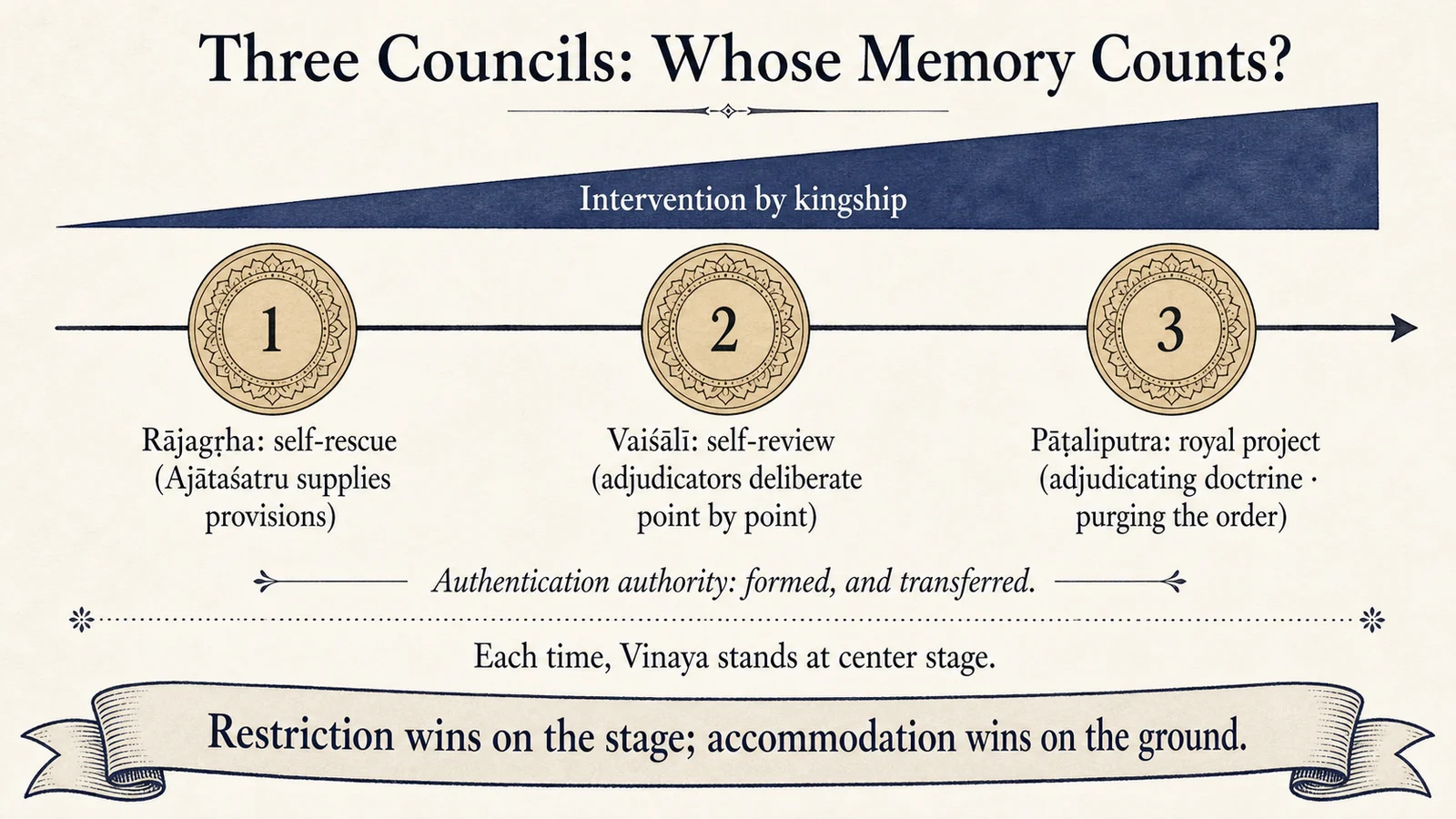
Read the same councils again with a different question and another line appears: each time, the Vinaya occupies the center of the stage. In the Pāli Vinaya's account of the First Council, Upāli recites the discipline before Ānanda recites the discourses. Southern commentaries state the reason plainly: "The Vinaya is the lifespan of the teaching; while the Vinaya endures, the teaching endures."4 The Second Council was convened entirely for the Ten Points—a Vinaya dispute from beginning to end, with not one point of doctrine at issue. In the southern account, the Third Council also began with a crisis of discipline: infiltrators had made a common observance impossible in Pāṭaliputta for seven years. The doctrinal judgment of the Kathāvatthu was an accompanying project; the conclusion was the expulsion of monks and restoration of the observance. The southern tradition remembered this line clearly and took pride in it. Most of its account of its own orthodoxy is staked on continuity of the Vinaya. The conjecture above called the First Council a decision by the disciplinary wing; the southern tradition's own memory magnifies that conjecture across all three councils. The chapter's question can thus be enlarged: why did the tightening side, the disciplinary lineage, repeatedly prevail in council history? Two layers of answer can be inferred securely. First, the form of a council is itself the Vinaya specialist's home ground. Before a meeting begins, it must decide qualification, agenda, and voting, all jurisdictions of the Vinaya. The masters of procedure are the holders of procedural knowledge, and in a meeting conducted by procedure, they are difficult to defeat. Second, the Vinaya genuinely is the load-bearing structure of institutional survival. If one discourse is lost, the teaching loses a corner; if the Vinaya collapses, ordination and formal acts immediately fail and the Saṅgha dissolves. Vinaya always appears in crisis as firefighters always appear at a fire: not because its desire for power is greatest, but because its jurisdiction concerns survival. Even these two layers do not answer everything. The remainder must be recorded candidly: council history is the victors' archive, and its custodians were the transmitters of Vinaya. The record of repeated Vinaya victories was entered by the Vinaya's own clerks. Reduced to one sentence: councils guarded not so much articles as rolls; rules were disputed on stage, while the lineage list was staked underneath. Part III returns to lists and lineages. As for the lenient side, the next chapter shows where it went: it lost every conference but won step by step in the community's everyday life. Tightening won on stage; accommodation won on the ground. Council history photographed only the stage.
A conference can authenticate memory; it cannot eliminate divergent memory. Purāṇa's statement, "I will preserve what I heard," lay quietly in the Vinaya for a century. The next chapter goes to Vesālī and the root schism.
References
References
-
For the First Council, see the council sections of the various Vinayas: Pāli Vinaya, Cullavagga XI; the Dharmaguptaka section on the assembly of five hundred; and the Mahīśāsaka section on the assembly of five hundred. The different Vinayas share the occasion (a monk ordained late in life rejoicing at the Buddha's death), Ānanda's qualification and attainment, his public accusation, with lists varying from five to seven items, his formula "I do not see this as an offense, but I acknowledge it out of respect and trust for the community," the discussion of minor rules, and the judgment "do not establish what was not established; do not abandon what was established," though details vary. ↩
-
For Purāṇa, see the final passage of the Pāli Vinaya, Cullavagga XI. The corresponding account in the Mahīśāsaka Vinaya is fuller and records his divergent recollection concerning several food rules, including storing and cooking food. ↩
-
The council of seven hundred appears in the corresponding sections of the various Vinayas and is cited separately in the next chapter. The Pāṭaliputta council does not appear in the complete Vinayas; it is recorded in the southern Dīpavaṃsa, Mahāvaṃsa, and Samantapāsādikā. Royal direction, the Kathāvatthu's refutations, and the purge all belong to the southern historical narrative; Part III evaluates its character as a victor's account. ↩
-
For the sequence, see the Pāli Vinaya, Cullavagga XI: Upāli is first asked to answer point by point on the discipline, then Ānanda on the discourses. "The Vinaya is the lifespan of the teaching; while the Vinaya endures, the teaching endures" appears in the opening council narrative of the Samantapāsādikā, corresponding to the Pāli phrase vinayo nāma sāsanassa āyu. For the Second Council as a Vinaya dispute over the Ten Points, see the council-of-seven-hundred sections. For the southern account of the Third Council beginning with seven years in which the Pāṭaliputta community could not hold a joint observance and ending with expulsion and restoration, with the Kathāvatthu linked to the same event, see Mahāvaṃsa chapter 5 and the Samantapāsādikā. ↩