Chapter 3: From Teacher to Savior—The Elevation of the Buddha
The end of Part II recorded a synchronized shift. As the arahant descended from the altar, the Buddha ascended. At first this was only a thesis in sectarian treatises: the Buddha's body was undefiled and lifespan immeasurable. By the age in which Mahāyāna sūtras emerged in batches, the thesis had become a world-picture. The Buddha was no longer a human teacher who had entered final nirvāṇa but a threefold existence: Dharma-body always present, reward-body magnificent, and transformation-bodies appearing as circumstances required. Present buddhas occupied all ten directions—Akṣobhya in Abhirati in the east, Amitābha in Sukhāvatī in the west. The human Śākyamuni became one manifestation among immeasurable buddhas in this world. Volume I described the doctrinal construction of buddha-body theory.1 This chapter asks what pushed it.
First, identify the problem it solved. The Buddha's death left more than vacuums of authority and authentication. It left a simpler thing: longing with nowhere to go. During the Buddha's life, seeing him was a blessing. After his death, only four places of pilgrimage and relics in stūpas remained. "The Buddha has entered final nirvāṇa" was doctrinally a door closed forever. Nirvāṇa without remainder no longer answers, receives prayers, or grants requests. In a religion founded on the fact that "an awakened one once lived in this world," its founder became permanently absent by its own doctrine. The schools filled the structural vacancy with two things: relics and Buddha-biography. Mahāyāna chose another solution and rewrote absence itself.
The rewriting came in three steps, each stepping on a precedent from the schools. First, multiply buddhas. Jātaka literature had spread out innumerable former lives; Dīpaṅkara stood before and Maitreya waited after. Once the Buddha became a temporal sequence, present buddhas in ten directions merely transformed succession in time into simultaneity in space. Second, make the Buddha permanent. The Mahāsāṃghika thesis that the Buddha's body and lifespan were immeasurable, treated in Part II, Chapter 3, became explicit in the Lotus: the Tathāgata's lifespan is immeasurable and nirvāṇa only a skillful display. The Buddha did not die; he withdrew backstage. Third, make the Buddha accessible. The Pratyutpanna samādhi supplied a technical solution: see a present Buddha in concentration and question him. Pure Land sūtras supplied a geographical solution: the Buddha lives in another land, reachable by holding his name.2 Once the three steps were complete, "the Buddha is absent" became "the Buddha never left; you must change your mode of attendance."
Elevation required one accompanying operation that receives little notice: demoting the person. Volume I already passed the judgment. Within the three-body framework, the historical Gautama was classified as a transformation-body, "demoting the man who awakened beneath the Bodhi tree and entered final nirvāṇa at Kuśinagara into a temporary body of adaptive manifestation"; "the demotion of Gautama as a historical person and the elevation of the 'primordial Buddha' are two sides of one act."3 The operation was structurally necessary. The Buddha's most powerful original identity was as one who realized the same Dharma as his disciples. In the early formula of recollection, the first title after "Blessed One" is arahant—itipi so bhagavā arahaṃ sammāsambuddho. Teacher and disciples share one name of attainment, the hardest proof of self-power: the road walked by the teacher can be walked by students. Once the Buddha must be elevated into a savior outside the system, the equation becomes an obstacle. If he is only the greatest arahant, arahants rise with him and the distance between savior and saved cannot open. Without breaking the equation, elevation fails. The operation is clearest in Chinese translation. When the ten epithets entered Chinese, arahant was rendered in the Buddha's list as "Worthy of Offerings." The meaning was correct, but the effect surgical. The Chinese world thereafter had two terms: "arhat" for the disciple's attainment and "Worthy of Offerings" for the Buddha's title. Their identity disappeared in the target language. A Chinese Buddhist can read the entire canon without meeting the sentence "the Buddha is an arhat"; in Chinese it sounds almost offensive. One translation completed a reclassification.
Theravāda still holds the old equation in defense of arahants: the Buddha himself carries the title arahant; to demean arahants is to demean the Buddha. Within a Theravāda setting, this is a ballast stone. Its actual hit rate against Mahāyāna criticism is approximately zero, for four reasons, each deeper than the last. First, the attack does not occur at the level of propositions. Mahāyāna never argues "arahants have not attained arahantship"; it rotates the axis of classification. Liberation no longer marks the finish; buddhahood does. The shared old title answers an old question, and the old question has been removed. A citation hits the topic but not the act of changing topics. Second, the anchor has already been taken. The equation's force depends on "Buddha" referring to the person who realized one Dharma with his disciples. The other side's "Buddha" is no longer that person. Once the man is demoted to a display, the entity tied to the equation's other end has been replaced. The defender holds one end of a rope whose far end is empty. Third, the other side possesses a machine for metabolizing citations. Hierarchies of teaching and "skillful means" digest every contrary text in place: your discourses were spoken by the Buddha for your capacities at that time. The Lotus even writes the scene into its script in advance; disciples themselves confess that the nirvāṇa they received was a phantom city, as the last chapter noted. Fire a citation at a machine designed to digest citations, and ammunition becomes feed. Fourth, there is no court. The parties share no tribunal. The equation has enormous weight in a Theravāda setting and none across the water. Hit rate is determined not by logic but by "who recognizes this court." This is not failed reasoning but the normal condition of a system without final appeal—the institutional premise established in Part II, Chapter 1, now appearing in sectarian controversy. The real function of such apologetic arguments should be recorded candidly. They are ballast addressed to wavering insiders, not artillery fired across the divide. Most apologetics serves this use. The illusion of effect comes from mistaking internal consolidation for an external hit.
None of the three steps occurred in a vacuum. Along the line of competing religions, India was becoming devotional. The Bhagavad Gītā supplied a divine template ("I will deliver those who remember me"), while the bhakti tides of Viṣṇu and Śiva religion rose. A religion with only relics and philosophy and no living divine person had an incomplete shelf in this market. Along the lines of kingship and trade, the Kuṣāṇa cosmopolitan court was accustomed to honoring multiple gods, while Silk Road merchants needed protectors they could carry and call upon during travel. Image-making began almost simultaneously in Gandhāra and Mathurā, giving the Buddha a visible body for the first time. Money and image completed each other; merit literature around producing images operated through the same mechanism as that around copying sūtras.4 Along the line of social composition, lay believers grew in weight. What they needed was not an argument for no-self but a reliable object of appeal.
The line of competition deserves closer analysis because the rival template is specific. Kṛṣṇa in the Bhagavad Gītā begins as a teacher on a battlefield and is fully divinized into the cosmic Lord: "I will deliver those who remember me." The rival had already demonstrated how a teacher becomes a savior. Another neighbor supplied the negative comparison. Jainism too built images and temples for its founders, with no lack of formal divinization, yet held one doctrinal line absolutely: the Jina has been liberated at the summit of the cosmos, receives no prayer, gives no answer or grace; worshiping him cultivates one's own mind and is not a transaction. Part II, Chapter 1 showed the price of maintaining the line: Jainism became a small, prosperous, endogamous community. Buddhism therefore faced a choice. Maintain "the Buddha is gone, never returns, and does not answer"—doctrinally most honest, commercially on Jainism's path. To reach a mass market, supply a god who answers. Later history is the answer to the choice.
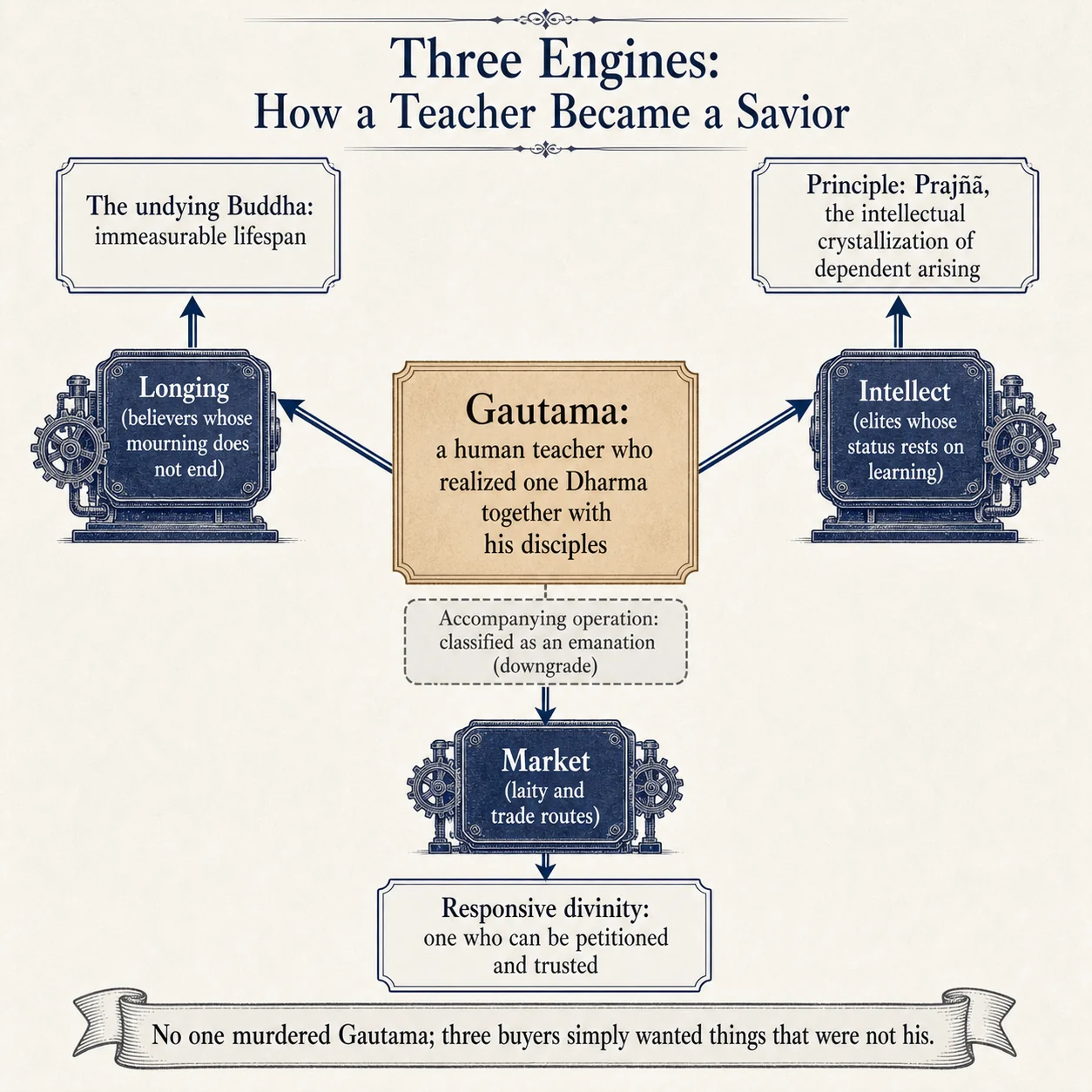
Following the rules, what follows is explicitly this volume's conjecture, and this time the conjecture must be plural. One motive cannot explain the hinge because elevation included the matching demotion. Mourners look up at the dead; they do not belittle them. The desire to see the Buddha alone cannot produce the judgment "Gautama was only an adaptive manifestation." Several engines must therefore be separated.
The first engine is longing, installed on the believers' side. The Buddha's final nirvāṇa was psychologically a mourning without end, and mourning invents doctrine. Corroboration: the earliest technique of seeing a Buddha explicitly gives longing as its motive—wanting to see the Buddha and being unable. Its practice systematizes memory into visualization. The emotional structure of Pure Land scripture is refuge and reunion, not argument. The "Lifespan of the Tathāgata" chapter is more precise: it first makes the audience experience grief at the Buddha's impending extinction, then reveals an immeasurable lifespan. It treats the loss it creates. This engine has a clear limit: it can produce an undying Buddha; it cannot produce a demoted Gautama.
The second engine is intellectual, installed on the elite side. Demotion is chiefly its product. The author of this book can offer a candid personal example as corroboration. After reading the Nikāyas to a certain depth, I too once suddenly thought that the essence of the Dharma lay entirely in dependent arising and everything else seemed peripheral. Volume II argued otherwise: the essence lies in suffering and its cessation, with dependent arising serving them. If intelligent people two thousand years ago often experienced the same flash, the selection of prajñā is easy to understand. Emptiness is the intellectual crystallization of dependent arising, that flash fixed as a system. For scholar-monks, the product's specifications were immaculate. Against outsiders, it was a universal solvent in debate, a meta-level winning move capable of dismantling any proposition—the weapon of the arms race in Part V. To patrons, it was subtle enough to lecture on and display. Most important, it carried no attainment threshold. One could explain it fluently without practice, more safely than claiming a fruit and more respectably than reporting meditation. For intelligent people, it was the ideal product. And this population did not necessarily revere the old man. Contempt did not begin with Nāgārjuna. The final-nirvāṇa narrative preserves Subhadda saying "now he is gone, at last we are free" immediately after the Buddha's death. The Buddha's final communal business was to impose the "brahmā punishment" of silent exclusion on the arrogant Channa.5 In the hands of this population, "depend on the Dharma, not the person" became a license: if seeing the Dharma is seeing the Buddha, the person need not be seen. The day principle rose was the day the person fell. If Madhyamaka literature were found to make Gautama's personality and life a substantive center of practice rather than merely a source of cited authority, this link would lose weight.
The third engine is market, analyzed above. Living gods stood on the rival shelf. To insist "gone and unresponsive" was to surrender the mass market. Jainism kept doctrinal honesty and kept its small scale. The three engines converged and pressed human Gautama from three directions: mourners replaced him with an undying Buddha; philosophers replaced him with principle; the market replaced him with a god who answers. No one murdered Gautama. Three buyers simply wanted three things that were not him.
The plain half: recollection of the Buddha was old practice, first among six recollections and shared across schools. Visualization and recitation extended it technically; they did not arise from nothing. The Dharma-body also has a serious philosophical beginning. What makes a Buddha a Buddha is the Dharma realized, not the physical body; early texts already say whoever sees the Dharma sees the Buddha. A real doctrinal line therefore runs through elevation; it is not all market. The complete picture requires both lines.
Where was the cost recorded? Once the Buddha changed from teacher to savior, the structure of liberation reserved an interface for other-power. Tathāgatagarbha internalized the guarantee; Pure Land outsourced delivery. Volume II treated the two later plug-ins separately. This chapter records only the installation date of the interface. One of the four questions remains: who was pushing all this? The next chapter inventories the populations.
References
References
-
For the doctrinal construction of buddha-body theory, see the relevant chapters of Volume I, Parts IV and VII. For the Mahāsāṃghika conception of the Buddha, see the Samayabhedoparacanacakra, cited in Part II, Chapter 3. ↩
-
See Lokakṣema's translation of the Pratyutpanna Samādhi Sūtra for seeing a Buddha in concentration and its explicit account of longing; see the "Lifespan of the Tathāgata" chapter of the Lotus Sūtra for nirvāṇa as a skillful display. ↩
-
The quotations are from Volume I, Part IV, Chapter 3: in the three-body framework, Gautama is classified as a transformation-body, and demotion and elevation are two sides of one act. The Pāli formula of ten epithets begins itipi so bhagavā arahaṃ sammāsambuddho…. In Chinese the epithet "Worthy of Offerings" follows "Tathāgata." The terminological separation and its effects in debate are this volume's observation. ↩
-
The Bhagavad Gītā is conventionally dated across the centuries around the beginning of the Common Era. For the classic debate on the Kuṣāṇa-era Buddha image in Gandhāra and Mathurā, see A. K. Coomaraswamy, "The Origin of the Buddha Image," The Art Bulletin 9.4 (1927); for an overview, see Susan Huntington, The Art of Ancient India (New York: Weatherhill, 1985). ↩
-
Channa's brahmā punishment was among the Buddha's final instructions; see Dīgha Nikāya 16 and related Vinaya accounts, sometimes treating it as silent exclusion. For Subhadda, see Part II, Chapter 2. For Kṛṣṇa as a "divinized teacher," compare Bhagavad Gītā 9.22, 12.6–7, and 18.65–66, the line summarized here as "I will deliver those who remember me." On Jain theology in which the Jina does not answer and on Jain social form, see Paul Dundas, The Jains, 2nd ed. (London: Routledge, 2002). ↩