Chapter 2: Replacing the Ideal—The Bodhisattva Beyond Inspection
The new gate opened, and its first entrant was a kind of person. In the new sūtras around the beginning of the Common Era, the central figure was no longer the arahant who destroyed the taints and verified realization in this life, but the bodhisattva—a buddha-in-waiting who vowed to attain buddhahood after immeasurable eons and practiced the six perfections life after life. Textbooks describe the replacement as an upgrade of ideals: from self-benefit to benefit for others, private perfection to universal deliverance. The upgrade is real, and this chapter will record it fairly at the end. But a history of transformation must first ask something else. Why was an ideal practiced for centuries replaced at precisely that moment, and why did its replacement take precisely this shape?
The interlude identified the old ideal's situation. Arahants had become a stock under public questioning. The Five Points filed the gap between ideal specifications and actual specimens, as Part II, Chapter 3 showed. The generation that personally knew the Buddha had long died; the proportion of arahants collapsed in a sea of monks inflated by patronage. No institution or public channel authenticated attainment, while the cost of claiming it rose. In one sentence, the ideal's largest problem was not that it was low but that it was near. Near meant accessible; accessible meant subject to an attainment test. Every self-proclaimed or publicly acclaimed arahant became a live test capable of damaging the name.
"Subject to a test" must be made concrete, because historically it never worked as imagination supposes. There was no court. After the Buddha's death, the absence of an authentication institution was also the absence of a falsification institution. The Vinaya even prepared an exit from liability. The defeat offense of a great false claim required "knowing one lacks it and saying one has it." An honest error, overestimation, was explicitly exempt. Anyone whose claim was challenged therefore had a lawful retreat: "I was wrong, but I did not lie." Individual cases could never secure a conviction, and famous frauds could not accumulate in the archive. Scarcity of precedent is an output of institutional design, not proof of honesty. Testing in practice followed two other routes. One was a behavioral red line. Arahants could not engage in sexual intercourse, steal, fear, or lie, and stories in which conduct defeated a claimant run through the tradition. Commentaries even preserve a full protocol. The elder Mahānāga believed himself an arahant for sixty years. A disciple conjured a mad elephant to test him; the elder leapt away, revealing on the spot that fear meant the fetter remained.1 But red lines cover only coarse claims. Stream-entry and once-returning have no behavioral red line, so subtle claims are socially unfalsifiable; the silence described in the interlude clusters at precisely these levels. The other route was wholesale action like the Five Points: test no person, but lower the value of the category "arahant" as a whole. Together, the two yield a more precise statement. Arahants were never falsified one by one; they were discounted in bulk.
Read the bodhisattva's specifications in contrast and each looks like a correction of this difficulty. In time, buddhahood lies three incalculable eons ahead: verification leaves every possible observation window. Volume II calculated the full soteriological cost of that schedule; here we record only its beginning. In rank, the ten grounds form a magnificent map with no reading protocol. No one can say how to verify a bodhisattva on the first ground, and therefore no one can falsify one. In qualification, the mature form grants entry at the arising of aspiration. The threshold drops to zero: everyone can identify as a bodhisattva and no one can be examined. Yet the zero threshold was not original; it resulted from a second replacement, treated below. In authentication, scripture supplies a prediction: the Buddha, inside the narrative, announces that someone will become a buddha, with Dīpaṅkara's prediction as the template. Authentication moved from a living teacher, as in Part II, Chapter 3, into the narrative layer of text, and no living certifier was needed.2 Together, the four features produce an ideal that cannot be verified, falsified, or examined and authenticates itself through narrative. Every problem of verification encountered so far is absent. It was not solved but canceled.
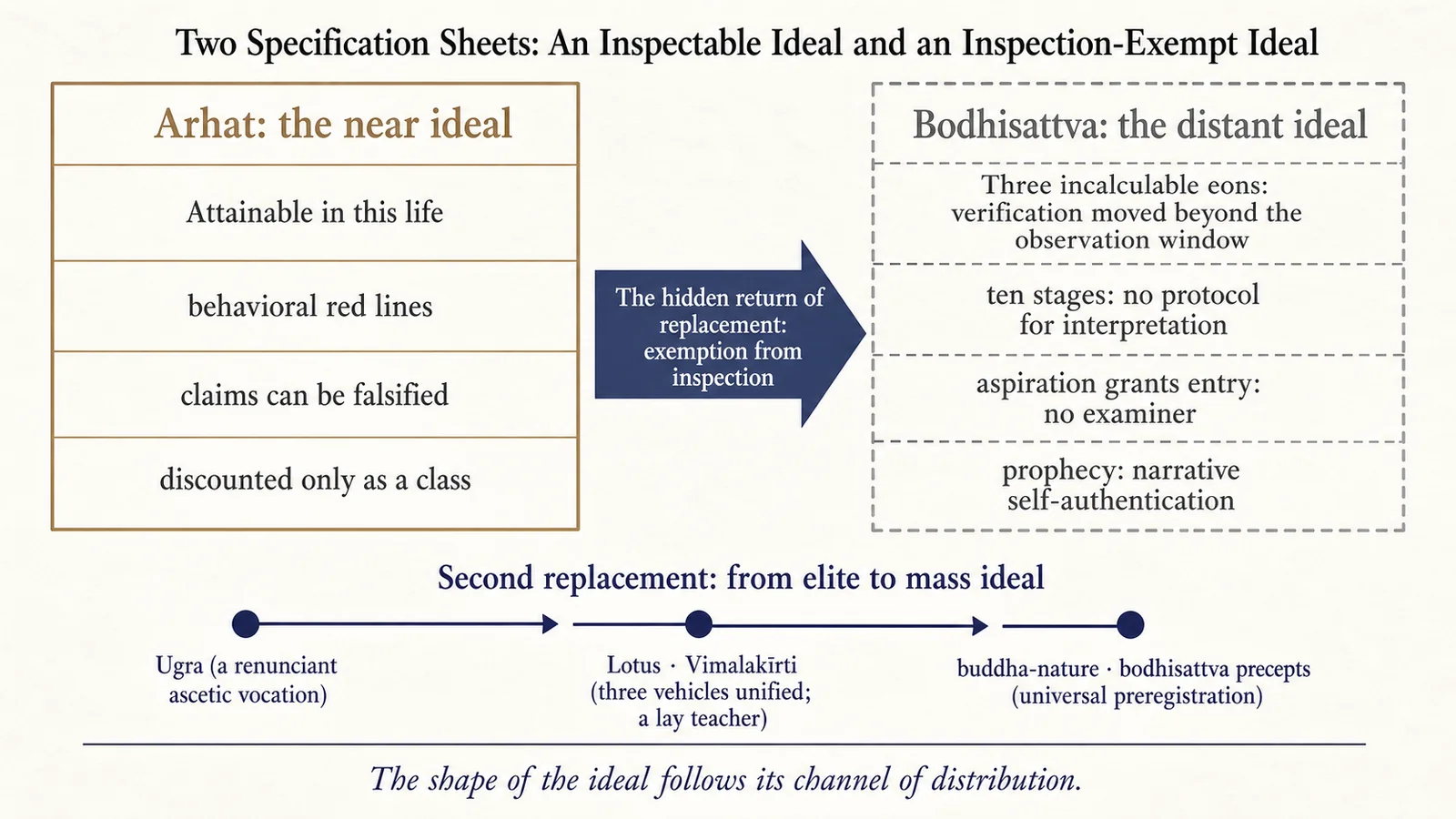
Following the rules, the next claim is explicitly this volume's conjecture. The hidden benefit of replacing the ideal was exemption from inspection. Accessible ideals face attainment tests; only distant ideals are safe. Once reports of attainment inflation had been made public and the discourse of living arahants moved into calendars and images, an unverifiable ideal was not only more elevated but the only affordable option. It would never be out of stock, never damage the brand, and never be discounted in bulk through another set of Five Points because no parameters remained to lower. It also supplied every monk without attainment a dignified self-description: not unable to realize, but traveling a longer road. Corroboration lies in the distribution of targets within the literature of replacement. The Vimalakīrti and Lotus humiliate precisely benchmarks of attainment such as Śāriputra. The parable of the phantom city reclassifies the arahant's endpoint as an illusion along the road. The old ideal is not disproved but repriced.3
The earliest bodhisattva path was elite. Nattier's study of the Inquiry of Ugra, cited in Volume I, established this. In that early text, the bodhisattva path is a super-vocation of ordination, asceticism, and forest dwelling; every instruction in the household chapter points toward leaving home. The bodhisattva is the vehicle reserved for the courageous within three parallel vehicles—rare, arduous, glorious. The earliest northern layer has this form. Theravāda has preserved an elite bodhisattva path to the present, historically the personal vow of kings and eminent elders, never a mass identity. Between "a super-vocation for a few" and "an identity everyone can receive through precepts" lies a second replacement whose milestones can be named. The Lotus unites the three vehicles in one and enrolls everyone on the path to buddhahood. Prediction inflates from a one-to-one honor into wholesale distribution: Śāriputra receives one, Devadatta receives one, the dragon girl receives one. The "Skillful Means" chapter lowers the threshold further than ever before: children playing who pile sand into a buddha stūpa, anyone who once says "Homage to the Buddha," have all completed the buddha path. The Vimalakīrti writes a victor's script for householders: a layman teaches, disciples listen. Against the Ugra's exhortation that householders ordain, the two texts mark two stages. Later still, universal buddha-nature preregistered every sentient being—the population-side form of the advance credit analyzed in Volume II's Tathāgatagarbha part. Bodhisattva precepts allowed the identity to be issued wholesale by ritual. At the Chinese extreme, emperors led in receiving the precepts and the whole realm called itself disciples of the bodhisattva precepts; Part X returns to this.4
What drove the second replacement? Four forces, each connected to the preceding mechanism. First, the mathematics of reproduction. A text recruiting only heroes has a base of copyists and patrons no larger than the population of heroes. A text lowering participation to one utterance of a name or one handful of sand makes everyone a potential reproducer. The copying incentives of the last chapter now performed selection. Universal scriptures outran elite scriptures; the Lotus became East Asia's king of sūtras while the Ugra almost ceased to be recited. That is a direct reading of differential reproduction. Second, the ideal's own enrollment logic. The bodhisattva's job description is to deliver every being, so the audience is no longer patrons outside the theater but future buddhas inside the plot. Telling a person "you too will become Buddha" turns a donor into a stakeholder. Third, exemption from inspection makes expansion free. Three incalculable eons make all progress invisible from outside; to an observer, a beginner and a tenth-ground bodhisattva are indistinguishable. Since quality control is already impossible, recruitment has no cost. Fourth, bargaining power on the patron side. Laypeople wanted not merely a field of merit but their own script of salvation. Whoever paid would be written into the sūtras as protagonist. Vimalakīrti is a custom order from that demand.
The compromise even left a confession. In the "Easy Practice" chapter of the Daśabhūmika-vibhāṣā, a questioner begins: the bodhisattva path is so difficult and long; is there an easy path that reaches nonretrogression quickly? The work attributed to Nāgārjuna first rebukes, then supplies it: "These are words of a weak and timid man without a great mind, not the resolve of a real man. If you insist on hearing this expedient, I will now explain it." After the rebuke comes exactly what was requested: utter names, recollect, rely on buddha-power. The market defeated the posture. The page is a miniature of the whole passage from elite to popular, and the birth certificate of Pure Land. Volume II's structural judgment of Pure Land finds its historical beginning here. "Nonretrogression," the central selling point, is the procedure that turns the bodhisattva vocation into guaranteed enrollment.5 Theravāda is the comparison group. A tradition with a welded gate had no market for reproducing new scriptures, and its bodhisattva path remained elite. One ideal, two markets, two fates. The shape of an ideal follows its channel of distribution.
The plain and balanced side requires three full statements. First, the ethical content of the bodhisattva ideal is a genuine direction. To include others' suffering in the definition of one's own practice has value that no functional advantage invalidates. Judging a structure's function does not judge its content; this volume's rule separating structures from persons applies to ideals as well. Second, it has roots within Buddhism. Jātaka literature had already spread the Buddha's former lives across a thousand bodhisattva practices. The replacement projected the Buddha's growth story outward as everyone's route; the material was ready. Third, it responded to a genuine criticism. To observers, the schools' ideal of practice could look self-concerned, and householders received too little space. The position opened to them by the bodhisattva path was a real reason it won the patron side, not only rhetoric.
Where was the cost recorded? On the trajectory dissected in Volume II: self-power surrendered, guarantees raised, verification moved farther away. Once the goal was placed beyond immeasurable eons, verification in this life became confidence in a route. Confidence in the route required a guarantee, and guarantees required ever heavier metaphysics. The chain of judgments Volume II followed from Madhyamaka to Pure Land links its first ring in this chapter.
The ideal has been replaced but still needs a guarantor. Someone must carry the candidate buddha along the long road. The next chapter shows how a teacher became a savior.
References
References
-
For the elements of the defeat offense of a great false claim ("knowing one lacks it and saying one has it") and the exemption for overestimation, see the fourth defeat rule in the schools' Vinayas. Its origin story concerns monks on the Vaggumudā River who praised one another's attainments for food during famine. The story of the elder Mahānāga occurs in Pāli commentarial tradition and is collected under his name in Malalasekera, Dictionary of Pāli Proper Names (London, 1937); Mahasi gives a modern retelling in his lectures on the Sallekha Sutta. For the monk who attained the four absorptions without learning and slandered the Buddha at death, see Mahāprajñāpāramitā-śāstra fascicle 17. On insight corruptions, vipassanūpakkilesa, as a routinized micro-falsification system, see the corresponding sections of Mahasi's Visuddhiñāṇa-kathā. ↩
-
Dīpaṅkara's prediction appears across Buddha biographies and Jātaka literature. For the expansion of Mahāyāna predictions, see the relevant chapters of the Lotus Sūtra. The ten-ground system was fixed in the Daśabhūmika tradition of the Avataṃsaka; on its lack of a reading protocol, compare the question of verification in Volume II's synthetic criticism. ↩
-
For the phantom city, see the "Parable of the Phantom City" chapter of the Lotus Sūtra. For Śāriputra as a supporting figure who must be taught, see the Vimalakīrti Sūtra and the "Parable" chapter of the Lotus. ↩
-
For the elite bodhisattva path in the Ugra, see Jan Nattier, A Few Good Men, cited in Volume I, Part IV, Chapter 1. For children piling sand into stūpas and "one utterance of homage to the Buddha" in the Lotus, see the "Skillful Means" chapter; predictions appear in the "Parable" and "Devadatta" chapters. Reading the Vimalakīrti and Ugra as milestones in two stages is this volume's interpretation. On universal buddha-nature, see Volume I, Part VII; on emperors and bodhisattva precepts in the line of Emperor Wu of Liang, see Part X below. For the elite form of the Theravāda bodhisattva ideal as personal vows by kings and eminent elders, see Jeffrey Samuels, "The Bodhisattva Ideal in Theravāda Buddhist Theory and Practice," Philosophy East and West 47.3 (1997). ↩
-
Daśabhūmika-vibhāṣā, fascicle 5, "Easy Practice," translated by Kumārajīva; the quotation follows the received Chinese text. Attribution to Nāgārjuna is disputed, and this volume therefore says "the work attributed to Nāgārjuna." The difficult/easy distinction became a source of Pure Land doctrinal classification and was used structurally in Volume II's Pure Land part. ↩