Part I, Chapter 6: Insight III: Goenka's Old Saṅkhāras and Three Maps¶
Chapters 4 and 5 restated the insight practice of the Mahāsi and Pa-Auk lineages. This chapter restates that of the Goenka lineage. From the fourth day of the ten-day course onward, students are aware of the sensations of the whole body in order from head to feet and maintain equanimity toward all sensations; the lineage also uses the accumulation, surfacing, and eradication of "old saṅkhāras" (saṅkhāra) to explain what this operation does and how far it has gone. The course schedule, the three and a half days of preparatory ānāpāna, the switch to insight on the fourth day according to the schedule, and U Ba Khin's original use of the light sign as the occasion for turning to insight have been covered in Chapter 3, Section 2, and are not restated here. Section 6 compares, in a single paragraph, two other Burmese meditation systems, and Section 7 sets the insight practice of the three lineages side by side. This chapter only restates what the three lineages themselves say and indicates the layer of provenance of each term; judgment is left to Chapter 10.
The sources fall into two kinds. One is the Goenka lineage's own literature: The Discourse Summaries, Hart's condensation of the evening discourses of Goenka's ten-day course; The Art of Living, which Hart wrote on the basis of Goenka's teaching and his answers to questions; U Ba Khin's lecture The Essentials of Buddha-Dhamma in Meditative Practice; and the lectures by U Ba Khin and articles by Goenka collected in the Sayagyi U Ba Khin Journal, edited by the Vipassana Research Institute. The Discourse Summaries is arranged by the days of the course, and below each part is cited simply as "the Day N discourse." The other kind consists of external accounts and points of reference: the psychological analysis by Zeng and colleagues of two concepts in Goenka's vipassanā, "awareness" and "equanimity"; the accounts of the Sunlun and Mogok lineages by Kornfield, Pyi Phyo Kyaw, and Jordt; and the explanatory notes in Bhikkhu Bodhi's edition of the English translation of the Abhidhammattha-saṅgaha, which are used to check the provenance of terms.
The period of several terms must be stated first. "Kalāpa," "bhavaṅga," "dissolution" (bhaṅga), and "equanimity toward formations" (saṅkhārupekkhā) all come from the commentaries and the Abhidhamma line; they are later categories. Bhikkhu Bodhi points out that the grouping of material phenomena into kalāpas, though it can be inferred from the distinction between the primary elements and derived matter, is first spelled out in the commentaries. Dissolution and equanimity toward formations are names of insight knowledges, and the ten levels of insight knowledge listed by U Ba Khin match the ten insight knowledges of the Abhidhammattha-saṅgaha item for item (see Section 5). Both Goenka and U Ba Khin attribute the doctrine of kalāpas to the Buddha.1 Wherever these terms are used below, they restate the Goenka lineage's teaching. Formations (saṅkhāra), feeling, perception, dependent origination, and the establishment of mindfulness are terms native to the suttas, and the lineage's use of them is noted item by item below.
1. The body scan: awareness and equanimity
From the fourth day the object widens from the area of the nostrils to the whole body; students move their attention in order from head to feet and are aware of the sensations in each part. The Day Four discourse answers several practical questions. Any order may be followed, but there must be an order, or some parts will remain "blind." Attention is given to a section two or three inches wide at a time; when the mind is dull one may take the whole face or the whole upper arm and then gradually narrow the area. If no sensation can be felt at a place, one may stay there for about a minute; if there is still none, one is aware of the touch of clothing or air and then moves on. When a sensation arises elsewhere one does not jump to it but observes it on arriving there. When the mind is sharp a round from head to feet takes about ten minutes, and at this stage it is not advisable to move faster; when the mind is dull a round may take from thirty minutes to an hour. At the beginning it is acceptable to be aware only of sensations on the surface and to enter the interior later.2 What is to be felt is any natural, ordinary bodily sensation, whether pleasant or unpleasant, gross or subtle, strong or weak, and no sensation is to be ignored on the grounds that it comes from the weather, from long sitting, or from an old disease. Goenka calls this "choiceless observation."3 Hart lists sensations that may appear: heat, cold, heaviness, lightness, itching, throbbing, contraction, expansion, pressure, pain, tingling, pulsation, vibration. The meditator does not look for special sensations, nor try to discover the cause of a sensation.4 A scan from the top of the head downward already appears in a discourse of U Ba Khin: attention moves from the top of the head to the forehead, the face, the neck, the shoulders, and then down along the arms; wherever the mind goes, it is like touching with a small torch, and one is aware of the burning and annihilation of atomic units within the body.5
The operation has two aspects, awareness and equanimity. The Day Four discourse says that the first aspect is breaking the barrier between the conscious and unconscious levels of the mind, so that the whole mind becomes aware; the second is equanimity: one is aware of every sensation but does not react, and does not tie new knots of craving or aversion.6 The Day Seven discourse restates the two aspects and says that the purpose of practicing vipassanā is to develop equanimity toward all sensations, not to experience a certain type of sensation; sensations keep changing, and progress on the path can be measured only by the equanimity developed toward every sensation. The Day Eight discourse adds that the only yardstick of progress is the equanimity one has developed.7 Hart compares the two to the two wings of a bird and the two wheels of a cart, and says that both must be equally strong.8
The lineage takes bodily sensation as its object for three reasons. First, Goenka says that what is unique in the Buddha's teaching is that it identifies bodily sensation as the point at which craving and aversion begin and at which they must be eliminated; between the external object and the reaction there is a "forgotten missing link," namely sensation.9 Hart says that sensation is the meeting point of mind and body: it arises within the body and is felt by the mind.10 Second, all four establishments of mindfulness are brought under the observation of sensations. The Day Ten discourse says that to experience the body one must feel the body, so observation of the body necessarily includes observation of sensations; and whatever arises in the mind is accompanied by a bodily sensation, so observation of the mind too cannot be separated from awareness of sensations.11 Third, U Ba Khin says that impermanence can be understood through contact at any of the six sense doors, but bodily contact covers the widest area and is the most evident, and beginners find it easiest to understand the change of material phenomena through bodily sensations; this is why the lineage chooses bodily sensation as its medium.12
Zeng and colleagues have analysed these two abilities from a psychological standpoint. They define "awareness" as sensitivity to subtle bodily sensations and the associated psychological processes. They say that the technique of using bodily sensation to monitor emotions is unique to Goenka's vipassanā, and that this awareness differs significantly from the present-moment attention of the Western concept of mindfulness, whereas "equanimity" is relatively close to the acceptance spoken of in mindfulness-based therapies.13 The two articles deal only with these two concepts and their measurement and do not touch on the model of old saṅkhāras described below.
2. Saṅkhāra as reaction and as kamma
What the Goenka lineage calls saṅkhāra means first of all the reaction of the mind. The Day Four discourse divides the mind into four parts. Consciousness only knows that something has come to a sense door, without discriminating. Perception recognizes it on the basis of past experience and memory and evaluates it as good or bad. Sensation, following this evaluation, becomes pleasant or unpleasant. Saṅkhāra is the reaction: liking for a pleasant sensation, disliking for an unpleasant one; a momentary liking develops into intense craving, and a momentary disliking into intense aversion. The discourse says that saṅkhāra is "the real seed that gives fruit."14 Hart presents the four mental processes in the same order, translates saṅkhāra as "reaction," and explains in a note that saṅkhāra is here taken as cetanā, that is, will or intention.15 The glossary appended to The Discourse Summaries says that saṅkhāra is one of the five aggregates and also the second link of dependent origination; "Saṅkhāra is the kamma," the action that gives future results and shapes one's future life.16 U Ba Khin also takes saṅkhāra as kamma: every action of body, speech, or mind leaves behind a force called saṅkhāra, "kamma in popular terminology," which goes to the credit or debit account of the individual according to whether the action is good or bad; everyone has an accumulation of saṅkhāras, which functions as the source of energy that sustains life.17
Saṅkhāras differ in depth. The Day Four discourse says that some reactions leave an impression so shallow that it is erased almost at once, some go somewhat deeper and take some time to be erased, and some are very deep and take a long time. At the end of a day, a month, or a year one remembers only the one or two saṅkhāras that made the deepest impression; at the end of life the saṅkhāra that made the strongest impression is bound to come up in the mind, and the next life begins with a mind of the same nature.18 In the article "What Happens at Death?" Goenka divides them more finely. Some saṅkhāras are so shallow that they bear no substantial fruit; some are heavier and are used up in this life; some are heavier still and pass with the stream of life into the next life, yet do not give rise to a new life. Many kammas, however, are "bhava-kammas, or bhava-saṅkhāras," which give rise to a new life; each carries a magnetic force in tune with the vibrations of a particular plane of existence, and whichever of them arises at the moment of death determines which of the thirty-one planes the stream of mind connects to. He compares the difference between shallow and deep to a line drawn on water, on sand, and on rock.19 The same article says that the bhava-saṅkhāras that give rise to rebirth lie deep in the bhavaṅga. If the meditator observes the various sensations at the time of death with equanimity, these bhava-saṅkhāras have no opportunity to arise; by gradually decreasing the bhava-saṅkhāras stored in the bhavaṅga of his own flow of consciousness, he shortens the journey of becoming. The term "bhavaṅga" used in this article comes from the Abhidhamma: in the Abhidhammattha-saṅgaha, bhavaṅga is the consciousness that preserves the continuity of a single existence from rebirth-linking to death, and it belongs to resultant consciousness. Goenka's article glosses it in parentheses as "seat of birth-producing kamma."20
3. The stock of old saṅkhāras and its surfacing
The stock of old saṅkhāras appears in the lineage's literature in three contexts: dependent origination, the mechanism of surfacing, and the stages of liberation. The first two are found in Chapter 8 of Hart's book and in the Day Six and Day Eight discourses; the third is treated in Section 5.
The context of dependent origination. In the subsection of Chapter 8 headed "The Stock of Past Reactions," Hart says that by maintaining awareness and balance one can stop creating new reactions, but suffering has another side: each person has a stock of conditioning, the sum total of past reactions, and even if nothing is added to it, the accumulated old saṅkhāras will still cause suffering.21 He translates saṅkhāra as "formation," covering both the act of forming and what is formed; each reaction is the last step in one series of mental processes and can also be the first step in a new series. Conditioning operates through perception. Consciousness merely registers that a contact has occurred, without discriminating; perception evaluates and categorizes a new phenomenon by drawing on the store of past experiences, so that past reactions become the points of reference for understanding new experience. In accordance with this distorted perception, an essentially neutral sensation immediately becomes pleasant or unpleasant, and the reaction to it creates new conditioning.22 Hart says that this double role of saṅkhāra can be seen in the twelve links of dependent origination: the second link, saṅkhāra, is the immediate precondition for the arising of consciousness, yet saṅkhāra also comes after consciousness, perception, and sensation, where it reappears in the form of craving and aversion; craving and aversion develop into clinging, which becomes the driving force of a new round of physical and mental activity.23 The Day Six and Day Ten discourses also say that perception gives sensations a valuation on the basis of past experience and past saṅkhāras, and that sensations accordingly become pleasant or unpleasant.24
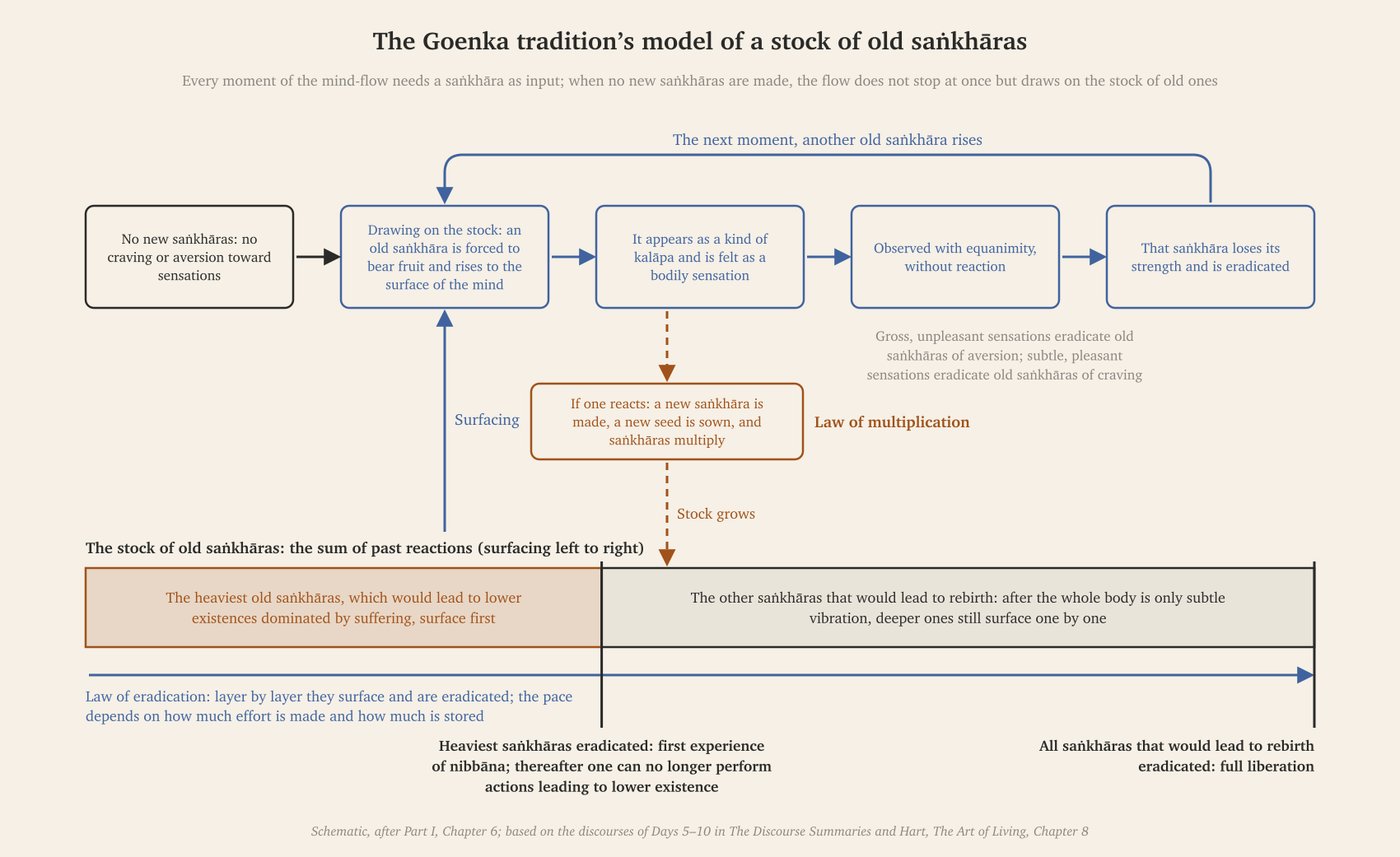
The context of the mechanism of surfacing. The Day Six discourse says that the body is composed of kalāpas, and kalāpas of the four elements and their subsidiary characteristics. Kalāpas arise from four causes: two are material, the food one eats and the environment one lives in, and two are mental, present saṅkhāras and past saṅkhāras. When anger arises in the present, kalāpas in which the fire element predominates arise at once, and one feels heat; when fear arises, kalāpas in which the air element predominates arise, and one feels trembling. A past saṅkhāra is a seed that bears fruit after a time; whatever sensation was experienced when it was planted, the same sensation arises when its fruit comes up to the surface of the mind. The discourse asks students not to decide which of the four causes a given sensation comes from, but only to observe without generating new saṅkhāras: if the mind is given no new reaction as input, an old reaction naturally gives its fruit and manifests as sensation; when it is observed, it passes away; if one again does not react, another old saṅkhāra must give its fruit.25 The Day Eight discourse and Hart's book both compare this to fasting. When the body stops taking food it does not stop functioning at once; it consumes the energy stored within it, and only when the store is exhausted does it die. The flow of mind needs a saṅkhāra as input at every moment, and the mind that arises at the next moment is the product of this saṅkhāra. If at some moment no new saṅkhāra is generated, the flow of mind does not stop at once either; it draws on the stock of old saṅkhāras, and an old saṅkhāra is forced to give its fruit, coming to the surface of the mind to sustain the flow and manifesting as a bodily sensation. To react to this sensation is to plant a new seed; to observe it with equanimity is to deprive it of its strength so that it is eradicated, and at the next moment another old saṅkhāra comes up.26 Hart reads the link "saṅkhāra conditions consciousness" as mental input at every moment, and says that old conditioning appears at the physical level by causing a particular type of kalāpa to arise, which is experienced as sensation; he calls vipassanā "a kind of fasting of the spirit."27
The stock has types. The Day Nine discourse says that when a defilement of a certain type arises at the conscious level, the old stock of the same type arises from the unconscious, connects with the present defilement, and multiplies; if one merely observes, the present defilement loses its strength and part of the old stock of that type is eradicated as well.28 The Day Ten discourse says that gross, unpleasant sensations are tools for eradicating the old stock of saṅkhāras of aversion, and subtle, pleasant sensations are tools for eradicating the old stock of saṅkhāras of craving.29 Hart says that as long as the conditioning of aversion remains, the mind tends to react with aversion whenever it meets an unpleasant experience; when conditioned responses of a certain type have been eradicated, one is free of that type of suffering, and when all conditioned responses have been eradicated one after another, the mind is totally liberated.30
The model does not begin with Goenka. U Ba Khin had already said that saṅkhāras accumulate in everyone as the source of energy that sustains life. The force of understanding impermanence can remove the saṅkhāras accumulated in one's account, while at the same time new saṅkhāras continue to accumulate and the energy that sustains life is also being reduced, so that getting rid of all saṅkhāras is "a matter of a whole lifetime or more." One who has got rid of all saṅkhāras comes to the end of suffering, because no saṅkhāra remains to supply the energy to sustain any form of life.31
The terms of the mechanism of surfacing can be compared with the Abhidhamma. Chapter 6 of the Abhidhammattha-saṅgaha says that material phenomena originate in four ways: from kamma, consciousness, temperature, and nutriment.32 The four causes of the arising of kalāpas named by Goenka correspond to these item by item: past saṅkhāras to kamma, present saṅkhāras to consciousness, the environment to temperature, and the food one eats to nutriment. The grouping into kalāpas was fixed by the commentaries, as noted at the beginning. The surfacing of the stock, the flow of mind drawing on old saṅkhāras in place of new ones, and the passing away of surfacing saṅkhāras through equanimity belong to the teaching of the U Ba Khin and Goenka lineage. The following diagram shows this cycle and its two end points; the wording of each step is taken from the discourses and from Hart's book cited above.
4. Two passages on "formations are impermanent"
In two places the lineage explains saṅkhāra by means of verses of the type "formations are impermanent," and the two go in different directions. The first moves from saṅkhāra as reaction to everything conditioned; the second reads a verse in which the suttas speak of formations in general as the multiplication and eradication of mental conditioning.
The first is verse 277 of the Dhammapada. The Day Six discourse quotes this verse, whose meaning is: when one sees with wisdom that all formations are impermanent, one becomes disenchanted with suffering; this is the path to purification. The discourse goes on to say that saṅkhāra here means not only mental reactions but also the results of these reactions. Every mental reaction is a seed that gives a fruit, and everything one experiences in life is a fruit, the result of one's own actions, that is, of one's own past or present saṅkhāras. The meaning of the verse is therefore that everything that arises, everything that is composed, will pass away and disintegrate.33 Hart quotes the same verse in Chapter 7. Before it he discusses breaking the chain at the link of sensation and says that the cause of suffering is kamma, that is, the blind reaction of craving and aversion, which is saṅkhāra. After quoting the verse he adds: "Here the word saṅkhāra has a very wide meaning. A blind reaction of the mind is called saṅkhāra, but the result of that action, its fruit, is also known as saṅkhāra; like seed, like fruit. Everything that we encounter in life is ultimately the result of our own mental actions. Therefore in the widest sense, saṅkhāra means anything in this conditioned world, whatever has been created, formed, composed."34 Both passages argue in three steps: a reaction is a saṅkhāra, and the fruit of a reaction is also a saṅkhāra; everything one encounters is the fruit of one's own saṅkhāras; therefore everything conditioned is saṅkhāra. The middle step is a premise about kamma and its results. Elsewhere the Day Eight discourse also says that whether one faces darkness or brightness now is not something one can choose; it is determined by one's past saṅkhāras.35
The second is Sakka's verse. The Day Eight discourse quotes this verse at its opening as the heading for "the law of multiplication" and its reverse, "the law of eradication." The Pāli of the verse can be translated: "Impermanent indeed are formations, of the nature to arise and pass away; having arisen, they cease; their stilling is happiness." The discourse explains at once that every saṅkhāra, every mental conditioning, is impermanent and has the nature of arising and passing away; it passes away, and the next moment it arises again, and again, and this is how saṅkhāras multiply. If the meditator develops wisdom and observes objectively, multiplication stops and eradication begins: when a saṅkhāra arises and the meditator maintains equanimity, it loses all its strength and is eradicated. Layer after layer of old saṅkhāras arise and are eradicated; one enjoys happiness in proportion to what has been eradicated, and when all past saṅkhāras have been eradicated, one enjoys the limitless happiness of full liberation.36 For "stilling" (vūpasamo) in the last line, "their stilling is happiness," the English translation appended to the discourse has "eradication," and Sakka's verse thereby becomes scriptural proof of the eradication of the stock. Hart quotes the same verse right after the sentence in Chapter 8, "And when all conditioned responses have been eradicated one after another, the mind is totally liberated," and notes that the verse comes from the sixteenth discourse of the Dīgha Nikāya and was spoken by Sakka, king of the gods, after the passing of the Buddha.37
The occasions in the suttas are as follows. The sixteenth discourse of the Dīgha Nikāya says that when the Blessed One attained parinibbāna, Sakka spoke this verse at the same moment. The parallel passage in the Youxing jing (Discourse on the Journey), fascicle 4 of the Dīrgha Āgama, reads: "Aggregates and formations are impermanent, mere things of rise and decline; of those who are born, none fails to die; the Buddha's extinguishing of them is bliss."38 The same verse is also the closing verse of the seventeenth discourse of the Dīgha Nikāya. After describing King Mahāsudassana's eighty-four thousand cities, palaces, elephants, horses, and treasures, the Buddha says that all these formations have passed, ceased, and changed, and that this is enough for one to become disenchanted with all formations, to become dispassionate toward them, and to be liberated; then he speaks this verse.39 The occasion of the one discourse is the Buddha's passing; that of the other is a king's cities and treasures, which have already vanished.
The uses of saṅkhāra seen in the sections above can be summarized as follows:
| Usage | What the sources say | Source |
|---|---|---|
| Reaction | The fourth part of the mind: liking for a pleasant sensation, disliking for an unpleasant one; "the real seed that gives fruit" | Discourse Summaries, Day Four, pp. 35–36; Hart, pp. 26–27 |
| Volition | Saṅkhāra here taken as cetanā, that is, will or intention | Hart, pp. 155–156, note |
| Kamma | One of the five aggregates and the second link of dependent origination; "Saṅkhāra is the kamma"; the force left by every action, "kamma in popular terminology" | Discourse Summaries, glossary, p. 118; U Ba Khin, Essentials, p. 13 |
| An accumulation of differing depth | Three grades: shallow, somewhat deeper, deep; those that give rise to rebirth are bhava-saṅkhāras, stored in the bhavaṅga | Day Four, p. 36; "What Happens at Death?," pp. 133–135 |
| The stock of past reactions | Surfaces when no new saṅkhāra is generated, manifests as kalāpas, and is felt as sensation | Day Six, p. 49; Day Eight, p. 62; Hart, pp. 101–105 |
| The fruit of reactions | Everything one experiences in life is the fruit of one's own saṅkhāras | Day Six, p. 45; Hart, p. 93 |
| Everything conditioned | In the widest sense, saṅkhāra means anything in the conditioned world | Hart, p. 93 |
| Mental conditioning | The formations of Sakka's verse read as every kind of mental conditioning, and "stilling" read as eradication | Day Eight, p. 60; Hart, p. 105 |
5. Stages and end points
The lineage uses the eradication of old saṅkhāras to explain the stages of insight and the two steps of liberation. The Day Seven discourse says that if students maintain equanimity, sooner or later they will feel sensations in areas that were "blind." Gross, solid, unpleasant sensations begin to dissolve into subtle vibrations, and a very pleasant flow of energy moves through the whole body; the danger lies in taking this pleasant experience as the goal. If, after a free flow of subtle vibrations throughout the body has been experienced, a gross sensation or a blind area appears again somewhere, Goenka says that this is a sign of progress, not of regression. As awareness and equanimity grow, the meditator goes deeper into the unconscious and digs out the impurities hidden there; when deep-rooted saṅkhāras rise to the surface, many of them are accompanied by gross, unpleasant sensations or blind areas; if one continues to observe without reacting, the sensation passes away, and with it the saṅkhāra of which it is a manifestation.40
Liberation comes in two steps. The discourse of the same day goes on to say that nibbāna cannot be experienced until the heaviest saṅkhāras, those that would lead to a lower existence in which suffering predominates, have been eradicated. When one practices vipassanā, these are the very saṅkhāras that surface first, and if one maintains equanimity they pass away. When all such saṅkhāras have been eradicated, one naturally experiences nibbāna for the first time, and thereafter can no longer perform actions that lead to lower existence. One then proceeds gradually to higher stages, until all the saṅkhāras that would lead to a future life anywhere in the conditioned world have been eradicated; such a person is fully liberated.41 The discourse presents this explanation by inserting it between the three parts of a sutta verse. The verse is from the Ākāsa Sutta in Saṃyutta 36 of the Saṃyutta Nikāya. It says that a bhikkhu who is ardent and does not neglect clear comprehension fully understands all feelings; having fully understood feelings, he is without taints in this very life, and at the breaking up of the body, established in the Dhamma, he does not enter reckoning. Its Chinese parallel, sutta 471 in fascicle 17 of the Saṃyukta Āgama, reads: "A bhikkhu who strives diligently, whose right knowledge does not waver, is wise and can fully understand all these feelings. Because he fully understands feelings, he exhausts the taints in this very life; when the body dies he does not fall into reckoning, and abides for ever in parinirvāṇa."42 The layer in which the heaviest saṅkhāras surface first and their eradication is the first sight of nibbāna is the discourse's own explanation, set between the parts of the sutta verse. The discourse adds that the stage in which there are only subtle vibrations throughout the body is very blissful but is not the final goal; deeper saṅkhāras will still arise and pass away one after another, and only when all have been eradicated does one experience the "deathless."43 The Day Five discourse, for its part, says that to begin the practice it is not necessary first to believe in past and future lives; in practicing vipassanā, the present is most important.44
The names of the stages appear in the Day Ten discourse. Goenka says that every section of the Satipaṭṭhāna Sutta ends with the same sentences, and that wherever one begins, the meditator must pass through certain "stations." The first station is experiencing arising and passing away separately: what one is aware of at this point are gross sensations, such as pain, which arises, seems to stay for a while, and finally passes away. Further on is experiencing arising and passing away simultaneously: gross, solid sensations dissolve into subtle vibrations arising and passing away with great rapidity, and the sense of solidity of the mental and physical structure disappears; this is dissolution (bhaṅga). Only when the dissolution of the mental and physical structure has been experienced is attachment to it removed; one can then remain detached in the face of any situation, which is entering the stage of equanimity toward formations (saṅkhārupekkhā). At this point old saṅkhāras buried deep in the unconscious begin to rise to the surface, and Goenka says this is progress, because unless they come to the surface they cannot be eradicated.45 The sentences he refers to are the refrain of the Mahāsatipaṭṭhāna Sutta: "he abides contemplating the nature of arising in the body, or he abides contemplating the nature of passing away in the body, or he abides contemplating the nature of both arising and passing away in the body." In the Madhyama Āgama discourse on the establishments of mindfulness, the refrain of each section reads: "Thus a bhikkhu contemplates the internal body as body and contemplates the external body as body, establishes mindfulness in the body, and has knowledge, vision, understanding, and penetration"; there is no sentence about contemplating arising and passing away.46 As for how soon the goal is reached, Goenka says it depends on how much work one does and how large an accumulation of past saṅkhāras one has to eradicate.47 Running parallel to this line are the three characteristics of impermanence, non-self, and suffering. Hart says that the meditator first understands that sensations change constantly, which is impermanence; then understands that there is no permanent self; and then understands that attachment to what is impermanent is suffering. The Day Ten discourse says that the purpose of disintegrating apparent reality is to enable the meditator to emerge from the illusion of "I."48
U Ba Khin lists, separately, ten levels of insight knowledge: comprehension (sammasana), rise and fall (udayabbaya), dissolution (bhaṅga), terror (bhaya), danger (ādīnava), disenchantment (nibbidā), desire for deliverance (muñcitukamyatā), reflection (paṭisaṅkhā), equanimity toward formations (saṅkhārupekkhā), and conformity (anuloma). He says that these are the levels one passes through in the course of vipassanā meditation; for those who reach the goal in a short time, they can be known only in retrospect; certain levels require adjustment or help from a competent teacher; and the meditator should not anticipate these attainments, lest this disturb continuous awareness of impermanence.49 These ten levels match item for item the ten insight knowledges listed in Chapter 9 of the Abhidhammattha-saṅgaha.50 U Ba Khin also says that one must observe impermanence until the immeasurable old unwholesome kamma accumulated in saṃsāra has been eradicated, and only then does one become a stream-enterer; the element of nibbāna that the meditator develops collides with the impurities within his own system and creates "a sort of upheaval, which must be endured."51
The stages of the Goenka lineage and the layer of provenance of their terms are listed below:
| Stage | The Goenka lineage's explanation | Source | Layer of provenance of the term |
|---|---|---|---|
| Gross sensations, blind areas | At first one mostly meets gross, unpleasant sensations; where nothing can be felt, stay about a minute | Day Four, pp. 30–31; Day Five, p. 38 | Practical instruction |
| Experiencing arising and passing away separately | A gross sensation arises, seems to stay, and finally passes away | Day Ten, p. 82 | Contemplating the nature of arising and the nature of passing away, in the refrain of the Mahāsatipaṭṭhāna Sutta |
| Experiencing arising and passing away simultaneously; free flow | Gross sensations dissolve into subtle vibrations; energy flows through the whole body | Day Seven, p. 52; Day Ten, p. 82 | Contemplating the nature of both arising and passing away, in the refrain of the Mahāsatipaṭṭhāna Sutta |
| Dissolution | The sense of solidity of the mental and physical structure disappears; only vibrations arising and passing away remain | Day Ten, p. 82; glossary, p. 113 | Name of an insight knowledge; later |
| Equanimity toward formations | Deep-lying old saṅkhāras surface as bodily sensations and are eradicated through equanimity | Day Ten, p. 82; glossary, p. 118 | Name of an insight knowledge; later |
| The heaviest saṅkhāras eradicated | First experience of nibbāna; thereafter no more actions that lead to lower existence | Day Seven, p. 55 | The stock model; the inserted sutta verse is from the Ākāsa Sutta |
| All saṅkhāras that give rise to rebirth eradicated | Full liberation | Day Five, p. 44; Day Seven, p. 55 | The stock model |
6. Other Burmese systems (for comparison)
Burma has two other systems centred on a single meditation master, which can serve for comparison. Sunlun Sayadaw (1878–1952) was a farmer before he became a monk. According to Kornfield, he was at first aware only of the in-breath and out-breath, later added the touch at the tip of the nose, and then extended this to all touch in the course of his work; in mid-1920 he attained stream entry, and in October of the same year arahantship. In the group sittings at the Sunlun meditation center, about forty-five minutes of rapid, forceful breathing come first; practitioners then turn to awareness of bodily sensations and sit motionless until the end of a two- or three-hour period, with particular emphasis on painful feeling. Teachers of the Sunlun lineage criticize methods such as Mahāsi's as developing concentration through concepts without direct insight.52 Pyi Phyo Kyaw records that Sunlun and another master both used rapid, strong, rhythmic breathing to induce intense and mostly unpleasant bodily sensations, which they then observed; he also records that senior members of the Burmese Saṅgha examined the two masters separately, using the Pāli canon and post-canonical texts as the standard, to verify the popular belief that they were arahants.53 Mogok Sayadaw (1899–1962) stood in the line of Ledi and emphasized dependent origination. Kornfield records that his teaching has three parts. Before practice there is an intellectual understanding of the Dhamma: distinguishing concepts from ultimate reality, understanding that ultimate reality is composed of the elements and aggregates, and then an explanation of dependent origination. Then the mind is concentrated through mindfulness of breathing, and practice turns to meditation on consciousness or on feeling. As practice deepens, all perception is only the arising and passing away of the five aggregates.54 The English translator of Mogok's talks also says that they were mostly based on emptiness, dependent origination, and the suttas on practice, and that this is foundational knowledge for insight practice which meditators should understand both before and during practice.55 Jordt contrasts the Mahāsi lineage with these two. Mahāsi drew attention away from arahant cults and formed a rationalized, formalized method that could be transmitted by monks who had not attained enlightenment but were trained in the teaching of vipassanā; the monasteries built around famous arahant monks such as Mogok and Sunlun went the way of traditional cults centred on a charismatic figure, and after the monk's death the moral community surrounding him was usually disbanded.56 The Sunlun lineage takes bodily sensations, especially painful feeling, as the object of insight, and in this it is close to Goenka.
7. Three maps
The insight practice of all three lineages takes mentality-materiality as its object. The Mahāsi lineage notes, one by one, the arising and passing away of mental and physical phenomena (Chapter 4); the Pa-Auk lineage discerns ultimate materiality, ultimate mentality, and their causes by the light of concentration (Chapter 5); the Goenka lineage is aware of bodily sensations from head to feet and maintains equanimity toward all sensations (Section 1 of this chapter). The three lineages differ in the map they use to explain what the meditator has seen and how far he has gone.
The Mahāsi lineage's map is the sequence of insight knowledges. It runs from the knowledge of discerning mentality-materiality, through the knowledge of discerning conditions, the knowledge of comprehension, the knowledge of rise and fall, the knowledge of dissolution, the knowledge of appearance as terror, and so on, then through the knowledge of equanimity toward formations, the knowledge of conformity, and change-of-lineage knowledge, to path knowledge, fruition knowledge, and reviewing knowledge, and it is divided according to the seven purifications of the Visuddhimagga. Chapter 6 of the Manual of Insight gives the signs of each knowledge level by level; the managing editor's preface to the English translation calls this chapter a complete template for evaluating practice and the development of insight knowledge, and a chart at the end of the book lists the whole sequence.57 The level of insight knowledge is judged by the teacher from interview reports (Chapter 4), and the Mahāsi center has a secret teaching manual; whether path and fruition have been attained, nominally only a Buddha can know for certain.58
The Pa-Auk lineage's map is Abhidhamma analysis. First, in four-elements meditation, kalāpas are divided into transparent and non-transparent kinds, and at least eight kinds of materiality are discerned in each kalāpa. Then mentality is discerned, that is, the cognitive processes at each sense door. Then past and future lives are discerned: following the three rounds of dependent origination, one sees link by link how five past causes give rise to five present effects, and in the future one must see as far as the life in which ignorance ceases without remainder, that is, the attainment of the arahant path. Then the insight knowledges are developed.59 Kalāpas and cognitive processes are categories of the commentaries and the Abhidhamma; progress is judged from the students' reports in interviews, and Pa-Auk says that he never certifies jhāna or path and fruition (Chapter 2, Section 4).
The Goenka lineage's map is the stock of old saṅkhāras: sensations are the manifestation of old saṅkhāras surfacing; equanimity makes the surfacing saṅkhāra pass away; when the heaviest saṅkhāras have been eradicated, nibbāna is seen for the first time; when all saṅkhāras that give rise to rebirth have been eradicated, there is full liberation. This map is made of three layers of material. Dependent origination, feeling, perception, and the refrain of the Mahāsatipaṭṭhāna Sutta come from the suttas; kalāpas, bhavaṅga, and the names of insight knowledges such as dissolution and equanimity toward formations come from the commentaries and the Abhidhamma; the accumulation, surfacing, and eradication of old saṅkhāras come from the U Ba Khin and Goenka lineage. The only yardstick of progress is equanimity, and the ten levels of insight knowledge listed by U Ba Khin are known only in retrospect.
The insight practice of the three lineages can be set side by side as follows:
| Mahāsi | Pa-Auk | Goenka | |
|---|---|---|---|
| Object | Mental and physical phenomena, entered through the pressure and touch of the rising and falling of the abdomen, each one noted | Ultimate materiality, ultimate mentality, and their causes, discerned by the light of concentration | Bodily sensations throughout the body, observed in order from head to feet |
| Map | Sequence of insight knowledges: from the knowledge of discerning mentality-materiality to reviewing knowledge | Kalāpas, cognitive processes, dependent origination across three lives, then the insight knowledges | Old saṅkhāras surfacing as sensations; rise and fall, dissolution, equanimity toward formations |
| Layers of provenance of the map | The sequence of insight knowledges divided according to the seven purifications of the Visuddhimagga | Kalāpas and cognitive processes from the commentaries and the Abhidhamma; the three rounds and three lives of dependent origination | Suttas (dependent origination, feeling, perception, the satipaṭṭhāna refrain); commentaries and Abhidhamma (kalāpas, bhavaṅga, names of insight knowledges); the U Ba Khin and Goenka lineage (the stock) |
| Who judges progress | The teacher judges the level of insight knowledge from interview reports, with a secret manual; path and fruition nominally known for certain only by a Buddha | Students report in interviews and the teacher guides them on the basis of the reports, saying that he does not certify | Equanimity the only yardstick; the ten insight knowledges known only in retrospect; some levels adjusted by the teacher |
| End point | Path knowledge, fruition knowledge, reviewing knowledge | Insight carried as far as the life in which ignorance ceases without remainder; attainment of the arahant path | Heaviest saṅkhāras eradicated: first sight of nibbāna; all saṅkhāras that give rise to rebirth eradicated: full liberation |
The diagram below shows the three maps and the common object: the bottom layer is the mentality-materiality shared by the three lineages, and the three columns above are the maps each lineage adds, with their layers of provenance.
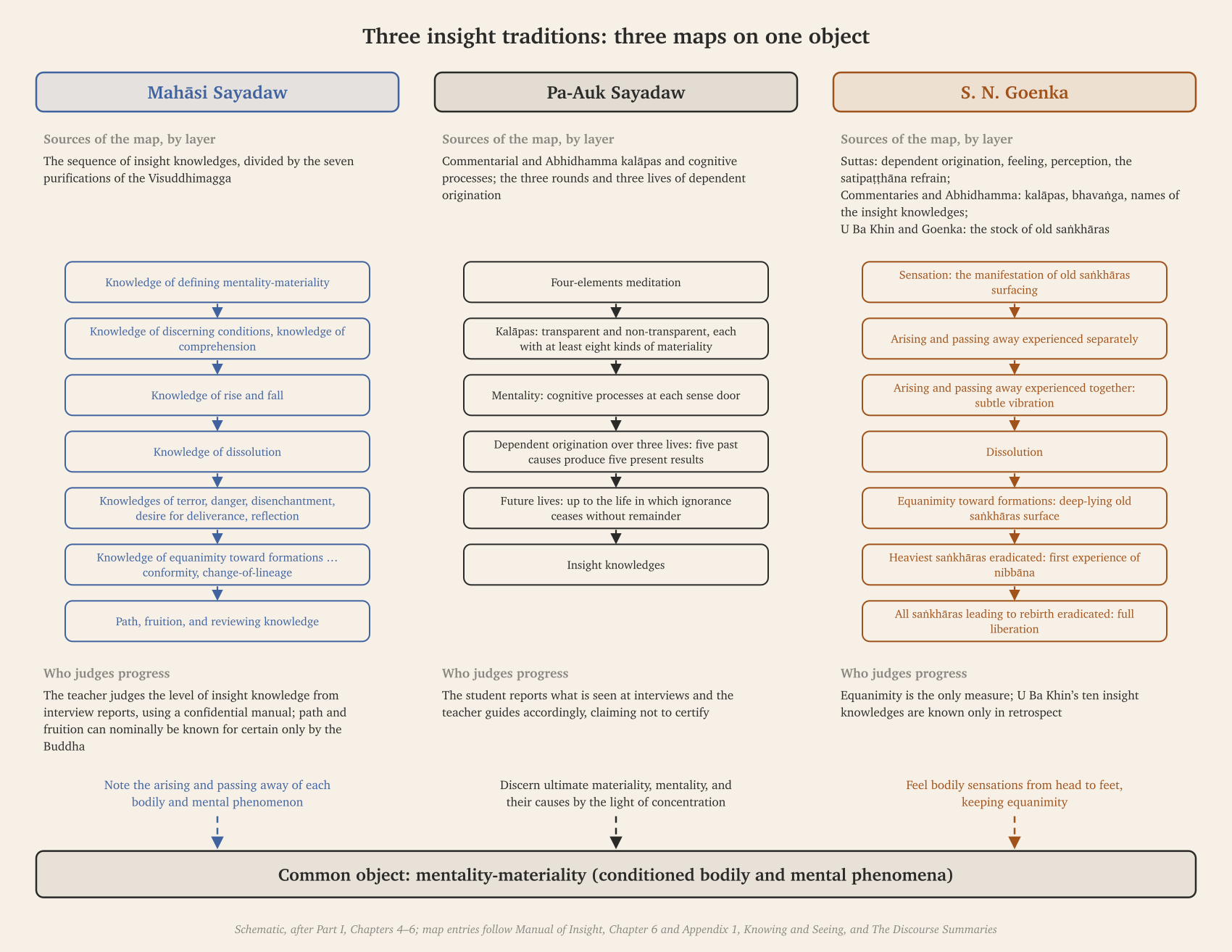
By comparison with the Geluk school, Tsongkhapa's insight takes as its object an object of negation defined in advance by doctrine: the view must be heard from others, and the object of negation must first be identified (Part III of Essay 2, The Meditation of Tsongkhapa, Chapter 2, Section 1). The object of insight in the three Burmese lineages is mentality-materiality, that is, conditioned mental and physical phenomena. The difference among the three lies in the map used for verification, and the three maps differ in their layers of provenance; the Goenka lineage's map is built from three layers, the suttas, the commentaries, and the lineage's own teaching. The relation between object and map is discussed in Chapter 10, Section 2.
References
-
Bhikkhu Bodhi (ed.), A Comprehensive Manual of Abhidhamma: The Abhidhammattha Sangaha of Ācariya Anuruddha, Onalaska: BPS Pariyatti Editions, 2000 (the electronic edition consulted has no original page numbers; cited by chapter and section), Introduction, section "The Commentaries": "The organization of material phenomena into groups (kalāpa), though implied by the distinction between the primary elements of matter and derived matter, is first spelled out in the Commentaries." Goenka says: "The entire structure of the body, the Buddha explained, is composed of subatomic particles—kalāpā—consisting of the four elements and their subsidiary characteristics, joined together." See S. N. Goenka, The Discourse Summaries: Talks from a Ten-day Course in Vipassana Meditation, condensed by William Hart, Onalaska: Vipassana Research Publications, 2012, e-book (first published by Vipassana Research Institute, 1987), Day Six, p. 48. U Ba Khin says: "The Buddha taught his disciples that everything that exists at the material level is composed of kalāpas." See Sayagyi U Ba Khin, The Essentials of Buddha-Dhamma in Meditative Practice, Onalaska: Vipassana Research Publications, 2012, e-book (first published by Vipassana Research Institute, 1991), p. 15. ↩
-
Goenka, Discourse Summaries, Day Four, pp. 30–32. p. 30: "Any order may be followed, but an order is necessary. Otherwise there is the danger of neglecting some parts of the body, and those parts will remain blind, blank." p. 31: "If this situation occurs throughout the body, it may be possible to move from head to feet in about ten minutes, but it is not advisable to move more quickly at this stage." p. 32: "Take a section of the body about two or three inches wide; then move ahead another two or three inches, and so on." ↩
-
Goenka, Discourse Summaries, Day Four, p. 33: "Never ignore a sensation on the grounds that it is caused by atmospheric conditions, or by sitting for long hours, or by an old disease." "It is a choiceless observation. Never try to select sensations; instead, accept whatever arises naturally." ↩
-
William Hart, The Art of Living: Vipassana Meditation as Taught by S. N. Goenka, Onalaska: Vipassana Research Publications, e-book (first published by Harper & Row, 1987), p. 88: "We move attention systematically throughout the physical structure from head to feet and feet to head, from one extremity to the other." "They may be of any type: heat, cold, heaviness, lightness, itching, throbbing, contraction, expansion, pressure, pain, tingling, pulsation, vibration, or anything else." "Nor is any effort made to discover the cause of a sensation." ↩
-
U Ba Khin, "The Ten Soldiers of Māra," in Sayagyi U Ba Khin Journal, Igatpuri: Vipassana Research Institute, 1991, p. 73 (the editors note that this piece is excerpted from a translation of a discourse U Ba Khin gave in Burmese during a course): "Focus your attention on the top of your head, and move down through the whole body, from the top of the head to the forehead and then the face, from the face to the neck, the neck to the shoulders, from the shoulders along to the hands. Wherever the mind goes it may be like touching with a small torch and feeling the heat wherever the torch touches, wherever the mind goes. Why? Because there is burning and annihilation taking place inside; it is the innate nature of combustion of atomic units within." ↩
-
Goenka, Discourse Summaries, Day Four, p. 37: "The first is breaking the barrier between the conscious and unconscious levels of the mind." "The second aspect of the technique is equanimity. One is aware of all that one experiences, of every sensation, but does not react, does not tie new knots of craving or aversion, does not create misery for oneself." ↩
-
Goenka, Discourse Summaries, Day Seven, p. 52: "In fact, the purpose of practicing Vipassana is not to experience a certain type of sensation, but rather to develop equanimity towards all sensations. Sensations keep changing, whether gross or subtle. One's progress on the path can be measured only by the equanimity one develops towards every sensation." Day Eight, p. 63: "The only yardstick to measure one's progress on the path is the equanimity that one has developed." ↩
-
Hart, The Art of Living, p. 100: "Both are essential, just as a bird requires two wings to fly or a cart needs two wheels to move. And they must be equally strong." ↩
-
Goenka, Discourse Summaries, Day Six, pp. 47–48: "Sensation is the forgotten missing link between the external object and the reaction." "The unique element in his teaching lies elsewhere, in his identifying physical sensation as the crucial point at which craving and aversion begin, and at which they must be eliminated." On Day Ten he says further that people had taken their reactions to be reactions to external objects, whereas "between the object and the reaction is a missing link: sensation" (Day Ten, pp. 80–81). ↩
-
Hart, The Art of Living, p. 88: "Sensation is the crossroads where mind and body meet. Although physical in nature, it is also one of the four mental processes (see Chapter Two). It arises within the body and is felt by the mind." ↩
-
Goenka, Discourse Summaries, Day Ten, p. 80: "To experience this reality directly, one must feel the body, that is, must be aware of sensations throughout the body. Thus observation of body—kāyānupassanā—necessarily involves observation of sensations—vedanānupassanā." "And whatever arises in the mind, The Buddha discovered, will be accompanied by a physical sensation." Glossary, s.v. satipaṭṭhāna (pp. 118–119): "All four are included in the observation of sensations, since sensations are directly related to body as well as to mind." ↩
-
U Ba Khin, Essentials, p. 17: "In practice, however, we have found that of all types of feeling, the feeling by contact of touch with the component parts of the body in a process of change, covers the widest area for introspective meditation." "This is the main reason why we have chosen bodily feeling as a medium for quick understanding of anicca." ↩
-
Xianglong Zeng, Tian P. S. Oei, Yiqing Ye and Xiangping Liu, "A Critical Analysis of the Concepts and Measurement of Awareness and Equanimity in Goenka's Vipassana Meditation," Journal of Religion and Health 54, no. 2 (2015): 399–412. p. 403: "Although the technique of using bodily sensation to monitor emotions is quite unique to GVM, the awareness of one's own emotions is obviously present in many people." p. 410: "Awareness in GVM, which refers to sensitivity toward bodily sensations and associated emotions, is significantly different from the present moment attention in the Western concept of mindfulness." The same page says that equanimity and the acceptance of mindfulness-based therapies "have relatively more similarity." See also Xianglong Zeng, Tian P. S. Oei and Xiangping Liu, "Monitoring Emotion Through Body Sensation: A Review of Awareness in Goenka's Vipassana," Journal of Religion and Health 53, no. 6 (2014): 1693–1705. Abstract, p. 1693: "Awareness is one of the two most important abilities cultivated in Goenka's Vipassana meditation, which refers to sensitivity to subtle bodily sensations and the associated psychological processes." ↩
-
Goenka, Discourse Summaries, Day Four, pp. 35–36. p. 36: "Here is the real seed that gives fruit, the action that will have results: the saṅkhāra, the mental reaction." ↩
-
Hart, The Art of Living, pp. 26–27; Chapter 2, note 1 (pp. 155–156): "Here saṅkhāra is taken as equivalent to cetanā/sañcetanā, meaning will, volition, intention." In the same note Hart cites the Cetanā Sutta of the Aṅguttara Nikāya and the Sattaṭṭhāna Sutta of the Saṃyutta Nikāya, among others, in support. ↩
-
Goenka, Discourse Summaries, glossary, p. 118, s.v. saṅkhāra: "One of the five aggregates (khandhā), as well as the second link in the Chain of Conditioned Arising (paṭicca samuppāda). Saṅkhāra is the kamma, the action that gives future results and that thus is actually responsible for shaping one's future life." ↩
-
U Ba Khin, Essentials, p. 13: "each action—whether by deed, word or thought—leaves behind an active force called saṅkhāra (or kamma in popular terminology), which goes to the credit or debit account of the individual, according to whether the action is good or bad. There is, therefore, an accumulation of saṅkhāras (or kamma) with everyone, which functions as the supply-source of energy to sustain life, which is inevitably followed by suffering and death." The same account appears in U Ba Khin, "The Real Values of True Buddhist Meditation," in Sayagyi U Ba Khin Journal, p. 67. ↩
-
Goenka, Discourse Summaries, Day Four, p. 36: "And like it or not, at the end of life, whatever saṅkhāra has made the strongest impression is bound to come up in the mind; and the next life will begin with a mind of the same nature, having the same qualities of sweetness or bitterness." ↩
-
S. N. Goenka, "What Happens at Death?," in Sayagyi U Ba Khin Journal, pp. 132–135; the quotations are at p. 133: "Many kammas however, are bhava-kammas, or bhava-saṅkhāras, those that give a new birth, a new life. Each one of these bhava-kammas (actions that give rise to the process of becoming) carries a magnetic force that is in tune with the vibrations of a particular plane of existence." "Some are like a line drawn on water, some like a line drawn on sand and some a line on rock." ↩
-
Goenka, "What Happens at Death?," p. 134: "Then, even those related bhava-saṅkhāras lying deep in the bhavaṅga (seat of birth-producing kamma) will not have an opportunity to arise." p. 135: "by slowly decreasing the stock of accumulated bhava-saṅkhāras stored in the bhavaṅga of his flow of consciousness, one shortens one's journey of becoming and reaches the goal sooner." For the definition of bhavaṅga, see Bodhi (ed.), Comprehensive Manual, Chapter 3, §8, explanatory guide: "Bhavanga is the function of consciousness by which the continuity of the individual is preserved through the duration of any single existence, from conception to death." The same place says that bhavaṅga consciousness is a resultant consciousness of the same type as the rebirth-linking consciousness. ↩
-
Hart, The Art of Living, p. 101: "By ceasing to react from this moment forward, we may create no further cause of misery, but each one of us has a stock of conditioning, the sum total of our past reactions. Even if we add nothing new to the stock, the accumulated old saṅkhāras will still cause us suffering." ↩
-
Hart, The Art of Living, p. 101: "The word saṅkhāra may be translated as 'formation,' both the act of forming and that which is formed." "Perception, however, is discriminative. It draws on the store of past experiences in order to evaluate and categorize any new phenomenon." "In accordance with the distorted perception, an essentially neutral sensation immediately becomes pleasant or unpleasant." ↩
-
Hart, The Art of Living, pp. 101–102: "The second link in the chain is saṅkhāra, which is the immediate precondition for the arising of consciousness, the first of the four mental processes. However, saṅkhāra is also last in the series of processes, following consciousness, perception, and sensation. In this form it reappears, later in the chain, after sensation, as the reaction of craving and aversion." ↩
-
Goenka, Discourse Summaries, Day Six, p. 47: "The perception gives a valuation to the sensation as good or bad, based on one's past experiences and conditionings, past saṅkhārā." Day Ten, p. 78: "Apparent, integrated truth is always full of illusions, because at this level saññā operates, perception, which is distorted by past reactions." Glossary, s.v. saññā (p. 118): "It is ordinarily conditioned by one's past saṅkhārā, and therefore conveys a colored image of reality." ↩
-
Goenka, Discourse Summaries, Day Six, pp. 48–49. p. 49: "The flow of mind requires mental input, which again is of two types: either a present or a past saṅkhāra." "Whatever sensation one experienced when planting the seed, the same sensation will arise when the fruit of that saṅkhāra comes to the surface of the mind." "Of these four causes, one should not try to determine which is responsible for the arising of a particular sensation." "If one does not give the input of a new reaction to the mind, automatically an old reaction will give its fruit, manifesting as sensation." ↩
-
Goenka, Discourse Summaries, Day Eight, p. 62: "If at any moment one does not generate a new saṅkhāra the flow does not stop at once; instead it draws on the stock of old saṅkhārā. An old saṅkhāra will be forced to give its fruit, that is, to come to the surface of the mind in order to sustain the flow; and it will manifest as a physical sensation." The comparison with fasting also appears in Hart, The Art of Living, pp. 103–104. ↩
-
Hart, The Art of Living, p. 104: "According to the chain of conditioned arising, consciousness originates from reaction (see p. 48)." "The conditioning will appear at the physical level by causing a particular type of kalāpa to arise, which one then experiences as sensation within the body." p. 105: "Vipassana meditation therefore is a kind of fasting of the spirit in order to eliminate past conditioning." ↩
-
Goenka, Discourse Summaries, Day Nine, p. 68: "Whenever a defilement starts at the conscious level, one's old stock of that type of defilement arises from the unconscious, becomes connected with the present defilement, and starts multiplying. If one just observes, not only the present impurity but also some portion of the old stock will be eradicated." ↩
-
Goenka, Discourse Summaries, Day Ten, p. 82: "One uses the gross, unpleasant sensations as tools with which to eradicate the old stock of saṅkhārā of aversion; one uses the subtle, pleasant sensations as tools with which to eradicate the old stock of saṅkhārā of craving." ↩
-
Hart, The Art of Living, p. 105: "When the conditioned responses of a certain type are eradicated, one is free of that type of suffering. And when all conditioned responses have been eradicated one after another, the mind is totally liberated." ↩
-
U Ba Khin, Essentials, p. 13: "This process begins with the correct understanding of anicca while further accumulations of fresh actions and the reduction of the supply of energy to sustain life are taking place simultaneously, from moment to moment and from day to day. It is, therefore, a matter of a whole lifetime or more to get rid of all one's saṅkhāras. He who has rid himself of all saṅkhāras comes to the end of suffering, for then no saṅkhāra remains to give the necessary energy to sustain him in any form of life." ↩
-
Bodhi (ed.), Comprehensive Manual, Chapter 6, §9: "Kammaṃ, cittaṃ, utu, āhāro cā ti cattāri rūpasamuṭṭhānāni nāma. Material phenomena originate in four ways, from kamma, consciousness, temperature, and nutriment." ↩
-
Goenka, Discourse Summaries, Day Six, p. 45: "Here the word saṅkhārā means not only mental reactions, but also the results of these reactions. Every mental reaction is a seed which gives a fruit, and everything that one experiences in life is a fruit, a result of one's own actions, that is, one's saṅkhārā, past or present. Hence the meaning is, 'Everything that arises, that becomes composed, will pass away, will disintegrate.'" For the verse quoted, see the Pāli passages appended to the same book, p. 97: "Sabbe saṅkhārā aniccā'ti; yadā paññāya passati, atha nibbindati dukkhe—esa maggo visuddhiyā." (Dhammapada XX.5 (277)) ↩
-
Hart, The Art of Living, p. 93. The preceding passage: "The cause of suffering is the kamma, the mental deed, that is, the blind reaction of craving and aversion, the saṅkhāra." (same page). For the source of the verse, see Chapter 7, note 6 (p. 157): "Dhammapada, XX. 5 (277)." ↩
-
Goenka, Discourse Summaries, Day Eight, p. 66: "One cannot choose whether one faces darkness now or brightness; that is determined by one's past saṅkhārā." ↩
-
Goenka, Discourse Summaries, Day Eight, p. 60; the first line of the summary of that day's discourse is "The law of multiplication and its reverse, the law of eradication". p. 60: "Every saṅkhāra, every mental conditioning is impermanent, having the nature of arising and passing away. It passes away, but next moment it arises again, and again; this is how the saṅkhāra multiplies. If one develops wisdom and starts observing objectively, the process of multiplication stops and the process of eradication begins." "If all the past saṅkhārā are eradicated, one enjoys the limitless happiness of full liberation." The Pāli passages appended to the same book, p. 103: "Aniccā vata saṅkhārā, uppādavaya-dhammino. Uppajjitvā nirujjhanti, tesaṃ vūpasamo sukho." The English translation renders the last line "their eradication brings happiness". ↩
-
Hart, The Art of Living, p. 105; Chapter 8, note 1 (p. 157): "D. 16, Mahā-Parinibbāna Suttanta. The verse is spoken by Sakka, king of the gods, after the passing of the Buddha." ↩
-
Dīgha Nikāya 16, Mahāparinibbāna Sutta, Burmese Sixth Council edition, §221: "Parinibbute bhagavati saha parinibbānā sakko devānamindo imaṃ gāthaṃ abhāsi – 'Aniccā vata saṅkhārā, uppādavayadhammino; Uppajjitvā nirujjhanti, tesaṃ vūpasamo sukho'ti." English translation: Maurice Walshe (trans.), The Long Discourses of the Buddha: A Translation of the Dīgha Nikāya, Somerville: Wisdom Publications, 1995 (first published 1987 as Thus Have I Heard; the electronic edition consulted has no original page numbers; cited by section), DN 16.6.10: "Impermanent are compounded things, prone to rise and fall, / Having risen, they're destroyed, their passing truest bliss." Chinese translation: Dīrgha Āgama, fascicle 4, Youxing jing 遊行經, translated by Buddhayaśas and Zhu Fonian of the Later Qin. ↩
-
Dīgha Nikāya 17, Mahāsudassana Sutta, Burmese Sixth Council edition, §272 and the closing verse: "Passānanda, sabbete saṅkhārā atītā niruddhā vipariṇatā. Evaṃ aniccā kho, ānanda, saṅkhārā … Yāvañcidaṃ, ānanda, alameva sabbasaṅkhāresu nibbindituṃ, alaṃ virajjituṃ, alaṃ vimuccituṃ." Walshe's translation, DN 16, note 457, also says of this verse: "Frequently quoted, it concludes DN 17". ↩
-
Goenka, Discourse Summaries, Day Seven, pp. 52–53. p. 52: "Even after one has experienced a free flow of subtle vibrations throughout the body, it is quite possible that again a gross sensation may arise somewhere, or a blind area. These are signs not of regression but of progress." p. 53: "If one continues to observe without reacting, the sensation passes away, and with it the saṅkhāra of which it is a manifestation." ↩
-
Goenka, Discourse Summaries, Day Seven, p. 55: "One cannot experience nibbāna until the heaviest saṅkhārā have been eliminated—those that would lead to a future life in a lower form of existence where misery would predominate. Fortunately, when one starts to practice Vipassana, it is these very saṅkhārā that arise first. … When all such saṅkhārā have been eradicated, then naturally one experiences nibbāna for the first time. … Gradually one proceeds to higher stages, until all the saṅkhārā have been eradicated that would have led to future life anywhere within the conditioned world. Such a person is fully liberated" ↩
-
The Pāli of the verse is given in the Pāli passages appended to The Discourse Summaries, p. 98, where the source is given as Paṭhama Ākāsa Sutta, Saṃyutta Nikāya XXXVI: "Yato ca bhikkhu ātāpī sampajaññaṃ na riñcati, tato so vedanā sabbā parijānāti paṇḍito; So vedanā pariññāya diṭṭhe dhamme anāsavo, kāyassa bhedā Dhammaṭṭho, saṅkhyaṃ nopeti vedagū." The discourse itself (Day Seven, p. 55) divides the verse into three parts, introducing them in turn with "The Buddha said," "The Buddha continued," and "the Buddha concluded." For the Chinese parallel, see Saṃyukta Āgama, fascicle 17, sutta 471. ↩
-
Goenka, Discourse Summaries, Day Seven, p. 56: "Naturally this stage is very blissful, but still it is not the final goal, and one must not become attached to it." "If one continues to observe equanimously, one after another all the deeper saṅkhārā will arise and pass away. When they are all eradicated, then one experiences the 'deathless'" ↩
-
Goenka, Discourse Summaries, Day Five, p. 44: "To start the work, it is not necessary that one should first believe in past lives and future lives. In practicing Vipassana, the present is most important." Same page: "Gradually you will progress towards a stage in which all saṅkhārā leading to new birth, and therefore to new suffering, have been eradicated: the stage of total liberation, full enlightenment." ↩
-
Goenka, Discourse Summaries, Day Ten, pp. 81–82. p. 82: "This is the stage of bhaṅga—dissolution—in which one experiences the ultimate truth of mind and matter: constantly arising and passing away, without any solidity." "Then one becomes detached in the face of any situation; that is, one enters the stage of saṅkhāra-upekkhā. Very deep lying impurities—saṅkhārā—buried in the unconscious now start appearing at the surface level of the mind. This is not a regression; it is a progress, for unless they come to the surface, the impurities cannot be eradicated." The glossary entries for bhaṅga (p. 113) and saṅkhārupekkhā (p. 118) say the same. ↩
-
For the refrain of the Mahāsatipaṭṭhāna Sutta, see the Pāli passages appended to The Discourse Summaries, p. 109: "Samudaya-dhammānupassī vā kāyasmiṃ viharati, vaya-dhammānupassī vā kāyasmiṃ viharati, samudaya-vaya-dhammānupassī vā kāyasmiṃ viharati." (Mahā-Satipaṭṭhāna Sutta, Dīgha Nikāya 22) Madhyama Āgama, fascicle 24, Nianchu jing 念處經 (sutta 98). ↩
-
Goenka, Discourse Summaries, Day Ten, p. 83: "How soon one may reach the goal depends on how much work one does, and how large an accumulation of past saṅkhārā one has to eradicate." ↩
-
Hart, The Art of Living, pp. 90–91; Goenka, Discourse Summaries, Day Ten, p. 79: "The purpose of disintegrating apparent reality is to enable the meditator to emerge from the illusion of 'I.'" ↩
-
U Ba Khin, Essentials, p. 18: "These are the levels of attainment which one goes through during the course of Vipassana meditation. In the case of those who reach the goal in a short time, they can be known only in retrospect. Along with one's progress in understanding anicca, one may reach these levels of attainment—subject, however, to adjustments or help at certain levels by a competent teacher. One should avoid looking forward to such attainments in anticipation, as this will distract from the continuity of awareness of anicca" ↩
-
Bodhi (ed.), Comprehensive Manual, Chapter 9, §25: "(1) Sammasanañāṇaṃ, (2) udayabbayañāṇaṃ, (3) bhangañāṇaṃ, (4) bhayañāṇaṃ, (5) ādīnavañāṇaṃ, (6) nibbidāñāṇaṃ, (7) muñcitukamyatāñāṇaṃ, (8) paṭisankhāñāṇaṃ, (9) sankhār'upekkhāñāṇaṃ, (10) anulomañāṇañ cā ti dasa vipassanāñāṇāni." ↩
-
U Ba Khin, "The Ten Soldiers of Māra," p. 73: "How long will one have to work? Until all the immeasurable, uncountable old akusala kamma (unwholesome actions) accumulated along one's journey through the saṃsāra (cycle of rebirth) are eradicated by observing the nature of anicca. Then one becomes sotāpanna" U Ba Khin, "The Real Values of True Buddhist Meditation," in Sayagyi U Ba Khin Journal, p. 68: "When one develops nibbāna dhātu, the impact of this nibbāna dhātu upon the impurities and poisons within his own system will create a sort of upheaval, which must be endured." ↩
-
Jack Kornfield, Living Dharma: Teachings of Twelve Buddhist Masters, Boston: Shambhala, 1996 (first published as Living Buddhist Masters, 1977), pp. 83–86. p. 86: "During the first forty-five minutes the entire hall is engaged in intensely practicing the heavy breathing concentration exercise. On the Sayadaw's instruction, the yogis then turn to mindfulness of sensation in the body, continuing to sit motionless until the end of a two- or three-hour period." The same page says that teachers of the Sunlun lineage "criticize other techniques such as Mahasi Sayadaw and Taungpulu Sayadaw as developing concentration through concepts but not direct insight". ↩
-
Pyi Phyo Kyaw, "The Sound of the Breath: Sunlun and Theinngu Meditation Traditions of Myanmar," Contemporary Buddhism 20, nos. 1–2 (2019): 247–291. Abstract, p. 247: "Their meditation techniques are similarly distinctive in employing rapid, strong and rhythmic breathing. They combined this with the contemplation of the intense, usually unpleasant, bodily sensations that are thus induced." "Senior members of the Burmese Sangha catechised both masters separately, using Pāli canonical and post-canonical texts as a benchmark to verify the popular belief amongst Burmese people that they were arahants." The other master is Theinngu Sayadaw (1913–1973). ↩
-
Kornfield, Living Dharma, pp. 209–210. p. 210: "First, Mogok stresses the importance of intellectual understanding of Dharma before actual meditation practice. He teaches the distinction between concepts and ultimate reality, and how ultimate reality is composed of the elements and aggregates. Then he explains the cycle of dependent origination" "Then practice is changed to either meditation on consciousness (the knowing faculty of mind) or meditation on feeling." ↩
-
Bhikkhu Uttamo (trans.), Dhamma Talks by Mogok Sayadaw: Emptiness, Conditioned, and Unconditioned, Taiwan, 2025 (translated into English from Burmese recordings; free distribution edition), Introduction, p. 2: "because Sayadaw's talks were mostly based on emptiness (suññatā), dependent co-origination (paṭiccasamuppāda) and many suttas on practice. These teaching were the foundation knowledge for insight practice. It is very important for yogis to know them before and during the practice." ↩
-
Ingrid Jordt, Burma's Mass Lay Meditation Movement: Buddhism and the Cultural Construction of Power, Athens: Ohio University Press, 2007, p. 32: "Mahasi drew attention away from arahat cults and helped sublimate the spiritual energy into the formation of a rationalized, formalized method that could be transmitted by monks who had not attained enlightenment themselves but who were trained in the pedagogy of vipassanā. By contrast, the monasteries built up around other famous (arahat) monks, such as Mogok Sayadaw and Sunlun Sayadaw, have gone the way of traditional cults focused on a charismatic monk." ↩
-
Mahāsi Sayādaw, Manual of Insight, trans. and ed. Vipassanā Mettā Foundation Translation Committee, Somerville: Wisdom Publications, 2016, Chapter 6, "Stages of Insight Knowledge," from p. 303; managing editor's preface, p. xxv: "The sixth chapter, 'Stages of Insight Knowledge,' presents a comprehensive template for evaluating one's practice and one's development of insight knowledge." Appendix 1 at the end of the book, "The Progress of Insight," is an unpaginated chart listing the knowledges divided according to the seven purifications. ↩
-
Jordt, Burma's Mass Lay Meditation Movement, p. 66: "The manual is kept secret so that inexperienced persons will not read it and be hindered by attempts to anticipate what is to come next." "At the same time, however, a sayadaw can never know with certainty whether the yogi has attained enlightenment—only Buddhas are said to have this knowledge." ↩
-
Pa-Auk Sayadaw, Knowing and Seeing: Talks and Questions-and-Answers at a Meditation Retreat in Taiwan, 2nd ed., © W. K. Ng, 2000. For the two kinds of kalāpa and the eight kinds of materiality, see pp. 125–126; for mentality and cognitive processes, Talk 5, from p. 163; for the three rounds of dependent origination and past and future lives, pp. 189–195, with p. 195: "You must discern as many lives into the future as it takes till ignorance ceases without remainder. This happens with the attainment of the arahant path"; for the insight knowledges, Talk 7, from p. 217. ↩