Part I, Chapter 1: Consciousness-Only and Liberation—The Core Claim
This is the first chapter of the part on Yogācāra. Its task is the same as that of the first Madhyamaka chapter: to state Yogācāra soteriology clearly in its strongest form without criticism for the moment. The analysis still uses the five questions established in the Introduction: prior premise—what suffering is; diagnosis—where suffering comes from; goal—what liberation is; mechanism—how liberation occurs; and verification—how the destination is recognized. Yogācāra is an object of a different kind from Madhyamaka under this standard. Madhyamaka claims only to explain the Four Truths completely; Yogācāra openly declares that it “supplies what is missing”: a complete theory of consciousness and a complete map of the path. Its degree of systematic self-awareness is unrivaled among Mahāyāna schools. Of the five systems, it gives the most complete account of mechanism. That completeness is its strongest self-claim and the object tested throughout Part II of this part.
The tradition of yogins: from meditation notes to a doctrinal system
The name Yogācāra means “practitioners of yoga.” Unlike Madhyamaka’s origins in debate, this school began as a tradition of meditators. The main body of its foundational treatise, the Yogācārabhūmi, meticulously organizes stages of practice, objects of meditation, and modes of attention. The five treatises of Maitreya and the works of the brothers Asaṅga, around the fourth to fifth century, and Vasubandhu build a doctrinal system upon that foundation, as Volume I, 6.1 and 6.2 explained. This origin determines the school’s difference of temperament from Madhyamaka. Madhyamaka texts scarcely discuss the operation of practice; Yogācāra texts abound in classifications of mental factors and stages of practice and concentration. It is a school that began with a manual of practice in hand.
In its own understanding, its central thesis of “representation-only” or Consciousness-Only (vijñapti-mātra) is not a speculative metaphysical assertion but a report from meditative observation. Observing experience in concentration, yogins find that every appearance is inseparable from consciousness. From this they extend the claim: the so-called external object is only a transformation of consciousness, while the dual opposition between grasper (grāhaka) and grasped (grāhya) is projected by consciousness’s own false imagination (abhūta-parikalpa).1 These terms can be restated in modern language; Volume I, 6.4.6 explained them in detail. The grasper is the subject pole in experience, “that which is cognizing”; the grasped is the object pole, “that which is cognized.” Everyday experience automatically divides itself between the two and congeals into the pattern “I am knowing the world.” When Consciousness-Only calls the twofold grasping delusive, it does not claim that experience is nonexistent. It claims that the division is not as things are: only the flow of consciousness is present, not a stable subject standing before a stable object. The entire work of soteriology unfolds from this observation.
The truth of suffering: suffering in the contaminated stream of consciousness and “coarseness”
In positing suffering, Yogācāra appears closer to the baseline than Madhyamaka. It not only preserves the three forms of suffering but gives the suffering inherent in conditioned existence a term with strong bodily resonance: coarseness (dauṣṭhulya), the heaviness, rigidity, and incapacity caused by contaminated seeds within the mind–body continuum, in contrast to pliancy (praśrabdhi). Suffering is not merely a feeling but the state in which defiled habitual tendencies have accumulated within the continuum. All contaminated phenomena are suffering, and the defiled dependent nature as a whole remains within coarseness. This account brings the suffering inherent in conditioned existence down from an abstract judgment into a bodily and mental texture perceptible in meditation. It is a substantive Yogācāra contribution to the truth of suffering.
But the system finally locates suffering in a particular place: the contaminated seeds retained by the storehouse consciousness (ālayavijñāna). Suffering is the suffering of the stream of consciousness; the stream’s defilement lies in seeds; the seeds are stored in the storehouse. Part II, Chapter 1 will examine the soteriological consequence of this placement. This chapter records only the claim: the truth of suffering remains unchanged and receives finer articulation than in Madhyamaka.
The truth of origin: twofold grasping, manas, and beginningless habitual tendencies
Where does suffering come from? Yogācāra’s diagnosis proceeds through three deepening levels. At the surface lies the imagined nature (parikalpita): objects transformed by consciousness are grasped as real things external to mind, and the opposition of grasping subject and grasped object is taken as true. At the middle lies the manas consciousness: a seventh consciousness operating continuously, constantly taking the storehouse consciousness as its object and “always examining and measuring” it as self, while permanently associated with four afflictions—delusion about self, view of self, pride of self, and love of self.2 This is an important Yogācāra addition to Buddhist theories of mind. For the first time, the subtle sense of self that precedes all reflection and never stops even in sleep receives doctrinal registration and a proper name. At the deepest level lies beginningless conditioning. Twofold grasping and self-grasping continually arise because the storehouse consciousness contains seeds of habitual tendencies conditioned since beginningless time. Conditions bring seeds into manifestation; manifestations plant new seeds; seeds and manifestations produce one another as the cycle turns without end.
The complete formulation of the truth of origin is therefore this: suffering arises from false imagination; false imagination depends on the manas’s constant grasping and the seeds of habitual tendency stored in the storehouse consciousness; the seeds continue without beginning. Diagnosis descends all the way to a repository that grounds every explanation. The very form of this “descent to the bottom” is something later chapters will repeatedly examine.
The truth of cessation: transformation of the basis and four kinds of nirvāṇa
What is liberation? Yogācāra answers with transformation of the basis (āśraya-parāvṛtti): the support is transformed. The root of defilement is uprooted. This is not a change of perspective but a change at the level of the basis: the contaminated seeds in the storehouse consciousness are wholly relinquished, uncontaminated seeds fully manifest, consciousness transforms into wisdom, and the eight consciousnesses become four wisdoms—mirror-like wisdom, wisdom of equality, discerning wisdom, and all-accomplishing wisdom. The storehouse consciousness then relinquishes its name.3
The Cheng weishi lun divides nirvāṇa into four kinds: nirvāṇa that is originally and intrinsically pure, nirvāṇa with a remainder, nirvāṇa without a remainder, and nirvāṇa without fixed abode.4 Of the four, only the middle two genuinely inherit older doctrine. Nirvāṇa with and without remainder preserve the baseline’s two stages unchanged on the list, as Chapter 2 of the Introduction explained. The first and last are Mahāyāna innovations. Originally and intrinsically pure nirvāṇa means that the thusness of all phenomena is originally pure. It is not newly obtained through practice; all sentient beings possess it equally, and noble beings’ realization only makes it manifest. In modern language, it declares that nirvāṇa is not only an event that will occur but first a fact that has always been so. Nirvāṇa without fixed abode means that wisdom prevents abiding in birth-and-death while great compassion prevents abiding in nirvāṇa, allowing endless benefit to sentient beings throughout the future. Of the four, the Buddha’s fruit principally realizes the last. After transformation of the basis, the purified continuum does not cease; the four wisdoms operate perpetually, and enlightened activity never ends. Cessation here takes the form of transforming the basis and continuing in a purified state rather than terminating the continuum.
The side of birth-and-death is correspondingly divided into two. The Śrīmālādevī Sūtra distinguishes ordinary death from inconceivable transformational death, and fascicle 8 of the Cheng weishi lun adopts this as formal doctrine. Ordinary birth-and-death is produced by contaminated karma, gives body and life a determinate limit, and is the birth-and-death of ordinary beings. Transformational birth-and-death is supported by uncontaminated karma and compassionate vows; body and life can be transformed and extended without a determinate limit, and this is the continuation of noble beings, whose body is called a mind-made body. Noble beings who have ended the afflictive obstruction relinquish the ordinary body and receive a mind-made body, dwelling in the world through transformational birth-and-death until it is exhausted only at buddhahood. Dependent arising’s “birth conditions aging-and-death” remains true but from then on governs only the ordinary half.5 Part II, Chapter 3 will examine the soteriological meaning of this arrangement.
The truth of the path: five stages, contemplation of Consciousness-Only, and conditioning through correct hearing
How does liberation occur? Yogācāra provides the most complete progression of the path among Mahāyāna systems: the five stages of provisions, preparation, seeing, cultivation, and culmination. The stage of provisions accumulates merit and wisdom. The stage of preparation cultivates the four investigations and four true cognitions; through the four levels of warmth, summit, receptivity, and highest mundane state, it contemplates first “the emptiness of the grasped” and then “the emptiness of the grasper.” At the path of seeing, nonconceptual wisdom becomes present, directly realizes thusness, and enters the real nature of Consciousness-Only. During the path of cultivation, one repeatedly cultivates through the ten grounds and gradually abandons the two innate obstructions. At the stage of culmination, transformation of the basis is complete and great awakening and great nirvāṇa are realized.6 Each stage has definite objects contemplated, obstructions abandoned, and attainments realized. Its density of calibration rivals Sarvāstivāda’s five paths, which it inherits. These names are only surveyed here; the next chapter explains the concrete meaning of each stage in modern language.
The core of the mechanism is a causal chain at the level of seeds. Uncontaminated seeds increase when they encounter the true Dharma; contaminated seeds are weakened and subdued through counteraction. On the path of seeing, the seeds of conceptually acquired forms of the two obstructions are abandoned. Through cultivation across the ten grounds, innate seeds are gradually abandoned. In vajra-like concentration, the coarseness of both obstructions is relinquished at once and transformation of the basis is accomplished. The chain begins with a famous arrangement: where do supramundane seeds of purity come from? The Mahāyānasaṃgraha answers that they arise “from seeds conditioned through correct hearing, an outflow of the completely pure Dharma realm”—that is, hearing the true Dharma flowing from a buddha’s pure Dharma realm conditions the seeds of supramundane mind.7 Liberation’s first cause is placed in the act of hearing the true Dharma.
Verification: the characteristics of the stages and the boundary of the unknowable
How does one recognize arrival? Yogācāra’s answer presents two sides together. One side offers the most commendable density of calibration in Mahāyāna. Every one of the five stages and ten grounds has describable characteristics; the four preparatory levels correlate with four concentrations (acquiring illumination, increasing illumination, convergence with reality, and no interval), the path of seeing has sixteen moments, and the afflictions abandoned on the path of cultivation are graded and listed. In theory, one can consult a table to determine a practitioner’s stage, what has been abandoned, and what remains. The other side sets an explicit boundary of unknowability. The storehouse consciousness, the pivot of the entire system, operates “unknowably.” The Triṃśikā expressly says that its appropriation and discernment are subtle and difficult to know.8 The manas’s constant examining and measuring likewise cannot be seen directly through introspection. Both the lesion identified by diagnosis and the basis on which the mechanism depends lie outside ordinary observation and can be realized only by noble wisdom. Verification consequently presents a curious two-level structure: calibration on the road is exceedingly dense, while observation of the foundation is exceedingly difficult. Part II, Chapter 6 will test this structure.
The shape of the soteriology: a two-step road
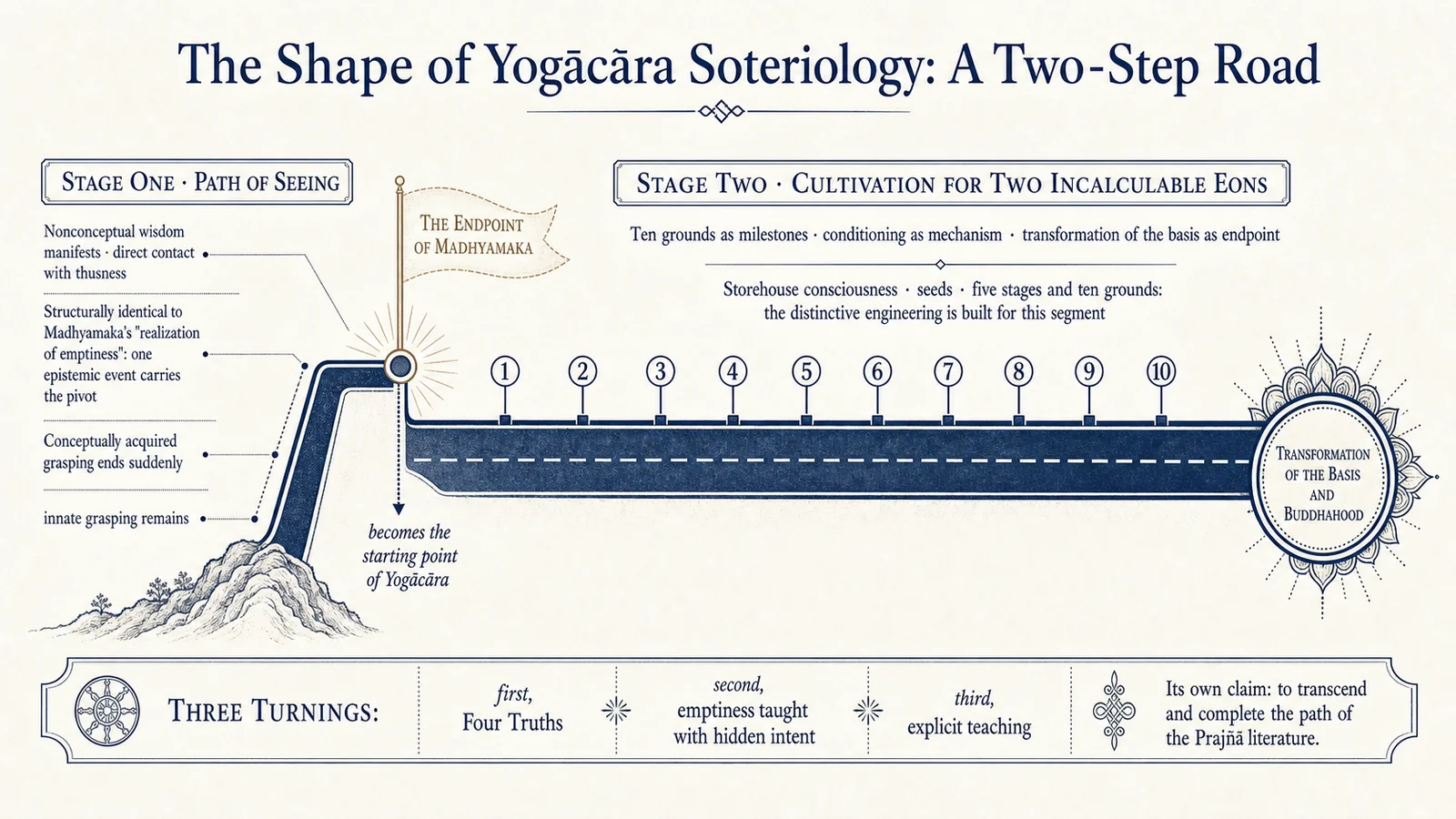
After the five questions, the overall shape of the answer must be drawn, because every test in Part II will hang upon it. Yogācāra soteriology is a two-step road. The first step is the path of seeing: nonconceptual wisdom becomes present, directly realizes thusness, and enters the real nature of Consciousness-Only. This step is highly isomorphic with Madhyamaka’s realization of emptiness. In both, one discrete epistemological event serves as the pivot; in both, the event is held suddenly to abandon conceptually acquired attachment while leaving the innate portion for the later path. The second step consists in the following two incalculable eons. To answer the difficulty that “innate grasping remains after the path of seeing,” Yogācāra builds a long road whose mechanism is conditioning, whose milestones are the ten grounds, and whose destination is transformation of the basis. Madhyamaka puts the whole burden on the first step and says little about the second—Candrakīrti’s systematization of the stages is later remedial work. Nearly all Yogācāra’s distinctive engineering—the storehouse consciousness, seeds, five stages, and ten grounds—is constructed for the second step. In other words, it turns Madhyamaka’s endpoint into its own point of departure.
This is not an imposition by the present book; the school says so plainly. The Saṃdhinirmocana Sūtra establishes a teaching of three turnings. In the first, the Four Truths were taught; in the second, emptiness was taught through an implicit characteristic; in the third, Consciousness-Only was taught explicitly. The Perfection of Wisdom teaching of emptiness is judged correct but incomplete (a halfway point), while Yogācāra presents itself as the entire course.9 “Surpassing and completing the road of prajñā” is Yogācāra’s self-claim. The shape is part of the tradition’s own account (the distinction between paths of seeing and cultivation is old), and drawing it is not itself criticism. Criticism asks about the quality of each step. Does the first step, isomorphic with Madhyamaka, inherit the problems identified in that part, as Part II, Chapters 4 and 6 will ask? Does the long engineering project of the second step genuinely explain its mechanism, as Chapter 5 will ask? And are the truth of suffering and diagnosis at its point of departure rearranged for the sake of that project, as Chapters 1 and 2 will ask?
Summary: the soteriology with the most complete mechanism
Taken together, Yogācāra answers the five questions as follows. The truth of suffering remains unchanged but gains finer detail through coarseness. Its diagnosis adds an entire architecture of consciousness beyond Madhyamaka—the manas and storehouse consciousness. The truth of cessation uses transformation of the basis to give a change at the foundational level and preserves the two stages of nirvāṇa. The truth of the path provides a complete map of five stages and ten grounds and realizes its mechanism through the arising and ceasing of seeds. Verification gives exact characteristics for every stage. Its self-positioning also differs from Madhyamaka. Madhyamaka says it establishes nothing; Yogācāra establishes without hesitation and carries establishment to the end, building one system that incorporates rebirth, karmic results, meditative concentration, and liberation into a unified explanation. This ambition “to explain everything to the end” is Yogācāra’s strongest form and the object of the preface’s judgment—attachment to foundations and certainty. Whether name and reality correspond, and what quality the two steps possess, will be tested link by link in Part II.
References
References
-
For representation-only or Consciousness-Only (vijñapti-mātra) and false imagination (abhūta-parikalpa), see Vasubandhu’s Viṃśatikā and Triṃśikā and the opening chapter of the Madhyāntavibhāga: “False imagination exists; in it, the two do not exist at all.” For translations and study, see Stefan Anacker, Seven Works of Vasubandhu (Delhi: Motilal Banarsidass, 1984). For an overview of the school, see Part VI of Volume I. ↩
-
For manas’s constant taking of the storehouse consciousness as its object, “always examining and measuring,” and permanent association with the four afflictions of delusion about self, view of self, pride of self, and love of self, see verses 5 through 7 of the Triṃśikā and fascicles 4–5 of the Cheng weishi lun. ↩
-
For transformation of the basis (āśraya-parāvṛtti) and transformation of the eight consciousnesses into four wisdoms, see fascicle 10 of the Cheng weishi lun; for relinquishing the name “storehouse consciousness” at the stage of the arahant, see fascicle 3. ↩
-
For the four kinds of nirvāṇa (originally and intrinsically pure, with a remainder, without a remainder, and without fixed abode), see fascicle 10 of the Cheng weishi lun. ↩
-
For the two kinds of death (ordinary death and inconceivable transformational death) and the three kinds of mind-made body, see the “One Vehicle” chapter of the Śrīmālādevī Siṃhanāda Sūtra (T no. 353). For definitions of ordinary and inconceivable transformational birth-and-death—coarse ripened results in the three realms produced by contaminated karma, with determinate limits to body and life; subtle and superior ripened results produced by uncontaminated discriminative karma, with body and life transformed by the force of compassionate vows and no determinate limit—see fascicle 8 of the Cheng weishi lun. ↩
-
For the five stages (provisions, preparation, seeing, cultivation, and culmination), the four preparatory levels of warmth, summit, receptivity, and highest mundane state, their four concentrations of acquiring illumination, increasing illumination, convergence with reality, and no interval, and the four investigations and four true cognitions, see fascicle 9 of the Cheng weishi lun and the “Entry into the Characteristics of the Knowable” section of the Mahāyānasaṃgraha. ↩
-
The claim that supramundane seeds arise “from seeds conditioned through correct hearing, an outflow of the completely pure Dharma realm” appears in Asaṅga’s “Support of the Knowable” section of the Mahāyānasaṃgraha. For an English translation, see John P. Keenan, trans., The Summary of the Great Vehicle (Berkeley: Numata Center, 1992). ↩
-
Verse 3 of the Triṃśikā calls the storehouse consciousness’s “appropriation, location, and discernment unknowable”—its appropriation, location, and discernment are all subtle and difficult to know. For intellectual histories of the concept, see Lambert Schmithausen, Ālayavijñāna: On the Origination and the Early Development of a Central Concept of Yogācāra Philosophy (Tokyo: International Institute for Buddhist Studies, 1987); and William S. Waldron, The Buddhist Unconscious: The Ālaya-vijñāna in the Context of Indian Buddhist Thought (London: RoutledgeCurzon, 2003). ↩
-
For the three-turning classification (the Four Truths in the first turning, emptiness taught through implicit characteristics in the second, and Consciousness-Only explicitly in the third), see the “Characteristics of the Absence of Intrinsic Nature” chapter of the Saṃdhinirmocana Sūtra. The list of questions in Part II, Chapter 2 also addresses this chapter. For the distinction between sudden abandonment of conceptually acquired obstructions on the path of seeing and gradual abandonment of innate obstructions on the path of cultivation, see fascicles 9–10 of the Cheng weishi lun. ↩