Chapter 1: A Comparative Analysis of the Five Soteriologies
The preceding six parts examined Madhyamaka, Yogācāra, tathāgatagarbha, Vajrayāna, and Pure Land in turn. This chapter returns all five to the same framework and places them side by side. They answer the same question, and their answers can be read across one table. No new argument is established; the verdicts already argued in the individual parts are juxtaposed so that their trajectory can reveal itself.
The five systems side by side
| Madhyamaka | Yogācāra | Tathāgatagarbha | Vajrayāna | Pure Land | |
|---|---|---|---|---|---|
| Shape of the road | One step: seeing emptiness is liberation | Two steps: path of seeing plus two incalculable eons | Zero steps: originally a buddha | Construction atop zero steps: heavy engineering within this body | Other-power: one does not arrive by oneself but is welcomed into birth |
| Location of suffering | Moved into views | Moved into the storehouse | Moved into the guest position | Guest position plus physiology | Moved into geography—the defiled land |
| Diagnosis | Wrong level | Correct level but too deep | Self-canceling | Engineered: the lesion is medicinal material | Changes the question: from craving to incapacity |
| Mechanism | Deficient—no construction plan | Excessive—the plan cannot be checked | Vacant—only the completed drawing | Complete but suspended—the plan is whole, its support an advance | Outsourced: the self-power principle is abolished |
| Verification | Criterion drifts | Hollowed out; authority belongs to scholastic lineage | Canceled; authority belongs to the certifier | Outer form reconstructed; authority positioned in the teacher beforehand | Moved beyond death and unrecoverable |
| Object of attachment | Intellect—argument itself | Foundation—the ultimate basis | Eternity and guarantee | Result—the resultant stage itself | Salvation |
| Mechanism of attachment | Recursion | Iteration | Advance payment | Rehearsal | Entrusting |
Three trajectories in the table
First, the object of attachment moves progressively “outside the self.” Each system grasps one thing: Madhyamaka intellect, Yogācāra foundation, tathāgatagarbha eternity and guarantee, Vajrayāna result, and Pure Land salvation. The object moves step by step from “is my understanding correct?” to “am I guaranteed and will I be taken away?” The mechanism words change accordingly: recursion, iteration, advance payment, rehearsal, and entrusting. In the first four, the self still acts; in entrusting, the self stops entirely for the first time.
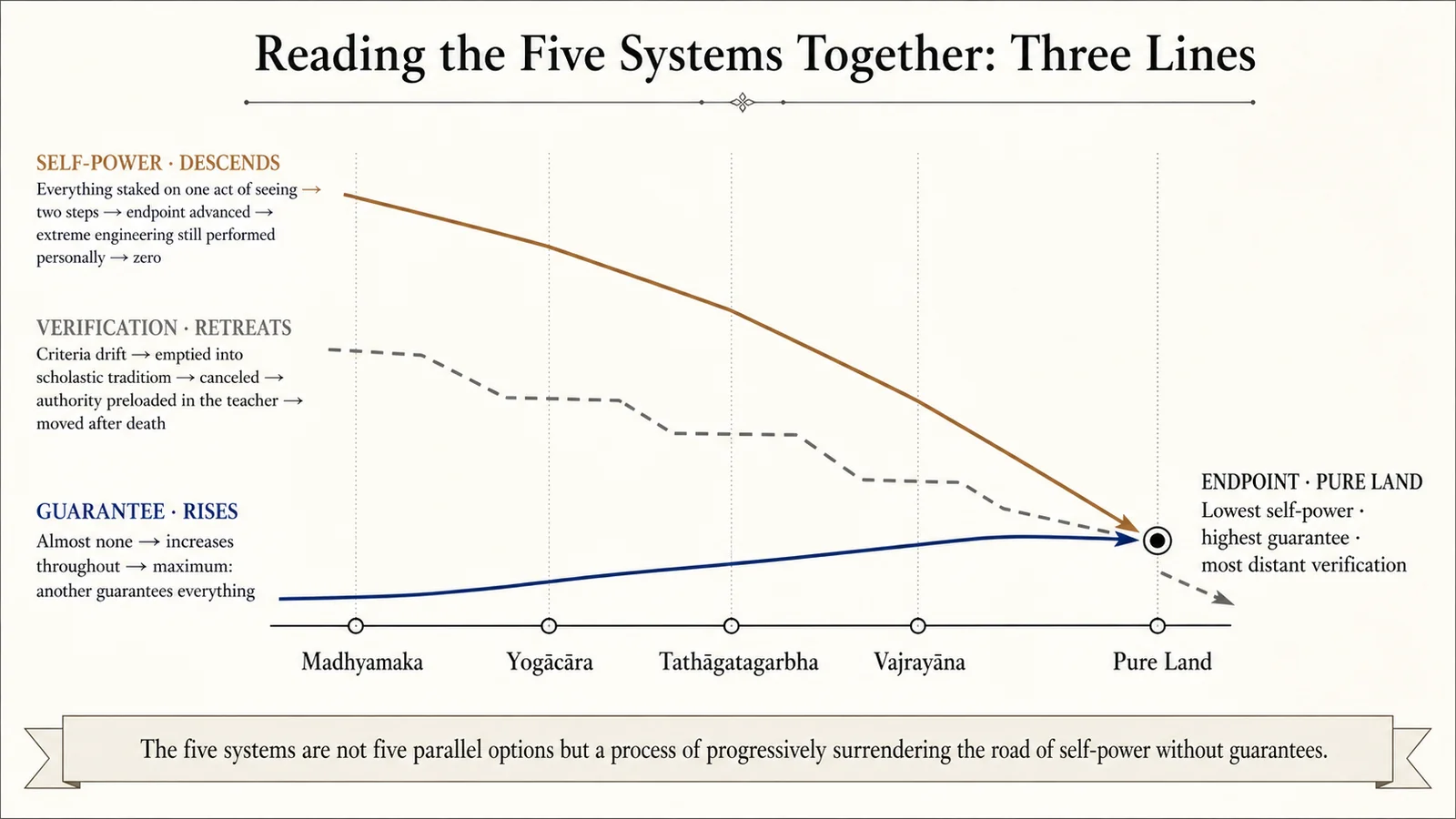
Second, self-power declines while guarantee rises, and the two lines meet in Pure Land. Madhyamaka stakes everything on one act of seeing. Yogācāra divides the road in two. Tathāgatagarbha advances the endpoint. Vajrayāna pushes self-powered engineering to its maximum but still requires personal rehearsal. Pure Land reaches zero. Guarantee begins with Madhyamaka’s near absence, grows step by step, and reaches its maximum in Pure Land. The five are therefore not five parallel proposals but stages in relinquishing “the unguaranteed road of self-power.” The less one can bear a road no one guarantees, the farther one moves toward guarantee.
Third, verification continuously retreats until no one can perform the check. Madhyamaka’s criterion drifts. Yogācāra is hollowed out and authority goes to scholastic lineage. Tathāgatagarbha cancels the object and gives authority to the certifier. Vajrayāna reconstructs the outer form but positions authority in the teacher in advance. Pure Land moves verification beyond death. The baseline’s completed statement verifiable by oneself in this life (“I know for myself there is no further becoming,” in Chapter 2 of the Introduction) loses blood one step at a time and is drained entirely in Pure Land.
The three trajectories point to one thing. Soteriology’s center of gravity moves from “in this life I see through and end my own suffering” toward “a system, another being, or an afterlife guarantees and completes me.” Pure Land is the trajectory’s endpoint and its disclosure. Viewed separately, the first four systems’ departures look like independent technical choices; read together, they move in one direction. Pure Land is not an extra fifth member of the sequence but the place toward which the sequence has always been walking (Part VI).
What deserves credit and transition
The genuine contributions of all five were recorded in their respective parts: Madhyamaka’s dismantling of the view of real existence; Yogācāra’s fine analysis of mental structure; tathāgatagarbha’s establishment of confidence for those in despair; Vajrayāna’s return of the body to soteriology; and Pure Land’s recognition of most people’s incapacity under self-power. Acknowledging contribution does not mean accepting a system’s soteriological claims as reliable. Separating those questions is the whole purpose of comparison. The next chapter extracts the tendencies shared across the five.
References
(This chapter is a synthetic comparison. For every verdict and source, see the chapters of the preceding six parts; no separate notes are added.)