Chapter 1: The Problem Structure of Soteriology
What are the central problems of soteriology? What counts as “liberation,” what is one liberated from, and by what standards can a theory of liberation be judged tenable? This chapter establishes the analytical framework of this book.
The distinction between “soteriology” and “theology of salvation”
This book uses “soteriology,” understood as a theory of liberation, rather than “theology of salvation” to translate and describe the relevant Buddhist theories. This choice is not merely a matter of Chinese usage; it has philosophical reasons. In Christian theology, “redemption” and “salvation” carry specific meanings: the forgiveness of sin, the payment of a debt, and reconciliation with God.1 This framework presupposes an external power capable of saving and a human condition that is fallen in either a moral or an ontological sense. The Buddhist schema of liberation is fundamentally different in structure. Even when Mahāyāna traditions speak of the compassionate vows and blessings of buddhas and bodhisattvas, their logical basis remains essentially different from that of Christian theories of salvation: liberation is achieved not by cleansing a debt of sin but by dispelling ignorance and ending craving.
In the Pāli tradition, “liberation” (vimutti; Sanskrit: vimukti) means the mind’s release and loosening from bondage. That bondage is cognitive and affective, not legal or theological. “Soteriology” therefore preserves the central meaning more faithfully: it is a theory of how human beings are released from the bonds of suffering (dukkha), not a doctrine of how they receive divine forgiveness. This book will use “soteriology” throughout, as a reminder that the claims of each school must always be considered within this distinctively Buddhist problem structure.
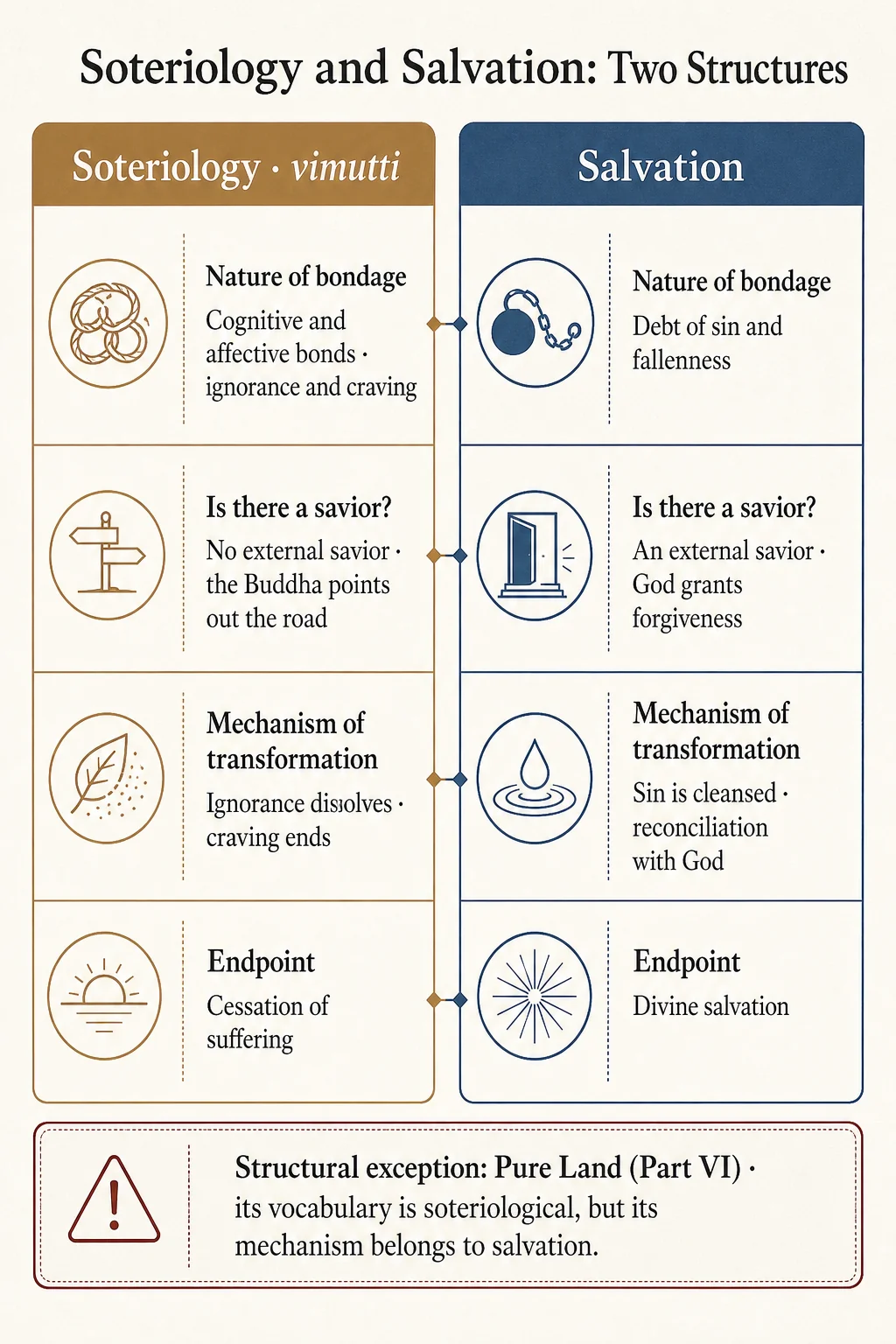
There is, however, one exception to this structural distinction that must be identified separately: Pure Land Buddhism. The preceding claim that Buddhist liberation differs from salvation applies to the mainstream schema. Pure Land soteriology has in fact crossed the boundary of soteriology and entered theology in the strict sense. It contains all the structural elements of Christian salvation theology: an external power capable of saving (Amitābha Buddha and his fundamental vows), a fallen condition from which beings cannot readily escape through their own power (beings in the Sahā world are heavily burdened by karma, and this world is deemed unfit for practice), and a path of salvation dependent on reception by other-power (reciting the Buddha’s name, being received at death, and attaining rebirth in the Pure Land). In its stated terms, Pure Land Buddhism still speaks the language of liberation: rebirth does not equal buddhahood, the Land of Bliss is described as a place more conducive to practice, and practitioners must continue along the path after arriving there. Yet close attention to the function of this account shows that it is far removed from merely “going somewhere favorable in order to practice.” According to its own doctrine, those reborn in the Land of Bliss immediately dwell at the stage of “non-retrogression” (avaivartika); from then on, their buddhahood is assured and they can never fall back.2 Functionally, therefore, rebirth is no longer “an opportunity to practice” but “a guarantee of buddhahood.” Its terminology belongs to soteriology, but its mechanism belongs to a theology of salvation: the step that actually determines one’s fate is being received by an external power and taken out of this world, not eliminating ignorance within this world. In this respect, Pure Land Buddhism is the only Buddhist system for which “theology of salvation” is more apt than “soteriology.” This book will still analyze it within a soteriological framework (see Part VI), but readers must remember that it remains a structural outlier within that framework.
The Pure Land example also points to a more general phenomenon that deserves notice before the analysis begins. The method just used was to distinguish the “status nominally claimed” for a concept from the “function it actually performs.” The two do not always coincide. This displacement between claim and function repeatedly appears throughout Mahāyāna systems and nearly constitutes a characteristic structure. Later parts of this volume will examine the following examples in detail; they are only previewed here.
Within the Yogācāra system, the storehouse consciousness functionally plays something very much like the role of a “self”: it extends across the three times, retains seeds, maintains the continuity of karmic results, and secures the continuity of the subject of rebirth. Nearly every function that would otherwise have to be performed by something occupying the place that early Buddhism emptied through its teaching of non-self falls to the storehouse consciousness. Yet Yogācāra must still insist in its doctrinal language that this consciousness arises and perishes from moment to moment, is neither permanent nor unitary, and is emphatically not a self. In Madhyamaka practice, ultimate truth functionally serves as a supreme criterion against which every conventional statement is measured. Yet Madhyamaka never ceases to use it while simultaneously declaring it to be only a raft for crossing the river, an expedient established to break attachment, and not something to be grasped as truly existent. With tathāgatagarbha, matters become still more confused: the schools internal to the tathāgatagarbha tradition disagree over whether this “true permanence” is genuinely permanent, whether it truly exists or is only provisionally designated. Some take it as a definitive and literal teaching; others treat it merely as an expedient construction intended to guide sentient beings. There is no consensus.
This book holds that all three examples share the same feature: a concept plays role A within a system, while the system verbally insists that it is not A. This volume does not intend simply to accuse such systems of “self-contradiction.” The gap between claim and function may sometimes be precisely where a theory does its work; it is not necessarily a defect. But readers of Mahāyāna soteriology must develop a habit: do not attend only to what a system “says” a concept is; also examine what that concept “does” within the mechanism as a whole. Separating the level of claims from the level of functions is one of this volume’s basic analytical methods. The four fundamental questions distilled below, especially the question of mechanism, are tools for bringing this gap into view.
A prior premise: the truth of suffering
Before those fundamental questions can be posed, a still prior premise must be put in place; otherwise the entire framework will remain suspended in midair. The sequence of the Four Noble Truths is suffering, its origin, its cessation, and the path. It begins with the truth of suffering, not the truth of origin: first establish that suffering exists, then ask how it arises. This sequence is not arbitrary. Every soteriology takes for granted that “there is suffering to be ended,” but that premise must itself be established rather than merely assumed.
More precisely, the truth of suffering must answer two questions. First, does suffering exist universally and certainly? Second, what exactly does “suffering” mean here? To skip this level and proceed directly to the question “Where does suffering come from?” is to conceal a subtle arrogance: it assumes that the existence of suffering is an accomplished fact requiring no argument, treating as self-evident background what ought first to be established as a proposition. The diagnostic question, where suffering comes from, logically depends on the truth of suffering. If the truth of suffering has not been established, diagnosis has no object to diagnose.
Whether suffering is universal is precisely what the parties do not all concede. To some, birth, aging, illness, death, separation from what one loves, and failure to obtain what one seeks make the universality of suffering virtually self-evident. To others, life possesses its own joys, and judging existence as a whole to be “suffering” instead appears to impose a biased undertone. The disagreement is difficult to resolve because it is tightly bound to the second question: the contending parties often mean entirely different things by “suffering” (dukkha). The Pāli word dukkha does not simply mean everyday pain or “life is miserable.” It is closer to the structural deficiency by which all conditioned phenomena, being impermanent, are ultimately unreliable and incapable of perfect fulfillment. A person may live a subjectively happy life and still remain within suffering in the sense of dukkha.3 Whether the universality of suffering is accepted and how suffering is defined are two sides of the same problem.
In contemporary sectarian discourse one often hears: “People who study Southern Buddhism think life is miserable, so they seek only their own liberation.” This statement is seriously defective, and this volume will respond to it directly in the chapter on Southern Buddhism. The point here is not where it goes wrong but what the form of the error reveals. The speaker understands the truth of suffering in the everyday sense of “life is miserable,” as though Southern Buddhism began from a pessimistic mood about life. The dukkha on which the Southern tradition itself relies, however, is a far more technical, structural concept and has nothing to do with emotional pessimism. One party reads the same word “suffering” as the intensity of a subjective feeling; the other reads it as a universal characteristic of conditioned phenomena. Their standards are completely different, and misunderstanding follows. This example shows that the way suffering exists in an ordinary sense, and what suffering actually is, constitute a prior question still awaiting clarification. It differs from the diagnostic question discussed below (where suffering comes from), and precedes diagnosis. In judging each soteriology, this volume’s first step is to determine what it posits as “suffering,” because once that step differs, the ensuing diagnosis, mechanism, and verification no longer occupy the same coordinate system.
The four fundamental questions of soteriology
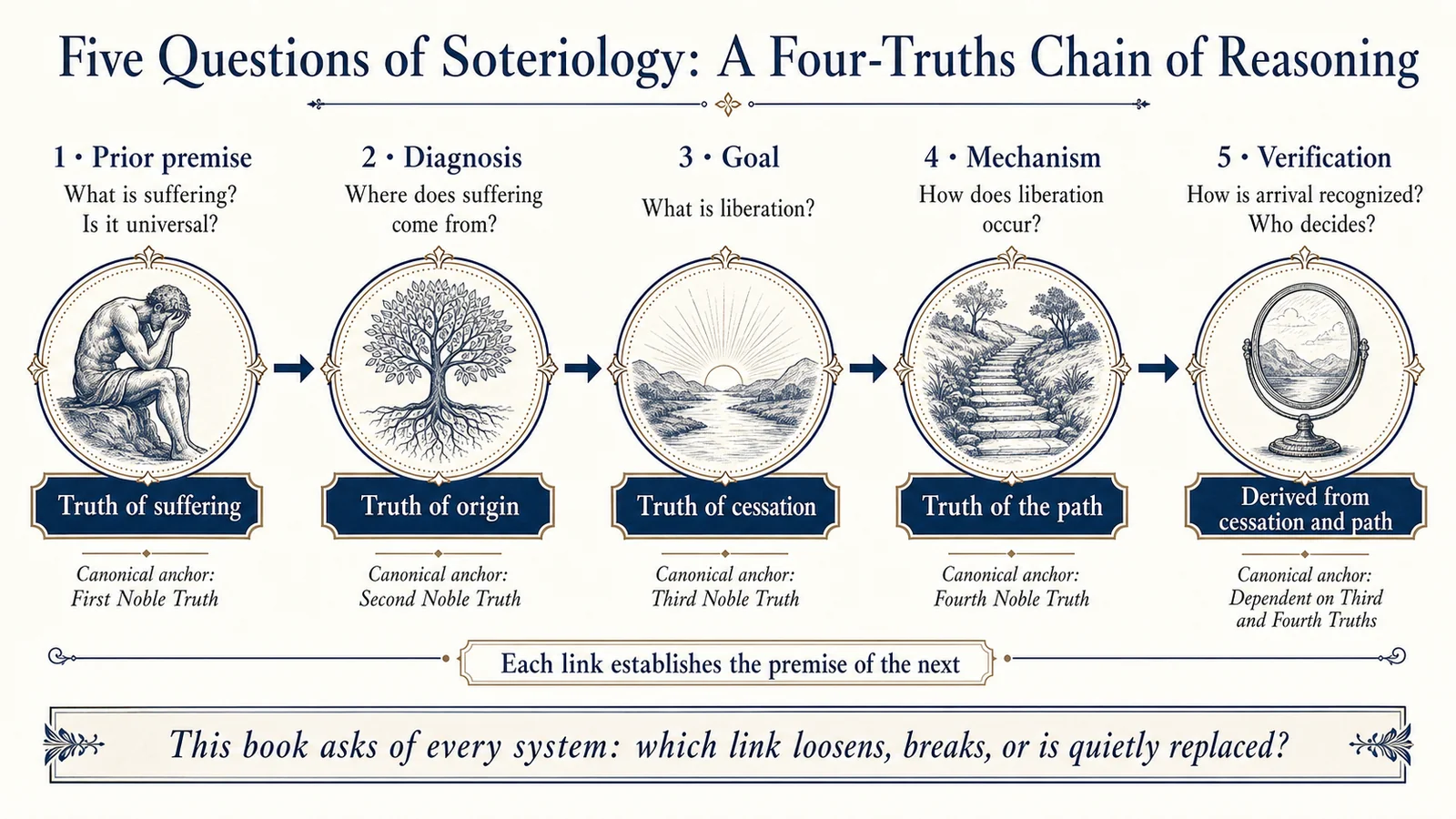
On the premise established by the truth of suffering, every soteriology, however complex its metaphysical commitments, must directly answer four fundamental questions. Together with the preceding premise, these four questions form the book’s basic framework for analyzing the schools.
One correspondence should be made explicit at the outset: this framework is not imposed on Buddhism from outside this volume. It is almost exactly the structure of the Four Noble Truths themselves. The truth of suffering establishes the premise—what suffering is and whether it is universal. The truth of origin corresponds to the diagnostic question below—where suffering comes from. The truth of cessation corresponds to the question of the goal—what liberation is. The truth of the path corresponds to the question of mechanism—how liberation occurs. The question of verification is an epistemological inquiry derived from the truths of cessation and the path—how one knows that the destination has been reached. Gautama’s teaching is a remarkably rigorous system in this respect: the Four Truths are not four parallel dogmas but a chain of reasoning in which each truth establishes a premise for the one that follows. Much of this volume’s work consists in clarifying that chain anew and then using it to measure where each school loosens, breaks, or substitutes one term for another. One qualification must be stated in advance: precisely because this framework is abstracted from the Four Noble Truths, its agreement with early Buddhism is not an independent test of early Buddhism—that would be circular reasoning. The framework’s efficacy becomes apparent only when it is used to assess Mahāyāna systems not derived from the Four Noble Truths. The next chapter will address this point specifically.
The first is the diagnostic question: Where does suffering come from? Why are human beings bound? The answer determines the direction of the entire soteriology. Early Buddhism answers craving (taṇhā) and ignorance (avijjā); Madhyamaka answers the view of intrinsic existence (svabhāva-dṛṣṭi); Yogācāra answers consciousness’s dualistic grasping of object and subject (grāhya-grāhaka); tathāgatagarbha systems answer adventitious afflictions (āgantuka-kleśa) that obscure the intrinsically pure mind; Vajrayāna answers the failure to recognize primordially pure awareness (rigpa); Pure Land Buddhism often answers that sentient beings bear heavy karmic obstructions and that the Sahā world is unfit for practice. Different diagnoses naturally yield different treatments. The diagnostic question is therefore the first key to understanding the disagreements among soteriologies.
The second is the question of the goal: What is liberation? What state remains when suffering has completely ceased, and how is that destination described? This question corresponds to the truth of cessation and stands between diagnosis and mechanism. The truth of suffering provides only the starting point; unless the destination is first determined, the path of liberation has no direction. This step cannot be omitted because, even when systems agree that “there is suffering,” they can set diametrically opposed destinations. Some speak of the nonduality of saṃsāra and nirvāṇa, or say that birth-and-death itself is nirvāṇa. Some say that the afflictions themselves are awakening and do not fundamentally regard them as suffering that must be eliminated. Others speak more straightforwardly of leaving suffering, obtaining happiness, and reaching another blissful realm. Once the destination differs, the same word “liberation” names entirely different places. The truth of cessation, the goal, is therefore a premise of the truth of the path—the mechanism: unless the destination is clear, a path cannot be judged correct or mistaken. It is likewise a premise of verification, for the judgment “has one arrived?” makes sense only after “what is the destination like?” has been specified. This volume pays particular attention to whether each system explains this step clearly or merely borrows words such as “liberation,” “nirvāṇa,” and “buddhahood” without fixing their referents.
The third is the question of mechanism: How does liberation occur? What is the actual mechanism of transformation? This is both the most central and the most easily neglected problem of soteriology. If a theory says only that “liberation is attained by eliminating ignorance” without explaining how ignorance is eliminated or what mechanism eliminates it, then the theory is incomplete. The mechanism proposed by early Buddhism is this: through knowledge and vision of things as they are (yathābhūtañāṇadassana)—directly observing impermanence, suffering, and non-self—craving is weakened; once craving weakens, the conditions for suffering’s arising are removed, and suffering accordingly ceases. This is a comparatively clear causal chain. Other systems each offer their own account of the mechanism, and one task of this book is to assess whether those accounts are internally coherent and whether they genuinely explain how transformation occurs.
The fourth is the question of verification: How is liberation recognized, and who has the authority to recognize it? Verification concerns the basis of a soteriology’s credibility. Early Buddhism offers a kind of phenomenological verification: the mind becomes more stable and afflictions diminish. These are observable changes within this world, immanent changes, that both the practitioner and those nearby can partially discern. As the theories of the various systems develop, their criteria of verification become increasingly elitist and devoid of discernible signs: in Chan, “seeing one’s nature” requires a teacher’s confirmation; in Vajrayāna, attainment requires recognition by a guru; in tathāgatagarbha systems, realization of the “intrinsically pure mind” is almost imperceptible to outsiders. This tendency is not an inconsequential side issue; it bears directly on the epistemological standing of soteriological claims.
This book’s critical framework: early Buddhism as the baseline
This book takes early Buddhist soteriology as its baseline for several reasons.
First is historical priority. Early Buddhism represents the earliest and most historically credible form of Buddhist teaching that can be traced. Although scholars disagree in many respects about reconstructing “precanonical Buddhism,” the core teachings of the Four Noble Truths, the Noble Eightfold Path, and dependent arising are recorded with sufficient consistency in both the Northern and Southern transmissions. Their historical credibility is greater than that of the complex developments of the various Mahāyāna systems. Second is internal consistency. Early Buddhist soteriology possesses a high degree of theoretical consistency: the logical connections among diagnosis (craving and ignorance), mechanism (seeing things as they are), goal (the cessation of suffering), and path (the Noble Eightfold Path) are clear and do not require numerous external metaphysical commitments. Third is relative metaphysical restraint. Early Buddhism maintains a cautious silence on metaphysical questions—the Buddha does not answer the fourteen undetermined questions. It posits no first cause, establishes no hierarchy of ontological levels, and affirms no truly permanent entity. The metaphysical commitments required by its soteriology are comparatively few. This gives the critic a clear point of reference: any system that adds metaphysical commitments must explain whether those additions are soteriologically necessary. The word “relative” matters, because this teaching is not free of commitments. The cosmology of rebirth is one of its load-bearing presuppositions, and half the weight of the suffering inherent in conditioned existence depends on rebirth to sustain it. Praise for “restraint” should not conceal that bill; the next chapter will address it specifically in the section “The Baseline’s Metaphysical Bill.” For now it is enough to explain why it does not dislodge the baseline. The premise of rebirth is shared by every later system: the bodhisattva’s three incalculable eons, rebirth in a Pure Land, and the Vajrayāna intermediate state all operate within saṃsāra. By using that common premise as a foundation, we can test what each school adds beyond what is shared. Criticisms that remain within the common premise can stand without depending on the baseline’s position.
The focus of this book must be stated plainly. Its question is not “Is this authentic Buddhism?” but “Can this soteriological claim stand as a theory?” These are entirely different questions, and this book addresses only the latter.
The boundary of criticism: distinguishing theoretical claims from practical efficacy
The object of this book’s criticism is the theoretical claims of each system’s soteriology, not the actual effects of the practices associated with it. This distinction is essential to understanding the book’s position.
“The theoretical claims of a soteriology” means a system’s explicit propositions about the nature of suffering, the mechanism of liberation, the goal of liberation, and the verification of liberation. The theoretical claims of Pure Land soteriology, for example, include the propositions that Amitābha Buddha made the Eighteenth Vow, that rebirth in the Pure Land is a genuinely practicable path to liberation, that recitation of the Buddha’s name is the principal condition for rebirth, and that the Pure Land is a domain of existence with specific characteristics. These are propositions that can be theoretically assessed.
“The actual efficacy of a religious practice,” by contrast, means whether a method actually reduces practitioners’ suffering, improves their psychological condition, and strengthens their compassion and wisdom. This is an empirical question. It must be answered by observing real changes in practitioners and cannot simply be deduced from theoretical claims.
This book holds that the two can, and must, be evaluated separately. It is entirely possible for a soteriology’s theoretical claims to contain grave philosophical problems while practices associated with it genuinely help particular practitioners. At the theoretical level, for example, Pure Land recitation faces epistemological difficulties associated with salvation by other-power. Yet as a practice of concentration, reciting the Buddha’s name may in fact reduce mental distraction and strengthen meditative stability. This effect does not require belief in Pure Land cosmology to explain it. The book criticizes the theoretical problems of the various soteriologies, but it does not thereby claim that those who practice their methods receive no benefit. A corresponding boundary also applies: this volume’s diagnoses concern structures of discourse and theory, not the psychology of any person or group. When “attachment” is used as a term of judgment, it identifies a system’s functional orientation, not the individual practitioner’s motives.
The overall structure of Volume II
This volume proceeds from baseline to particular systems and from particular systems to synthesis. The Introduction, Part I, establishes the critical framework, distills the early Buddhist baseline, and surveys the overall pattern of transformation among Mahāyāna systems. Part II, on Madhyamaka, then examines how Nāgārjuna’s doctrine of emptiness reconstructs soteriology and evaluates its gains and losses for a theory of liberation. Part III, on Yogācāra, addresses the mechanism of transformation of the basis in Consciousness-Only and the theoretical tensions introduced into soteriology by the concept of the storehouse consciousness. Part IV, on tathāgatagarbha, examines how buddha-nature theory introduces into soteriology a danger approaching eternalism and considers the strategies developed by different schools in response. Part V, on Esoteric Buddhism, assesses the promise of attaining buddhahood in this very body and the difficulties that its system of empowerment and lineage poses for verification. Part VI, on Pure Land, analyzes the structure of salvation by other-power and its fundamental tension with early Buddhism’s principle of relying on one’s own effort. Finally, Part VII, the synthetic critique, uses the book’s preceding criticisms to propose positive criteria for a “credible soteriology” and concludes the volume. Each part devoted to a particular system follows a common format. Its first half presents the strongest form of that soteriology through the five questions, without criticism. Its second half tests it truth by truth in the order of suffering, origin, cessation, path, and verification, and concludes with a judgment concerning attachment and an overall assessment. The format is itself part of the method: first allow each system to finish making its case, then check it link by link.
The intention of this structure is to reveal a philosophical picture of Buddhist soteriology as a whole by analyzing the specific contributions and specific difficulties of each system’s theory of liberation.
References
References
-
“Redemption” and “salvation,” understood as forgiveness of sin, payment of a debt, and reconciliation between humanity and God, form a central structure of Christian theology. See Alister E. McGrath, Christian Theology: An Introduction, 6th ed. (Oxford: Wiley-Blackwell, 2016), chap. 11, on metaphors of salvation, including “reconciliation.” ↩
-
The claim that those reborn there dwell at the stage of “non-retrogression” (avaivartika/avinivartanīya) occurs in the Amitābha Sūtra: “The sentient beings born in the Land of Bliss are all avaivartikas; among them are many who will attain buddhahood after one more life.” (Taishō Tripiṭaka, vol. 12, no. 366, trans. Kumārajīva.) The Infinite Life Sūtra, in the passage on the fulfilment of the vow (fascicle 2), expresses the same point: “all sentient beings born in that land dwell in the rightly determined group,” and those who hear the name with a believing mind “attain birth at once and dwell in non-retrogression” (trans. Saṅghavarman, Taishō Tripiṭaka, vol. 12, no. 360). For scholarly discussion, see Luis O. Gómez, The Land of Bliss: The Paradise of the Buddha of Measureless Light (Honolulu: University of Hawai‘i Press, 1996). ↩
-
Dukkha is not limited to “pain” in the ordinary sense. Tradition analyzes it into three forms: the suffering of pain (dukkha-dukkha), the suffering of change (vipariṇāma-dukkha), and the suffering inherent in conditioned existence (saṅkhāra-dukkha). The last refers to the structural deficiency by which all conditioned phenomena, because they are impermanent and conditioned, are ultimately unfulfilling and unreliable; it most clearly conveys the technical meaning of dukkha. See Rupert Gethin, The Foundations of Buddhism (Oxford: Oxford University Press, 1998), 61–62; for canonical evidence of the three forms, see Saṃyutta Nikāya 38.14, among other texts. ↩