Part II, Chapter 1: The Truth of Suffering—From Observable Formations to an Unknowable Storehouse
The three chapters of Part I presented Yogācāra soteriology in its strongest form. Criticism begins here and again follows the order of the five questions: first suffering, then origin and cessation, followed by two chapters on the path (the continuation of confrontation and the mechanism’s empty rotation), then verification, a concluding judgment of attachment at the functional level, and finally an overall assessment. The rule of every chapter remains unchanged: first give Yogācāra its strongest defense, then judge.
This chapter tests the furthest upstream question. Chapter 1 of Part II in the Madhyamaka part concluded that, beneath its claim that “the truth of suffering remains unchanged,” Madhyamaka moves suffering from formations into view. Yogācāra initially appears to do the opposite. Far from weakening the suffering inherent in conditioned existence, it gives that suffering a bodily name—“coarseness.” Yet close attention to suffering’s final location within the system reveals a move of a different kind. Suffering moves not into view but into the storehouse: out of the observable stream of experience and into an unobservable warehouse of seeds.
1. Credit first: Yogācāra strengthens the suffering inherent in conditioned existence
One statement should be made at the outset. The baseline sets its measure at the suffering inherent in conditioned existence, as Chapter 2 of the Introduction explained, and among the Mahāyāna systems Yogācāra takes that suffering most seriously. The term coarseness (dauṣṭhulya) gives “the unreliability of the aggregates’ very continuation” a texture perceptible in body and mind. Defiled seeds accumulate in the continuum and make body and mind heavy, rigid, and unworkable; the counteractive direction is pliancy and workability. “All contaminated phenomena are suffering” is not merely a judgment here but a category of practice with remedies, stages, and bodily indicators. At the level of claim, Yogācāra’s truth of suffering possesses the greatest continuity with the baseline among the five systems.
The establishment of transformation of the basis should likewise receive credit. Chapter 1 of Part II in the Madhyamaka part argued that the nonduality of saṃsāra and nirvāṇa prevents suffering from being inherent in formations. Yogācāra does not follow that route. It accepts that the defiled dependent nature as a whole is suffering and that liberation requires a change at the level of the basis. In literal terms, Yogācāra preserves the baseline’s judgment that suffering resides in formations.
2. But suffering’s final location is unknowable
The problem appears at the next step. Suffering lies in the stream of consciousness; the stream’s defilement lies in seeds; seeds are stored in the storehouse consciousness; and the storehouse consciousness is “unknowable,” as Part I, Chapter 1 explained. Follow this chain of placement to its end and the truth of suffering undergoes a silent qualitative change. Suffering’s ultimate location moves from a feature of experience observable here and now by anyone (impermanence, oppression, and unreliability) into the internal state of a theoretical posit: the existence and strength of contaminated seeds within the storehouse consciousness.
The cost of this move must be stated clearly. The baseline’s truth of suffering is a report of observation. The suffering inherent in conditioned existence is deep, but it appears within the stream of experience and is in principle accessible through the observations of the four establishments of mindfulness, as Chapter 2 of the Introduction explained. Yogācāra’s truth of suffering is a theoretical diagnosis: you suffer because your fundamental consciousness contains defiled seeds that you cannot see. The former invites testing; the latter demands trust. The epistemological status of the truth of suffering, the prior premise of the entire framework, changes from “a point of departure available to common observation” into “an inference internal to the system.” The starting point’s weight is pawned to the system’s explanatory power.
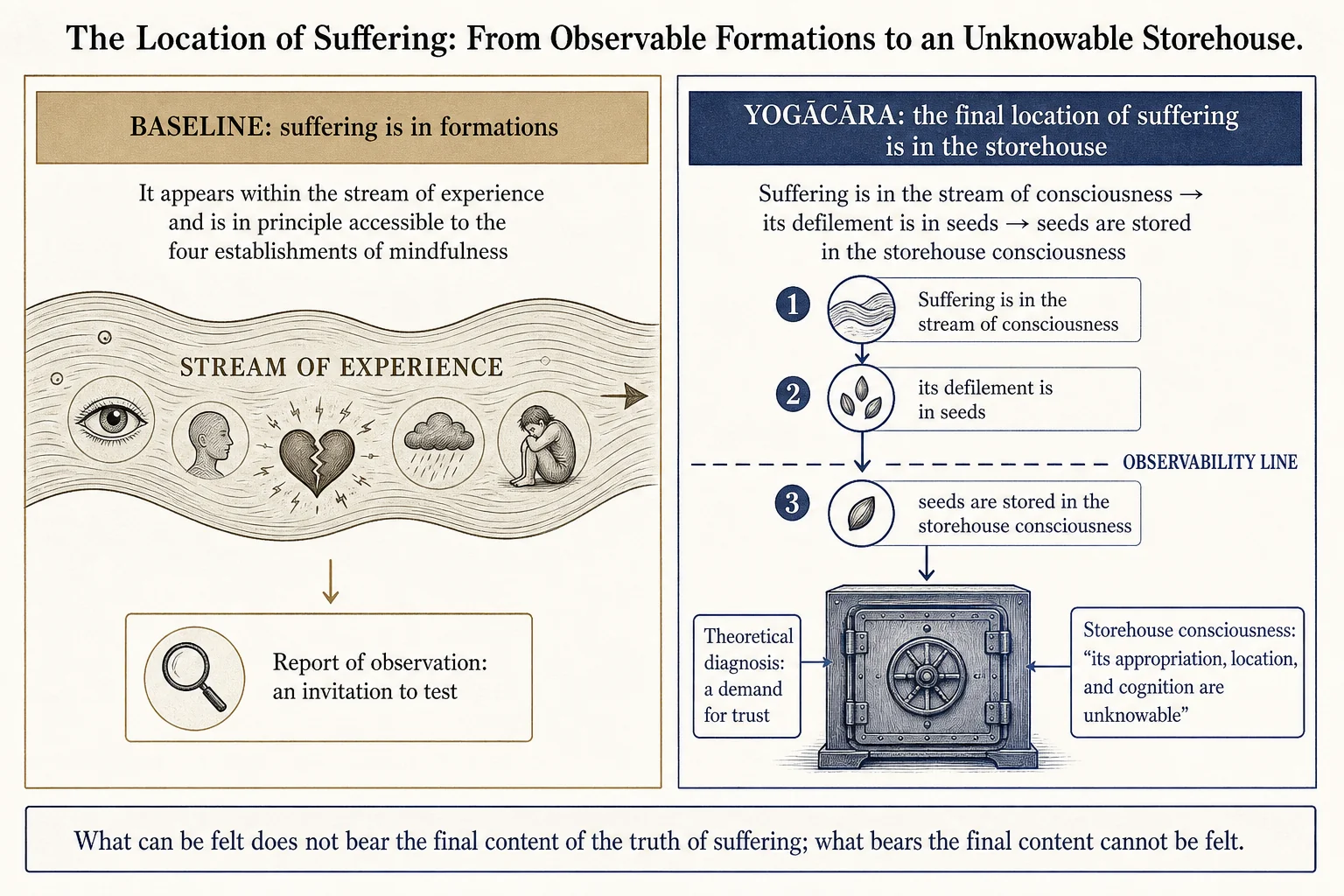
Yogācāra has a ready reply. Suffering has not left experience: coarseness is its bodily and mental texture, and pliancy is evidence of its reduction; only suffering’s latent form is placed within the storehouse consciousness. Half of this response must be accepted as it stands. The system genuinely preserves a perceptible manifest face of suffering, as the preceding section acknowledged. But the other half cannot be accepted. Under the system’s own rules, coarseness is the manifest result of seeds, while seeds are the substance of suffering’s cause. Results are perceptible; causes are not. Which coarseness corresponds to which seed is guaranteed entirely by the theory and cannot be independently checked. The perceptible portion therefore does not bear the truth of suffering’s final content; the portion that bears its final content cannot be perceived. The reply clarifies the division of labor and, by doing so, restates this chapter’s criticism.
3. Comparison with Madhyamaka: two moves
Place the findings of the two parts side by side. Madhyamaka moves suffering into view, silently deleting the second level of conditioned suffering—the aggregates’ continuation is itself suffering. Yogācāra moves suffering into the storehouse. It preserves conditioned suffering but gives up its observability. The two moves go in different directions but spring from the same motive. Each system places liberation’s mechanism upon its own central act (Madhyamaka on seeing emptiness, Yogācāra on transformation of the basis), and moves suffering into the place that act can affect. Seeing emptiness acts upon view, so suffering must reside in view. Transformation acts upon the basis, so suffering must reside in the storehouse. Diagnosis accommodates mechanism instead of mechanism following diagnosis. Both systems share this reversal of order, though each produces a different shape from it.1
4. An ambiguity within the framework of the three natures
An ambiguity internal to the level of claim must also be registered. First, restate the three natures in one sentence; see Volume I, 6.4 for the detailed account. The imagined nature is the mistaken recognition that an appearance is a real thing external to mind and is entirely fictional. The dependent nature is the appearing activity of the stream of consciousness arising through causes and conditions; it exists but lacks intrinsic nature. The perfected nature is the fact that the imagined nature never exists within the dependent—that is, thusness. The three natures mark separate territories for “what is mistaken,” “what is occurring,” and “what is true.” To which nature does suffering belong? If it belongs to the imagined, suffering is a product of misrecognition and ends when misrecognition ends, which falls into the Madhyamaka pattern of “suffering is in view.” If it belongs to the defiled dependent nature, suffering is inherent in the dependently arisen stream of consciousness itself, and transformation of the basis is necessary. Yogācāra orthodoxy gives the latter answer, but some of its formulations (Consciousness-Only without external objects, objects appearing from mind, and the original emptiness of the imagined) continually leak toward the former. Fine distinctions within later Consciousness-Only, such as “a nature-object does not follow the mind” and “a solitary image follows only the perceiving part,” are partly intended to stop the leak. The terminology is dense, so it can be laid out in modern language:
| Formulation | What it says | In modern language |
|---|---|---|
| Consciousness-Only without external objects | Only consciousness, cognitive activity, actually occurs; no independently established object exists outside consciousness | Every object in experience does not exist on its own outside cognition. What is denied is the “thing outside mind,” not appearance itself |
| Objects appear from mind | Appearing objects are all results of transformations of consciousness | The world you see is an image projected after processing by consciousness; its source is internal, not external |
| The imagined is originally empty | The level grasped as real outside mind, the imagined nature, has never existed | What is mistaken is not appearance but the determination “this appearance is an independent real object.” The thing produced by that determination was never there |
| A nature-object does not follow the mind | One of three kinds of object: an object with its own seeds and actual substance and function (such as colors and sounds presently perceived by the five consciousnesses) that does not change its nature with the discrimination of the apprehending mind | Within the system, one class of object is acknowledged to have “a provenance of its own.” However you think about it, it remains what it is; this is the level closest to “objectivity” within Consciousness-Only |
| A solitary image follows only the perceiving part | One of three kinds of object: an image with no seeds of its own and produced solely by the apprehending part (such as memories, dreams, a turtle’s hair, or a rabbit’s horn) which follows mind completely | Another class of object is entirely drawn by mind itself and follows thought completely |
The first three formulations push toward “objects are unreal.” Without limits, suffering would become a product of misrecognition together with the objects. The last two come from the traditional rule of three kinds of object attributed to Xuanzang.2 They stratify “objects” and preserve a place for “some objects do not follow however you think,” thereby reaffirming within the system the real weight of the defiled dependent nature. This chapter will not enter the details of commentarial history. It points out only that suffering’s location is not wholly stable within the system; the two endpoints of its movement are precisely the Madhyamaka-style move and the seed-style move. The pressure comes from one source: a system that makes consciousness the basis of everything has difficulty leaving a clean place for “suffering not produced by consciousness’s misrecognition.”
The movement has named representatives within the tradition. Sthiramati’s lineage classifies both perceiving and perceived parts under the imagined nature, making the territory of misrecognition extremely broad and pulling the pathology of suffering toward “a product of misrecognition.” Dharmapāla’s lineage insists on the real existence of the appearances of consciousness in the dependent nature; only then can “the defiled dependent nature as a whole is suffering” stand securely. Xuanzang transmits Dharmapāla’s line. Sthiramati’s commentary on the Triṃśikā survives in Sanskrit and Tibetan, and Paramārtha’s older Chinese translations likewise incline toward Sthiramati.3 The dispute between one and four parts is usually treated as an epistemological case. Soteriologically, it is also a dispute over suffering’s location: the two endpoints of movement identified here already appear in the division among masters.
5. Historical corroboration: why seeds had to be posited, and who rejected them
The chapter’s question was not absent from the tradition. Setting out the history both makes the account fair and explains why Yogācāra insists on “a cause of suffering within seeds” beyond “observable suffering.” Part I, Chapter 3’s table already gave the arguments establishing the storehouse consciousness as a system-level posit; the present concern is only the line of motivation directly related to the truth of suffering.
First consider the reason for insisting on seeds. The four establishments of mindfulness can reach only manifest activity: greed arising now and feeling occurring now. But the schools repeatedly confronted an observable fact: afflictions return unchanged after remaining unmanifest for a long time. In deep concentration, afflictions do not arise; after leaving concentration, they flare up again. Infants display no active greed or aversion, yet neither is missing when they grow. The Majjhima Nikāya’s simile of the infant already gives this a proper name: latent tendency (anuśaya), an affliction’s dormant state.4 How the dormant state exists became a subject of sectarian dispute. Sarvāstivāda connects it through “acquisition”; Sautrāntika calls it a “seed”; the Theravāda commentarial tradition establishes the life-continuum mind; Yogācāra adopts Sautrāntika’s metaphor and builds a warehouse for the seeds. The driving force behind seed theory is therefore not that “suffering is difficult to observe,” but that “the interruption and recurrence of affliction are observable.” Add a doctrinal iron law: mundane concentration can only suppress afflictions; only the noble path can end them forever.5 Suppression and severance are indistinguishable at the manifest level—both appear as “not arising.” Their difference must therefore reside at the latent level, and the system requires a realist grammar of latency. The six characteristics of seeds and the capacity to be conditioned and retain seeds all write “suppressed but not severed” and “permanently severed” as two different states of inventory.
This reason must be acknowledged honestly: it has a genuine observational point of departure. The criticism applies to the next step. Acknowledging dormant tendencies is one thing; writing them as a stock of entities stored in an unknowable place is another. The baseline faces recurrence too. Its treatment allows “latent tendency” to remain a dispositional description (this person will still become greedy when conditions arise), and leaves testing to time and manifestation: only if greed does not recur through long exposure to many conditions can it be called severed. It establishes no ontological residence for the tendency. Yogācāra reifies a tendency as a seed, gaining precision in its account of mechanism at exactly the cost described in this chapter: the ultimate forms of suffering and its cause are placed within a basis no one can inspect.
Rejection did occur and came from within Buddhism. In chapter 6 of the Madhyamakāvatāra, Candrakīrti directly denies the necessity of the storehouse consciousness: karma does not cease by intrinsic nature and can therefore produce results without a storehouse; scriptural statements concerning the storehouse consciousness are expedient provisions for people unable to enter the profound meaning of emptiness directly.6 Bhāvaviveka likewise gives a systematic criticism of Yogācāra metaphysics of consciousness.7 This Madhyamaka line shares the present chapter’s point: explaining karmic results and recurrence does not require positing an unobservable repository. Yogācāra’s reply is also on record. Without a real dependent nature, causation between defilement and purity has no support; emptiness carried to the end becomes a badly grasped emptiness. Volume I, 6.5 described this dispute over emptiness and existence. Modern scholarship restates the same dispute in philological and philosophical language. Schmithausen’s research argues that the initial motivation for the storehouse consciousness was to solve an exegetical problem concerning the attainment of cessation: it was a product of theoretical pressure rather than a report of contemplative observation. Waldron defends it as a reasonable theorization of a “Buddhist unconscious.” The “Critical Buddhism” line, represented by Matsumoto Shirō and others, judges it a substrate theory contrary to dependent arising.8 One agreement among the opposing parties deserves notice: seeds and the storehouse consciousness are theoretical posits, not objects of observation. The dispute concerns only whether such positing is legitimate. This chapter’s thesis is narrower than “illegitimate” and harder to evade: legitimate or not, once the truth of suffering’s ultimate content is borne by a posit, the truth of suffering ceases to be a prior premise available to common observation.
6. Boundary and summary
This chapter does not claim that Yogācāra abolishes suffering. Precisely the opposite: among the five systems it speaks of suffering most forcefully and corporeally. Nor does it deny that “using theoretical posits to explain observable suffering” is common to all deep explanation. It asserts only where the cost falls. When suffering’s final location is placed within an unknowable storehouse consciousness, the truth of suffering changes from a prior premise that all parties can observe into an internal proposition confirmable only by accepting the system. The baseline obtains its right to testing through observability. As “The Baseline’s Metaphysical Bill” in Chapter 2 of the Introduction noted, its debt lies at the endpoint, not the point of departure. Yogācāra spends that credit in advance at the starting point. The consequences come fully due in the chapter on verification. The next chapter first examines diagnosis: at which level do twofold grasping and manas, established as causes of suffering, strike?
References
(For the doctrines cited in this chapter, see the notes to Part I, Chapters 1 and 3. On coarseness and pliancy, see the Śrāvakabhūmi and the account of the coarseness of the two obstructions in fascicle 9 of the Cheng weishi lun. For the comparison with Madhyamaka, see Part II, Chapter 1 of the preceding part.)
References
-
“Diagnosis accommodating mechanism” is this book’s own formulation, but scholarship has long discussed related directions. Bronkhorst and Vetter argue that the content of “liberating knowledge” was repeatedly rewritten in early and sectarian literature according to each school’s philosophy; see Johannes Bronkhorst, The Two Traditions of Meditation in Ancient India (Stuttgart: Franz Steiner, 1986), and Tilmann Vetter, The Ideas and Meditative Practices of Early Buddhism (Leiden: Brill, 1988). For Schmithausen’s stratified study of descriptions of “liberating insight,” see “On Some Aspects of Descriptions or Theories of ‘Liberating Insight’ and ‘Enlightenment’ in Early Buddhism,” in Studien zum Jainismus und Buddhismus (Wiesbaden, 1981). For Sharf on the discursive construction of meditative “experience,” see Robert H. Sharf, “Buddhist Modernism and the Rhetoric of Meditative Experience,” Numen 42.3 (1995); for Anālayo’s reply, see Early Buddhist Meditation Studies (Barre: BCBS, 2017). On Madhyamaka, Burton argues that Nāgārjuna’s philosophical placement of suffering’s root in conceptual construction is difficult to sustain; see David F. Burton, Emptiness Appraised: A Critical Study of Nāgārjuna’s Philosophy (Richmond: Curzon, 1999). ↩
-
“Nature-objects do not follow mind; solitary images follow only the perceiving part; objects bearing substance share both source and cognition; nature and seed correspond as appropriate.” Traditionally attributed to Xuanzang, this verse appears in Kuiji’s Essentials of the Cheng Weishi Lun and is also quoted in fascicle 68 of the Record of the Mirror of the Teaching. Later thinkers used it to classify nature-objects, solitary-image objects, and substance-bearing objects. ↩
-
For the doctrinal content of the dispute between one and four parts, see Volume I, 6.3 and the adjudication table in Part I, Chapter 3 of this part. Sthiramati’s Sanskrit Triṃśikābhāṣya was edited by Sylvain Lévi in Vijñaptimātratāsiddhi: Deux traités de Vasubandhu (Paris, 1925), and also survives in Tibetan. Scholars generally associate Paramārtha’s translated corpus with Sthiramati’s lineage; only the point that “the imagined nature occupies more territory than in Dharmapāla’s lineage” is relied upon here. ↩
-
For the infant who has no manifest pernicious view but remains accompanied by latent tendencies, see the Mahāmāluṅkya Sutta (Majjhima Nikāya 64). For sectarian disputes over how latent tendencies exist (Sarvāstivāda’s connection through “acquisition” and Sautrāntika’s account through seeds), see the discussion of “latent sensual desire” in the Abhidharmakośa’s “Exposition of the Latent Tendencies.” For the Theravāda commentarial tradition’s assignment of continuity to the life-continuum mind (bhavaṅga), see the Visuddhimagga and Abhidhamma commentaries. ↩
-
For the claim that mundane paths can only suppress afflictions and cannot permanently sever latent tendencies, while the noble path severs seeds, see the Śrāvakabhūmi’s discussion of mundane paths of dispassion and the divisions of suppression and severance across the stages in fascicles 9–10 of the Cheng weishi lun. ↩
-
Candrakīrti’s chapter 6 of the Madhyamakāvatāra argues that because karma does not cease by intrinsic nature, it can produce results without a storehouse consciousness. His autocommentary treats statements concerning the storehouse as teachings with implicit intent for people unable to bear the profound Dharma. ↩
-
For Bhāvaviveka’s criticism of the three natures and Consciousness-Only without external objects, see chapter 5, “Entry into the Determination of Yogācāra Reality,” of the Madhyamakahṛdaya and its commentary, the Tarkajvālā. For study and annotated translation, see Malcolm David Eckel, Bhāviveka and His Buddhist Opponents (Cambridge, MA: Harvard University Press, 2008). ↩
-
Lambert Schmithausen, Ālayavijñāna: On the Origination and the Early Development of a Central Concept of Yogācāra Philosophy (Tokyo: IIBS, 1987), especially the “initial passage” hypothesis that the concept arose from an exegetical problem concerning the attainment of cessation; William S. Waldron, The Buddhist Unconscious: The Ālaya-vijñāna in the Context of Indian Buddhist Thought (London: RoutledgeCurzon, 2003); for Critical Buddhism’s criticism of the storehouse consciousness and “substrate theory” (dhātu-vāda), including essays by Matsumoto Shirō, see Jamie Hubbard and Paul L. Swanson, eds., Pruning the Bodhi Tree: The Storm over Critical Buddhism (Honolulu: University of Hawai‘i Press, 1997). ↩