Part II, Chapter 2: The Truth of Origin—The Discovery of Manas and the Abyss of Iteration
Chapter 2 of the Madhyamaka critique concluded that Madhyamaka diagnoses the root of suffering as the view of real existence, but that view resides at the reflective level while craving and appropriation in the baseline operate pre-reflectively; the diagnosis strikes the wrong level. This chapter applies the same test to Yogācāra’s diagnosis and reaches a three-part conclusion. In terms of level, Yogācāra diagnoses more accurately than Madhyamaka: manas is precisely a doctrinal registration of the pre-reflective level. But the diagnosis does not stop after identifying that level. It continues iterating downward until its foundation lies in an untestable depth. Meanwhile, the accurately identified lesion is not itself targeted by any treatment; therapy shifts its surface of operation elsewhere. The accurate diagnosis is Yogācāra’s achievement; the latter two features are its illness.
1. Manas: doctrinal registration of the pre-reflective sense of self
Begin with the point deserving praise. The Madhyamaka part used contemporary phenomenological vocabulary to distinguish post-reflective self-grasping from the pre-reflective sense of self and argued that Madhyamaka reductio can reach only the former. Yogācāra needs no borrowed vocabulary; it possesses its own. Manas always examines and measures, preceding reflection, independent of learning, and continuously grasping the storehouse consciousness as self even during sleep and stupor. The sixth consciousness’s view of self is intermittent and can arise from erroneous teaching and thought—conceptually acquired self-grasping. Manas’s self-grasping is innate and spontaneous. As Part I, Chapter 1 explained, this is the first time in the history of Buddhist theories of mind that “the subtle, continuously present sense of self” receives a proper name and a dedicated institution.1
The comparison is ready at hand. The three tests in Chapter 2 of the Madhyamaka critique (infants, animals, and people who lose reflective capacity) show that the pre-reflective sense of self does not depend on post-reflective self-grasping. Yogācāra has no difficulty with any of them. Infants and animals possess manas and innate self-grasping; the presence or absence of reflective capacity concerns only conceptually acquired self-grasping by the sixth consciousness. When Gelug thinkers respond to the problem of levels through the distinction between innate and conceptually acquired forms, as discussed in the Madhyamaka critique, they borrow precisely this Yogācāra distinction. In the level indicated by its diagnosis, Yogācāra comes closest among the five systems to the baseline: it not only acknowledges the pre-reflective operation of craving and appropriation but institutionalizes it.
2. After registration: why diagnosis does not stop
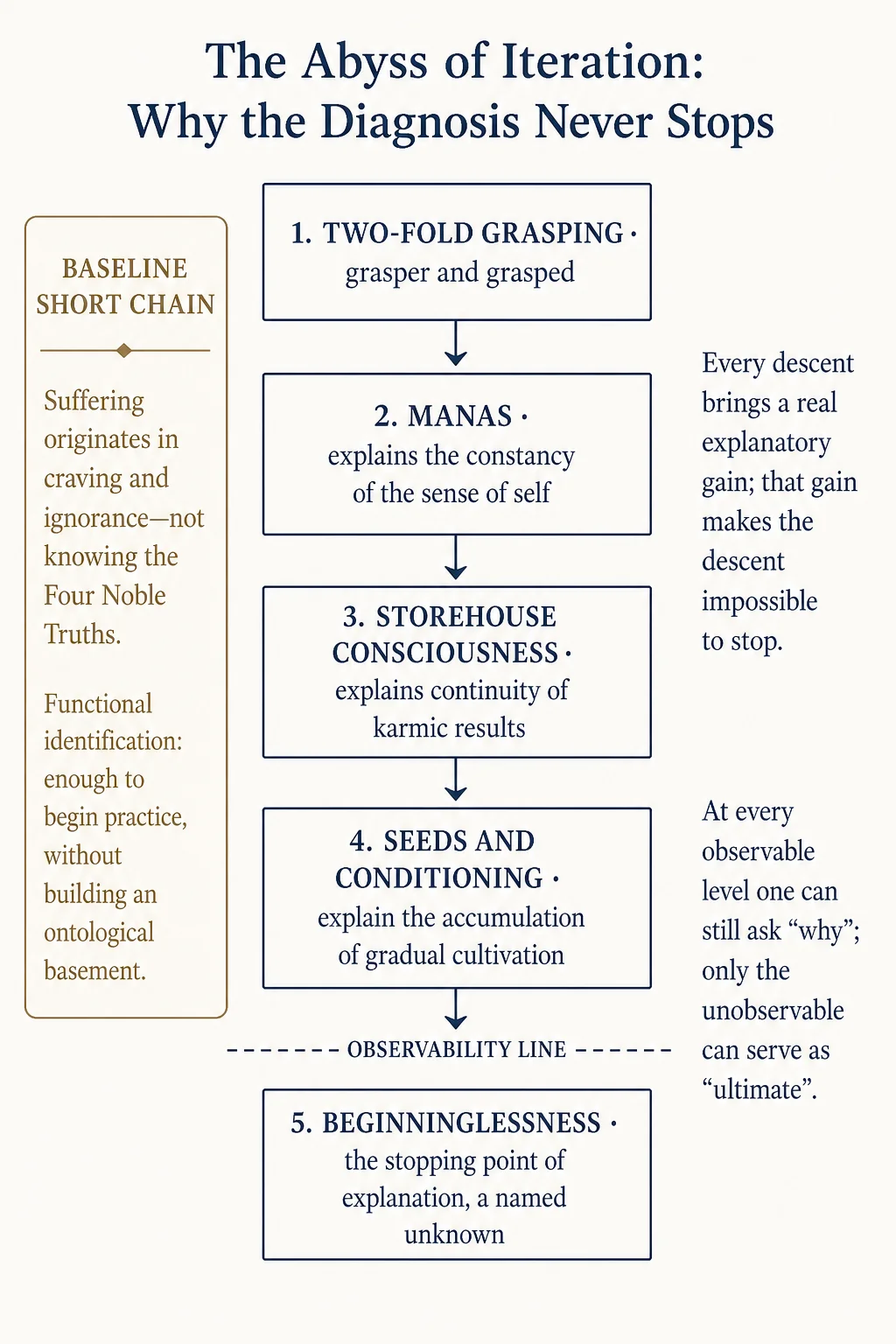
But diagnosis does not conclude here. Whom does manas grasp as self? The storehouse consciousness. Why does manas grasp constantly? Because of beginningless habitual tendencies. Where are those tendencies stored? In the storehouse consciousness. Why does the storehouse contain defilement? Because seeds and manifestations have conditioned one another since beginningless time. Every question receives an answer, every answer requires another question, and the chain descends until it stops at “beginningless” (anādi): “the realm beginninglessly present in time, the equal support of all phenomena.”2
The role “beginningless” plays in this structure must be seen clearly. It is not an explanation but the stopping point of explanation. The chain ceases not because the question is answered, but because the system declares that no further question is required. The baseline also uses “beginningless,” but the two uses differ. The baseline’s beginninglessness is a necessity within the worldview of dependent arising, as Volume I, 1.5 explained. Everything that arises has conditions; no link can serve as a first link. “Beginningless” is thus a structural feature of the chain’s grammar, not a piece of historical information. The Buddha says that ignorance’s “first point cannot be discerned” but never says that ignorance is a result accumulated through conditioning over infinite time. Ignorance has no manufacturing history. It is simply maintained here and now by its conditions—the discourses say that ignorance too has nutriment, with the five hindrances as its nutriment. The baseline’s diagnostic chain is therefore short: suffering is conditioned by craving and ignorance; ignorance is not knowing the Four Noble Truths. This is a functional identification and does not proceed downward to ask where ignorance is stored or how it was manufactured, as Chapter 2 of the Introduction explained. Yogācāra’s chain is long. Beneath ignorance it constructs an institution (manas), a warehouse (the storehouse consciousness), an inventory (seeds), and a process (conditioning) before arriving at the same word. By then, the grammatical function of “beginningless” has changed. It no longer states the structural fact that “the chain has no first link,” but the age of the warehouse. Habitual tendencies are accumulated stock conditioned over infinite time; ignorance now has a manufacturing history and place of custody. The two chains stop at the same word but mean different things when they stop. The intervening layers explain more and commit to more. Every added level is a new theoretical existent requiring defense, and every final defense converges on one point: without this posit, some phenomenon cannot be explained.
This posture (“every question must have an answer”) has its most intuitive textual specimen in Yogācāra’s foundational scripture, the Saṃdhinirmocana Sūtra. Place the questions it addresses chapter by chapter beside the approaches to the same questions in the baseline and Madhyamaka, and one can see what happens to the list of problems here:3
| Question | Baseline’s treatment | Madhyamaka’s treatment | Treatment in the Saṃdhinirmocana Sūtra |
|---|---|---|---|
| At the boundary of death and birth, who retains body and mind, and how do the consciousnesses operate together? | Stops after reporting that “consciousness conditions name-and-form”; creates no institution of retention | Refutes a “prior inhabitant”: a retainer preceding the faculties is reduced to absurdity | Establishes the appropriating consciousness to answer specifically: it appropriates the physical sense bases, maintains continuity in taking rebirth, and supports the simultaneous operation of the consciousnesses, like waves arising from water in a waterfall (“Characteristics of Mind, Thought, and Consciousness”) |
| Are images taken as objects in concentration inside or outside mind? | Does not pose the question; observes body, feelings, mind, and phenomena as they are | Dismisses both inner and outer: image and observer alike lack intrinsic nature | Answers explicitly “not different”: “I say the objects of consciousness are only manifestations of consciousness” (“Analysis of Yoga”)—the foundation of Consciousness-Only |
| The Buddha first taught existence (the Four Truths, aggregates, bases, and elements), and later taught emptiness in the Perfection of Wisdom. Why do the teachings not conflict? | No such problem; two conflicting bodies of scripture did not yet exist | Uses the two truths: existence is taught conventionally, emptiness ultimately | Constructs three turnings and three absences of intrinsic nature, explaining level by level when the Buddha spoke implicitly and when definitively (“Characteristics of the Absence of Intrinsic Nature”) |
| Are ultimate truth and formations identical or different? | Questions such as “Are life and the body identical or different?” belong among the undeclared | Refutes both identity and difference; the question is conceptual proliferation | Positively argues “neither identical nor different” and explains why it exceeds identity and difference (“Characteristics of Ultimate Truth”) |
| Hearing the same Dharma, why do some proceed to cessation and others to buddhahood? | Attributes the difference to disposition and conditions; establishes no separate theory | Does not include the question on its list | Establishes differences of spiritual disposition (disciples exclusively directed toward cessation and those who turn toward awakening), initiating the distinction of five dispositions (“Characteristics of the Absence of Intrinsic Nature”) |
The effect of placing the three columns together should already be clear. Faced with the same questions, the baseline either judges that no answer is needed (the undeclared) or gives a functional identification and stops. Madhyamaka dismantles the question together with its presuppositions. The Saṃdhinirmocana Sūtra treats each as a genuine question, every genuine question as owing the system an answer, and every answer as leading to the same new theoretical existents—the appropriating consciousness, three natures, and three turnings. The title itself declares the program: what is profound and hidden must be explained. Every silence left by the Buddha is read as a knot awaiting untying. “Why?” never stops, because each component used to untie one knot is itself a new posit not yet defended. The descending chain observed above is not a later mistake but a direction consciously chosen by the foundational scripture.
3. Iterative depth: connecting with the preface’s judgment
The preface judges Yogācāra to be attached to foundational and certain explanations, with iterative depth as its mechanism: it drills ever downward, seeking an ultimate ground. This chapter can supply the diagnostic mechanism behind that judgment. Every descent produces a genuine explanatory gain—manas explains the constancy of self-sense, the storehouse explains continuity of karmic results, and seeds explain accumulation in gradual practice. Precisely because each step delivers, the descent cannot stop. When it reaches the “beginningless storehouse consciousness,” the system obtains a strange foundation: it explains everything but is itself unobservable and untestable, and its entire warrant is that “the system needs it.” The pursuit of certainty ends in a named unknown. This is not Yogācāra’s oversight but the inevitable endpoint of the impulse “iterate diagnosis to the bottom.” One can always ask another “why?” at an observable level; only an unobservable level can serve as the “ultimate.”
The tradition did not ignore such challenges. Its mode of response is itself worth recording as evidence. When establishing the storehouse consciousness, the Cheng weishi lun registers external objections one by one and answers each. If “this consciousness should be the self,” it replies that it continuously turns like a waterfall, neither permanent nor annihilated. If seeds and manifestations mutually produce one another, which came first? It answers with simultaneous causation: “as a wick produces flame and flame chars the wick,” then caps the sequence with “beginningless.”4 Notice the form. Every objection is accepted for adjudication, every answer deploys a new metaphor or finer specification, and none ends by saying “this question is invalid.” The baseline closes questions by leaving them undeclared; Madhyamaka dismantles them through reductio; Yogācāra hears them all. Hearing an objection produces explanatory gains; the gains produce the next question. The mechanism that cannot stop is directly visible in the text’s question-and-answer form.
4. After diagnosis: why manas is not treated
Having identified manas as the active institution of the lesion (its inventory form lies in the storehouse, as the preceding section explained), the next question naturally asks: how is manas treated? Yogācāra’s answer is surprising: it is not. Verse 7 of the Triṃśikā lists only three occasions when defiled manas stops: the state of the arahant, the attainment of cessation, and the presence of the supramundane path.5 None is something a practitioner can do to manas; all are states in which it ceases by itself. Search the entire progression of practice and no exercise takes manas as its object or direct target.
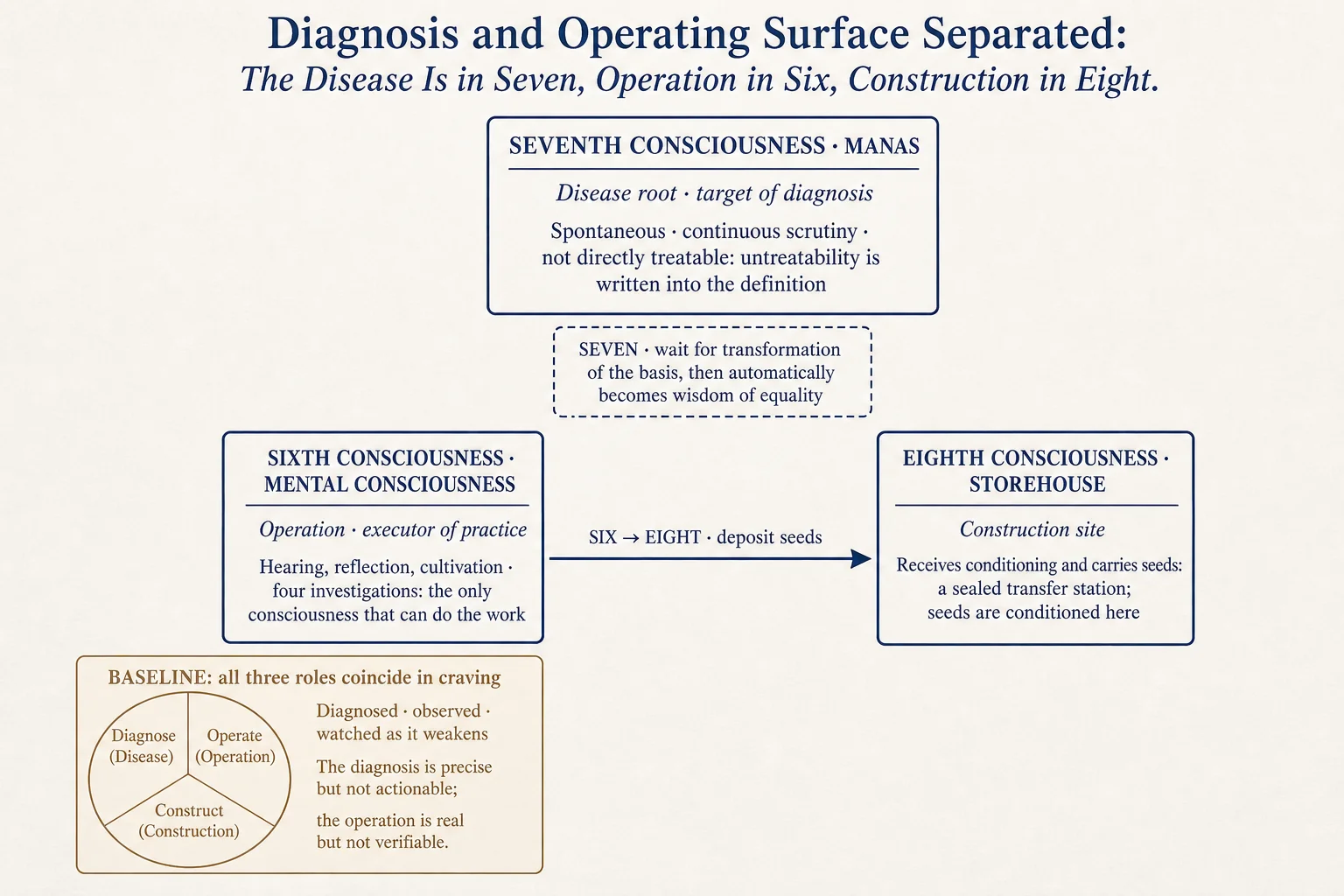
First state the system’s own logic and alternatives fairly. The sixth consciousness performs the practices—hearing, thinking, cultivation, and the four investigations. The resulting seeds enter the storehouse. The strength of uncontaminated seeds gradually grows. When nonconceptual wisdom becomes present, manas temporarily loses its object and has nothing to grasp. When transformation of the basis occurs, its entire support is replaced and manas automatically becomes the wisdom of equality. If the guard on duty cannot be repaired, transform both the warehouse he guards and the supplies that sustain him. A structural separation results: the target of diagnosis is the seventh consciousness, the executor of work is the sixth, and the construction site is the eighth. The illness lies in seven, operation in six, construction in eight. In the baseline all three coincide: craving is the diagnosed illness, the observed object, and what the practitioner watches weaken with their own eyes. Yogācāra separates them with a transfer station that cannot be opened.
The plan sounds coherent link by link. Precisely for that reason, we should not immediately credit the “absence of direct treatment” before testing the status of the proposition “manas cannot be treated.” It is certainly internally coherent, but coherence is not correctness, and here coherence is all that is available. Manas is an existent posited to explain. The inferential chain in Part I, Chapter 3 (whatever the system needs must exist) applies to the seventh consciousness too. Whether an invented institution can be treated depends not on observation but on the attributes its inventors assign it. The system registers it as spontaneous, constantly examining, subtle, and beyond the reach of the sixth consciousness, while every practical operation can begin only in the sixth; it is therefore untreatable. Register it differently and it would be treatable. This is a stipulation, not a discovery. The direction of stipulation is already fixed by the architecture. Suffering’s location has been installed in the storehouse consciousness, as Part II, Chapter 1 showed; the only writable surface in the entire system is the conditionable eighth consciousness. If the lesion could be worked on directly, the entire design of detouring through the warehouse would be superfluous. “Manas cannot be treated” is therefore not an observation report but a load-bearing component whose function is to guarantee that therapy must detour through the storehouse. An invention that writes untreatability into its definition cannot then claim credit because “it indeed proves untreatable.”
The judgment has a mirror in the baseline. The baseline encountered the same problem, and its solution is worth placing beside Yogācāra’s. In the Khemaka Sutta, the ill Khemaka contemplates the five clung-to aggregates as “not self, not mine” but says he is not yet an arahant with influxes exhausted: “I am,” desire for “I,” and the underlying tendency to “I” have not been abandoned, known, removed, or expelled. Right view has arrived; a deep sense of self remains. This is the baseline’s version of the problem of manas. There, “the deep sense of self does not obey commands” is an experiential fact encountered by a practitioner. To command self-sense, the commander is the very suspect being sought; the command’s failure is a report after testing, not a theoretical stipulation. The discourse treats it not through suppression but through “further reflection and observation of arising and ceasing.” Its simile is a garment washed clean that “still retains a residual odor and must be perfumed with many fragrances until the odor is eliminated.”6 The literal image is “conditioning”: vāsanā itself comes from the metaphor of perfuming, and Yogācāra conditioning uses the same image. The difference lies entirely in where it is registered. Khemaka’s residual odor can be smelled, and the progress of conditioning checked in experience: pride of self arises less often, more weakly, and for shorter periods. Yogācāra moves the odor into a cabinet that cannot be opened. Progress in perfuming becomes a theoretical inference whose result appears only at the path of seeing. The same metaphor remains phenomenal in the baseline and becomes warehouse chemistry in Yogācāra. Their difference in epistemological status is fixed here. When Khemaka says “the deep sense of self does not obey commands,” it is an observation report. When Yogācāra writes the same proposition, it is a specification. The designers may have had the same experience, but once written into a definition its status within the system changes from evidence to axiom. An axiom is no longer tested and can no longer claim merit for “conforming to observation.”
Two points should be said on the system’s behalf, together here. First, no theorist writes something visibly false into a definition. Manas was probably specified in this way because the specification appears broadly correct: the deep sense of self does not obey commands, as anyone who has tried can test. The specification’s resemblance to truth has a direct consequence for the division of work within the system: this page can be closed. Once manas is properly defined, theorists set it aside and concentrate on the real engineering center, the storehouse consciousness. Part I, Chapter 3 showed where refinement occurs: the six proofs, six characteristics of seeds, and qualifications for receiving conditioning. The meticulous defense concentrates on the eighth consciousness; the seventh receives only a section called “establishing a dedicated institution.” It looks correct and is therefore exempted from testing; it is stipulated and therefore settled. This concession does not shift the criticism but completes it: the stipulation can safely function as a stipulation precisely because it resembles experience. Second, the form of replacing treatment with conditioning may be the mechanism among the five systems closest to modern psychology of habit. Implicit processes are not directly commanded by will and can only be rewritten through repeated practice; “knowing” does not equal “changing.” The scope of retraction must be drawn clearly. Nothing praised in the first section is withdrawn: external evidence (tests involving infants and animals and the Khemaka discourse) can confirm the pre-reflective level and the operation of self-sense within it. What is withdrawn is only credit reserved for the definitional attribute “untreatable.”
The section can be condensed into one sentence. Yogācāra’s diagnosis and operating surface are separated, and the separation is a feature of the design, not an error in execution. Diagnosis points one level beneath direct intervention (manas); work occurs one level beyond inspection (the storehouse consciousness). Diagnosis is accurate but not actionable; the operation is real but not checkable. This separation is also one structural cause of the three-eon schedule: when the only lever is indirect seed-storage, the road must be measured in eons, as Part I, Chapter 2 explained. What is mistaken is never the form of gradual rewriting, but locating the record of that rewriting where no one can inspect it. The consequences of that location run through the whole system. Transformation of the basis promised by the truth of cessation becomes a replacement occurring invisibly; accepting it requires accepting the entire system. Every exercise of the truth of the path is directed into the invisible site and receives no feedback from it, leaving practitioners unable to correct their route. Once the registry enters the unknowable, the credibility, verifiability, and practicability of cessation and path are all mortgaged in advance; the debts come due respectively in Part II, Chapters 3, 5, and 6.
5. Two points of fairness
First, as in the Madhyamaka case, self-refinement does not amount to admitting error; Chapter 1 of that critique set this qualification. Manas and the storehouse consciousness each answer genuine explanatory aims. The criticism is not that they were added, but the direction of addition: every step moves toward “a deeper basis,” not toward “a more testable mechanism.” Second, the baseline’s diagnosis likewise faces the question “Why does craving arise?” and its stopping point (ignorance, not knowing the Four Noble Truths) is not an ultimate explanation either. The difference is that the baseline admits this is a practical identification: knowing it allows practice to begin. It does not build an ontological basement underneath it. Depth of diagnosis is not a fault; what must be audited is the ontological cost paid for depth.
6. Summary
Yogācāra’s truth of origin diagnoses the level more accurately than Madhyamaka: it sees the pre-reflective level and gives it a name. But accurate diagnosis does not yield accurate treatment. The identified lesion receives no direct remedy; the operating surface moves into the storehouse consciousness. Precisely because the lesion is defined as spontaneous and unresponsive to commands, therapy must detour. Accurate diagnosis and therapeutic detour are two sides of the same registration. Diagnosis also refuses to stop at an actionable level and iterates into unknowable depths, finally placing suffering’s ultimate cause (beginningless habitual tendencies in the storehouse consciousness) beyond every possible observation. The deeper diagnosis goes, the further it moves from testability. This is the other side of suffering’s move in the preceding chapter: suffering moves into the storehouse, and its cause resides there too. A lesion residing in the unknowable and a treatment route that does not pass through the lesion decisively affect mechanism and verification, the subjects of later chapters. The next chapter first examines the endpoint: is the cessation promised by transformation of the basis a cessation, or an upgrade?
References
References
-
For manas and the distinction between innate and conceptually acquired self-grasping, see fascicles 4–5 of the Cheng weishi lun. For manas’s “constant examination and measurement,” permanent association with the four afflictions, and its suppression and abandonment only in the attainment of cessation and supramundane path, see fascicle 5. On the historical significance of the storehouse consciousness and deeper models of mind as supplements to surface-consciousness models, see William S. Waldron, The Buddhist Unconscious (London: RoutledgeCurzon, 2003). ↩
-
“The realm beginninglessly present in time, the equal support of all phenomena” is a verse from the Mahāyāna Abhidharma Sūtra cited in the “Support of the Knowable” section of the Mahāyānasaṃgraha as scriptural evidence for establishing the storehouse consciousness. ↩
-
The Saṃdhinirmocana Sūtra, Xuanzang’s translation, T no. 676: “Characteristics of Ultimate Truth” argues that ultimate truth and formations are neither identical nor different; “Characteristics of Mind, Thought, and Consciousness” establishes the appropriating consciousness, which retains the physical sense bases, maintains continuity in taking rebirth, and supports the simultaneous operation of consciousnesses like waves arising from water; “Analysis of Yoga” answers that images in concentration are “not different … I say the objects of consciousness are only manifestations of consciousness”; “Characteristics of the Absence of Intrinsic Nature” establishes the three turnings, three absences of intrinsic nature, disciples exclusively directed toward cessation, and disciples turning toward awakening. For an English translation, see John Powers, trans., Wisdom of Buddha: The Saṃdhinirmocana Sūtra (Berkeley: Dharma Publishing, 1995). For “Are life and the body identical or different?” among the undeclared questions, see Chapter 2 of the Introduction and Volume I, 1.5. ↩
-
For external objections and replies in establishing the storehouse consciousness, see fascicles 2–4 of the Cheng weishi lun: “continuously turning like a waterfall” answers the objection of permanence and unity; simultaneous causation between seeds and manifestation (“as a wick produces flame and flame chars the wick”) answers the regress concerning mutual production. ↩
-
“It does not exist in the state of an arahant, the attainment of cessation, or the supramundane path,” verse 7 of the Triṃśikā. Defiled manas does not operate on those three occasions; see the explanation in fascicle 5 of the Cheng weishi lun. ↩
-
The Khemaka Sutta, Saṃyukta Āgama 103 (T no. 99), and its Pāli parallel, Saṃyutta Nikāya 22.89. Khemaka contemplates the five clung-to aggregates as “not self, not mine” but says that “I am,” desire for “I,” and the underlying tendency to “I” remain unremoved. The discourse gives the simile of a washed garment that retains an odor and must be perfumed with many fragrances, after which Khemaka further observes arising and ceasing within the five aggregates and abandons the remaining conceit. ↩