Part II, Chapter 6: Verification—Unknowable Appropriation and the Five-Stage Checkpoints
Part II, Chapter 6 of the Madhyamaka part traced a historical drift in criteria of attainment: from the cessation of suffering toward skill in debate. Yogācāra’s problem of verification takes a different form. Its criteria have scarcely drifted—the characteristics of its stages have stood in black and white, largely unchanged for a thousand years. Its problem is an original structural defect: the path with the densest checkpoints is installed upon the least observable basis. Every milestone along the road is perfectly clear, but the roadbed lies where no one can see it. This chapter proceeds in three steps. It first records the density of Yogācāra’s checkpoints, a genuine contribution to the problem of verification; it then examines how unknowability hollows them out from beneath; finally, it asks who receives the power of certification within this structure.
1. What deserves credit: the densest checkpoints among the five systems
As Part I, Chapter 1 explained, each of the five stages and ten grounds has its characteristic mode. The stage of accumulation has the four powers and generation of the aspiration; the stage of preparation has warmth, peak, acceptance, and the highest mundane dharma, each paired with one of four concentrations and possessing its own contemplative content; the path of seeing has sixteen mental moments; each of the ten grounds of the path of cultivation eradicates a portion of innate hindrance and realizes a portion of thusness; finally come the vajra-like concentration and ultimate transformation of the basis. Every station has a name, something eradicated, and something realized. Compared with Madhyamaka (where the content of the path of seeing remains disputed between direct realization and inference, as Madhyamaka Part II, Chapter 6 observed), Yogācāra supplies the richest public descriptive vocabulary for the progress of practice in Mahāyāna. In principle, a Yogācāra practitioner can answer the questions “At which stage are you?” and “By which characteristic do you identify yourself as being there?” This is a genuine asset to a culture of verification.
2. Hollowing out: three sites of unknowability
Yet a checkpoint is a checkpoint only if it has content that can be checked. Examination of the key nodes in this table reveals three systematic sites of unknowability.
First, the basis is unknowable. Every checkpoint ultimately checks the growth and decline of defiled and pure seeds, but seeds are stored in the storehouse consciousness whose “appropriation is unknowable” (Part I, Chapter 1). The milestones claim to mark changes in seeds inside the basis, while no one can inspect the basis itself. The actual operation at every checkpoint thus degenerates into the same procedure: observable characteristics (concentrative states, pliancy, and contemplative images) serve as signs from which unobservable changes in seeds are inferred. The correspondence between sign and seed is prescribed by the theory itself. In principle, therefore, verification cannot escape the circuit in which the theory confirms itself—the map problem from the preceding chapter replayed in the circuit of verification.
Second, the pivot is unknowable. On the path of seeing, thusness is directly realized and nonconceptual wisdom becomes present. By definition, this event is beyond language and characteristics and can be known only as one knows one’s own sensations. Yet it is the most important station on the entire table: the discriminatively arisen two hindrances are suddenly eradicated here, and here one becomes a noble being. Apart from the practitioner’s report and indirect evidence from later conduct, there is no public criterion for whether it has occurred. It shares this structure with seeing one’s nature in Chan and realization in Vajrayāna—the elitist tendency announced in Chapter 1 of the Introduction. Yogācāra’s tabulation does not change the structure. It merely gives a public name to an event that cannot be publicly checked.
Third, qualification is unknowable. The doctrine of five distinct dispositions specifies five intrinsic dispositions (disciple, solitary buddha, bodhisattva, indeterminate, and no disposition), and teaches that beings without a disposition can never attain buddhahood.1 Disposition is stored in the storehouse consciousness, in the presence, absence, and kind of intrinsic uncontaminated seeds. Neither the person concerned nor anyone else can directly observe it. Practitioners therefore cannot establish for themselves whether the road is in principle open to them. In practice, disposition can be judged only through a teacher’s observation and inference, but the basis of the judgment (the naturally given uncontaminated seed) is the system’s most deeply concealed posit. Here the power of verification does not historically drift into authority’s hands, as in the Madhyamaka part. The theory assigns it to authority from the beginning.
Beyond these three sites lies one more retrospective injury that must be recorded. The baseline formula of verification—“Birth is ended, the holy life has been lived, what had to be done has been done, and I know for myself there is no further becoming” (Madhyamaka Part II, Chapter 6)—is a declaration practitioners make after personally checking at the observable level. Once the doctrine of transformational birth-and-death has been established (Part II, Chapter 3), that declaration is narrowed. “Birth is ended” is true only of ordinary birth-and-death. The Śrīmālādevī Siṃhanāda Sūtra states plainly that arahants “have residual birth-dharmas not yet exhausted, and therefore have birth.” A deeper birth that they cannot observe by the system’s own definition (a mind-made body produced when the ground of ignorance conditions uncontaminated karma) is still entered under their name.2 Consciousness-Only leaves room for this through the five distinct dispositions. A disciple of fixed disposition attains final nirvāṇa, while one of indeterminate disposition turns toward Mahāyāna, receives a transformational body, and continues. Yet this accommodation welds retrospective narrowing to the third unknowability. Whether an arahant’s “birth is ended” is a terminus or a transfer point depends upon that person’s disposition, which the person cannot know. From beginning to end, no new observation overturns or suspends the verification; a new theoretical entity does. The addition of an unknowable level thus reveals a second power. It not only hollows out present checkpoints but retrospectively reverses completed verifications. The finish line itself becomes a parameter the theory can adjust.
3. Two registers: an epistemic criterion and a feeling-criterion
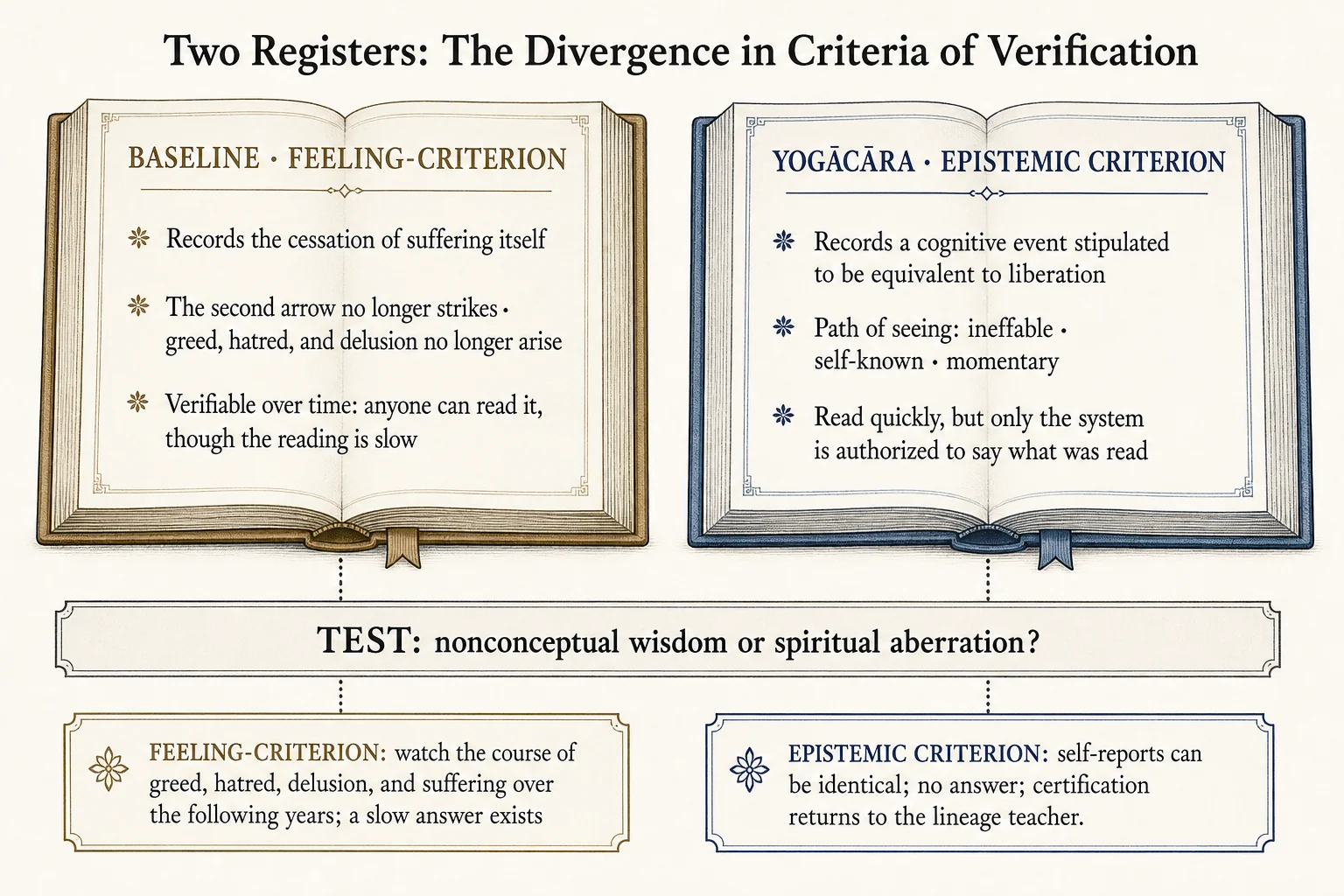
The three unknowabilities mean that the entry cannot be checked. A deeper problem remains: even if it could be checked, the two systems are not keeping the same ledger. The baseline criterion of verification is a criterion of feeling. The practitioner does not receive the second arrow; painful feeling no longer produces sorrow, lamentation, pain, grief, and despair; greed, hatred, and delusion no longer arise. The criterion lies in the long-term trajectory of feeling and affliction. The practitioner can check it and others can indirectly corroborate it (Introduction, Chapter 2). The pivotal verification throughout Yogācāra is epistemic: whether one has reached the path of seeing depends upon whether a single ineffable direct realization has occurred. These criteria do not merely differ in granularity. They are two registers. One records the cessation of suffering itself; the other records a cognitive event that doctrine has stipulated to be equivalent to liberation.
Their difference appears in a single question: how can one distinguish someone who has attained nonconceptual wisdom from someone undergoing a severe aberrant state? Under a criterion of feeling, the question has an answer, although it is slow. Observe over years and decades the course of greed, hatred, delusion, and suffering; cessation is checkable over the long term. Under the epistemic criterion, there is no answer. The event is ineffable, self-known, and momentary, and its content is by definition inexpressible. In immediate experience and later self-report, a genuine direct realization and an intense anomalous experience without an object can look identical. The tradition was not unaware of this problem. Chan works contain many sections on distinguishing demonic states, but their criteria remain agreement in characteristics, behavior, and doctrine—that is, peripheral evidence.3 The system therefore can only turn outward: later conduct provides corroboration, the characteristics of the stages provide comparison, and a lineage versed in doctrine serves as final judge. This converges with the next section. The power of certification belongs to the scholastic lineage not only because three sites are unknowable, but because the system records verification in a register that only theory can read. Anyone can read the baseline register, although reading it takes time. Yogācāra’s can be read instantly (a single moment decides everything), but only the system itself is authorized to announce what was read.
4. Where certification settles and the shape of scholastic lineage
Together, the three unknowabilities determine the shape of Yogācāra’s culture of verification: the table is public, interpretation belongs to experts. Who can interpret the characteristics, certify the stage, and identify the disposition? Someone who has mastered this treatise. The power of verification therefore naturally gathers at the center of scholastic transmission: the treatise master and the master’s lineage. The historical form corresponds. Yogācāra is the most scholastic of the Mahāyāna systems. The debating halls of Nālandā, Xuanzang’s translation workshop, and the Faxiang tradition of doctrinal adjudication all organized authority around “mastery of the system” (Volume I, 6.5 and 10.7). The drift recorded in the Madhyamaka part (from cessation as criterion toward skill in debate) does not need to occur here, because Yogācāra’s criterion presupposes mastery of theory by design. Madhyamaka drifts to the same destination; Yogācāra builds a road directly to it.
One point must be stated in Yogācāra’s defense. Its normative texts do not confuse “mastering the treatise” with “attaining the fruit.” Treatise masters clearly know that stages are gained through realization in practice, not through exposition. Their meticulous descriptions also offer genuine practitioners more reference points for self-examination than any other system. This chapter does not question individuals’ honesty but the structure. When basis, pivot, and qualification are all unknowable, even the densest checkpoints can gather evidence only within the theory’s circuit. At that point, “verification” no longer means “checking a claim against experience” but “checking experience against the system.”
5. Summary
The baseline’s verification is observable in the present life and does not outsource its criteria (Introduction, Chapter 2). Its restraint is to verify progress along the route but not completion at the endpoint—the section on the “metaphysical bill.” Yogācāra reverses that restraint entirely. It constructs a table for the whole route and endpoint, then places the table’s ultimate referents—seeds, thusness, and disposition—where they cannot be observed. It also changes registers, from cessation of suffering to occurrence of a cognitive event. The more complete the table, the more completely theory monopolizes verification. Madhyamaka fails because there is no table to consult; Yogācāra fails because theory writes and checks its own table. The latter failure is more concealed because it looks exactly like a model answer to the problem of verification. Before determining attachment, one last question remains: to what, exactly, is a system of this kind attached?
References
References
-
For the five distinct dispositions (disciple, solitary buddha, bodhisattva, indeterminate, and no disposition) and the doctrine that beings without a disposition cannot attain buddhahood, see the “Disposition” chapter of the Bodhisattvabhūmi in the Yogācārabhūmi and fascicle 2 of the Cheng weishi lun on intrinsic uncontaminated seeds. The conflict between this doctrine and proponents of the One Vehicle (the Lotus Sūtra and tathāgatagarbha currents) was the point at which Consciousness-Only faced its strongest attacks in China; see Volume I, 10.7, and Part IV of this volume. For the other doctrinal sources, see the notes to the chapters of Part I. ↩
-
“Arahants and pratyekabuddhas have fear … because residual birth-dharmas are not exhausted, they have birth,” in the “One Vehicle” chapter of the Śrīmālādevī Siṃhanāda Ekayāna Mahopāya Vaipulya Sūtra (T no. 353). For transformational birth-and-death and mind-made bodies, see Part II, Chapter 3 of this Yogācāra part and fascicle 8 of the Cheng weishi lun, cited there. The distinction between disciples of fixed and indeterminate disposition belongs to the doctrine of five distinct dispositions; see the preceding note. ↩
-
Examples include the “realm of demonic activity” among the ten realms in Zhiyi’s Mohe zhiguan and the fifty demons of the aggregates distinguished in the final fascicles of the Śūraṅgama Sūtra. Their criteria are agreement in characteristics, behavior, and doctrine and thus constitute peripheral corroboration; this chapter does not examine them further. ↩