Part I, Chapter 1: From Liberation to Salvation—The Core Claim
Pure Land is the final system examined in this volume and the only one to leave the boundary of soteriology. However deeply the preceding four systems rewrite the Four Truths, they remain within one framework: end suffering by eradicating afflictions through one’s own power. The end of the preceding part said that after Vajrayāna pushes self-powered engineering to its maximum, Mahāyāna has only one direction left: hand the entire project away. Pure Land takes that step and follows it to the end.
The boundary of this part and one structural exception
As usual, draw two boundaries first. The first is the same as in the preceding part: this volume criticizes theoretical claims, not the practical efficacy of cultivation. Recitation of the Buddha’s name as a practice of concentration and settling may genuinely gather and pacify the mind. But that efficacy does not depend upon whether Pure Land cosmology is true, and the two must be evaluated separately—the boundary established in Chapter 1 of the Introduction. The second belongs uniquely to Pure Land: it is a structural exception within this volume’s framework. Chapter 1 of the Introduction observed that the first four systems remain soteriologies in the strict sense—no external savior, no presupposed state of fallenness, and an endpoint consisting in a self-verifiable cessation of suffering. Pure Land contains every element of a doctrine of salvation: an external savior—Amitābha Buddha and his Fundamental Vow; a predicament from which one’s own power cannot escape—an evil ordinary being caught in birth-and-death; and a path of reception through other-power. Its language remains soteriological—it continues to speak of buddhahood and nirvāṇa—but its mechanism is salvific. This part still applies the five-question framework precisely to identify the link and manner in which Pure Land leaves soteriology.
Texts and the Fundamental Vow
Pure Land takes the “three sūtras and one treatise” as its central canon: the Larger Sukhāvatīvyūha Sūtra, the Sūtra on the Contemplation of Amitāyus, the Smaller Sukhāvatīvyūha Sūtra, and Vasubandhu’s Treatise and Verses on Aspiration for Birth in the Sukhāvatīvyūha. The axis of the entire system is Amitābha’s Eighteenth Vow in the Larger Sukhāvatīvyūha: “If, when I attain buddhahood, sentient beings in the ten directions sincerely entrust themselves, desire birth in my land, and think of me even ten times, yet are not born there, may I not attain complete awakening.”1 The system’s soteriological essentials can likewise be stated in one sentence: because one cannot walk out through one’s own power, rely upon Amitābha’s Fundamental Vow, attain birth in the Pure Land, and become a buddha there. For genealogy, doctrinal classification, and Chinese and Japanese developments (from Huiyuan’s White Lotus Society on Mount Lu through Tanluan, Daochuo, and Shandao to Hōnen and Shinran), see Volume I, Part X. This part extracts only the soteriological structure.
Answers to the five questions
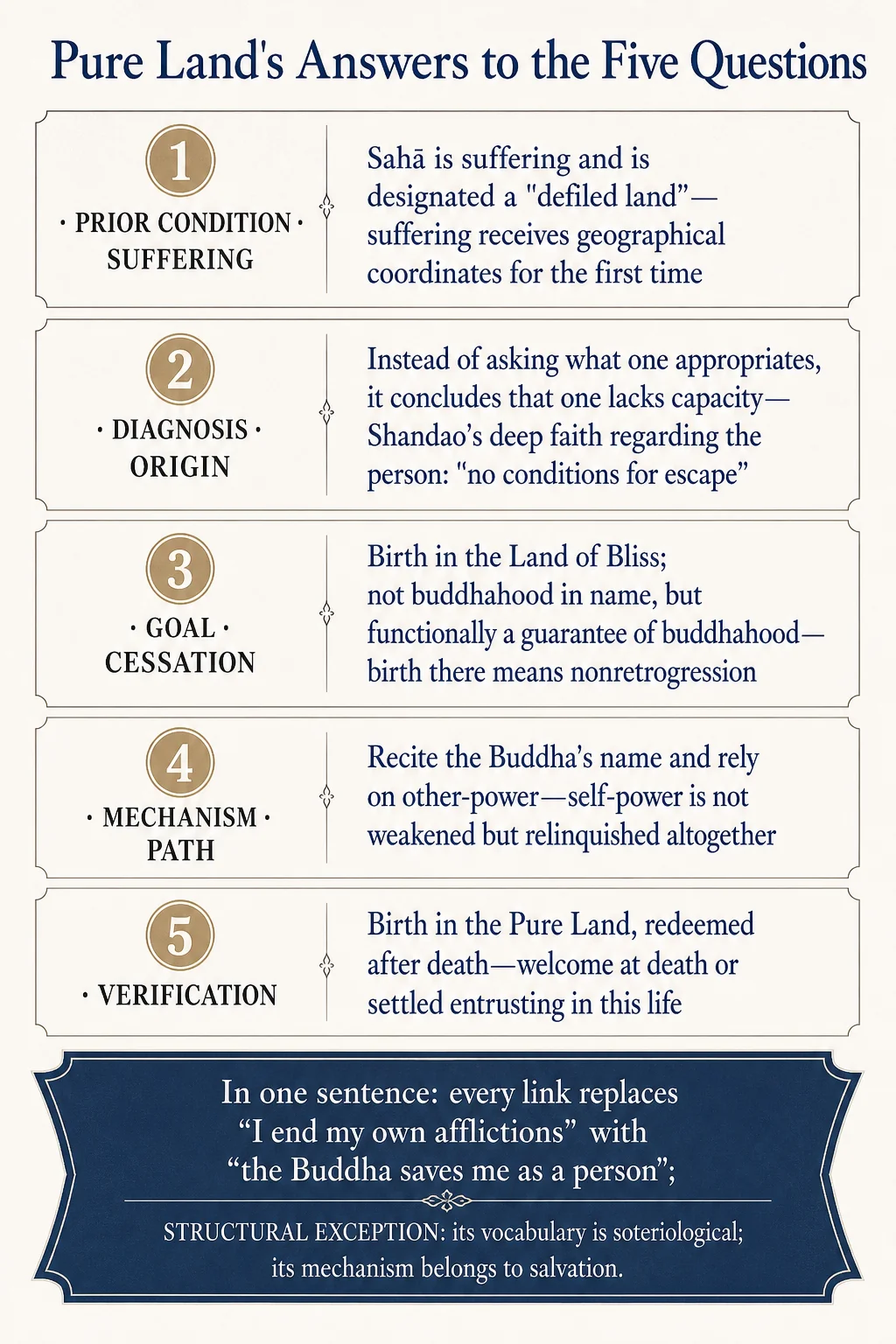
Prior premise—what is suffering? Sahā is suffering and is characterized as a “defiled land.” Suffering is not merely the actual condition of conditioned existence but becomes an attribute of location: this evil age of the five corruptions is a place where practice is difficult to complete. Suffering receives geographical coordinates for the first time.
Diagnosis—where does suffering come from? Self-power is insufficient and karmic obstruction deep. Shandao formulates this diagnosis as “deep faith regarding the being”: I am now an evil ordinary being subject to birth-and-death, always sinking and wandering throughout distant eons, without the conditions for escape.2 Observe the nature of this diagnosis. It does not ask what one appropriates; it determines that one lacks ability. The root of the illness moves from “your craving” to “your incapacity.”
Goal—what is liberation? Birth in the Land of Bliss. Precision is needed. Nominally, birth there is not buddhahood. The Pure Land is a setting more conducive to practice where one cannot regress. Yet doctrinally, birth immediately enters the stage of nonretrogression (avaivartika), and buddhahood becomes certain.3 Functionally, therefore, birth is a guarantee of buddhahood, not an opportunity to practice.
Mechanism—how does liberation occur? Recollection of the Buddha and reliance on other-power. Through faith, aspiration, and recitation of the Name, one rides the power of Amitābha’s Fundamental Vow and attains birth. Self-power is not weakened here but relinquished entirely.
Verification—how is arrival certified? Birth in the Pure Land. At death Amitābha comes to welcome the practitioner (the line of Shandao and Hōnen), or birth is settled in the present life at the moment entrusting becomes established (the Shin tradition). The central event lies after death or in one moment of faith, making it the least publicly verifiable in the present life among the five systems. Part II, Chapter 3 treats this directly.
A change of track, not another rewriting
Read the five questions together. At every link, Pure Land performs the same operation: “I eradicate my afflictions” becomes “a buddha saves me, this person.” Suffering becomes the wrong location; its cause becomes my incapacity; cessation becomes a guarantee that I will be taken away; the path becomes reception of rescue; verification becomes redemption after death. This is not a fifth rewriting within soteriology but a replacement of the question itself: “how does suffering end?” becomes “how am I saved?” However far the first four systems depart from the baseline, they still ask the former. Pure Land asks the latter.
Summary
Pure Land’s answer is the simplest and most thorough: one’s own power cannot succeed, so ask another to save. Its strength and transgression share a source. It alone after the four systems dares to face the practical impotence of most people’s self-powered cultivation, and it alone hands the entire project of liberation to a buddha outside the system. The first accusation it attracts is obvious: relying on other-power and seeking birth looks like an escape from practice. Nearly the whole theoretical construction of Pure Land tradition consists of layered replies to this charge. Those replies are varied and substantial. The next chapter presents them in full before criticism begins.
References
References
-
The Eighteenth Vow (the Fundamental Vow or vow of birth through recollection of the Buddha) states: “If, when I attain buddhahood, sentient beings in the ten directions sincerely entrust themselves, desire birth in my land, and think of me even ten times, yet are not born there, may I not attain complete awakening; except those who commit the five grave offenses or slander the true Dharma.” See fascicle 1 of Saṅghavarman’s Chinese translation of the Larger Sukhāvatīvyūha Sūtra. For the three sūtras and one treatise and the history of Pure Land teaching, see Volume I, Part X. ↩
-
“First, decisively and deeply believe: I myself am now an evil ordinary being subject to birth-and-death, always sinking and wandering from distant eons until now, without the conditions for escape. Second, decisively and deeply believe: Amitābha Buddha’s forty-eight vows embrace sentient beings; without doubt or anxiety, riding the power of those vows, one certainly attains birth.” Shandao, Commentary on the Contemplation Sūtra in Four Fascicles, “Meaning of Nonmeditative Good,” on the two forms of deep faith. ↩
-
For nonretrogression upon birth (avaivartika), see the Smaller Sukhāvatīvyūha Sūtra: “Sentient beings born there are all nonretrogressors.” Tanluan’s Commentary on the Treatise on Birth uses the Eleventh Vow (abiding in the rightly settled group and necessarily reaching cessation) to establish the nonretrogression of those born there. For the distinction between birth and buddhahood (the Land of Bliss as a superior site of practice) and the judgment that it functions as a guarantee of buddhahood, see Chapter 1 of the Introduction. ↩