Part II, Chapter 1: The Truths of Suffering and Origin—From Abandoning Affliction to Seeking Rescue
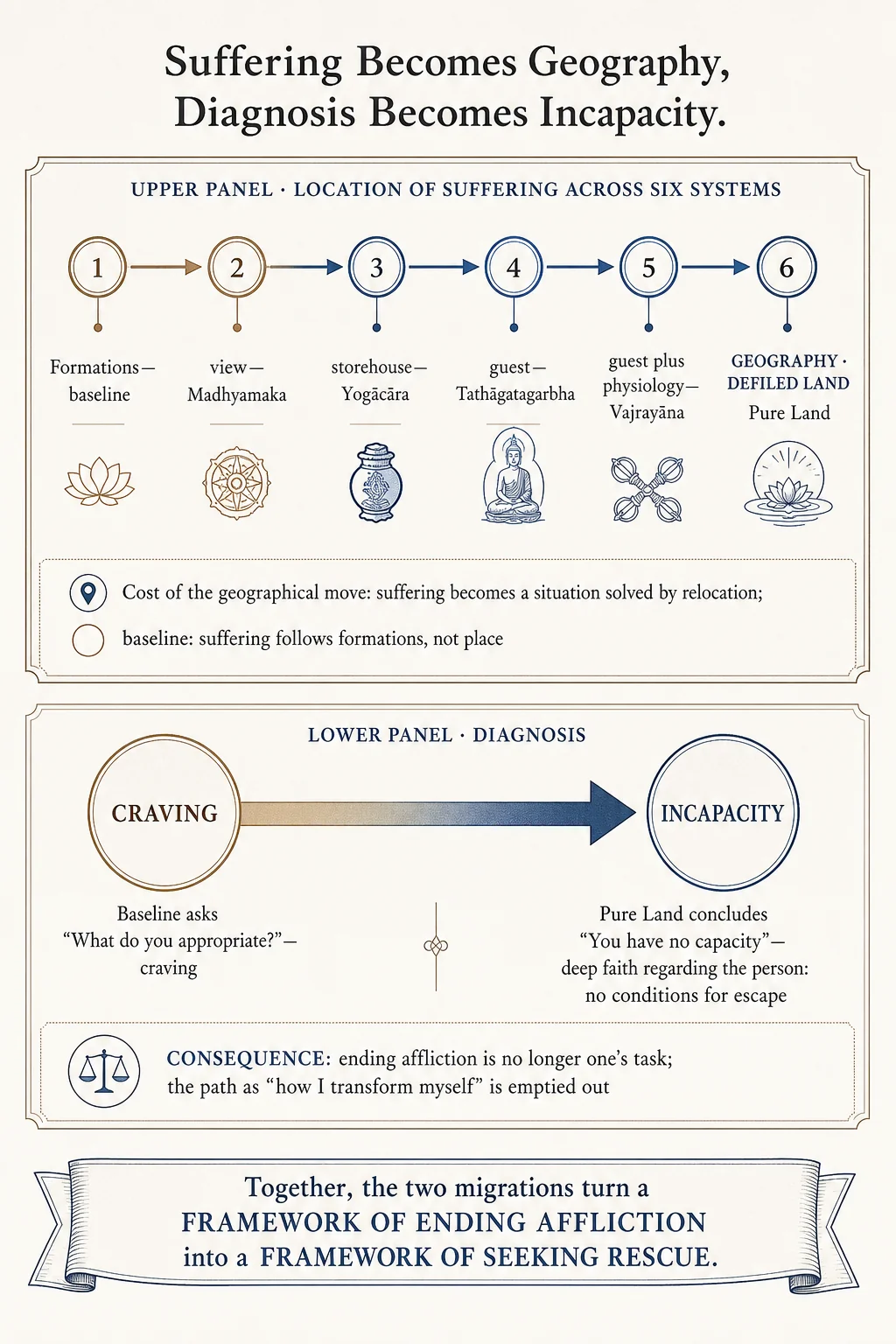
Following the compressed format, the truths of suffering and origin are combined. Pure Land provides another reason: suffering becomes the wrong location and its cause my incapacity, two sides of a single change of track that replaces “the framework of abandoning affliction” with “the framework of seeking rescue.” Combining them is the verdict.
1. The location of suffering: from conditioned existence to geography
This volume has traced suffering’s location through five rounds. In the baseline, suffering is in formations—the actual condition of conditioned existence. Madhyamaka moves it into views; Yogācāra into the storehouse; tathāgatagarbha into the guest position; Vajrayāna leaves it as guest and supplies a physiology. Pure Land gives it a sixth and most distinctive placement: suffering is located in a place. Sahā is a “defiled land,” an evil age of the five corruptions where capacities are dull, obstructions heavy, supportive conditions scarce, harmful conditions surrounding, and practice difficult to complete. The Land of Bliss is a “Pure Land,” with immeasurable life, complete supportive conditions, and neither regression nor fall. Suffering is no longer merely the universal condition of conditioned existence but a predicament that can be solved by changing locations. Liberation’s first operation is therefore not “cessation” but “migration.”
Record one genuine observation first. Environment does affect practice. Drawing near good friends, leaving harmful conditions, and dwelling where supporting conditions are complete all matter within the baseline itself—the good friend is the whole of the holy life. Pure Land enlarges this observation into the foundation of an entire soteriology. At that scale, a cost appears. Locating suffering fundamentally in geography announces that movement can solve it, while the baseline’s judgment is the opposite: suffering follows formations rather than place. It depends upon conditioned activity itself, not upon one’s location. Someone who changes location while greed and hatred remain has not taken one step beyond suffering. Pure Land answers that the Land of Bliss itself removes the conditions in which greed and hatred arise—there are no three bad destinations and no conditions for regression. This answer transfers the full burden to the land’s attributes and therefore to the Fundamental Vow guaranteeing those attributes. For the first time, the removal of suffering rests not upon practitioners but upon an environment guaranteed by other-power.
2. Diagnosis: from craving to incapacity
Diagnosis changes accordingly, in the largest rewriting observed in this volume. The baseline truth of origin asks “what do you appropriate?” and answers craving. Madhyamaka answers the view of real existence, Yogācāra seeds, tathāgatagarbha adventitious stains, and Vajrayāna misplaced energy. However deeply and metaphysically those five proceed, they continue to ask the same question: what in you produces suffering? Pure Land replaces it. It does not ask what one appropriates but determines that one lacks ability. Shandao’s deep faith regarding the being is the diagnosis at its extreme: I am now an evil ordinary being subject to birth-and-death, always sinking and wandering throughout distant eons, without the conditions for escape. The root of illness moves from “your craving” to “your incapacity.”
The change has an honesty that cannot be denied. It faces a fact the first four systems refuse to face: most people will not reach cessation of suffering in this life through self-powered practice. Vajrayāna promises “buddhahood in this very body” to everyone, but in practice only a few of highest capacity can genuinely reach it (Vajrayāna Part II, Chapter 3). Pure Land makes no such empty promise. It says directly: you cannot. In facing human weakness, Pure Land is more honest than Vajrayāna. Yet once diagnosis becomes “you are incapable,” one structural consequence follows immediately. Abandoning affliction is no longer one’s task because one cannot perform it. The entire content of the path as “how I transform myself” is emptied, leaving only “how I am transformed.” Primary responsibility for liberation moves from practitioner to buddha.
3. Boundary and summary
As usual, draw the boundary. This chapter does not deny the genuine value of Pure Land’s honesty about capacity or its observation of environment. The verdict records structure alone. Suffering becomes a geographical problem and origin a problem of ability. Together, the two truths complete at the starting point Pure Land’s change of track from a “framework of abandoning affliction” to a “framework of seeking rescue.” This is not soteriology going astray in the truths of suffering and origin but soteriology being replaced here by a doctrine of salvation. It no longer answers “how does suffering end?” and begins answering “how am I saved?” The next chapter examines this doctrine’s central apparatus: the guarantee issued by other-power.
(The judgments in this chapter concerning the truths of suffering and origin synthesize sources already cited in the notes to Part I, Chapters 1 and 2—the defiled Sahā world, Shandao’s deep faith regarding the being, and the Eighteenth Vow. For the baseline grounds that “suffering follows formations, not place” and “the good friend is the whole of the holy life,” see Chapter 2 of the Introduction; no separate notes are added here.)