Part I, Chapter 1: Buddhahood in This Very Body—The Core Claim
The boundary of this part: a critique of soteriology, not of Vajrayāna
Establish the boundary first. Vajrayāna has attracted many historical and contemporary criticisms: abuse of the teacher’s authority, ethical controversies surrounding sexual practice, entanglement between religion and government, and appeals to miracles. Each criticism has its place, but none is this book’s subject. This book asks Vajrayāna only the same question it has asked the preceding three systems: does its proposed method for ending suffering succeed as a soteriology? Vajrayāna’s symbolic system (wrathful deities, skull vessels, and sexual images) also commonly receives two treatments: sensation-seekers magnify its strangeness, while defenders vindicate its orthodoxy. This book shares neither interest. It reads every symbol according to the system’s own explanation (as representation), and directs judgment only to soteriological structure. One further practical limitation must be stated. Secrecy is institutional to Vajrayāna; by rule, core oral instructions are not written and not shown to the uninitiated. This book relies upon publicly available texts and teachings. It criticizes structure, does not treat secrecy itself as a fault, and does not pretend to have seen what remains private.
The object must also be selected. Internal differences are enormous: from the rites of Action and Performance Tantra to the channels, winds, and drops of Highest Yoga Tantra; from the empowerment of the three mysteries in Japanese Esoteric Buddhism to Tibetan Mahāmudrā and Dzogchen. Following this volume’s usual method, the analysis takes the strongest form. Its main object is Tibetan Highest Yoga Tantra and its summit systems (Mahāmudrā and Dzogchen), because Vajrayāna’s boldest soteriological claims, buddhahood in this very body, transforming afflictions into the path, and taking the fruit as path, are most complete there. Japanese Esoteric Buddhism supplies corroboration at decisive points. For historical and textual detail, see Volume I, Parts VIII and XI. Following the compressed format, this part extracts only the soteriological essentials.
The self-description of the resultant vehicle
Vajrayāna situates itself in relation to the preceding systems with a pair of classificatory terms: causal vehicle and resultant vehicle. The exoteric teachings constitute a causal vehicle: practice at the causal stage, accumulate provisions, and wait for the fruit to ripen. Vajrayāna is the resultant vehicle: take the state of the fruit directly as the path and perform a buddha’s body, speech, and mind now. The honesty in this self-description is that it expressly claims no new goal—the fruit remains the same buddhahood, three bodies, and four wisdoms. What it offers is a new method and schedule: attain buddhahood in this very body rather than over three incalculable eons. The Treatise on the Bodhicitta condenses the promise: “With this body born of father and mother, swiftly realize the station of great awakening.” Kūkai names a foundational work The Meaning of Attaining Buddhahood in This Very Body and writes in verse, “Through empowerment by the three mysteries, it swiftly manifests.”1
The end of the preceding part said that tathāgatagarbha establishes “originally a buddha” but provides only a subtractive road; the guarantee now receives a construction crew. This is exactly where Vajrayāna enters. It inherits tathāgatagarbha’s guarantee in full—Dzogchen calls it primordial purity, Mahāmudrā calls it coemergence, and Nyingma personifies the premise as Samantabhadra, the primordial buddha. It inherits the grammar of removing obstruction—primordial purity concealed by adventitious stains—and then does what none of the preceding systems did: turns the metaphysical guarantee into a construction plan. If one is originally a buddha, then beginning today work to a buddha’s specifications: form a buddha’s mudrā with the body, recite a buddha’s sound with speech, and perform a buddha’s contemplation with mind, until performance and being converge. Structural continuity and mutation can be stated in one sentence: every premise is old; the verb is new.
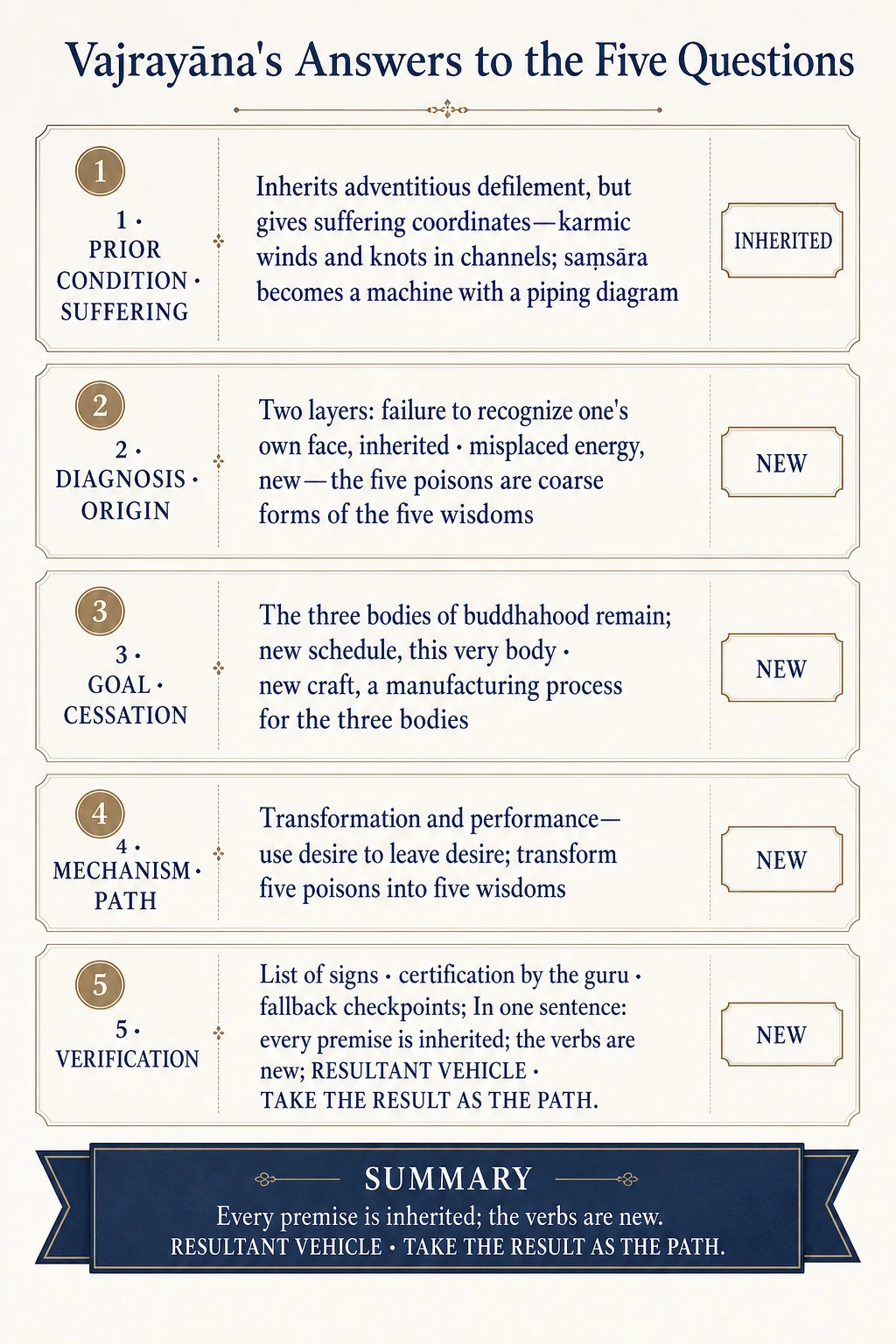
Answers to the five questions
Prior premise—what is suffering? Tathāgatagarbha’s answer remains: suffering is primordial purity obstructed by adventitious stains. But obstruction receives coordinates for the first time. Afflictions have a route of operation: karmic winds travel through the right and left channels, knots constrict them, and drops dissipate. Saṃsāra is a machine with a piping diagram, and suffering is its operating state.
Diagnosis—where does suffering come from? It has two levels. The cognitive level is inherited: failure to recognize one’s own face. The new engineering level is energy in the wrong place. The five poisons are the coarse states of the five wisdoms. Greed, hatred, and delusion are not enemies to be destroyed but energy moving through the wrong pipes. When winds fail to enter the central channel, wisdom leaks out in the form of affliction.2
Goal—what is liberation? The three bodies of buddhahood; the goal is not new. Schedule and technology are new. The schedule promises this body and this life. In technology, the three bodies receive a manufacturing process for the first time: illusory body cultivates the cause of the enjoyment body, clear light realizes the dharma-body, and their union accomplishes buddhahood.
Mechanism—how does liberation occur? Transformation and rehearsal. It is not confrontation (Madhyamaka), not cultivation alone (Yogācāra), and not disclosure alone (tathāgatagarbha), but transformation: use desire to leave desire, transform the five poisons into the five wisdoms, and make affliction itself fuel. Operations are layered. Empowerment authorizes entry; the generation stage rehearses the fruit through deity yoga; the completion stage controls the carrier through channels, winds, and drops; and the summit removes operation and returns to no-practice.
Verification—how is arrival certified? A list of signs of attainment—warmth, bliss, luminosity, dreams, and clear light; one judge (the guru’s certification); and a series of fallback gates—if buddhahood does not occur in this body, death, the intermediate state, and later lives remain. Vajrayāna alone among the five systems dares to write observable indicators into its promise. Part II, Chapter 3 tests the quality of this boldness.
The shape of the soteriology: heavy engineering for one already arrived
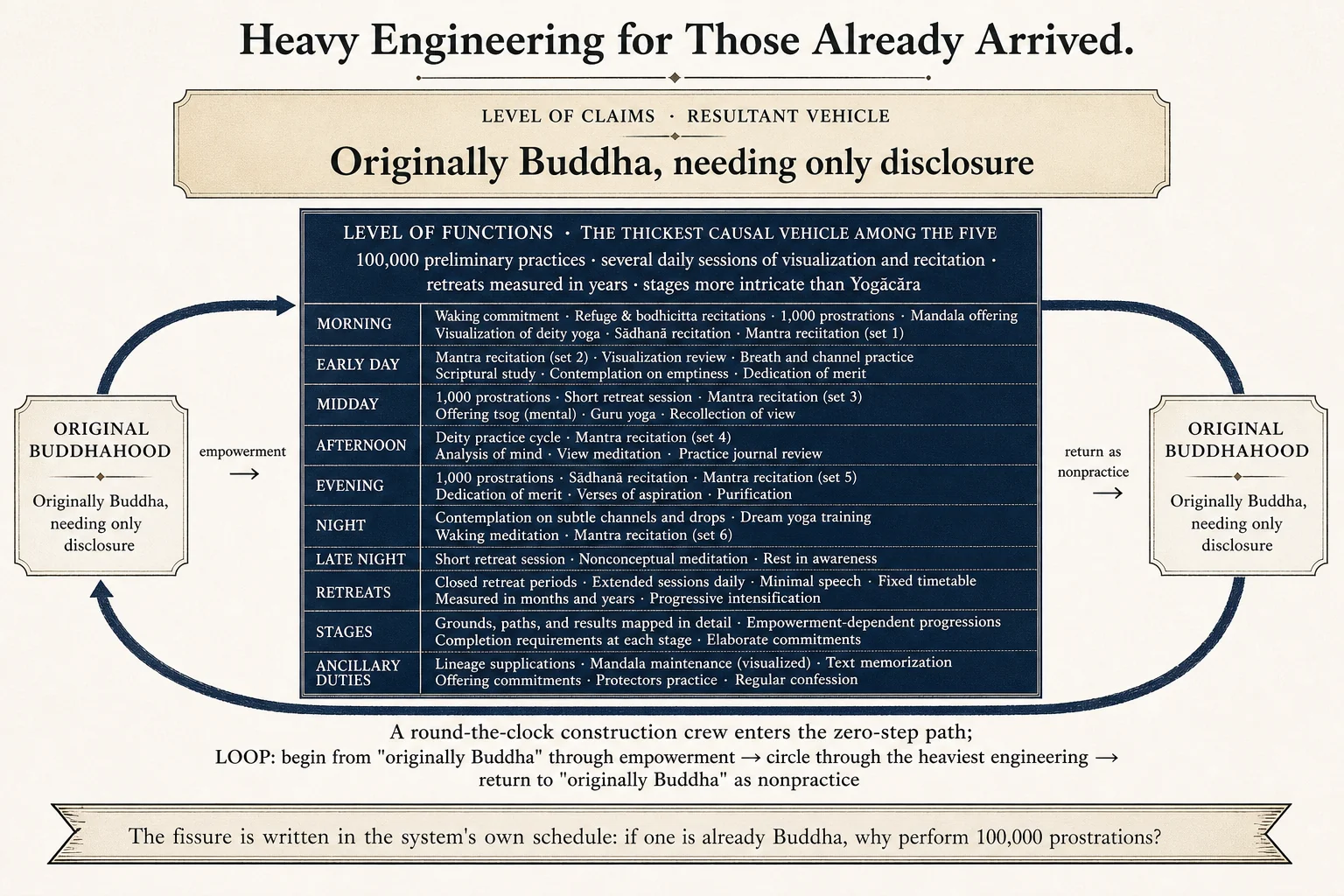
As usual, describe the shape. Vajrayāna has the most paradoxical shape of the five systems. It holds the strongest premise of “already arrived” (originally a buddha, the self-declared resultant vehicle), while operating the heaviest daily engineering of all five: preliminary practices counted in hundreds of thousands, multiple daily sessions of visualization and recitation, retreats measured in years, and a path structure more intricate than Yogācāra’s. A round-the-clock construction crew enters the zero-step road. At the level of claims it is the resultant vehicle; at the level of function, the thickest causal vehicle among the five. Critics did not pry open this fissure; it is written in the system’s own calendar. If one is already a buddha, why perform one hundred thousand full prostrations? Part II, Chapter 2 tests whether the traditional answer (obstructions are heavy and rehearsal requires mastery) preserves the name “resultant vehicle.”
Internal lucidity
Three aspects of the system’s self-awareness deserve to be recorded in advance. First, its awareness of risk is the strongest among the five systems. Tibetan traditions often say that Vajrayāna practitioners are like a snake inside a bamboo tube: they can go only up or down. There is no level ground between buddhahood and vajra hell. The awareness has a real experiential basis. Lists of wrong turns and demonic states and institutions for selecting students are accumulated records of accidents. It also avoids the particular lie “this teaching is absolutely safe.” But the credit stops here; the correct name is awareness of risk, not honesty. The warning performs three other tasks at once. It advertises efficacy—a shortcut is a shortcut precisely because it is dangerous, and the promise of speed requires a reputation for danger as collateral. It absorbs failure—anyone harmed must have broken samaya, lacked qualification, or failed to follow the teacher, so injury becomes confirmation rather than counterevidence. And it licenses control—precisely because the path is dangerous, the complete supervision of teacher, vow, and secrecy becomes necessary, authorizing the teacher’s power. Moreover, “only up or down” erases the most common third outcome from the risk map: neither buddhahood nor vajra hell; the snake grows old and dies inside the tube, and nothing happens. Part II, Chapter 3 incorporates these functions of warning into the problem of verification. Second, the exoteric-esoteric lock. Gelug makes this a standard rule: without renunciation, bodhicitta, and correct view of emptiness, Vajrayāna does not become a path of liberation; every tantric operation must run inside right view. This amounts to acknowledging that technology itself is not the path; view is.3 Third, a distinction between supernormal power and liberation. Ordinary siddhis (mundane attainments) and extraordinary siddhi (buddhahood) are explicitly distinguished. Flying through the air or walking through fire does not equal exhaustion of the influxes. This accords with the baseline discipline that supernormal power is not evidence of liberation. Record all three credits. Whether they withstand the structure’s gravity is a question for Part II.
Summary
Vajrayāna’s answer is this. Suffering is the machine’s operation—it retains adventitious stains but gives them coordinates. The cause is misplaced energy—it retains nonrecognition and adds engineering. Cessation is redemption in this body—it retains buddhahood and changes the schedule. The path is transformation and rehearsal—the fourth verb. Verification consists of signs and a teacher’s certification—peripheral evidence becomes the main line. Its relation to the preceding systems can be condensed in one sentence: the goal follows the older specification, the guarantee follows tathāgatagarbha, and everything new lies at the operational level. This part therefore has one question: does the new operational layer provide the mechanism the preceding systems owed, or package advance payment as engineering?
References
References
-
For the distinction between causal vehicle (the Pāramitā Vehicle) and resultant vehicle (Vajrayāna or Mantrayāna), and the structure of Highest Yoga Tantra, see Tsongkhapa’s Great Exposition of Secret Mantra, translated into Chinese by Fazun. “If a person seeks buddha-wisdom and penetrates bodhicitta, with this body born of father and mother they swiftly realize the station of great awakening,” in the Treatise on the Mind of Unsurpassed Complete Awakening in Vajra-Pinnacle Yoga, attributed in Chinese to Amoghavajra. “Through empowerment by the three mysteries, it swiftly manifests,” in Kūkai’s verse in The Meaning of Attaining Buddhahood in This Very Body. Nyingma’s nine-vehicle classification places Atiyoga, Dzogchen, at the summit; see Volume I, Part XI. ↩
-
Transformation of the five poisons into the five wisdoms and their association with the five buddha families is standard in Highest Yoga Tantra: greed becomes discerning wisdom, hatred great mirror wisdom, delusion wisdom of the dharma realm, pride wisdom of equality, and jealousy all-accomplishing wisdom. Assignments vary slightly among lineages. ↩
-
Renunciation, bodhicitta, and correct view of emptiness are the “three principal aspects of the path.” For the requirement that they govern Vajrayāna, see Tsongkhapa’s Great Treatise on the Stages of the Path to Enlightenment and Great Exposition of Secret Mantra. The division between ordinary and extraordinary siddhis is standard across the tantric classes; the snake-in-a-bamboo-tube simile is commonly cited in Tibetan traditions. ↩