Part II, Chapter 5: Determining Attachment and Concluding Audit—Attachment to Eternity
Following the compressed format announced at the beginning of this part, the diagnosis of attachment and concluding audit are combined in one chapter. In this system the two are difficult to separate in any case. The attachments of the preceding systems must be identified within fissures in their structures; tathāgatagarbha’s attachment is not hidden in a fissure. It is the plan itself.
1. Two levels of fear, twofold attachment
The preface’s verdict is attachment to eternity. It also states that this attachment is fear’s other side, and that fear has two levels. The shallower level belongs to everyone: birth, aging, illness, death, and separation from loved ones make impermanence itself disturbing, so one seeks a place that will not decay. This level is shared with every religion that promises eternity and is not uniquely Buddhist. The deeper level is generated by early Buddhism itself. The simile of the lamp’s extinguishing, refusal to declare what follows death, and an ineffable endpoint sound at every point like annihilation to those who have not realized them. The more strictly silence is maintained, the less room this fear has to settle. The second fear is produced within Buddhism, and Buddhism must invent its own reassurance. Permanence, bliss, self, and purity are not a heaven borrowed from elsewhere but term-by-term reversals of the three characteristics that barred Buddhism’s own door (Part II, Chapter 2). The preface further says that the attachment is twofold: attachment both to an imperishable object (the dharma-body of permanence, bliss, self, and purity) and to a certainty that cannot fail—the guarantee “originally a buddha.” The five chapters of this part supply complete evidence for those three sentences. Suffering becomes misunderstanding and its cause becomes mystery (Part II, Chapter 1), clearing the ground on which the guarantee can stand. The door is pushed open and a conclusion awaiting proof becomes a premise (Chapter 2), forming the guarantee’s text. The path becomes removal without a mechanism (Chapter 3), and verification loses its object and rests on certification (Chapter 4), protecting the guarantee from examination when it falls due.
2. The word for the mechanism: advance payment
Madhyamaka’s mechanism of attachment is recursion: thought takes itself as object, winds around itself layer by layer, and becomes attached to argument itself (Madhyamaka Part II, Chapter 7). Yogācāra’s is iteration: it descends an explanatory chain in search of the bottom and becomes attached to the final foundation (Yogācāra Part II, Chapter 7). This volume has used the word for tathāgatagarbha’s mechanism throughout: advance payment. When Part I, Chapter 1 described the shape, it said that Madhyamaka advances the efficacy of seeing, Yogācāra the existence of the basis, and tathāgatagarbha the endpoint itself. The first two draw limited credit; the third makes advancement its general rule and distributes every attribute of the fruit at the causal stage in advance.
Now that “advance payment” has reached the third system, its object should be defined clearly; otherwise the term remains rhetoric. On the surface, the three systems advance different things (efficacy, existence, and endpoint), but the operation is one: a status that under baseline rules only verification may confer is conferred by the system itself. Madhyamaka grants “seeing” the status of efficacy; Yogācāra grants the “storehouse” the status of existence; tathāgatagarbha grants the “endpoint” the status of already accomplished. What a system advances is its load-bearing wall, so the changing object is diagnostic rather than ambiguous. Nominally, the system grants a status. What is actually distributed into believers’ hands and consumed at once is the endpoint’s felt benefit: certainty, consolation, and immunity from despair. What is never delivered is verification. This is what “advance payment” says beyond “circular argument.” A circle is a static defect in reasoning. Advance payment has a temporal structure: consume now, settle later, while settlement can be institutionally postponed. It explains system design rather than merely argumentative form—why every system performs surgery precisely upon verification, since verification is where the advance falls due. Finally, state the limit of the simile. A real advance has external accounts and a due date; here issuer and auditor are the same party. Strictly speaking, this is self-extended credit. The volume retains “advance payment” for its structural meaning: taking what has not been verified first and suspending repayment.
The three mechanism words correspond exactly to the shapes of the three roads. Recursion corresponds to one step—that step must become infinitely pure. Iteration corresponds to two steps—the second must extend without limit. Advance payment corresponds to zero steps—the endpoint must already be present. Their difference is equally clear. Recursion and iteration are attachments directed toward depth: both judge present answers insufficiently deep. They remain cognitive undertakings and preserve, in principle, truth and error. Advance payment is attachment directed toward certainty. It digs into no depth but announces that the treasure is already in hand, abolishing exploration. Its product, the feeling of certainty, is fully distributed before verification, and the system’s entire design turns toward protecting that credit. Suffering must be misunderstanding, because present suffering would otherwise be evidence of default. The cause must be unknowable, because tracing defilement’s origin would lead the question back to purity itself. Cessation must be a premise, because otherwise the guarantee would accept inspection. The path must be removal, because anything produced through cultivation would prove that perfection was not original. Verification must confirm identity, because failure to find progress would expose the guarantee. These five necessities point to one place: every link at which the guarantee might fail is moved beyond testing. What the preceding four chapters observed separately is one scheme of credit protection.
3. Critical Buddhism: corroboration in the same direction, with a different criterion
Modern Buddhist studies contains a famous controversy centered on tathāgatagarbha that must be registered directly. Beginning in the late 1980s, Matsumoto Shirō and Hakamaya Noriaki launched “Critical Buddhism.” Matsumoto coined dhātu-vāda, “theory of a locus,” and judged the deep structure of tathāgatagarbha and original awakening to be the production of all phenomena from a unitary basis, incompatible with dependent arising and non-self; he concluded that tathāgatagarbha thought is not Buddhism. Hakamaya targeted the social effects of Japanese original-awakening thought, arguing that “all are originally buddhas” dissolves the motivation for criticism and reform. The later English collection Pruning the Bodhi Tree contains both sides. Critics such as Sallie King argue that buddha-nature doctrine is completely Buddhist within the practical register: its function is exhortation, not ontological assertion. A different, philological route (Takasaki, Zimmermann, and others cited in Part I, Chapter 1) reads the texts through historical formation and naturally checks any overly tidy account of a single structure.1 This volume’s observations overlap substantially with Critical Buddhism: at the functional level, tathāgatagarbha does arrange everything from a permanent basis. That corroborates this volume’s reading: non-self at the level of claims, true permanence at the level of function. But the criteria must remain distinct. Critical Buddhism uses doctrinal membership: “this is not Buddhism.” That is an act of doctrinal classification, which this volume does not perform. This volume uses soteriological efficacy: how much testable content remains in the system as a method for ending suffering? Its conclusion is therefore not that tathāgatagarbha is unworthy of the name Buddhist, but that its truth of suffering is no longer observation, its truth of cessation no longer accepts testing, its truth of the path no longer possesses a mechanism, and verification no longer has an object. The same observations, two criteria. Readers may reject Matsumoto’s doctrinal classification while still facing this volume’s questions, and vice versa. One further note: Critical Buddhism’s strongest reply (that buddha-nature language is exhortative and practical rather than an ontological assertion) is the modern repetition of the two readings of doctrinal classification (Part II, Chapter 2). Definitive and provisional continue their division of labor.
4. Concluding audit: verdicts on the five questions
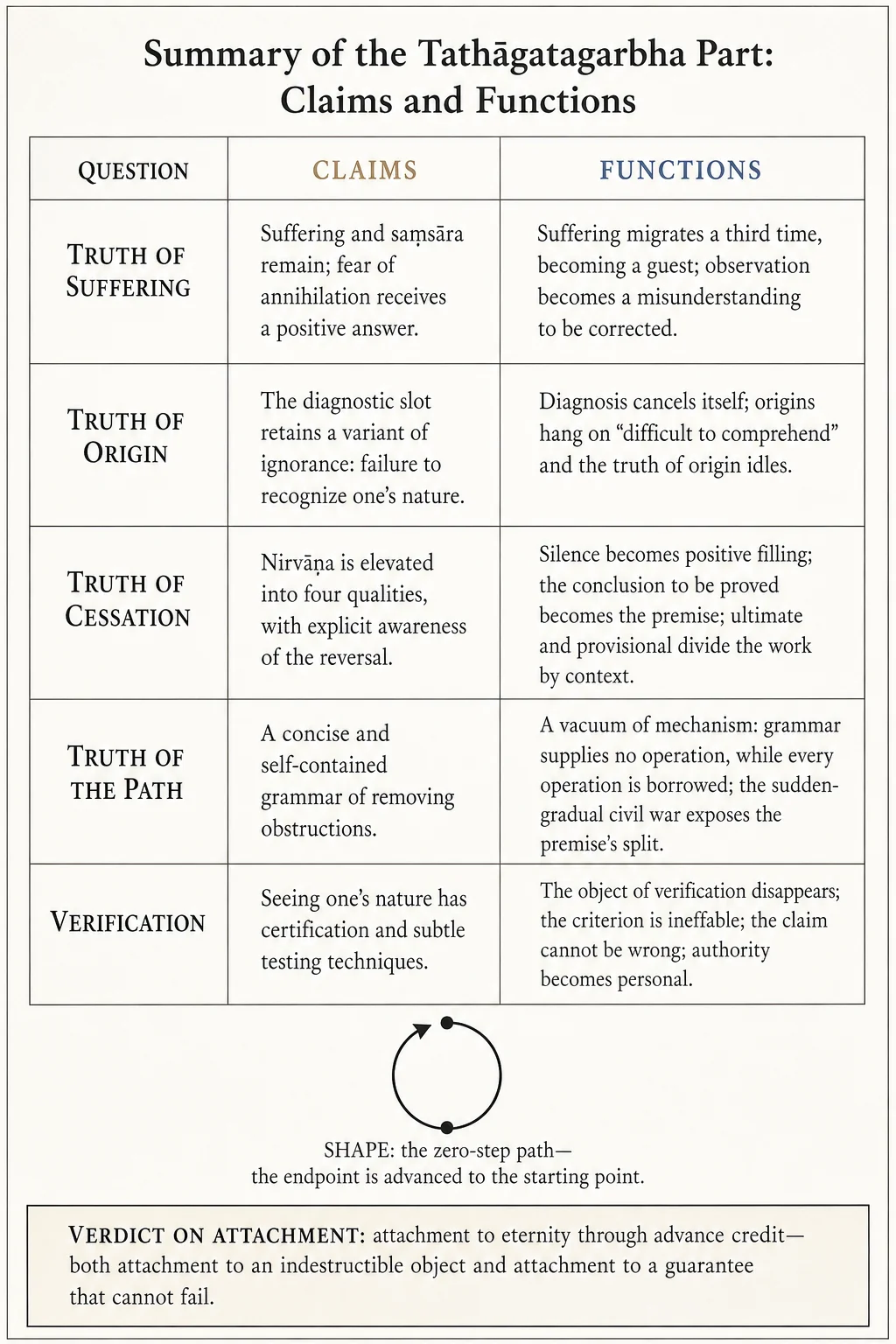
Following the established format, gather the verdicts by separating the level of claims from the level of functions. The arguments appear in the indicated chapters and are not repeated.
The truth of suffering: at the level of claims, the framework of suffering and saṃsāra remains, and fear of annihilation receives a direct response—an achievement to be credited. At the level of function, suffering completes its third migration and becomes adventitious stain. An observation report becomes a misunderstanding awaiting correction, while the prior premise is inverted into prior faith that one is not ill (Part II, Chapter 1).
The truth of origin: at the level of claims, the diagnostic position contains a variant of ignorance—failure to recognize one’s nature. At the level of function, diagnosis cancels itself. The origin of defilement is filed under “difficult to comprehend,” and the truth of origin spins idle. It is the inverse of Yogācāra’s excessive answering; in opposite ways the two systems abandon testable diagnosis (Part II, Chapter 1).
The truth of cessation: at the level of claims, every item of nirvāṇa vocabulary remains and is elevated into the four qualities; the reversal is explicitly self-aware through the milk-as-medicine simile, another achievement to be credited. At the level of function, silence becomes affirmative filling, the door barred by the three characteristics is pushed open, and a conclusion awaiting proof becomes a premise. Definitive and provisional divide their labor according to context (Part II, Chapter 2).
The truth of the path: at the level of claims, an independent grammar of removing obstruction is concise and self-contained. At the level of function, there is a causal vacuum. The grammar has no operational content; every operation is borrowed and its original causal account ceases to work; and the internal war between sudden and gradual exposes a split within the premise itself (Part II, Chapter 3).
Verification: at the level of claims, seeing one’s nature receives the judgment of certification, and testing encounters are ingenious—their contribution to preventing fraud is credited. At the level of function, the object of verification disappears, the criterion is ineffable, the universal claim cannot be wrong, and the power of certification becomes personalized (Part II, Chapter 4).
Attachment: attachment to eternity, operating through advance payment, and twofold: attachment to an imperishable object and to a guarantee that cannot fail (sections 1 and 2 of this chapter).
5. The three Mahāyāna systems side by side
The three Mahāyāna systems have now been audited. Place them side by side to establish coordinates for the final two parts.
| Madhyamaka | Yogācāra | Tathāgatagarbha | |
|---|---|---|---|
| Shape of the road | One step: seeing emptiness is liberation | Two steps: the path of seeing, then two incalculable eons of conditioning | Zero steps: originally a buddha, needing only disclosure |
| Location of suffering | Moved into views—a product of misapprehension | Moved into the storehouse—unknowable inventory | Moved into the guest position—a temporary resident outside the nature |
| Diagnosis | Wrong level—the illness is in feeling, the diagnosis in views | Correct level but too deep—accurate identification followed downward into the unknowable | Self-canceling—“difficult to comprehend” |
| Mechanism | Deficient—a load-bearing wall without a construction plan | Excessive—explains everything and therefore cannot be tested | Vacant—grammar without operation, operation without explanation |
| Verification | Historical drift in the criterion | Structural hollowing-out; authority belongs to scholastic lineage | Object canceled; authority belongs to the certifier |
| Mechanism of attachment | Recursion—attachment to argument itself | Iteration—attachment to the final foundation | Advance payment—attachment to certainty itself |
The trend is immediately visible across the columns: the advance grows heavier, verification thinner, and the baseline structure of the Four Truths more deeply rewritten. Their failures differ, but they surround the baseline from three directions. A mechanism needs explanation, but its variables must be observable—Madhyamaka and Yogācāra establish this from opposite sides. Diagnosis must reach deeply but stop where action is possible—Yogācāra establishes this. The starting point must be a publicly observable condition, and the endpoint a promise still awaiting verification—tathāgatagarbha establishes this. Looking back from here, the sequence of the Four Truths—establish suffering before discussing cessation—is not narrative convenience but the framework of testing. The truth of suffering preserves observability at the beginning; the truth of cessation preserves the endpoint’s status as awaiting verification. Loosen either end, and path and verification lose their support. Together, the three critical parts reestablish Chapter 2 of the Introduction’s judgment: the baseline’s power lies not in metaphysical profundity but in leaving every link where it can be checked.
6. A balanced word and transition
Before concluding, several balanced observations are due. Measured by religious rather than soteriological standards, tathāgatagarbha may be the most successful of the five systems. It is the shared foundation of East Asian Buddhism in practice—Tiantai, Huayan, Chan, and Pure Land all stand upon it (Volume I, Part X). Its response to fear of annihilation has stabilized the largest number of practitioners’ lives. Its declaration of equality has genuine historical consequences. Its grammar of removing obstruction protects practitioners from inferiority and outward seeking. This volume has no intention of erasing these achievements. It insists only upon consulting the other register. In the column “does the cessation of suffering occur in a verifiable way?” tathāgatagarbha supplies almost no content. The separation of the two registers has now been demonstrated for the third time. Which matters more is the reader’s own doctrinal judgment.
Transition. Tathāgatagarbha establishes “originally a buddha” but offers only a subtractive road; the next system fills the gap between proposition and operation. Deity yoga in Vajrayāna operationalizes “originally a buddha.” It does not wait for disclosure but takes the fruit as the path, turning a buddha’s body, speech, and mind into daily rehearsal. The subtraction of removing obstruction becomes a complete engineering technology—empowerment, visualization, channels, winds, and drops. The guarantee receives a construction crew. Whether this operationalization supplies tathāgatagarbha’s missing mechanism or advances the credit still further is analyzed in Part V.
References
References
-
Matsumoto Shirō, Pratītyasamutpāda and Emptiness: A Critique of Tathāgatagarbha Thought (Daizō Shuppan, 1989); Hakamaya Noriaki, A Critique of Original-Enlightenment Thought (Daizō Shuppan, 1989). For the English controversy, see Jamie Hubbard and Paul L. Swanson, eds., Pruning the Bodhi Tree: The Storm over Critical Buddhism (University of Hawai‘i Press, 1997), especially Sallie B. King, “The Doctrine of Buddha Nature Is Impeccably Buddhist,” as a representative response. For the philological approach, see Takasaki, Zimmermann, Ruegg, and Yinshun cited in the notes to Part I, Chapter 1. ↩