Part II, Chapter 4: Verification—A Path with Nothing to Verify
Each of the three systems has a different problem of verification. Madhyamaka undergoes historical drift in its criterion; Yogācāra’s checkpoints are structurally hollowed out. Tathāgatagarbha presents a third and most thorough form: the object of verification disappears first. Baseline verification checks the progress of a process—the long-term course of greed, hatred, and delusion, and whether painful feeling still produces the second arrow. Something changes, so something can be checked. In the tathāgatagarbha system, no change is under way. Buddha-nature neither increases nor decreases, gains nothing from practice, and loses nothing through defilement. Change occurs only on the side of obstructions, but their growth and decline belong to the adventitious stains declared “difficult to comprehend.” The verb of verification therefore changes. One no longer checks how far a person has traveled but confirms whether the person recognizes an identity. Checking progress becomes confirmation of identity. This chapter examines the institutional form of that conversion.
1. Seeing one’s nature: an ineffable event and a personal criterion
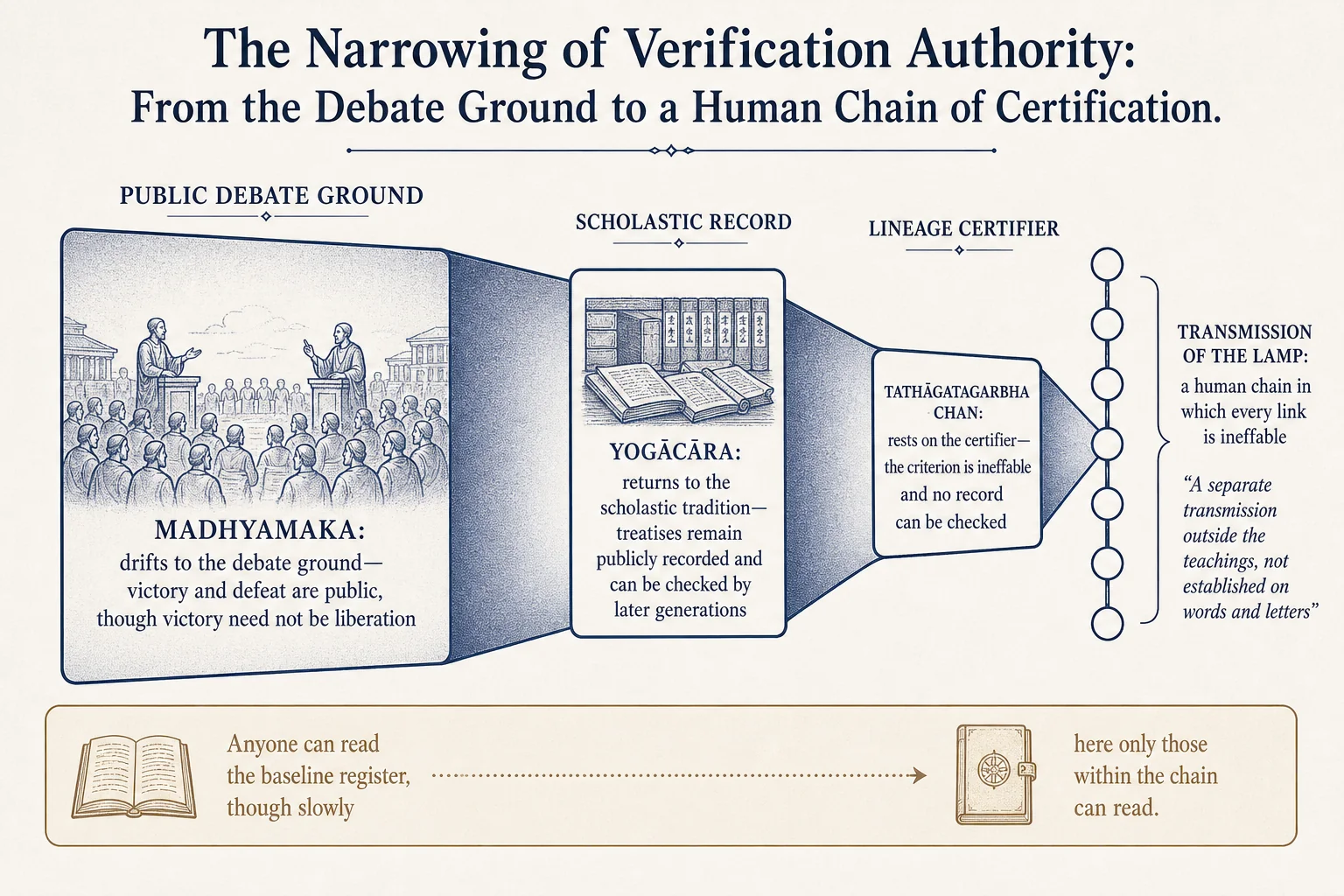
Seeing one’s nature inherits every verification problem of the path of seeing—ineffability, self-knowledge, and instantaneous occurrence (Yogācāra Part II, Chapter 6)—but no longer possesses Yogācāra’s table. The sudden approach does not pass through ranked stages: “Extinguishing the inverted thoughts of incalculable eons, I attain the dharma-body without traversing incalculable eons.” Intermediate stations are expressly abolished. Although Tiantai and Huayan retain the five stages and ten grounds in their doctrinal classifications, these do not perform the work of adjudication in Chan’s actual culture of certification.1 Two criteria remain: the practitioner’s own acknowledgment and the lineage teacher’s certification. Self-acknowledgment cannot be communicated, so all publicity rests upon certification. Whether one person has seen their nature is decided by another person already certified. Across the three systems, the locus of verification narrows by stages. In Madhyamaka, it drifts into the debating hall: victory is at least visible to all, though the winner is not necessarily liberated. In Yogācāra it belongs to scholastic lineage: the treatises at least remain publicly on record, and later readers can review the interpretation. In Chan it attaches to a person. The criterion resides in no public text but in the certifier’s own attainment, while that attainment depends in turn on the certifier’s certifier. The lamp-transmission genealogy is the institutional form of this structure. Verification’s final basis is a chain of persons, and every link is ineffable. “A separate transmission outside the teachings, not established in words” names the arrangement directly. The flower sermon and silent smile is retrospectively made the chain’s first link (its supporting scripture is judged by scholars to be late), which shows precisely why the structure requires an anchor beyond history. Scholastic monopoly at least leaves a case file. Personalized monopoly leaves nothing to consult. The narrowing of verification reaches its final position here.
2. Testing encounters: peripheral evidence at its limit
One point deserves acknowledgment first. Chan may show the greatest awareness among the five systems of how easily this structure can be counterfeited. The insults “verbal Chan” and “wild-fox Chan,” the sharp exchanges of testing encounters, the hammer-and-tongs of training, and surprise and pressure in questioning are all behavioral probes designed to puncture imitation. The Record of Linji contains a dedicated section on “testing and discerning” that records precisely such tests.2 As a technique of peripheral evidence, it is harder to game than Yogācāra’s checklist of characteristics—the table can be studied in advance, while an ambush is difficult to rehearse. This volume gives it due credit. But the probe’s limit is also clear. It tests vitality and consistency of response and protects against falsehood; it cannot establish truth. A person fluent in encounter dialogue has not necessarily ended greed and hatred. The two registers remain separate: agility of response is recorded in one, cessation of suffering in another. Moreover, only the examiner can read the probe. The entire antifraud system hangs from the human chain in the preceding section. Anyone can indirectly corroborate the baseline’s slow criterion—the course of affliction over years and decades. Only the certifier is entitled to read Chan’s rapid criterion—the instant of one question and answer. Yogācāra Part II, Chapter 6 encountered this exchange of publicity for speed once already. Here the terms are purer, because nothing else can be seen beyond the exchange itself.
3. All possess buddha-nature: a claim that cannot be wrong
The system presents only one verifiable claim to everyone: “all sentient beings possess buddha-nature.” Its history exposes the claim’s character exactly. The initial portion of the Mahāparinirvāṇa Sūtra transmitted into China explicitly excluded icchantikas: those who had cut off wholesome roots could not attain buddhahood. Daosheng, advancing alone through independent insight, insisted that icchantikas too would attain buddhahood. Older scholars condemned his view as heterodox and expelled him from the monastic community. When Dharmakṣema’s longer recension later arrived, it indeed contained the teaching, Daosheng’s case was reversed, and the episode became Chinese Buddhist history’s most famous instance of “scriptural proof arriving afterward.”3 Scholars read the recension’s disagreement with itself as a trace of textual stratification. This volume is concerned with its structural consequence. The guarantee’s scope was adjustable: scripture alone widened or narrowed it, and no observation on the side of sentient beings took part. When universal possession finally prevailed and the range became truly universal, the claim simultaneously lost all predictive content. It is compatible with every condition in every person. One who has not awakened has buddha-nature under entanglement; one who commits evil is dominated by adventitious stains; the icchantika’s buddha-nature is temporarily hidden. A claim that excludes no observation accepts testing by no observation. Yogācāra’s five distinct dispositions at least dare to distinguish, although their criterion is hidden in the unknowable. Universal buddha-nature abolishes the distinction. The two systems withdraw from testing in opposite directions: one hides the criterion; the other makes sure no criterion exists.
4. Boundary and summary
As usual, draw the boundary. This chapter does not deny that certification institutions sustained the vitality of transmission, that testing encounters eliminated many imitators, or that “supplementing the ineffable with behavioral probes” is a genuine invention in the history of verification. Its verdict records structure alone: the object of verification disappears—there is no progress to check; the criterion is ineffable—there is no content to inspect; the claim is universal—error is impossible; and authority becomes personalized—there is no case file to review. Madhyamaka loses verification through drift; Yogācāra through hollowing-out; tathāgatagarbha through cancellation. It is not that no one patrols this road, but that by design the road has nothing to verify. The final chapter reads every structure back into its motive: everything serves a guarantee that cannot fail.
References
References
-
“Extinguishing the inverted thoughts of incalculable eons, I attain the dharma-body without traversing incalculable eons,” Ānanda’s verse in fascicle 3 of the Śūraṅgama Sūtra. For the scripture’s authenticity, see Volume I, Part VII; the verse is cited here as a representative expression of the sudden approach’s abolition of stages. For “a separate transmission outside the teachings, not established in words” and the lamp-transmission genealogy, see the Jingde Record of the Transmission of the Lamp. The flower-sermon encounter appears in fascicle 1 of the Wudeng huiyuan; scholars judge its supporting Sūtra of Questions Resolving Doubts for the Great Brahmā King to be a later composition. ↩
-
The Record of Chan Master Linji Huizhao of Zhenzhou contains a section titled “Testing and Discerning.” “Wild-fox Chan” derives from Baizhang’s wild-fox encounter, case 2 of the Gateless Barrier. Criticism of “verbal Chan” appears throughout Chan works from the Song onward. ↩
-
On changing accounts of the icchantika: Faxian’s six-fascicle Mahāparinirvāṇa Sūtra explicitly denies buddha-nature to icchantikas, whereas later chapters in the northern recension teach that they too possess it. For the scripture’s textual strata, see Ming-Wood Liu, “The Problem of the Icchantika in the Mahāyāna Mahāparinirvāṇa Sūtra,” Journal of the International Association of Buddhist Studies 7, no. 1 (1984). For Daosheng, see his biography in fascicle 7 of Huijiao’s Biographies of Eminent Monks. ↩