Part II, Chapter 2: The Truth of Cessation—The Door Pushed Open
This volume has followed this door for a long time. Chapter 2 of the Introduction explained that the single word “suffering” cannot close the escape route of “seeking permanence, bliss, self, and purity on the far shore.” The two characteristics of impermanence and non-self bar the door. The same chapter announced that tathāgatagarbha would push it open again. Madhyamaka passes before the door without pushing it. Its nonduality of saṃsāra and nirvāṇa merely removes the partition between this shore and the other; it furnishes nothing on the other shore. Yogācāra installs the hinge: “nirvāṇa intrinsically pure by nature” rewrites cessation from an event yet to occur into a fact that has always been so—the back door of Yogācāra Part II, Chapter 3. Tathāgatagarbha pushes the door fully open: nirvāṇa has the four qualities of permanence, bliss, self, and purity. The four reverse the three characteristics term by term: permanence against impermanence, self against non-self, and bliss and purity against suffering. The line pursued longest through the volume reaches closure in this chapter.
1. Pushing the door: silence replaced by four qualities
The baseline truth of cessation has two features (Introduction, Chapter 2). In content, cessation is stopping (the extinguishing of greed, hatred, and delusion), and nothing is added. In expression, early discourses praise nirvāṇa with epithets such as “peace” and “deathless,” but do not unfold those epithets into an enduring substance; they also decline to say that the Tathāgata after death exists, does not exist, both exists and does not exist, or neither exists nor does not exist. This restraint avoids turning the endpoint into a new object in which one can dwell and feeding craving for existence. Tathāgatagarbha replaces both features. Stopping becomes disclosure: cessation is not a fire’s extinguishing but the manifestation of inherent perfection. A limited set of functional epithets becomes a systematic affirmative list: dharma-body, buddha-nature, permanence, bliss, self, and purity. The replacement is explicitly self-aware. The Mahāparinirvāṇa Sūtra says, “That which is non-self is called birth-and-death; that which is self is called Tathāgata,” and explains itself with the simile of milk as medicine. The earlier teaching of non-self was like a good physician’s prohibition on milk, prescribed to treat the illness of non-Buddhist attachment to self. When the illness is gone, the medicine stops and the true self must be established.1 This awareness deserves to be recorded first. Like the Laṅkāvatāra’s claim to “lead in those who conceive a self” (Part I, Chapter 1), the system clearly knows what it reverses.
2. The guarantee: treating a conclusion awaiting proof as a premise
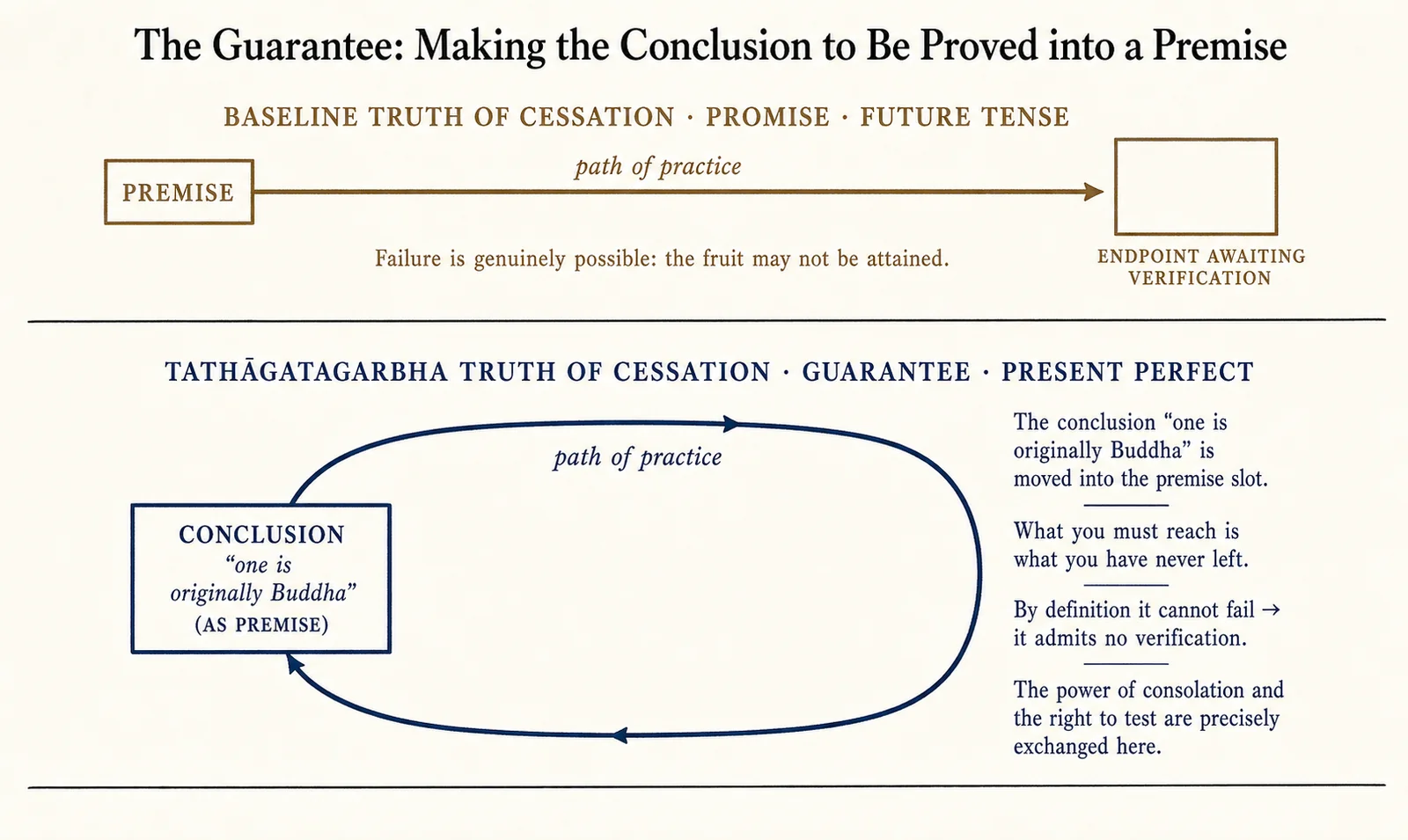
Deeper than affirmative filling is a second change. The baseline truth of cessation is a promise: stopping lies at the road’s end; walk there and check for yourself. Its grammar is future tense, and failure is a genuine possibility. Practice may not attain its fruit, and one may not witness it in this life. Tathāgatagarbha’s truth of cessation is a guarantee. The endpoint does not lie at the end of the road but before its beginning. “All sentient beings possess buddha-nature” has the grammar of the present perfect: the place one is to reach is a place one has never left. The preface has already named this structure: a conclusion still awaiting verification is presupposed as a premise. This chapter adds its consequence for the truth of cessation. A guarantee that by definition cannot fail is no longer a claim about the future but a redefinition of the present. It promises no event yet to occur and therefore accepts no check. The truth of cessation changes from the weightiest empirical proposition among the Four Truths (suffering can cease, which requires someone to complete the road and return as witness) into the system’s lightest analytic proposition—you are originally a buddha, which requires only acceptance. Chapter 2 of the Introduction said that the baseline’s restraint verifies progress but not final completion. Tathāgatagarbha’s arrangement is exactly the reverse: the endpoint holds before any progress. Consolatory force and eligibility for testing are exchanged precisely at this point.
3. Division of labor between definitive and provisional
Is true permanence a definitive teaching or a provisional one? Both answers are explicit within the system. The Laṅkāvatāra judges it provisional: tathāgatagarbha is taught “to lead in those non-Buddhists who conceive a self,” as pedagogical strategy (Part I, Chapter 1). The Mahāparinirvāṇa Sūtra judges it definitive. The entire logic of the milk-as-medicine simile proceeds from the provisional to the definitive: non-self is the provisional therapeutic teaching, while true self is the authentic flavor after the illness is cured. Later doctrinal classifications institutionalized the divergence. The mainstream Chinese tradition treated tathāgatagarbha as definitive. Fazang placed the School of Dependent Arising from Tathāgatagarbha at the summit of four schools, and in his five teachings the final teaching of tathāgatagarbha ranks above the initial teaching of Prajñāpāramitā. Gelug reverses the judgment: relying on the Laṅkāvatāra’s self-explanation, it classifies the language of true permanence as intentional and provisional, requiring reinterpretation through emptiness. Jonang carries the definitive reading to its endpoint through other-emptiness: adventitious stains are empty of themselves, buddha-nature is not empty of itself, and ultimate truth truly exists.2
The three readings can be placed side by side:
| Interpretive tradition | Judgment of true permanence | Principal basis | Resulting position |
|---|---|---|---|
| Mainstream Chinese tradition—the Fazang line | Definitive teaching | The Mahāparinirvāṇa Sūtra’s milk simile, moving from provisional to definitive | The School of Dependent Arising from Tathāgatagarbha stands at the summit; the final teaching ranks above the initial teaching |
| Gelug | Provisional and intentional teaching | The Laṅkāvatāra’s self-explanation that it “leads in those who conceive a self” | The language of true permanence must be reread through emptiness |
| Jonang | Definitive teaching of other-emptiness | Adventitious stains are empty of themselves; buddha-nature is not empty of itself | Ultimate truth truly exists; the definitive reading is carried to its endpoint |
That the same texts have resisted a common adjudication for a thousand years shows that their dual availability is structural, not a defect in later understanding. The system needs true permanence to be definitive for its reassurance to work: no one accepts a guarantee that declares itself merely expedient. It also needs true permanence to be potentially provisional to preserve the orthodoxy of non-self: when asked “how does this differ from the metaphysical self?” it can retreat to pedagogical strategy. Definitive and provisional are not unresolved; they report for separate duties. Definitive teaching provides reassurance; provisional teaching supplies defense. When Chapter 1 of the Introduction established the method of “claims and functions,” the critic had to analyze the separation between the two levels. In tathāgatagarbha, the separation is part of the system’s own operating procedure. Both levels are explicit and switch according to context. This is the purest specimen encountered in the volume.
4. Boundary and summary
As usual, draw the boundary. This chapter does not deny the stabilizing force of the four qualities as religious language, nor the intellectual-historical honesty of the system’s explicit awareness of its reversal. Both credits are gathered in Chapter 5. It records only the structural consequence: the empirical content of the truth of cessation is emptied, eligibility for testing is removed, and every discipline by which the baseline prevented craving from migrating to the endpoint (the three characteristics barring the door, the refusal to declare, and the fourteen undeclared questions) fails when the door is pushed open. The truth of suffering becomes a misunderstanding (the preceding chapter); the truth of cessation becomes a premise (this chapter). What work can a path do between a misunderstanding and a premise? That is the next chapter’s question. What remains of verification in a system that accepts no checking? Chapter 4 asks that question.
References
References
-
“That which is non-self is called birth-and-death; that which is self is called Tathāgata,” and the simile of milk as medicine appear in the relevant passages of the “Lifespan” chapter in the forty-fascicle northern recension of the Mahāparinirvāṇa Sūtra. The thirty-six-fascicle southern recension redistributes this material into a “Lamentation” chapter. “Self is precisely the meaning of tathāgatagarbha; all sentient beings possess buddha-nature, which is precisely the meaning of self,” appears in the northern recension’s chapter on the nature of the Tathāgata. Citations must distinguish the two recensions rather than assigning the southern chapter title to the northern text. ↩
-
Fazang places the “School of Dependent Arising from Tathāgatagarbha” at the summit of four schools in fascicle 1 of his Commentary on the Awakening of Faith in the Mahāyāna; for the classification into the small, initial, final, sudden, and perfect teachings, see his Treatise on the Five Teachings of the Huayan One Vehicle. For Gelug’s classification of true-permanence language as intentional and provisional on the basis of the Laṅkāvatāra’s self-explanation, see Tsongkhapa’s Essence of Eloquence Distinguishing the Definitive and Provisional Meanings and the Gyaltsab Je lineage of commentary on the Ratnagotravibhāga. For Jonang other-emptiness, see Dolpopa’s Mountain Dharma: Ocean of Definitive Meaning; Jeffrey Hopkins, trans., Mountain Doctrine: Tibet’s Fundamental Treatise on Other-Emptiness and the Buddha Matrix (2006); and Cyrus Stearns, The Buddha from Dolpo (1999). ↩