Part II, Chapter 3: The Truth of the Path—The Paradox of Polishing the Mirror
The standard question for criticism of the path (indirect cultivation or direct confrontation, from Chapter 2 of the Introduction) receives the most distinctive answer among the five systems here: neither. Removing obstruction cultivates no quality; the nature is complete, so nothing can be cultivated. Nor does it confront any view. Confrontation presupposes an enemy that exists as an object of work, while adventitious stains, according to the verdict, “do not touch” the nature. It employs a third verb: reveal. This chapter tests that verb’s substance—what operation it specifies, why the operation should work, and why the internal war between sudden and gradual must occur.
1. The discontinuity between grammar and operation
Part I, Chapter 2 inventoried the resources: an indigenous grammar (wiping a mirror and opening a mine), and a borrowed curriculum—calm-and-insight, ethical conduct, and generosity. The discontinuity lies at their joint. Each practice has a causal account in its original system. The baseline clearly explains how mindfulness of breathing gathers the mind into concentration and how the four establishments of mindfulness produce insight. Yogācāra further equips calm-and-insight with a complete seed mechanism. But every such explanation depends upon the grammar of “cultivation”: it explains how concentration and wisdom are produced step by step. Moved into the grammar of “wiping away,” the original explanations fail immediately, because wiping away by definition produces nothing new; the new grammar supplies no explanation of its own. In the same practice of counting breaths, how does dust disappear because one counts? How does a mirror brighten through ethical observance? The nine similes repeatedly say that treasure lies within obstruction and appears when the obstruction is removed. The similes include acts (removing filth, smelting ore, splitting a husk), but those acts guarantee only that obstruction can be removed. What in actual practice corresponds to the shovel outside the simile is never stated. Moreover, the actor inside the simile is often a buddha or someone with divine vision, not the treasure concealed within.1 Tathāgatagarbha’s truth of the path consequently displays an unusual distribution: one hundred percent indigenous grammar and one hundred percent absence of causal explanation. Madhyamaka’s causal deficit builds a load-bearing wall without a construction plan. Yogācāra’s excess supplies plans too detailed to check. Tathāgatagarbha presents a third form: the plans contain only an image of the completed building and no construction steps. This absence is structural, not an oversight. To explain how obstruction disappears, one must first explain what obstruction is and how it attaches. The truth of origin already hangs that question beneath “difficult to comprehend” (Part II, Chapter 1). No medicine with an explicit mechanism can be prescribed for an illness of unknowable provenance. One can only borrow medicine and rename its effect. The vacancy in the truth of origin reappears unchanged in the truth of the path.
2. The paradox of polishing the mirror: the internal war between sudden and gradual
The fissure left at the end of Part I, Chapter 2 can now be restated critically. “Originally pure, defiled by adventitious stains” is a two-part premise. Each part entails a path, and the two paths cancel one another. Take “defiled by adventitious stains” seriously and the gradual path follows: dust is real, wiping is real work, and one must constantly and diligently wipe it clean. But once dust becomes a real object of work, the judgments “does not touch” and “unassociated” cease to fit, and suffering is no longer guest. The more earnestly the gradual path works, the more it devalues the consolation “suffering is only a misunderstanding” from the chapter on suffering. Take “originally pure” seriously and the sudden path follows: dust never truly exists, nothing can be wiped, and originally there is not a single thing. Once nothing can be wiped, the entire truth of the path loses its employment and practice contracts into a single act of recognition. The system then faces a new question: why do some hear this and not awaken? The answer can only be that obstructions differ in thickness and capacities in sharpness, which lets the gradual path’s ontology back in through the rear door. The encounter about polishing a tile expresses the deadlock completely. If polishing a tile cannot make a mirror, how can seated meditation make a buddha? Yet if seated meditation cannot make a buddha, why should wiping remove dust? The tradition’s own synthesis is Zongmi’s formula “sudden awakening followed by gradual cultivation”: first recognize the nature, then wipe away habitual tendencies.2 Pedagogically, the solution is harmonious. Causally, it preserves the original conflict unchanged. What does cultivation after awakening cultivate, and why should it work? No explanation appears. The sudden-gradual dispute is therefore not sectarian temperament but an internal war generated by the grammar of removing obstruction. Both sides are honest: each honestly takes one piece of the premise and follows it to its endpoint.
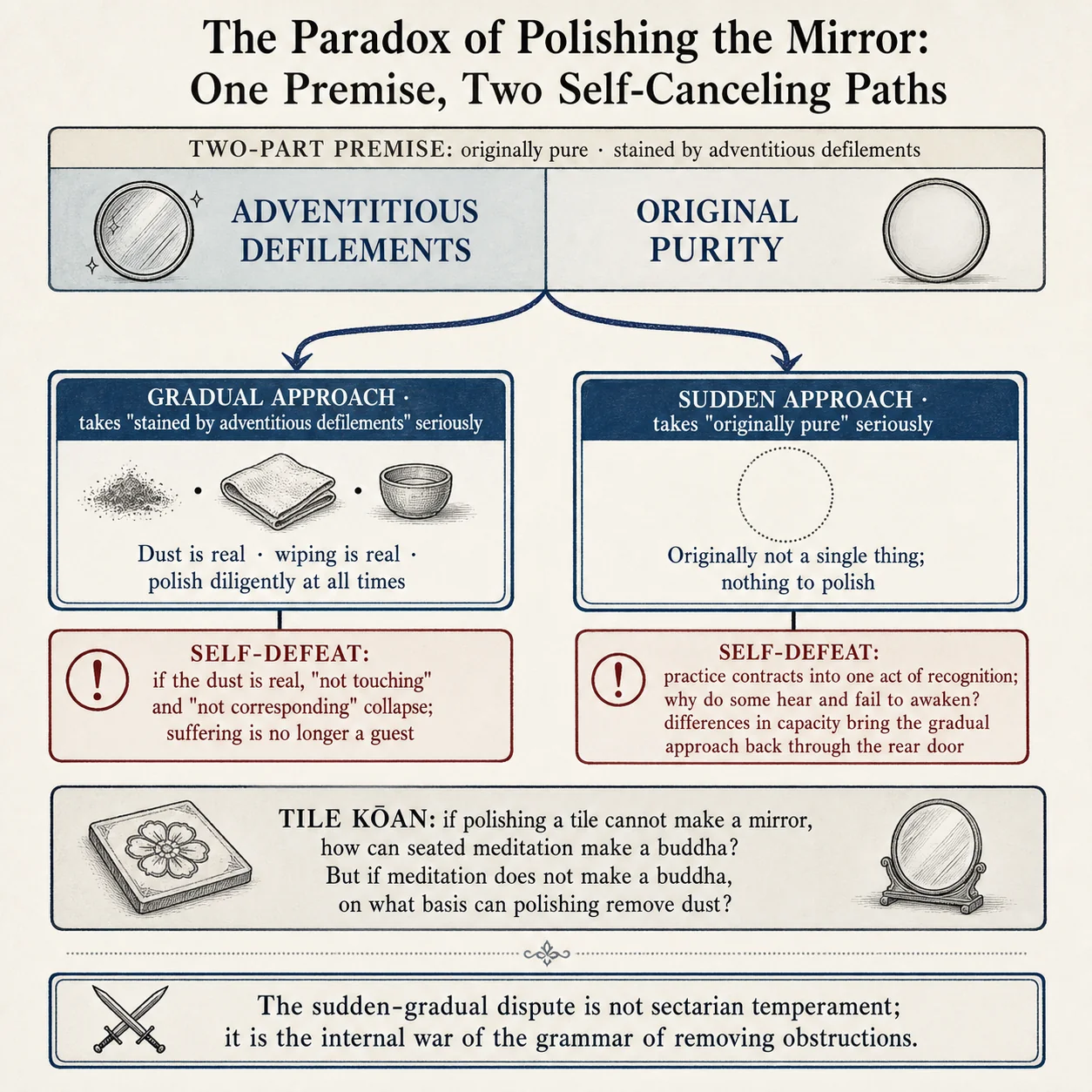
3. “Walking” on a zero-step path
Combine the preceding sections and ask: what can “practice” mean on a zero-step path? Historically, the system’s answer contracts step by step. First comes the complete curriculum of the gradual path, but its causal account is borrowed and ceases to work under the new grammar. Then comes the sudden path’s single act of recognition. The mechanism contracts to one epistemic event and converges in form with Madhyamaka’s one step, but carries still less weight. Madhyamaka’s seeing at least has something to dismantle; here seeing need only acknowledge. Finally, with “ordinary mind is the Way” and the practice of no-practice, the truth of the path approaches zero content.3 This approach to zero is not degeneration but the grammar’s logical endpoint. Once the endpoint has been advanced, every inch of road is superfluous; the more honest the system, the shorter the road. The prescription in the latter half of the preceding Yogācāra part was “repeat for a long time”: astonishing duration with empty content. The prescription here is “recognize now”: zero duration with an unclear verb. They leave the baseline truth of the path in opposite directions. One sinks its mechanism into an unobservable depth; the other evaporates its mechanism in the radiance of what has always been so.
4. Positive acknowledgments and summary
Three points require affirmative acknowledgment. First, the grammar of removing obstruction has a genuine experiential seed. Afflictions can be removed and mind can become clear—phenomena directly available in meditation. The baseline itself says, “This mind is extremely luminous, but it is defiled by adventitious afflictions,” as cited in the note to Part II, Chapter 1. Tathāgatagarbha does not fabricate from nothing. It amplifies the observation “mind can be purified” into “mind is originally the fruit of buddhahood,” advancing an observation about possibility into a metaphysical claim about the present condition. Second, “originally a buddha” has genuine dynamic value as a working belief. It restructures practitioners’ relation to themselves—the therapeutic value announced in the preceding chapter. A sinner awaiting rescue or an ordinary being without hope becomes a buddha temporarily covered in dust. Inferiority, outward seeking, and fear of failure are dismantled in one stroke. Chan’s pedagogical force of “accepting responsibility directly, here and now” rests precisely upon this. Acknowledging it does not conflict with judging the mechanism vacant. Confidence is fuel, not engine; fuel determines whether one begins moving, while the engine determines whether the road can be traversed. Third, the practice of no-practice can genuinely antidote the impulse to decorate selfhood through cultivation, and in this it accords with the baseline’s caution against attachment to practice. The chapter’s verdict is a causal vacuum. Its indigenous grammar contains no operational content, its borrowed operations have no valid explanation within that grammar, and the sudden-gradual war exposes a split inside the premise itself. The source lies in the vacancy of the truth of origin: if one does not know what obstruction is, one naturally cannot say how it is removed. The remaining problem passes to verification. How can one know that a road with nothing to do has been completed?
References
References
-
For the orientation of the nine similes (each elaborates the “treasure under entanglement” and its “appearance after freedom from entanglement,” while a buddha or someone with vision usually performs the release within the simile), see the Tathāgatagarbha Sūtra and the explanation of each simile in the Ratnagotravibhāga. Sources appear in the notes to Part I, Chapter 2. ↩
-
For the verses attributed to Shenxiu and Huineng and the encounter about polishing a tile, see the notes to Part I, Chapter 2. The standard formula “sudden awakening followed by gradual cultivation” appears in Zongmi’s General Preface to the Collected Writings on the Sources of Chan. ↩
-
“Ordinary mind is the Way,” attributed to Mazu Daoyi, appears in fascicle 28 of the Jingde Record of the Transmission of the Lamp. “The preceding thought deluded is an ordinary being; the following thought awakened is a buddha,” appears in the “Prajñā” chapter of the Platform Sūtra of the Sixth Patriarch. ↩