Part I, Chapter 1: Buddha-Nature and Liberation—The Core Claim
The format of the next three parts: compression and acceleration
Beginning with this part, the prose will compress and the pace accelerate. The two most theoretically demanding components of Mahāyāna soteriology (the hard structure of Madhyamaka and the complexity of Yogācāra) have now been argued through. This volume’s instruments have also been completely forged and tested twice in practice: the five-question framework, the distinction between claims and functions, the criterion separating indirect cultivation from direct confrontation, the test of “stipulation or discovery,” and the two registers. The parts on tathāgatagarbha, Vajrayāna, and Pure Land follow the same template: an overview followed by criticism, with suffering, origin, cessation, path, and verification kept in the same order. Chapters will be combined and the treatment tightened. This does not rank their importance; it is economy of argument. The preceding two parts have already surveyed many of these three systems’ decisive structures. The door to “permanence, bliss, self, and purity” erected in the Introduction, the hinge installed by Yogācāra, and the guarantee structure that “the endpoint is presupposed as already attained” all await closure here. The remaining work applies refined standards to new objects more than it constructs new standards.
From installing the hinge to pushing the door: texts and genealogy
The tathāgatagarbha current does not possess the lineage of treatise masters and tradition of debate found in Madhyamaka and Yogācāra. Its main body is a group of scriptures. The Tathāgatagarbha Sūtra establishes the teaching through nine similes—a buddha inside a withered flower, true gold amid filth, and a wheel-turning king within a poor woman’s womb. The Śrīmālādevī Siṃhanāda Sūtra supplies the central grammar of “mind intrinsically pure yet defiled” and declares tathāgatagarbha the “support” of both saṃsāra and nirvāṇa. The Mahāparinirvāṇa Sūtra advances “all sentient beings possess buddha-nature” and the four qualities of permanence, bliss, self, and purity. The Ratnagotravibhāga offers the current’s sole Indian-style systematic treatment. The Laṅkāvatāra Sūtra merges tathāgatagarbha with the storehouse consciousness. The Awakening of Faith in the Mahāyāna gives the Chinese form its definitive structure through “one mind and two gates.” Volume I, Parts VII and X already treated the details of this genealogy, the dispute over the authenticity of the Awakening of Faith, and its Chinese developments—Tiantai’s inclusion of all qualities within nature, Huayan’s arising from nature, and Chan’s seeing one’s nature.1 This part extracts only the soteriological essentials. They can be stated in one sentence: sentient beings are originally buddhas; liberation is not arrival but disclosure.
Answers to the five questions
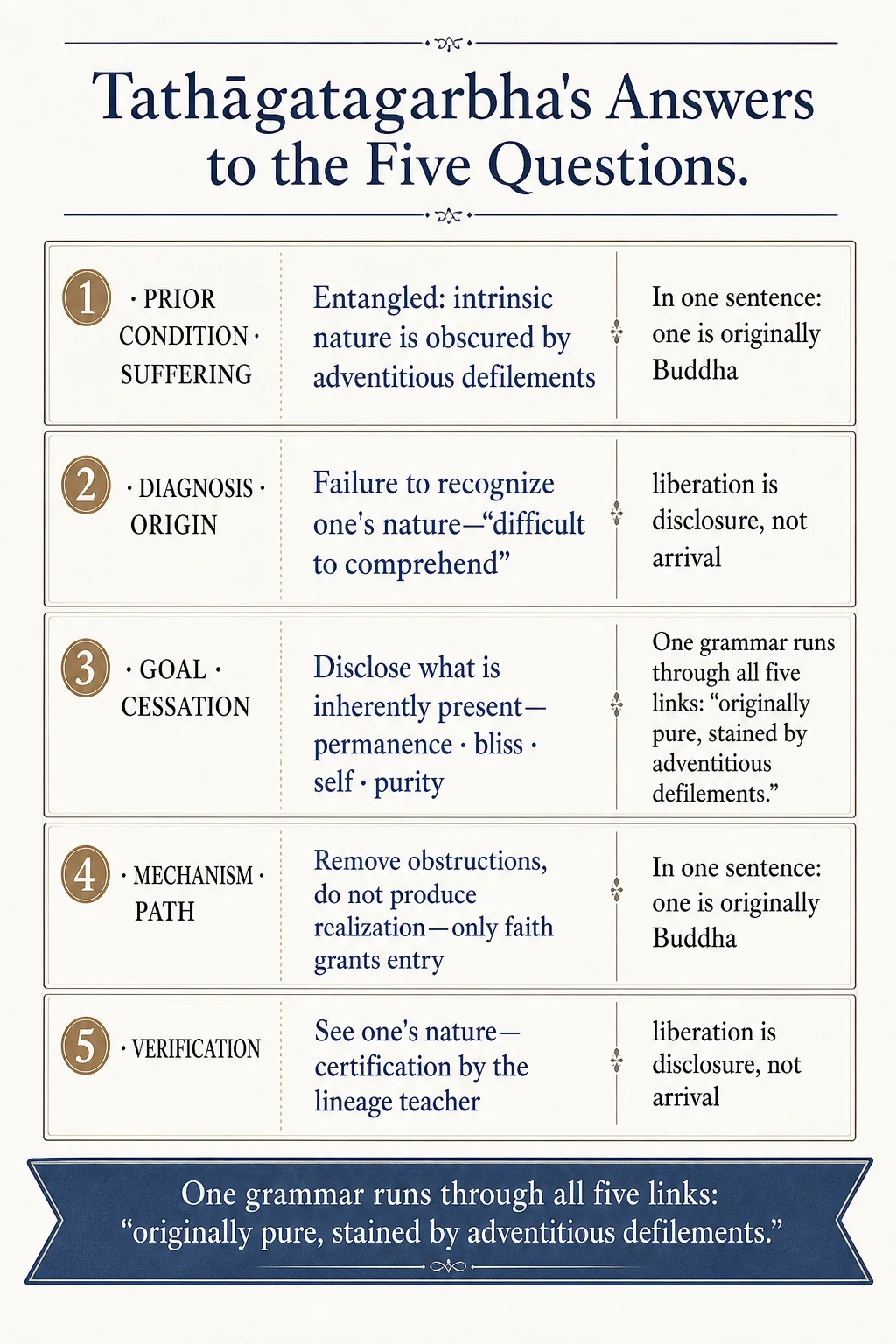
Prior premise—what is suffering? Suffering is “tathāgatagarbha under entanglement.” Sentient beings inherently possess a pure and complete tathāgatagarbha, but adventitious afflictions entangle, cover, and obstruct it. Suffering is not the nature of existence but the condition in which that nature is concealed. The Śrīmālādevī Siṃhanāda Sūtra speaks of “tathāgatagarbha under entanglement” and “dharma-body freed from entanglement”: the same thing, distinguished only by entanglement and its absence.2 Observe how deeply this arrangement rewrites the truth of suffering. In the baseline, suffering is the actual condition of conditioned existence. Here suffering becomes a layer of foreign accident occurring upon a pure nature. The word “adventitious” literally declares that affliction is guest, not host.
Diagnosis—where does suffering come from? Failure to recognize one’s nature. Sentient beings do not know their inherently present buddha-nature, take the guest for the host, and wander along with afflictions. Ignorance here is not failure to know the Four Noble Truths but failure to know “I am originally a buddha.” As for where the adventitious stains themselves come from and how beginningless defilement can cover original purity, the Śrīmālādevī Siṃhanāda Sūtra concedes that “the intrinsically pure mind is defiled, and this is difficult to comprehend.” Part II, Chapter 1 examines the weight of that concession.
Goal—what is liberation? Disclosure of what is inherently present. Delusion turns into awakening, entanglements and obstructions are removed, and the inherently complete dharma-body and buddha-nature are fully disclosed. The Mahāparinirvāṇa Sūtra gives this endpoint four positive qualities: permanence, bliss, self, and purity. The door barred by the three characteristics in Chapter 2 of the Introduction is formally pushed open here. Nirvāṇa is no longer cessation but the manifestation of an inherent perfection. Silence is no longer maintained; a complete set of affirmative descriptions takes its place.
Mechanism—how does liberation occur? Removing obstruction, not producing attainment. Since purity is inherent, practice creates nothing new but merely removes what blocks it. The scriptures use the similes of wiping dust from a mirror and opening a mine to obtain gold. At the operational level, faith occupies the pivot. While the nature is entangled it cannot see itself; one must therefore first trust “I possess buddha-nature” and begin practice on the strength of that trust. The Ratnagotravibhāga expressly says this principle and object exceed conceptual thought and can be entered only through faith.3 The concrete curriculum (calm and insight, ethical observance, and meditation) mostly inherits older methods. This current’s distinctive causal account is concentrated in the single grammar “remove obstruction and reveal the true.”
Verification—how is arrival certified? Seeing one’s nature. When the nature is disclosed, practitioners know for themselves. Yet the event is ineffable and cannot be publicly witnessed, so the tradition in practice relies on certification by a teacher’s lineage. This current built almost no checkpoint system of stages and characteristics of its own. It either borrows Yogācāra’s five stages and ten grounds or, as in Chan, discards stages entirely and replaces checkpoints with testing encounters.
The system’s self-awareness: the defense in the Laṅkāvatāra
This current possesses self-awareness of the same kind as the verse on the appropriating consciousness, but still more explicit. In the Laṅkāvatāra Sūtra, Mahāmati asks directly: the tathāgatagarbha is said to be “intrinsically pure, permanent, and unchanging”; how does it differ from the non-Buddhist ātman? The Buddha’s answer has two levels. Tathāgatagarbha differs from the non-Buddhist self because it has emptiness, signlessness, wishlessness, and related meanings as its essence. Tathāgatagarbha is taught “to lead in those non-Buddhists who conceive a self,” providing support for beings frightened by non-self, and therefore one “should rely on the non-self tathāgatagarbha.”4 This directly addresses the charge “does this not resemble a metaphysical self?” It acknowledges the apparent resemblance and explains it as pedagogical strategy. Where the defense line is placed and whether it holds are questions for Part II. For now, record this: among the five systems, none is pressed more insistently with “is this not a self?” and none states its self-defense more explicitly.
The shape of the soteriology: a zero-step path
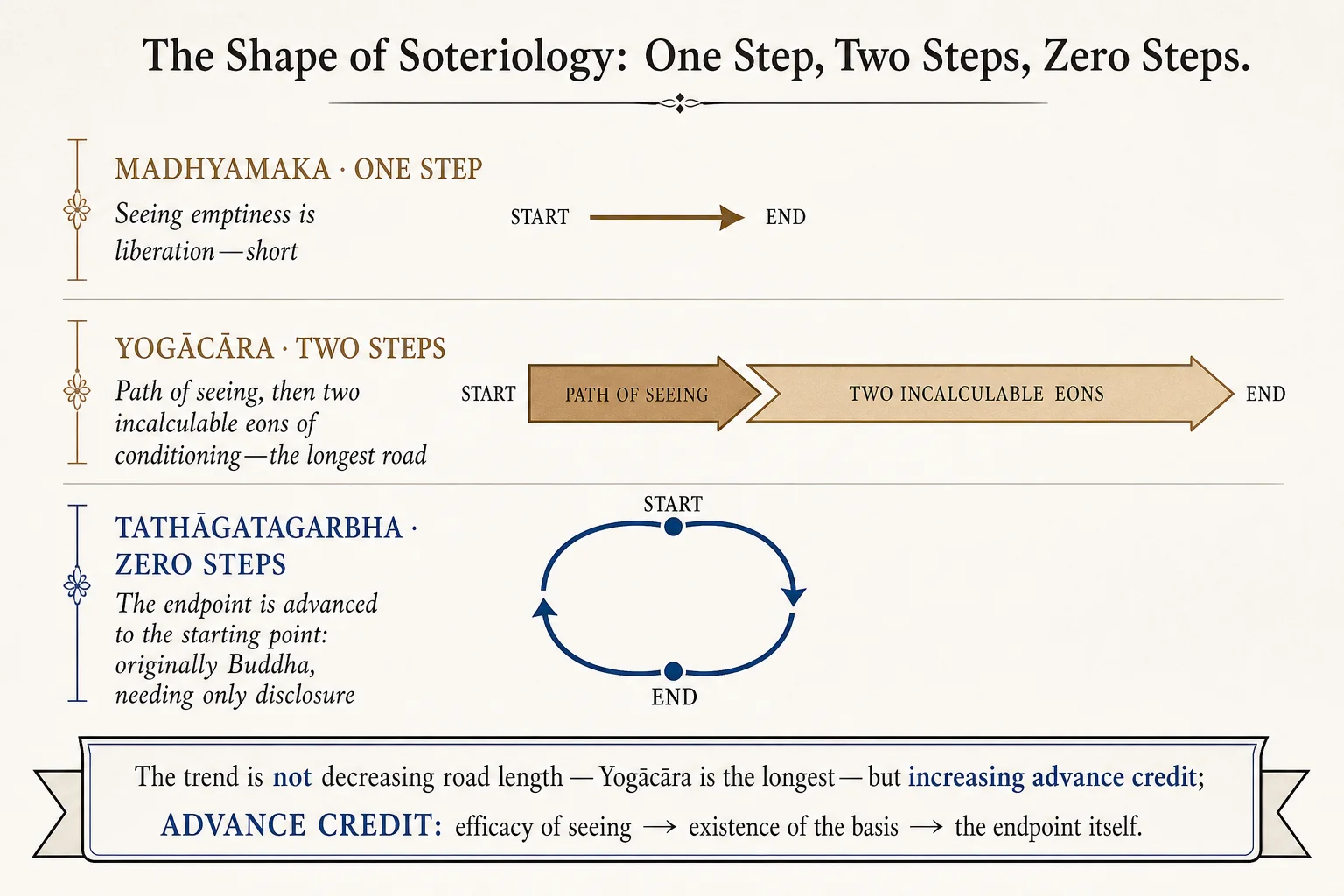
As usual, describe its shape. Madhyamaka is a one-step path: seeing emptiness is liberation, and the entire weight rests upon a single epistemic event. Yogācāra is a two-step path: after the path of seeing come two further incalculable eons of conditioning. Tathāgatagarbha is a zero-step path: the endpoint was complete before the starting point; one is not traveling toward buddhahood but is originally a buddha, and the entire path merely removes what blocks this fact. Placed in a line, the three systems reveal a clear trend: the metaphysical advance payment grows heavier. Madhyamaka advances the “efficacy of seeing”; Yogācāra advances the “existence of the basis”; tathāgatagarbha advances the endpoint itself. This shape is also the tradition’s own description—original awakening, inherent possession, and original buddhahood are all explicit in its scriptures and treatises. Merely describing it is not criticism. Criticism asks what eligibility remains for the truth of suffering after the endpoint has been advanced (Part II, Chapter 1); what replaces the truth of cessation’s silence (Chapter 2); what “practice” can mean on a zero-step path (Chapter 3); and how a promise incapable of failure can be verified (Chapter 4).
Summary
Tathāgatagarbha’s answer is concise. Suffering is concealment, its cause is nonrecognition, cessation is disclosure, the path is removal of obstruction, and verification is seeing one’s nature. Every component shares one grammar: “originally pure, defiled by adventitious stains.” Its strength and problem share a source. This current answers fear of annihilation most directly and promises liberation most equally (everyone possesses it), while rewriting every link of the baseline most thoroughly. The preface diagnoses it with attachment to eternity, and the attachment is twofold. Part II’s five compressed chapters decide the question of name and reality.
References
References
-
The Tathāgatagarbha Sūtra and its nine similes; the Śrīmālādevī Siṃhanāda Ekayāna Mahopāya Vaipulya Sūtra; the northern recension of the Mahāparinirvāṇa Sūtra; the Ratnagotravibhāga; the Laṅkāvatāra Sūtra; and the Awakening of Faith in the Mahāyāna. For genealogy and questions of authenticity, see Volume I, Part VII; for Chinese developments, see Volume I, Part X. Modern studies include Jikido Takasaki, A Study on the Ratnagotravibhāga (Rome: IsMEO, 1966); Michael Zimmermann, A Buddha Within: The Tathāgatagarbha Sūtra (Tokyo: Soka University, 2002); David Seyfort Ruegg, La théorie du tathāgatagarbha et du gotra (Paris: EFEO, 1969); and Yinshun, A Study of the Tathāgatagarbha (Zhengwen Publishing, 1981). ↩
-
For tathāgatagarbha under entanglement, freedom from entanglement, and “tathāgatagarbha is the support, the sustainer, and the foundation,” see the “Intrinsic Purity” chapter of the Śrīmālādevī Siṃhanāda Sūtra. “The intrinsically pure mind is defiled, and this is difficult to comprehend” appears in the same chapter. ↩
-
For the teaching that intrinsic purity yet defilement, and defilement yet subsequent purification, are “known only by a buddha” and can be entered at the ordinary stage only through faith, see fascicle 4 of the Ratnagotravibhāga on the four inconceivable points; compare Takasaki’s translation around RGV I.153. For its three proofs that all sentient beings possess tathāgatagarbha (the dharma-body pervades, thusness is undifferentiated, and disposition truly exists), see fascicle 1, RGV I.28. ↩
-
For Mahāmati’s question about the difference between tathāgatagarbha and the non-Buddhist self, and the Buddha’s replies that tathāgatagarbha is taught “to lead in those non-Buddhists who conceive a self” and that one “should rely on the non-self tathāgatagarbha,” see fascicle 2 of the Laṅkāvatāra Sūtra. A comparative note: in the classical context, the charge of resemblance to a metaphysical self usually compares the teaching with Sāṃkhya or Vedāntic theories of ātman. In the mechanism of concealment and removal, however, the closer parallel is the Jain doctrine of jīva: intrinsically possessing infinite knowledge, covered and bound by material karmic dust, and liberated through removing bondage and disclosure; its similes likewise include gold in ore and sun behind cloud. This comparison is primarily a product of modern scholarship. See Usha Khosla, Study of the Tathāgatagarbha as True Self and the True Selves of the Brahmanic, Sāṅkhya and Jaina Traditions, PhD diss., University of Toronto, 2015. For early criticism within the Buddhist schools of the “adventitious stains” formula, see the note to Part II, Chapter 1. ↩