Part II, Chapter 8: Concluding Audit—Claims and Functions
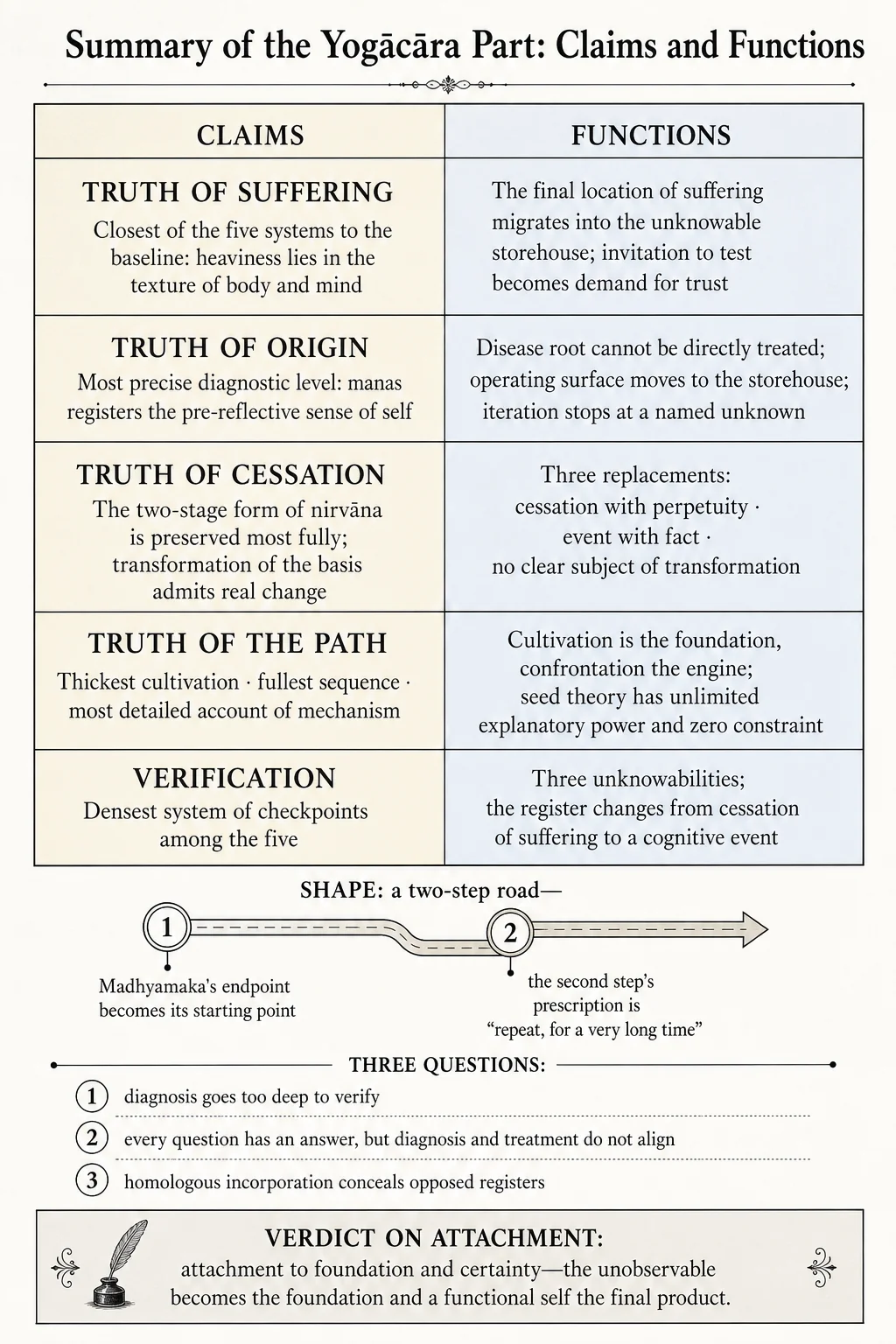
The three chapters of Part I presented the strongest form of Yogācāra soteriology through the five questions; the preceding seven chapters of Part II criticized it truth by truth. This chapter gathers the verdicts in the format established by the Madhyamaka part. For each question, it separates the level of claims from the level of functions. The arguments for the verdicts appear in the indicated chapters and will not be repeated. The final section places Yogācāra beside Madhyamaka and establishes coordinates for the two systems that follow.
The truth of suffering
Level of claims: the most faithful of the five systems to the baseline. It preserves all three kinds of suffering, gives the suffering of formations an embodied and mental texture through “heaviness,” treats everything contaminated as suffering, and identifies the entire defiled other-dependent nature as suffering (Part I, Chapter 1). Level of functions: suffering’s final location is placed in the unknowable storehouse consciousness as contaminated seeds. What began as a publicly accessible report of observation becomes an inference internal to the system. At the starting point, eligibility for testing is mortgaged to explanatory power (Part II, Chapter 1). In comparison: Madhyamaka moves suffering into views; Yogācāra moves suffering into the storehouse. Both make diagnosis accommodate their mechanism.
The truth of origin
Level of claims: the system whose diagnosis most accurately identifies the level of the problem. Manas gives a dedicated name and office to the subtle pre-reflective sense of self, and the distinction between innate and discriminatively arisen grasping directly answers the question “at which level?”—an achievement credited in Part II, Chapter 2. Level of functions: the accurately identified lesion receives no treatment; the operating surface moves to the storehouse consciousness, separating diagnosis from operation (Part II, Chapter 2). Diagnosis also refuses to stop at an actionable level. It iterates through the twofold grasping, manas, storehouse consciousness, seeds, and beginninglessness, placing the final form of suffering’s cause in an untestable depth. “Beginningless” serves as the terminus of explanation, and the pursuit of certainty comes to rest in a named unknown (Part II, Chapter 2).
The truth of cessation
Level of claims: formally, the most complete preservation of the baseline. Nirvāṇa with and without remainder remain on the list unchanged, and transformation of the basis acknowledges real replacement at the level of the support—an achievement credited in Part II, Chapter 3. Level of functions: three replacements. Cessation becomes purified perpetuity—the eternal turning of the four wisdoms and nirvāṇa without fixed abode. An event becomes an always-already fact—nirvāṇa intrinsically pure by nature, which installs tathāgatagarbha’s hinge in advance. Cessation without self becomes a transformation whose subject cannot be named—the problem of the subject of transformation. Every item of the baseline vocabulary remains while its content is replaced beneath it (Part II, Chapter 3).
The truth of the path
Level of claims: the thickest cultivation among the five systems—the nine stages of mental abiding and the complete calm-and-insight training are its own inheritance; the fullest path—the five stages and ten grounds; and the most detailed causal account—seeds and conditioning. Level of functions: three judgments. First, its central mechanism remains direct confrontation. The four investigations dismantle objects through insight; entry into the true nature of Consciousness-Only is expressly made the pivot of the path; and conditioning through correct hearing makes “acceptance of correct doctrine” the first link in liberation’s causal chain. Cultivation is the foundation, confrontation the engine (Part II, Chapter 4). Second, causal explanation is excessive and spins idle. Seed theory explains every possible outcome; every variable sinks into the unobservable, giving the explanation unlimited explanatory power and zero constraining power. This is the mirror image of Madhyamaka’s causal deficit; both fail the test “does the mechanism constrain experience?” (Part II, Chapter 5). Third, a self-confirming circuit draws the map before seeking landmarks. The framework comes first, experience is filed according to it, and conditioning theory turns learning itself into planting (Part II, Chapter 5).
Verification
Level of claims: the greatest density of checkpoints among the five systems. The characteristics of the five stages and ten grounds can be consulted, and the system possesses the richest public descriptive vocabulary—an achievement credited in Part II, Chapter 6. Level of functions: three sites of unknowability hollow out those checkpoints from below. No one can inspect the basis, the seeds; the pivot, direct realization on the path of seeing, is ineffable and self-known; and qualification, one’s disposition stored in the storehouse consciousness, cannot be known by the person concerned. Verification changes from “checking claims against experience” to “checking experience against the system.” By design, the power of certification belongs to the lineage that has mastered the system. Yogācāra builds a road directly to the endpoint Madhyamaka reaches through drift (Part II, Chapter 6).
Attachment
The preface’s verdict is attachment to a foundation and to explanatory certainty, operating through iterative depth. Part II, Chapter 7 supplies the mechanism: explanatory completeness becomes an obligation, filling every blank left by the Buddha; downward iteration becomes the method; the unknowable becomes the foundation; and a functional self becomes the final product. Here the storehouse consciousness completes the first example of “claims and functions” in Chapter 1 of the Introduction. Non-self remains intact at the level of claims, while at the level of function a bearer occupies the system’s center in its least identifiable form. What attachment to a foundation finally grasps has the same shape as what it most explicitly seeks to dismantle. The qualifications must also be retained. Yogācāra’s explanatory impulse responds to the danger of badly grasped emptiness; its explicit awareness in the verse on the appropriating consciousness is unique among the five systems; and its iteration produced genuine knowledge, including the registration of manas and the systematization of calm and insight.
Shape and three questions: drawing the whole part together
First condense the seven critical chapters into one shape. Yogācāra soteriology follows a two-step road (Part I, Chapter 1). The first step is nonconceptual wisdom on the path of seeing, structurally equivalent to Madhyamaka’s realization of emptiness. The second is a project spanning two incalculable eons of conditioning, constructed because “innate grasping remains after realizing emptiness.” The problems identified throughout the part fall into three main lines when arranged according to this shape. First, to provide an object of work for the second step, the system questions continuously downward until it stops at the inexplicable—the storehouse consciousness and beginninglessness. Suffering and its cause move into the unknowable. The soteriological result is difficulty of verification, by oneself or another, from the retrospective narrowing of “birth is ended” to the inability to distinguish realization from aberration (Part II, Chapters 1, 2, and 6). Second, to answer every challenge, the system continually manufactures purely explanatory components—manas, seeds, and transformational birth-and-death. The soteriological result is misalignment. The target of diagnosis, the executor of work, and the site of construction stand separately, so diagnosis and therapy no longer meet (Part II, Chapters 2 and 3). Third, the first step incorporates Madhyamaka, but incorporation is not resolution. The hole (how can an epistemic event guarantee the cessation of suffering?) is carried unchanged into the first stair. Verification of nonconceptual wisdom also uses an epistemic criterion, while the baseline’s criterion of not receiving the second arrow is a criterion of feeling; they belong to two different registers (Part II, Chapters 4 and 6). As for the mechanism of the second step itself, translating its account back into operational language leaves only “repeat for a long time.” It seems to say much and nothing at all (Part II, Chapter 5).
Placed beside Madhyamaka, the contrast becomes more orderly. Madhyamaka moves suffering into views, diagnoses the wrong level, lacks mechanism (a load-bearing wall without a construction plan), undergoes historical drift in verification, and exhibits recursive attachment to argument itself. Yogācāra moves suffering into the storehouse, diagnoses the correct level but descends too deeply, has an excess of mechanism (an explanation that can never be wrong and therefore never tested), suffers structural hollowing-out of verification through an original theoretical monopoly, and exhibits iterative attachment to a final foundation. They share three themes. The entire weight of liberation rests upon an epistemic event—seeing emptiness or entering the true nature of Consciousness-Only. The content of the truth of cessation changes while baseline vocabulary is retained. And the work of liberation is exchanged for an intellectual enterprise. Their complementary modes of failure mark the baseline’s location from opposite sides. A mechanism needs explanation, but its variables must be observable. Diagnosis must reach deeply, but depth must stop where action is possible. A path needs stages, but stages cannot prescribe experience before experience occurs.
Transition
The most important door Yogācāra leaves behind opens into the next part. Nirvāṇa intrinsically pure by nature, the grammar of an intrinsically pure mind defiled by adventitious stains, and the One Vehicle dispute provoked by beings without a disposition converge exactly where the tathāgatagarbha system enters. It will openly declare the bearer Yogācāra cautiously encloses within the “unknowable” to be the buddha-nature of permanence, bliss, self, and purity. Madhyamaka did not push the door barred by the three characteristics in Chapter 2 of the Introduction; Yogācāra installed the hinge; tathāgatagarbha will push it open. Part IV examines that opening.
References
(The verdicts in this chapter are based on Part II, Chapters 1–7 of the present Yogācāra part and the notes cited there; no separate notes are added.)