Part II, Chapter 4: The Truth of the Path I—Consciousness-Only Contemplation and the Continuation of Confrontation
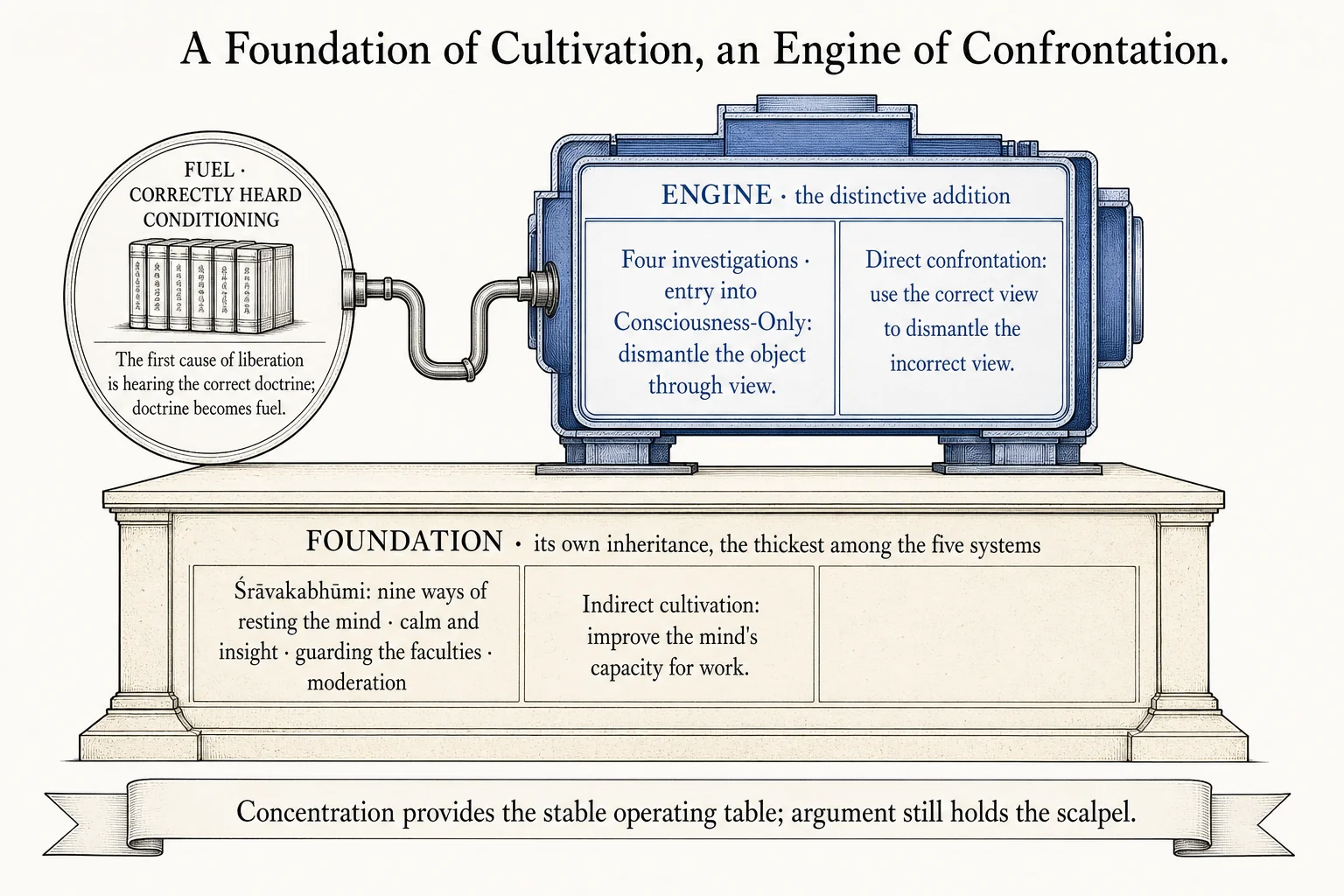
The standard established in Chapter 2 of the Introduction is this: the early right path does not launch a frontal assault on symptoms but changes the soil in which the illness survives through the long cultivation of ethical conduct, concentration, and wisdom; many later systems retreat to a framework of direct confrontation. Part II, Chapter 4 of the Madhyamaka part concluded that Madhyamaka’s distinctive contribution falls mostly on the side of confrontation, while most of its cultivation is borrowed. This chapter applies the same test to Yogācāra. Its situation is subtler. Its cultivation is an ancestral possession preserved with exceptional completeness (Part I, Chapter 2), and in this respect its record is much cleaner than Madhyamaka’s. Yet its distinctive central operation (the four investigations and entry into Consciousness-Only) remains the confrontation of attachment through insight, except that this confrontation is performed upon an unprecedentedly complete foundation of cultivation. In one sentence: the foundation is cultivation, but the engine remains confrontation.
1. Credit due to the foundation
First give full credit. In Yogācāra’s account of the path, the cultivation of ethical conduct, concentration, and wisdom is not background but main text. The nine stages of mental abiding, guarding the faculties, moderation in consumption, and the yoga of wakefulness in the Śrāvakabhūmi faithfully continue the baseline’s indirect cultivation through the meditative theory of the schools. The concepts of pliancy and workability make “improving the terrain of mind” an explicit intermediate goal. They are the doctrinal formulation of “changing the conditions in which the root of the illness can survive” from Chapter 2 of the Introduction. Compared with both sides of the Samye debate (Madhyamaka Part II, Chapter 4), Yogācāra stands furthest from Moheyan’s suppression of thoughts. Earlier and more systematically than Kamalaśīla’s analysis of thoughts, it insists upon the sequence of calm before insight and the nurturing of insight through concentration. If this volume’s standard asked only whether the component of cultivation is thick enough, Yogācāra would score highest among the five systems.
2. The character of the engine: the four investigations dismantle objects through insight
But now consider the central operation Yogācāra itself adds. The four investigations at the stage of preparation take names, referents, intrinsic natures, and distinctions as their objects. They examine each in turn as mere designation and as inseparable from consciousness, first dismantling the apprehended and then the apprehender, until the highest mundane dharma confirms both kinds of emptiness (Part I, Chapter 2). This operation is not of the same kind as the direct observation practiced in mindfulness of the body. It does not allow attachment to weaken by itself under clear seeing; it uses the view of Consciousness-Only as an instrument to argue away the object’s reality. Its difference from Madhyamaka reductio lies only in the tool (Consciousness-Only inference rather than reductio) and the platform—contemplation within concentration rather than debate. The direction of force is identical: strike directly at “grasping” and remove a mistaken view with a correct one.
Yogācāra states this even more clearly than Madhyamaka. Its causal chain is explicit: when nonconceptual wisdom arises, it directly eradicates the manifest activity of the discriminatively arisen two hindrances; what the path of seeing eradicates is precisely a view; the innate portion remains to be worn away gradually over the ten grounds. The pivot of the entire path is expressly specified as an epistemic event—entry into the true nature of Consciousness-Only and direct realization of thusness. The load-bearing wall identified in the Madhyamaka part—epistemological optimism, the conviction that seeing emptiness is liberation—is not merely shared by Yogācāra. Yogācāra supplies a construction plan: the wall stands at the path of seeing, its material is nonconceptual wisdom, and its completion date is the first ground.
To state the nature of this step exactly: it is an incorporation, and incorporation is not resolution. Part I, Chapter 1 sketched the shape of the whole. Yogācāra turns Madhyamaka’s endpoint into its own first step and then builds two more incalculable eons of road for the innate grasping that remains. This arrangement appears to repair Madhyamaka’s deficiency—no road after realizing emptiness. But the actual hole found in the Madhyamaka critique was not “there is no road after realizing emptiness.” It was “why should an epistemic event guarantee the cessation of suffering?”—the mismatch of levels in Madhyamaka Part II, Chapter 2 and the confrontation diagnosed in Chapter 4. Yogācāra imports this unverified event unchanged as the first stair and continues building upward. The hole beneath the stair is not filled; it is merely covered by the building’s weight. Adding subsequent engineering to the same structural problem postpones it rather than settles it.
3. Correct hearing and conditioning: another appearance of confrontation
The starting point of the mechanism reveals something deeper. Where do supramundane seeds come from? From conditioning by correctly hearing the Dharma, which flows from the utterly pure dharma realm (Part I, Chapter 1): hearing the correct teaching conditions pure seeds. Placed on the baseline’s coordinates, this means that liberation’s first mover is acceptance of the correct doctrine. In the baseline sequence, cultivation through ethical conduct, concentration, and wisdom comes first. Right view heads the list, but its content is a practical understanding of the Four Noble Truths, and a person with little literacy can proceed from conduct to confidence, as Chapter 4 of the Introduction noted by contrast. Yogācāra begins with hearing and reflecting on the correct Dharma; the seeds of liberation themselves are conditioned by “attending the right lesson.” Doctrine is no longer only the map. Doctrine becomes the fuel. This is the causal-theoretical completion of the position that takes insight as the mechanism’s center: insight not only completes liberation; insight initiates it.
Yogācāra possesses an internally coherent defense of this arrangement: because the teaching flows from the dharma realm, it is not ordinary speech; conditioning through hearing is deposited in the ripening consciousness and grows gradually; and it must still operate together with calm and insight. This chapter does not deny the system’s internal fit. It identifies only the direction: once “hearing the correct theory” becomes the first link in liberation’s causal chain, the framework of direct confrontation shapes not only the method of practice but also the account of practice’s origin.
4. Apparatus and bridge: comparison with Gelug
Part II, Chapter 4 of the Madhyamaka part observed that Gelug alternation between analytical and stabilizing meditation is a bridging apparatus that hands analysis over to attention; the bridge’s existence acknowledges the river. Yogācāra is the original builder of this bridge. The four investigations are themselves prescribed as contemplation within concentration; warmth, peak, acceptance, and the highest mundane dharma are each paired with their concentration. Analysis is installed on the platform of calm from the outset. In other words, Yogācāra does not need to build a bridge afterward. Its confrontation is designed from the beginning as “confrontation within concentration.” This protects it from the charge of dry wisdom, but it also permits this chapter’s criticism to be narrower and harder. Even when direct confrontation receives the most complete escort concentration can supply, its content remains the replacement of one view with another. Concentration provides a stable operating table; argument still holds the scalpel. The preceding chapter’s discovery of manas showed that Yogācāra knows the lesion lies at a pre-reflective level. Here we see that the prescription it delivers to that level still travels through correct view at the reflective level. The diagnosis is accurate, but the delivery route continues to detour through views. The preceding chapter’s fourth section structurally explained why manas receives no treatment and why the operating surface shifts to the storehouse consciousness. This displacement unfolds fully in the next chapter, on the mechanism’s idle rotation.
5. Summary
Measured by the standard of Chapter 2 of the Introduction, Yogācāra’s account of the path possesses the thickest cultivation among the five systems. It is an ancestral inheritance and need not be borrowed. Yet its distinctive central mechanism (the four investigations, entry into Consciousness-Only, and conditioning through correct hearing) remains within the framework of direct confrontation, and raises confrontation from a method to an account of origins. Its difference from Madhyamaka concerns the quality of confrontation’s equipment, not whether confrontation occurs. The baseline route (do not fight symptoms frontally, but make them lose their soil and loosen by themselves) is absorbed here as foundation but not adopted as engine.
References
(For the nine stages of mental abiding in the Śrāvakabhūmi, the four investigations and four concentrations of preparation, and conditioning through correct hearing cited in this chapter, see the notes to Part I, Chapters 1 and 2. For the comparisons with Gelug analytical and stabilizing meditation and the Samye debate, see Part II, Chapter 4 of the Madhyamaka part.)