Part II, Chapter 7: Determining Attachment—Attachment to a Foundation
The preface gives each of Madhyamaka, Yogācāra, and tathāgatagarbha a one-sentence diagnosis of attachment. Yogācāra’s is attachment to a “foundation” and to explanatory certainty, operating through iterative depth in contrast to Madhyamaka’s recursive depth. The preceding six chapters distributed their criticism across suffering, origin, cessation, path, and verification. Like the corresponding Madhyamaka chapter, this chapter draws the functional analysis together. It reads the structures previously observed as one causal account of attachment.
1. Iteration and recursion: two attachments to depth
First unfold the pair of diagnoses from the preface. Madhyamaka’s attachment is recursive: thought takes itself as object, layer after reflective layer, emptiness applied to emptiness, until the instrument that dismantles attachment becomes a new site of appropriation (Madhyamaka Part II, Chapter 7). Yogācāra’s attachment is iterative. Instead of turning back and winding around itself, it digs continuously downward. Beneath the sense of self lies manas; beneath manas, the storehouse consciousness; inside the storehouse, seeds; before seeds, beginningless conditioning—until it reaches a bottom beyond which no question can be asked. Recursion ends in an infinity that entangles itself. Iteration ends in a named unknown. Both forms of depth present themselves as “more thorough,” and neither can stop in its chosen direction.
Part II, Chapter 2 already supplied the diagnostic mechanism: every descent produces a genuine explanatory gain; that gain prevents descent from stopping; and the “final bottom” can only be placed where it cannot be observed, because anything observable permits another question. The present chapter adds two further manifestations of this attachment.
2. First manifestation: the self-expansion of explanatory obligation
Compare how the baseline and Yogācāra approach the same set of questions. How do karmic results continue across lives? The baseline’s response approaches preservation without discussion: karma has its result, but its mechanism lies outside the questions the Four Noble Truths undertake to answer—a glimmer of the discipline of the undeclared. Where does consciousness go during the attainment of cessation? The Buddhist schools disagreed without obstructing practice. Yogācāra’s attitude toward such questions is that every one must be answered, and the same posit must answer them all. Read the six proofs of the storehouse consciousness one by one (Part I, Chapter 3): each reclassifies “a question that can be suspended” as “a problem that must be solved” and then solves it with the same newly constructed theoretical entity.
This is attachment to a foundation as method. It makes completeness of explanation an obligation of the system, while the baseline makes non-explanation a discipline—the fourteen undeclared questions in Chapter 2 of the Introduction. Yogācāra fills every blank the Buddha left. Its motive need not be delusion and often is the honesty of compassion and reason: it cannot bear to leave students without support. Yet filling the blanks has a structural consequence. Every filled space gives the system another entity it must defend and makes it more dependent upon the claim “this bottom is real.” The preface invokes the Abrahamic traditions’ desire for a first cause as corroboration. A structural parallel can now be added: the place of the storehouse in Yogācāra is the Buddhist version of the form of thought “there must be an ultimate bearer,” even though it is carefully defined as momentarily arising and ceasing, neither eternal nor unitary.
3. Second manifestation: the storehouse as a functional self
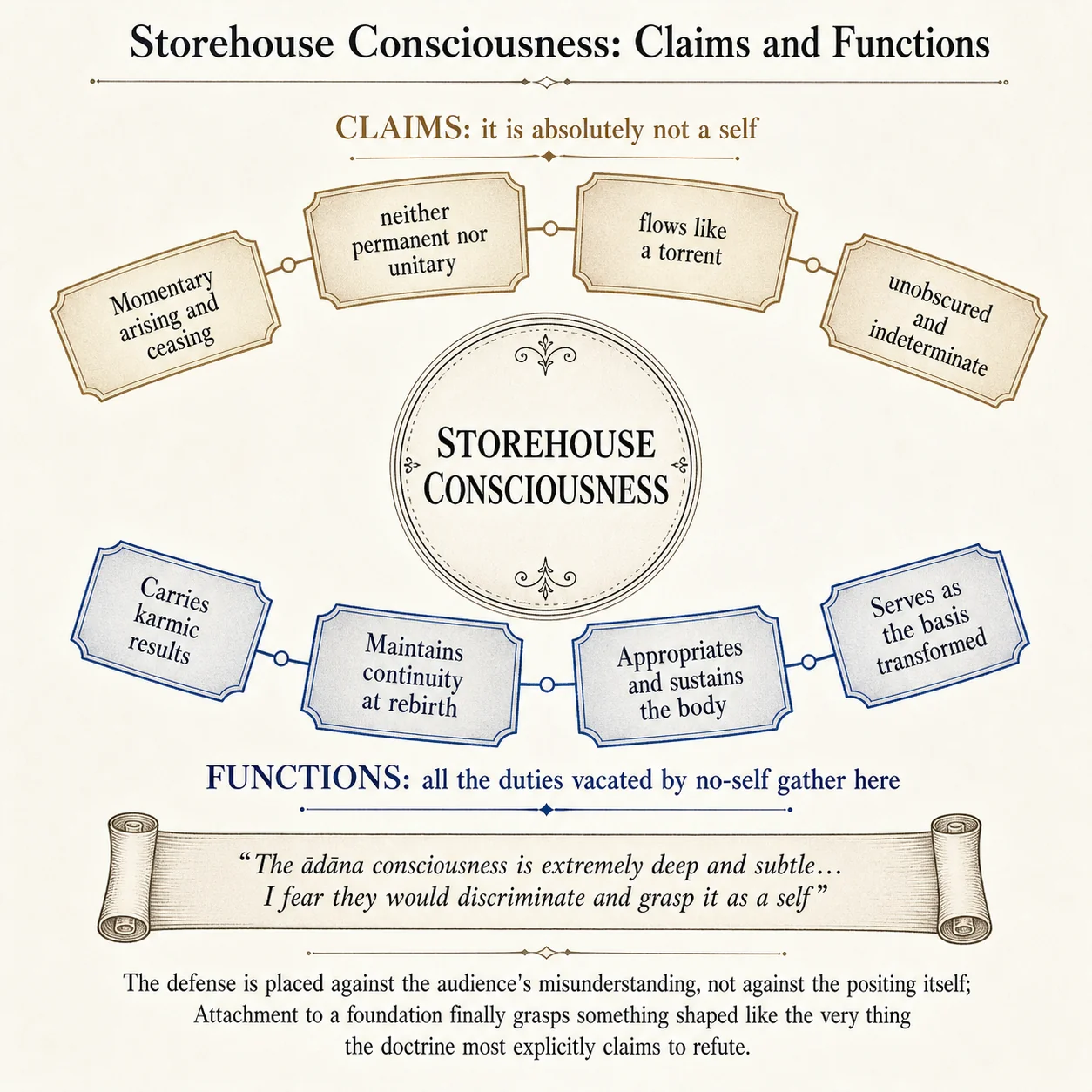
When Chapter 1 of the Introduction established the method of “claims and functions,” its first example was the storehouse consciousness. Functionally it spans the three times, retains seeds, and maintains continuity of karmic results. Almost every function that some bearer would need to assume in the space cleared by “non-self” falls to it. In wording, however, it must always be called momentarily arising and ceasing, neither eternal nor unitary; it can never be admitted as a self. At this point, the present part can complete the causal account behind the example.
Yogācāra is not unaware of the danger. The famous verse of the Saṃdhinirmocana Sūtra states: “The appropriating consciousness is profound and subtle; all its seeds flow like a torrent. I do not teach it to ordinary and foolish beings, fearing they would discriminate and grasp it as self.”1 This is explicit awareness within the system of its own risk: this consciousness can too easily be taken as self, so the Buddha does not teach it to ordinary beings. But observe the form of that awareness. It fears that others will grasp it as self; it does not suspect that the posit itself functions as a substitute for self. The defense line is placed at the audience’s misunderstanding, not at the theoretical posit. Every protective measure is therefore verbal (it continually turns like a torrent, is neither eternal nor unitary, and is unobscured and indeterminate), while not one function is surrendered. It retains karmic results; it takes rebirth; it sustains the body; and it remains the support replaced at transformation of the basis. Madhyamaka Part II, Chapter 2 observed that Madhyamaka refuses to supply this explanation and pays in explanatory power. Yogācāra supplies it fully and pays by mortgaging the functional content of its non-self position. Non-self remains undamaged at the level of claims. At the level of function, “self” returns to the system’s center in its deepest, least visible, and least identifiable form. What attachment to a foundation finally grasps has exactly the same shape as what it most explicitly claims to dismantle.
4. What must be said on Yogācāra’s behalf
As usual, several points must be stated in its defense. First, Yogācāra’s explanatory impulse belongs to the context of its opponent. It faced both the theoretical vacuum created by Madhyamaka’s “only refuting, never establishing” and the practical danger of badly grasped emptiness. Its positive construction assumed for Mahāyāna as a whole the burden of explaining causation between defilement and purity. That is a responsible philosophical posture, not careless fabrication. Second, although its awareness of danger in the verse on the appropriating consciousness places the defense line incorrectly, Yogācāra alone among the five systems explicitly warns that “this teaching may be grasped as self.” Third, its iterative attachment produced genuine knowledge: the registration of the pre-reflective level as manas, credited in Part II, Chapter 2; the embodied phenomenology of heaviness and pliancy; and the nine stages of mental abiding. All are positive products of the impulse “make everything clear.” A diagnosis of attachment never means that its products lack value. The preface already declares that this volume’s own classificatory impulse is likewise an attachment; what differs is only its direction. Yogācāra’s attachment points toward foundation and certainty. That direction produces a system and buries testing; it produces registration and installs tathāgatagarbha’s hinge in advance (Part II, Chapter 3).
5. Summary
The complete mechanism of attachment to a foundation in Yogācāra is this: explanatory completeness becomes an obligation, filling every blank; downward iteration becomes the method, as each level’s gain drives the next; the unknowable becomes the foundation, because only the unobservable can count as “final”; and a functional self becomes the final product, a bearer concealed beneath the language of non-self. It shares one theme with Madhyamaka’s recursive attachment: the work of liberation is exchanged for an intellectual enterprise. Madhyamaka exchanges it for purity of argument; Yogācāra, for completeness of explanation. The concluding audit follows in the next chapter.
References
References
-
“The appropriating consciousness is profound and subtle; all its seeds flow like a torrent. I do not teach it to ordinary and foolish beings, fearing they would discriminate and grasp it as self,” in the “Characteristics of Mind, Thought, and Consciousness” chapter of Xuanzang’s translation of the Saṃdhinirmocana Sūtra (T no. 676). The Mahāyānasaṃgraha and Cheng weishi lun both cite this verse as scriptural evidence for the storehouse consciousness. Ādāna, “appropriating” or “retaining,” is another name for the storehouse consciousness. ↩