Part II, Chapter 1: The Truth of Suffering—Is Suffering in Formations or in View?
The three chapters of Part I presented Madhyamaka soteriology in its strongest form. With this chapter, the criticism begins. It proceeds in the order of the five questions: first the truth of suffering, then origin, cessation, and the path (the path receives two chapters, one examining the direction in which effort is applied and one the source of its norms), followed by verification, a judgment concerning attachment that concludes the analysis of function, and finally an overall examination. Every chapter still follows the rule of this volume: give Madhyamaka its strongest defense first, then offer judgment.
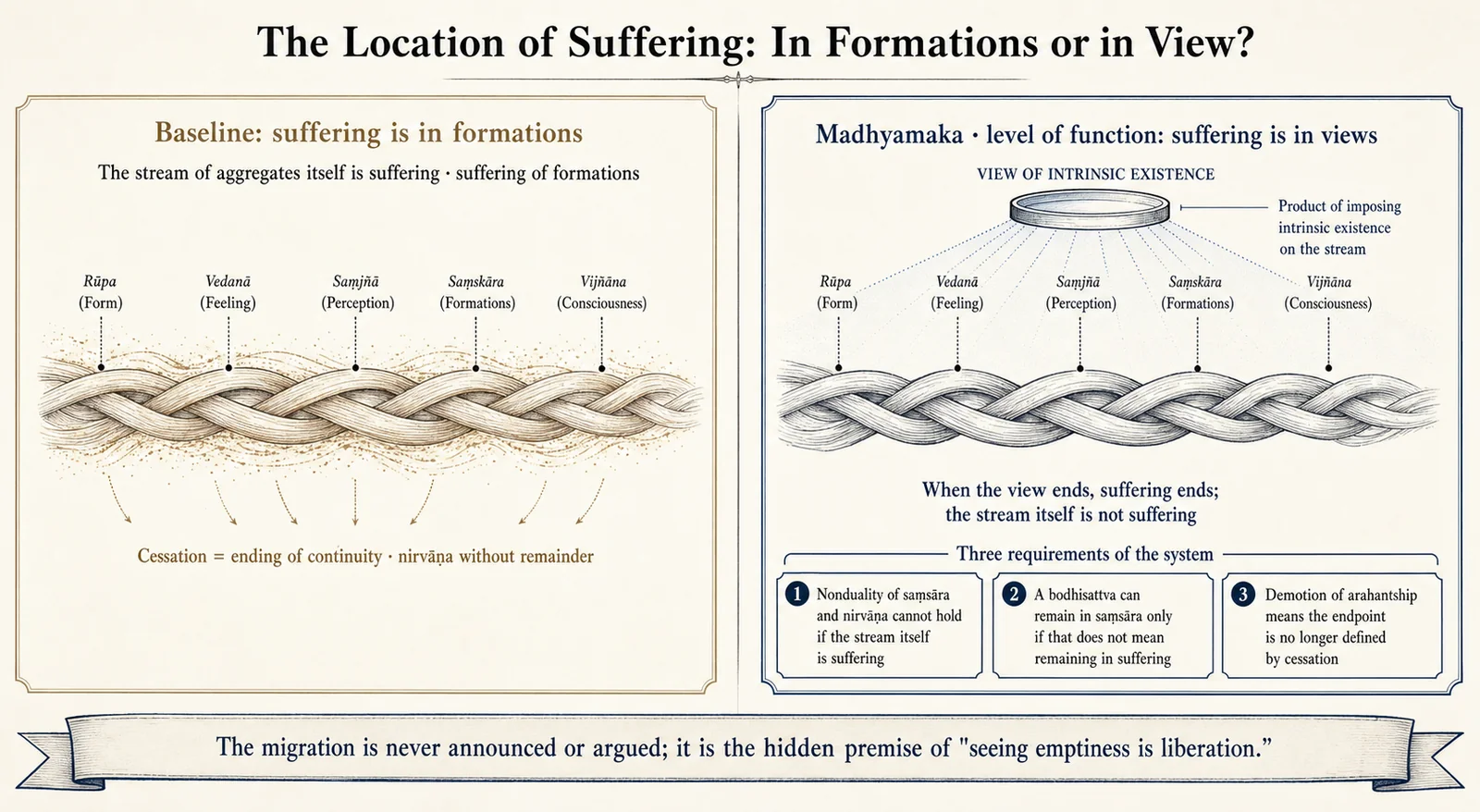
This chapter tests the furthest upstream question. Chapter 1 of Part I stated Madhyamaka’s own position as follows: the truth of suffering remains unchanged, and the three characteristics are intact. This chapter will show that the “unchanged” truth is the same in name but different in reality. Without saying or arguing so, Madhyamaka moves the location of suffering from “formations” into “view.” That move is the hidden premise of its entire mechanism of liberation.
1. The baseline’s suffering: a predicate applied to formations
First establish the baseline. It need only be cited, not restated, for Chapter 2 of the Introduction gave the complete account. First, the measure of the truth of suffering is set at the suffering inherent in conditioned existence: “all formations are suffering” (sabbe saṅkhārā dukkhā). Suffering is a predicate applied to conditioned constructions themselves. Because formations are impermanent, they are unreliable and incapable of fulfillment; this structural deficiency neither increases nor decreases with one’s mental attitude. Second, the judgment is directly encoded in the truth of cessation’s two stages. One whose influxes are exhausted immediately ends mental suffering and is not struck by the second arrow; this is nirvāṇa with a remainder. But the continuing aggregates remain within the suffering inherent in conditioned existence. Suffering’s complete end must await nirvāṇa without a remainder (parinirvāṇa), when the aggregates no longer continue. Half the weight of the truth of suffering rests on this latter level. Suffering is not merely “feeling pain” but the unreliability of conditioned existence as a whole. If the truth of cessation completes only its first stage, it remains incomplete. Everything tested below concerns this latter level.
2. Madhyamaka’s suffering: a concept awaiting analysis
The Mūlamadhyamakakārikā devotes chapter 12, the “Examination of Suffering,” to the topic, and its method deserves attention. The opening verse gives four alternatives: “Some maintain suffering is produced by itself, by another, by both, or without cause; such claims concerning suffering as an effect do not hold.”1 The entire chapter tests the four possible answers to “By what is suffering produced?” (self, other, both, and no cause), reduces each to absurdity, and concludes that suffering lacks intrinsic nature and, because dependently arisen, is empty.
This operation is completely coherent within the Madhyamaka framework, but its placement of suffering must be seen clearly. Suffering here is a concept awaiting analysis, a proposition that can be tested through the four alternatives, rather than experiential data awaiting observation. The early tradition observes suffering phenomenologically—contemplating feelings as suffering. Madhyamaka analyzes suffering conceptually—suffering cannot be found. Part I, Chapter 1 described Madhyamaka as an epistemological undertaking, and it is already so at the link of the truth of suffering.
The conclusion “suffering lacks intrinsic nature” does not by itself automatically conflict with “all formations are suffering.” Madhyamaka can perfectly well say that precisely because suffering lacks intrinsic nature it can cease, following the route of the “Examination of the Four Noble Truths.” The problem arises at the system’s next step.
3. The system requires suffering not to reside in formations
Three pieces of structural evidence show that the Madhyamaka system requires suffering not to be inherent in formations.
First is the nonduality of saṃsāra and nirvāṇa. Chapter 25 of the Mūlamadhyamakakārikā concludes that there is not the slightest difference between nirvāṇa and saṃsāra, as Part I, Chapter 1 explained. For that conclusion to stand, suffering cannot be an intrinsic characteristic of the stream of formations. If the stream of the five aggregates is itself suffering, then there is a genuine difference between saṃsāra (the continuing stream of aggregates) and nirvāṇa (the cessation of that stream), and nonduality cannot be preserved. Conversely, if suffering is merely a product imposed on the stream of formations by the view of real existence, nonduality follows naturally: when grasping at view is exhausted, the same stream of formations is no longer suffering. What the conclusion “saṃsāra and nirvāṇa are nondual” itself proves, and how far its argument reaches, will be tested separately in Chapter 3 of Part II.
Second is the practical structure of the bodhisattva path. Bodhisattvas voluntarily dwell within saṃsāra for immeasurable eons in order to save sentient beings. If the truth of suffering retains the force it has in the early teaching (conditioned existence as a whole is unreliable and should be brought to cessation), this choice is difficult to understand soteriologically. It becomes intelligible and even praiseworthy only on the tacit premise that bodhisattvas who see emptiness dwell within the stream of formations without suffering from it. Suffering must already have been moved into view, or dwelling long in saṃsāra would equal dwelling long in suffering.
Third is the demotion of arahantship. As Part I, Chapter 1 explained, the exhaustion of the influxes by disciples becomes incomplete liberation in Madhyamaka classification. If the cessation of suffering is the destination, exhausting the influxes completes the journey. To declare it incomplete is to acknowledge that the system’s destination is no longer defined by “the cessation of suffering.”
4. The deleted second level
Taken together, the three pieces of evidence state the actual content of Madhyamaka’s truth of suffering: suffering is a product that the view of real existence, together with the conceptual proliferation and grasping it drives, imposes upon the stream of experience; when view ends, suffering ends, and the stream of formations is not in itself suffering. This position fully absorbs the baseline’s first level (mental suffering arises from grasping and ceases when grasping ends, entirely compatible with the early teaching), but deletes the latter level: the continuation of the aggregates is itself suffering. That level of suffering inherent in conditioned existence has no place within Madhyamaka’s framework. Nor can it have one, or the nonduality of saṃsāra and nirvāṇa and the bodhisattva path would fail. In the baseline’s terms, nirvāṇa without remainder loses its soteriological necessity within this system.
This is the exact meaning of “the same in name but different in reality.” At the level of claim, the truth of suffering remains unchanged and the three characteristics intact. At the level of function, suffering changes location, moving from formations into view. The move is never announced, still less argued. The method of “claim and function” established in Chapter 1 of the Introduction here encounters its furthest upstream case. In previous typical examples, a concept performed the role it denied performing. Here, what is silently rewritten is the prior premise of the entire system.
5. The move is the hidden premise of the central assumption
The weight of this move lies in its logical relation to the truth of the path’s central assumption. Part I, Chapter 1 identified Madhyamaka as placing the entire burden of liberation upon the epistemological act of “seeing emptiness.” Whether that epistemological optimism can stand depends first on suffering’s location. If suffering resides in formations, no correction of view can suffice to end suffering. Suffering’s complete cessation can only be the cessation of conditioned continuity, and “seeing emptiness is liberation” is logically incomplete. Only if suffering resides in view can “seeing emptiness ends suffering” become possible in principle.
In other words, Madhyamaka does not “prove that seeing emptiness can end suffering.” It “defines suffering in the place that seeing emptiness can reach.” The feasibility of the mechanism is guaranteed in advance by a redefinition of the truth of suffering, and that redefinition itself has not been argued. The next chapter will show that diagnosing the root illness as the view of real existence is the other face of this same move.
6. Madhyamaka’s defense and the boundary of this chapter
Madhyamaka has a ready and powerful response to accusations such as “you deny suffering.” At the level of conventional truth, suffering is genuine and undeceiving, comprehended by conventional valid cognition. The “Examination of the Four Noble Truths” further maintains that only because phenomena are empty can suffering, origin, cessation, and path stand, as Part I, Chapter 1 explained. This defense entirely defeats crude charges of nihilism, but it does not defeat the present criticism, because the question here is not whether suffering is real but where it is located. Saying “there is suffering at the level of conventional truth” does not answer whether suffering is an intrinsic characteristic of formations or a product of view. Three structures within Madhyamaka (the nonduality of saṃsāra and nirvāṇa, the bodhisattva path, and the demotion of arahantship) have already made the choice on its behalf.
The tradition did not entirely fail to feel the pressure identified here. A qualification should come first: a tradition’s self-refinement can be normal theoretical development and need not amount to an admission of error. The following constructions provide testimony because they refine the teaching precisely at the seam identified in this chapter. Two doctrinal constructions are evidence. First, whether disciples realize the non-self of phenomena became a point of dispute within Madhyamaka. In his autocommentary on verse 1.8 of the Madhyamakāvatāra, Candrakīrti expressly claims that disciples and solitary buddhas also understand that phenomena lack intrinsic nature. His reason is precisely consistency of mechanism: if liberation necessarily occurs by seeing emptiness, and arahants truly are liberated, then arahants must have seen emptiness.2 This position preserves the mechanism’s coherence at the cost of locating the “incompleteness” of arahantship only in the provisions of merit and wisdom and in buddhahood, not in liberation itself. In other words, “the cessation of suffering” and “the endpoint of the road” are formally separated into two things. This is exactly the rearrangement of the structure of the goal described in this chapter. Bhāvaviveka and the Yogācāra lineage hold the opposite position (that disciples realize only the non-self of persons), and Tibetan thinkers debated the issue for centuries in the later dissemination: Tsongkhapa’s lineage follows Candrakīrti, while older positions from the early dissemination and Mipham’s lineage take the other side. Each position faces its difficulty. If disciples realize emptiness, bodhisattvas’ long dwelling within saṃsāra needs another reason; if they do not, arahants become counterexamples to the mechanism “seeing emptiness is liberation.” Second is the invention of “nirvāṇa without fixed abode” (apratiṣṭhita-nirvāṇa): through wisdom, bodhisattvas do not abide in the three realms; through compassion, they do not abide in nirvāṇa. The reason this later concept exists (it was standardized in Yogācāra treatises and later became common Mahāyāna doctrine) is precisely to answer “How can those who see emptiness remain in saṃsāra?” Together with claims of “taking birth through the power of vows” and “retaining afflictions to lubricate rebirth,” it provides a special doctrinal arrangement for “remaining in the stream of formations without suffering from it.” The existence of these constructions is itself testimony: the tradition clearly felt a seam between the bodhisattva path and the early truth of suffering that required special engineering to fill.
The boundary of this chapter remains the same. It does not assert that Madhyamaka practitioners feel no suffering, or that anyone deliberately made this move. It asserts only a theoretical structure: within the Madhyamaka framework, the operational content of the truth of suffering differs from the baseline, and the difference carries the weight of the entire mechanism. For this chapter’s dependence on the premise of rebirth and why that does not invalidate its argument, see “The Baseline’s Metaphysical Bill” in Chapter 2 of the Introduction. Madhyamaka and the baseline share the premise; the board is accepted by both. With the location of suffering clarified, the next chapter examines diagnosis: what level does identifying the root illness as the view of real existence actually strike?
References
For canonical evidence concerning the baseline (the suffering inherent in conditioned existence, the metaphor of the two arrows, and nirvāṇa with and without remainder), see the notes to Chapter 2 of the Introduction; they will not be repeated here.
References
-
The opening verse of chapter 12, “Examination of Suffering,” in Kumārajīva’s Chinese translation of the Mūlamadhyamakakārikā. The chapter tests suffering’s arising through four alternatives (produced by self, other, both, or without cause), refutes each, and concludes with dependent arising and emptiness. For an English translation and analysis, see Jay L. Garfield, The Fundamental Wisdom of the Middle Way (New York: Oxford University Press, 1995), chap. 12. ↩
-
In his autocommentary on verse 1.8 of the Madhyamakāvatāra, Candrakīrti maintains that disciples and solitary buddhas also realize that phenomena lack intrinsic nature; see Padmakara Translation Group, Introduction to the Middle Way (Boston: Shambhala, 2002), and the citation in Part I, Chapter 3. Tsongkhapa develops the point in his commentary on the Madhyamakāvatāra. Bhāvaviveka and the Yogācāra lineage hold the contrary position that disciples realize only the non-self of persons. The modern debate between Gelug scholars and Mipham over chapter 9, verse 40 and following, of the Bodhicaryāvatāra continues the same dispute. “Nirvāṇa without fixed abode” was standardized in Yogācāra treatises such as the Mahāyānasaṃgraha and later adopted widely in literature on the Mahāyāna path, including the Abhisamayālaṃkāra lineage’s account of bodhisattvas avoiding both extremes through the union of wisdom and compassion. ↩