Part II, Chapter 3: The Truth of Cessation—Deobjectification and Reobjectification
The preceding two chapters examined suffering’s location and diagnosis’s level; this chapter examines the endpoint. Madhyamaka’s truth of cessation, presented in Part I, Chapter 1, has three components: the cessation of conceptual proliferation, the emptiness even of nirvāṇa, and the nonduality of saṃsāra and nirvāṇa. The test proceeds in two stages. First, it records what Madhyamaka gains at this link—the judgment most favorable to it in this volume. It then examines what Madhyamaka loses.
1. What is gained: fidelity to silence
Chapter 2 of the Introduction pointed out that the key to the early Buddhist truth of cessation is its cautious silence on “what nirvāṇa is”: it rejects eternalism, rejects annihilationism, and leaves the fourteen undeclared questions unanswered. Later systems fill the vacuum left by this silence in their own directions. Tathāgatagarbha fills it most thoroughly by directly supplying “permanence, bliss, self, and purity.”
Madhyamaka goes in the opposite direction. It not only refuses to fill the silence but goes further, denying the very grasping expressed in “nirvāṇa is a real object that can be attained.” Nirvāṇa too lacks intrinsic nature; it cannot be grasped; there is nothing to attain, as chapter 25 of the Mūlamadhyamakakārikā and Part I, Chapter 1 explained. A note in that earlier chapter suspended a question: if early Buddhism always remained silent about nirvāṇa, did it really teach people to “realize nirvāṇa” as an object? We can now give a directional answer. Language treating nirvāṇa as something that can be approached and realized is indeed a later objectification. At the level of claim, Madhyamaka resists rather than advances that tendency. Among the five systems, it is the most faithful to the baseline’s truth of cessation. This judgment must be recorded as it is.
2. What does the nonduality of saṃsāra and nirvāṇa prove? The nirvāṇa under analysis
Immediately after recording that judgment, however, we must ask about the scope of an argument. What exactly is proved by the most famous conclusion of the “Examination of Nirvāṇa”: “There is not the slightest difference between nirvāṇa and the world”?
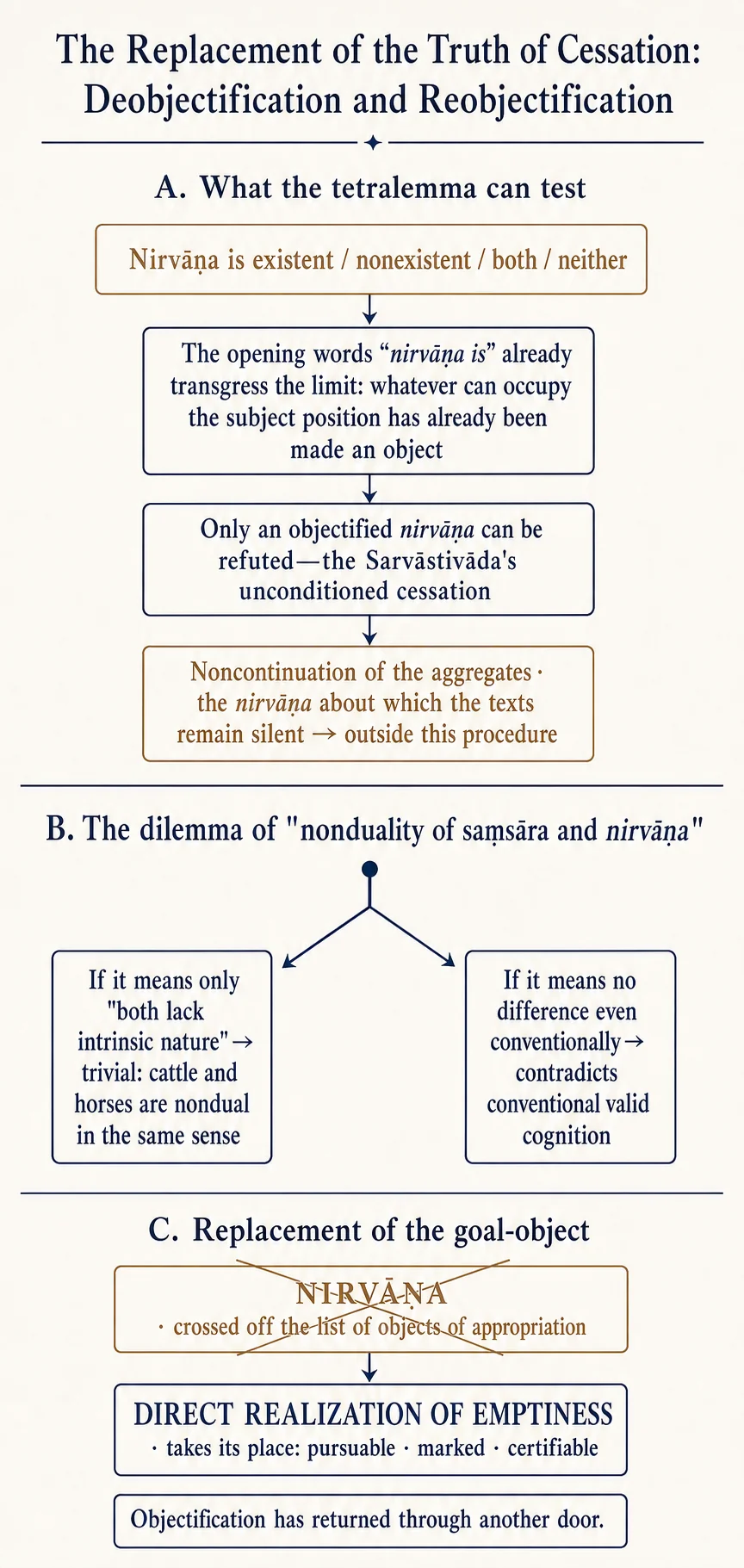
Consider the premise of the argument. Reductio requires a proposition or concept that has first been posited and can then be driven into contradiction. Candrakīrti is more explicit: Prāsaṅgika borrows only premises commonly accepted in the world by the parties to debate, as Part I, Chapter 3 explained. Which “nirvāṇa,” then, does chapter 25 analyze? Its procedure provides the answer. The chapter tests in turn the four alternatives “nirvāṇa exists, does not exist, both exists and does not exist, or neither exists nor does not exist.” The nirvāṇa tested through those alternatives can only be one already established as a topic. Its historical target is precisely Sarvāstivāda’s cessation through discernment, reified as an unconditioned dharma.1 The baseline’s nirvāṇa is exactly not such a thing. Nirvāṇa without remainder means that the continuity of the aggregates is not renewed, as Chapter 2 of the Introduction explained. “Not arising again” is not a dharma, not an existent to which intrinsic nature can be attributed or denied. It has no place within a procedure that tests the four alternatives. Each alternative begins with a form such as “nirvāṇa is”; for this nirvāṇa, the words “nirvāṇa is” already cross the boundary. Anything that can occupy the grammatical place of a subject and accept a copula has first been established as an object. Looked at in reverse, this also proves from another angle that chapter 25 cannot be testing a nirvāṇa permitted only negative description.
A ready objection must be met here. A Madhyamaka philosopher can say that chapter 25 does not merely refute “nirvāṇa exists.” Verse 25.7 and following also refute “nirvāṇa does not exist.” Has the non-objectifiable nirvāṇa not already been encompassed and tested under the alternative of “nonexistence”? The answer has two levels. First, the “nonexistence” alternative refutes a thesis establishing nirvāṇa as an item whose essence is “nonexistence,” corresponding historically to the Sautrāntika position that “nirvāṇa is only nonexistence,” discussed in the notes to this chapter. It still refutes a topic that has been posited. The baseline’s silence does not establish “nirvāṇa is nonexistent”; it never enters the proposition. Second, the argument from grammatical subject position applies equally to the alternative of nonexistence. “Nirvāṇa is nonexistent” still begins with “nirvāṇa is” and still must first establish nirvāṇa as an item capable of predication. The four alternatives exhaust four possible values of a predicate; they do not exhaust the fifth position of “not entering predication.” The Buddha occupies precisely that position when treating the Tathāgata’s existence or nonexistence after death as undeclared. What the argument genuinely establishes is therefore this: any nirvāṇa that is stated and established as a concept is no different from saṃsāra under ultimate analysis. The nirvāṇa never posited and guarded through silence is untouched from beginning to end and cannot be touched.
Now consider the strength of the conclusion, where a dilemma appears. If “saṃsāra and nirvāṇa are nondual” means only that both lack intrinsic nature, this is a trivial truth applying to any pair of concepts. Cows and horses are both empty; fire and water are both empty. Madhyamaka never holds that emptiness erases their conventional distinctions. Candrakīrti works strenuously to preserve precisely the conventional distinctions comprehended by conventional valid cognition. What kind of distinction separates saṃsāra and nirvāṇa? According to the baseline, it is not a distinction of intrinsic nature between two entities but the difference between a process’s continuation and cessation: the aggregates continue, or they do not. This distinction can be stated entirely within conventional truth by conventional valid cognition and is independent of the dimension “possessing or lacking intrinsic nature.” It follows that, if “nonduality” says only that both are empty, it carries no more weight than “cows and horses are nondual” and cannot support anything later tradition places upon it. If it says more (if saṃsāra and nirvāṇa cannot be distinguished even conventionally), it cancels a conventional distinction that conventional valid cognition is fully entitled to establish. By Candrakīrti’s own standard, that violates the rules. One route is trivial; the other contradicts Madhyamaka’s own method.
An intriguing turning point within the text itself marks exactly where the boundary is crossed. Chapter 25 proceeds in the following order. It first refutes the four alternatives concerning nirvāṇa, then addresses the four alternatives of the Tathāgata’s existence or nonexistence after death and concludes that they are inexpressible in verses 25.17–18. Structurally, this repeats the Buddha’s refusal to answer and preserves the fidelity to silence recorded in the preceding section. But the character changes immediately in verses 25.19–20, which say, “There is not the slightest difference between nirvāṇa and the world.” The Buddha’s refusal of the four alternatives was never converted into a positive judgment of identity. To leave a question undeclared means “the form of the question is defective,” not “therefore the two sides are undifferentiated.” The boundary is crossed between those two sets of verses, when refusing to answer becomes giving an answer.
A defense of Madhyamaka is readily available. It can argue that verse 25.19 itself remains only a negative formulation, saying that “under analysis no distinction can be found at the level of intrinsic nature,” not positively asserting identity. At the level of claim, this defense works. But it concedes the judgment above: read this way, “the nonduality of saṃsāra and nirvāṇa” retains only the trivial horn of the dilemma and cannot support any soteriological rearrangement. Its function in the tradition is far greater. Precisely this “nonduality” allows cessation to be moved into view, as Chapter 1 of Part II explained, and gives theoretical permission for bodhisattvas to dwell long in saṃsāra. At the level of claim it is a modest negative formulation; at the level of function it is a load-bearing beam. This is another standard case of claim and function.
The dilemma is not an invention of this volume. The history of Madhyamaka itself testifies to it. There is already partial self-awareness among Indian commentators. In his commentary on chapter 25, Candrakīrti identifies the Vaibhāṣika’s truly existent cessation through discernment when refuting “nirvāṇa exists” and targets the Sautrāntika claim that “nirvāṇa is only nonexistence” when refuting “nirvāṇa does not exist.” The tradition thus knew that the four alternatives test different schools’ claims concerning nirvāṇa. Bhāvaviveka’s lineage further standardized a distinction between approximate ultimate truth and ultimate truth itself, institutionally acknowledging that any ultimate truth capable of being stated and argued is an ultimate already rendered conventional.2 In Tibet, the map of the schools almost splits along the dilemma. Tsongkhapa’s lineage claims the first horn: emptiness is a “non-affirming negation” (a pure negation containing no positive implication), and that negation is a real object of knowledge, established by inference and directly realized in contemplation. This explicitly asserts that “the nirvāṇa under analysis is nirvāṇa.” Gorampa’s famous criticism is precisely that it turns emptiness into an object of concepts and a new attachment. The freedom-from-proliferation line represented by Gorampa claims the second horn: ultimate truth is beyond the four alternatives and beyond conceptual proliferation; it is not an object of consciousness, and every stated “nonduality” is only a finger pointing at the moon. Silence is preserved, but the authority of recognition is entirely internalized, leaving only yogic direct perception and a teacher’s confirmation—the subject of this part’s chapter on verification. Jonang simply fills nirvāṇa through other-emptiness as a truly permanent reality, exits Madhyamaka, and moves into tathāgatagarbha, the subject of Part IV. Modern scholarship has likewise openly disputed what “nirvāṇa” means in Madhyamaka. Readings range from Stcherbatsky and Murti’s absolutism to Garfield and others’ perspectivism—nirvāṇa is saṃsāra seen correctly, precisely a modern version of “suffering is in view.” Burton argues from the form of reductio that it can refute only something attributed intrinsic nature. One absence is worth noticing. No classical lineage turns back to the early distinction between nirvāṇa with and without remainder to delimit the argument’s scope. Among modern scholars, Kalupahana comes closest in direction by reading Nāgārjuna wholesale back into early Buddhism’s empiricist tradition, but that rereads the entire book rather than limiting the scope of one argument. The reason is not difficult to identify. For Mahāyāna thinkers, the nirvāṇa consisting in “the non-continuation of the aggregates” had already been demoted as “incomplete liberation” before entering the discussion, so the question lost any place from which it could be posed inside the tradition.
The preceding two sections together now permit a more exact statement. The nirvāṇa destroyed by Madhyamaka can only be a nirvāṇa already objectified. Its remedy addresses Sarvāstivāda reification, and its method requires a reified target in advance. Concerning a nirvāṇa never objectified, Madhyamaka neither refutes nor proves anything. It simply has nothing to say. The fidelity is real, but this is its boundary. The next two sections examine what is lost beyond it.
3. What is lost I: the reobjectification of direct realization
Objectification returns through another door. When “seeing emptiness” bears the entire load of the mechanism of liberation, as Part I, Chapter 1 explained, it becomes an achievement that can be pursued, calibrated, and certified. The Abhisamayālaṃkāra constructs the path of seeing around it, while the system of ten grounds marks progress toward it ground by ground, as Part I, Chapter 3 explained. What is objectified is no longer nirvāṇa but the event of “seeing emptiness.”
The grammar of the goal quietly changes: from “the cessation of suffering” (the attainment of a state or, in the baseline’s strict sense, the ending of a continuum) to “the occurrence of an epistemological event.” The practitioner no longer moves toward cessation but toward seeing. Nirvāṇa is crossed off the list of objects of grasping, and “direct realization” takes its place. The seeds of the drift in verification standards, discussed in Chapter 6 of Part II, and attachment to intellectual activity, discussed in Chapter 7, are planted here.
4. What is lost II: directional orientation between cessation and the path
The nonduality of saṃsāra and nirvāṇa possesses a strict context at the level of ultimate truth. Its slippage into the conventionalized misreading “saṃsāra is nirvāṇa” was analyzed in a dedicated chapter of Volume I (5.6), and will not be repeated. The present concern is only the cost that remains internal to soteriology.
If saṃsāra and nirvāṇa are undifferentiated, what preserves the orientation “from this shore to the other shore”? Candrakīrti’s answer is that their distinction is intact at the level of conventional truth: the stages of the path, abandonment of afflictions, and attainment of fruits all stand conventionally, as Part I, Chapter 3 explained. Formally, this answer is coherent. But it places the entire operational content of the truth of cessation inside conventional truth. According to the analysis in Chapter 1 of Part II, that conventional “cessation” has already changed its nature. The stream of formations is no longer called suffering; cessation is therefore no longer the ending of that stream but another way of seeing it. The truth of cessation changes from “an event that will occur” into “a perspective available at any time.” From here, only one loosening of the grip is needed to reach readings such as “the afflictions themselves are awakening.” Madhyamaka itself does not take that step; its descendants do, as Volume I, 5.6 showed.
5. Comparison with the baseline and the boundary of this chapter
The first of the baseline’s four structural features is that the measure is set at the suffering inherent in conditioned existence, the goal is suffering’s complete cessation, and silence is maintained regarding nirvāṇa, as Chapter 2 of the Introduction explained. By comparison, Madhyamaka’s truth of cessation preserves the silence and even guards it more thoroughly than the early teaching by also denying the residual sense of something “attainable.” But it moves the goal from cessation to direct realization. This move strictly corresponds to the relocation of the truth of suffering in Chapter 1 of Part II. Once suffering has moved into view, cessation can only be the completion of seeing.
This chapter does not assert that Madhyamaka abolishes liberation. It asserts a substitution in the truth of cessation’s operational content and identifies the soil that substitution prepares for two later problems. If the endpoint is an epistemological event, who recognizes that the event has occurred—the problem of verification? And can effort directed toward that event itself become a new attachment—the problem of attachment? With the endpoint clarified, the next two chapters examine the road.
References
(For the remaining scriptural and treatise sources, see the notes to Part I, Chapters 1 and 3 and Volume I, 5.6. For the distinction between nirvāṇa with and without remainder, see the notes to Chapter 2 of the Introduction.)
References
-
Chapter 25 of the Mūlamadhyamakakārikā, “Examination of Nirvāṇa”: for the refutation of “nirvāṇa exists” and the other alternatives, see verse 25.4 and following; for the inexpressibility of the four alternatives concerning the Tathāgata after death, see 25.17–18; for “There is not the slightest difference between nirvāṇa and the world; there is not the slightest difference between the world and nirvāṇa,” see 25.19–20 in Kumārajīva’s translation. The historical target of its refutation is Sarvāstivāda’s cessation through discernment (pratisaṃkhyā-nirodha), established as a truly existent unconditioned dharma; see Volume I, 3.1 and 3.2. ↩
-
For Candrakīrti’s sectarian identification of the “existence” and “nonexistence” alternatives in his commentary on chapter 25 of the Prasannapadā, see Th. Stcherbatsky, The Conception of Buddhist Nirvāṇa (Leningrad: Academy of Sciences of the USSR, 1927), which includes annotated translations of chapters 1 and 25 of the Prasannapadā; see also Mervyn Sprung, trans., Lucid Exposition of the Middle Way: The Essential Chapters from the Prasannapadā (Boulder: Prajñā Press, 1979). For the distinction between approximate ultimate truth (paryāya-paramārtha) and ultimate truth itself (aparyāya-paramārtha), see the lineages of Bhāvaviveka’s Madhyamakahṛdaya and Jñānagarbha’s Satyadvayavibhaṅga, and Malcolm David Eckel, Jñānagarbha’s Commentary on the Distinction Between the Two Truths (Albany: SUNY Press, 1987). For Tsongkhapa’s treatment of emptiness as a “non-affirming negation” and an object of knowledge, see the vipaśyanā chapter of his Great Treatise on the Stages of the Path to Enlightenment. For Gorampa’s criticism in his Distinguishing the Views, see José Ignacio Cabezón and Geshe Lobsang Dargyay, Freedom from Extremes: Gorampa’s “Distinguishing the Views” and the Polemics of Emptiness (Boston: Wisdom, 2007). For absolutist readings, see Louis de La Vallée Poussin, Nirvāṇa (Paris: Beauchesne, 1925), and T. R. V. Murti, The Central Philosophy of Buddhism (London: Allen & Unwin, 1955); for the perspectivist reading, see Garfield cited above. Garfield’s reading is not genealogically a neutral external interpretation: his English Mūlamadhyamakakārikā was translated from Tibetan and takes its doctrinal framework from the Gelug lineage—he studied with Geshe Yeshe Thabkhe and co-translated Tsongkhapa’s great commentary on the Mūlamadhyamakakārikā with Geshe Ngawang Samten; see rJe Tsong Khapa, Ocean of Reasoning, trans. Geshe Ngawang Samten and Jay L. Garfield (New York: Oxford University Press, 2006). It can be read as a contemporary restatement of the “first-horn” position described above. For criticism of the scope of reductio, see David F. Burton, Emptiness Appraised: A Critical Study of Nāgārjuna’s Philosophy (Richmond: Curzon, 1999). For the internal Theravāda dispute over “nirvāṇa is only nonexistence,” refuted in chapter 16 of the Visuddhimagga, see Volume I, 9.2. For the approach reading Nāgārjuna wholesale back into early Buddhism, see David J. Kalupahana, Nāgārjuna: The Philosophy of the Middle Way (Albany: SUNY Press, 1986). ↩