Part II, Chapter 6: Verification—The Drift in Certifying Realization
Part I, Chapter 3 observed that systematization made the threshold for recognizing “direct realization of emptiness” higher and more specialized. The chapter on the truth of cessation, Part II, Chapter 3, further showed that “direct realization” itself became an objectified goal. This chapter traces the actual direction taken by that standard of recognition within the tradition.
Early Buddhism’s criterion of liberation
Early Buddhism’s criterion of liberation has a structure that appears simple but is in fact exact: suffering has ceased, craving has ended, and one is no longer propelled into rebirth. Epistemologically the criterion is inward and gives priority to the subject’s self-report; in external observability it is weak. No outward behavior can establish with certainty that a person is liberated, because liberation is fundamentally a transformation of experiential state, not the acquisition of a skill or accumulation of knowledge. The Saṃyutta Nikāya’s descriptions of the exhaustion of the influxes emphasize the character of inward experience. A bhikkhu whose influxes are exhausted knows as it is: “Birth is ended, the holy life has been lived, what had to be done has been done; I know there is no more of this state of being.”1 This is self-knowledge, not a performance.
Although difficult to externalize, the criterion points clearly. It describes a change in the stream of experience, specifically the actual termination of craving, not philosophical recognition that craving is ineffective. The tradition does have a structure of “direct realization” (abhisamaya) that provides a framework for attaining this inward state, but the framework’s center remains a direct experiential transformation of suffering, not a theoretical analysis of suffering.
The process of drift
As Madhyamaka and its succeeding traditions unfold, the criterion of liberation undergoes a gradually discernible drift. The drift is not one person’s deliberate choice but a structural and incremental process. It gradually replaces the experiential criterion “cessation of suffering” with a group of epistemological standards: the ability to use Madhyamaka method correctly in discussing emptiness, effectively demolish an opponent’s claim of intrinsic nature in debate, give a striking repartee, write doctrinally precise commentaries, and compose verses on emptiness.
These activities share one structural feature. They are performances at cognitive and linguistic levels that can be displayed in public, received and recorded by learned traditions, evaluated, and transmitted. Compared with the privacy and incommunicability of “suffering’s cessation,” epistemological performances possess conspicuous social visibility. That visibility makes them extremely convenient for institutional operation, and this is not accidental.
Scholasticization is the structural cause
The drift cannot be separated from the scholasticization of Buddhist institutions. When wandering communities (including the Indian itinerant tradition that retained considerable vitality in Nāgārjuna’s time) became monastic colleges with permanent buildings, systematized canons, teacher–disciple lineages, and relations of lay patronage, normal institutional operation required workable standards of evaluation. The cessation of suffering is private and almost unusable for certifying qualifications and managing rank within an institution. Victory in debate, the quality of a commentary, and command of doctrine are public, comparable, and available as criteria of advancement.
Ecological pressure within institutions naturally tends to substitute the latter for the former as outward signs of “realization.” This is not a product of corruption but a natural extension of institutional logic. When an institution must identify who may teach, who qualifies to receive support, and whose transmission is authoritative, it must have standards of evaluation. Those standards necessarily favor observable performance over unobservable transformation of inner state.
The drift’s internal logic
In addition to external institutional pressure, the drift has an internal philosophical logic. Madhyamaka argument is a highly technical philosophical activity. Mastery of reductio requires long training, a fine grasp of logic, and practical exercise in debate. The ability of a monastic to use reductio fluently in debate is itself difficult to acquire and displays a deep command of emptiness’s argumentative structure. Under these conditions, “using reductio correctly” is readily internalized as a practice in itself, rather than merely a tool for understanding practice.
The internalization has psychological plausibility. If the view of emptiness is liberation’s epistemological foundation and argument deepens the view of emptiness, improvement in argumentative technique seems to advance liberation. But a subtle and important turn occurs. Improvement in argumentative technique and genuine deepening of the view of emptiness are not phenomenally equivalent. A person may deploy reductio with impeccable logic while making no progress whatever in actually removing self-grasping from the mental continuum, just as one may explain the mechanics of swimming with great skill while being unable to keep oneself afloat in water.
Without an independent standard distinguishing the two, argumentative skill quietly rises into an outward sign of realization. In a Madhyamaka college, how do teachers and peers determine whether a gifted debater is genuinely practicing rather than merely training an epistemological technique? If the question has no clear answer, skill in debate becomes, in fact, the realization recognized by the community.
An analysis of the Gelug debate system
The drift reaches a highly institutionalized form in the debate (rtsod pa) system of Tibetan Gelug Buddhism. The geshe (dge bshes) degree is the highest degree in the Gelug monastic system. Obtaining it requires ten to twenty years of systematic study and demonstrating mastery of five major subjects (epistemology, Perfection of Wisdom, Madhyamaka, Abhidharma, and monastic discipline) in large debate assemblies. Debate assessment is essentially a display of epistemological performance: whether a candidate can accurately cite treatises under argumentative pressure, distinguish valid from invalid reasoning, and maintain consistency in the Madhyamaka position throughout debate.2
The Gelug school has a complete internal defense of the system. Correct understanding of doctrine is a necessary condition of practice, and debate effectively tests whether that understanding is genuine, deep, and free of confusion. Geshes established through debate are qualified to serve as doctrinal authorities, guaranteeing the quality of transmission. The defense stands within its own logical framework.
This book’s criticism does not target that defense itself but the relation between the debate system and “certification of realization.” When a geshe is regarded by the community as an “accomplished practitioner” rather than only a “doctrinal authority,” and when excellence in debate is confused with direct realization of emptiness, the drift is complete. Gelug tradition makes the distinction in its normative statements (it fully acknowledges that achievement in debate does not equal direct realization), but institutional arrangements continually wear the distinction down. Dreyfus’s field research supplies an institutional annotation. Debate training occupies the overwhelming majority of the traditional curriculum, while systematic meditation is generally postponed until after the geshe course is complete. A test indefinitely deferred in the timetable gives way in practice to the one conducted every day, as Dreyfus’s study cited above shows.
The case of contemporary academic Buddhist studies
The drift has a curious contemporary continuation in academic Buddhist studies, whose history was discussed in Volume I, 12.3, “Academic Buddhist Studies.” Some Buddhist-studies communities functionally circulate the publication of precise scholarly papers on emptiness, acquisition of degrees, and correct exposition of Nāgārjuna at conferences as credentials that one has in some sense “understood emptiness.” The boundary set by this volume must be observed: this is not an assertion about any person’s psychology but a description of a mechanism of recognition. This volume diagnoses structures, not motives, as Chapter 1 of the Introduction specified. As a mechanism of recognition, it has entered the domain of certifying realization.
The case reveals the universal mechanism of drift. It is not peculiar to medieval colleges. Whenever a tradition makes a highly technical epistemological activity (whether monastic debate or academic research) its central intellectual practice, social pressure turns “performing this activity correctly” into an outward form of realization, however expressly the tradition’s normative texts distinguish the two.
Resistance within the tradition
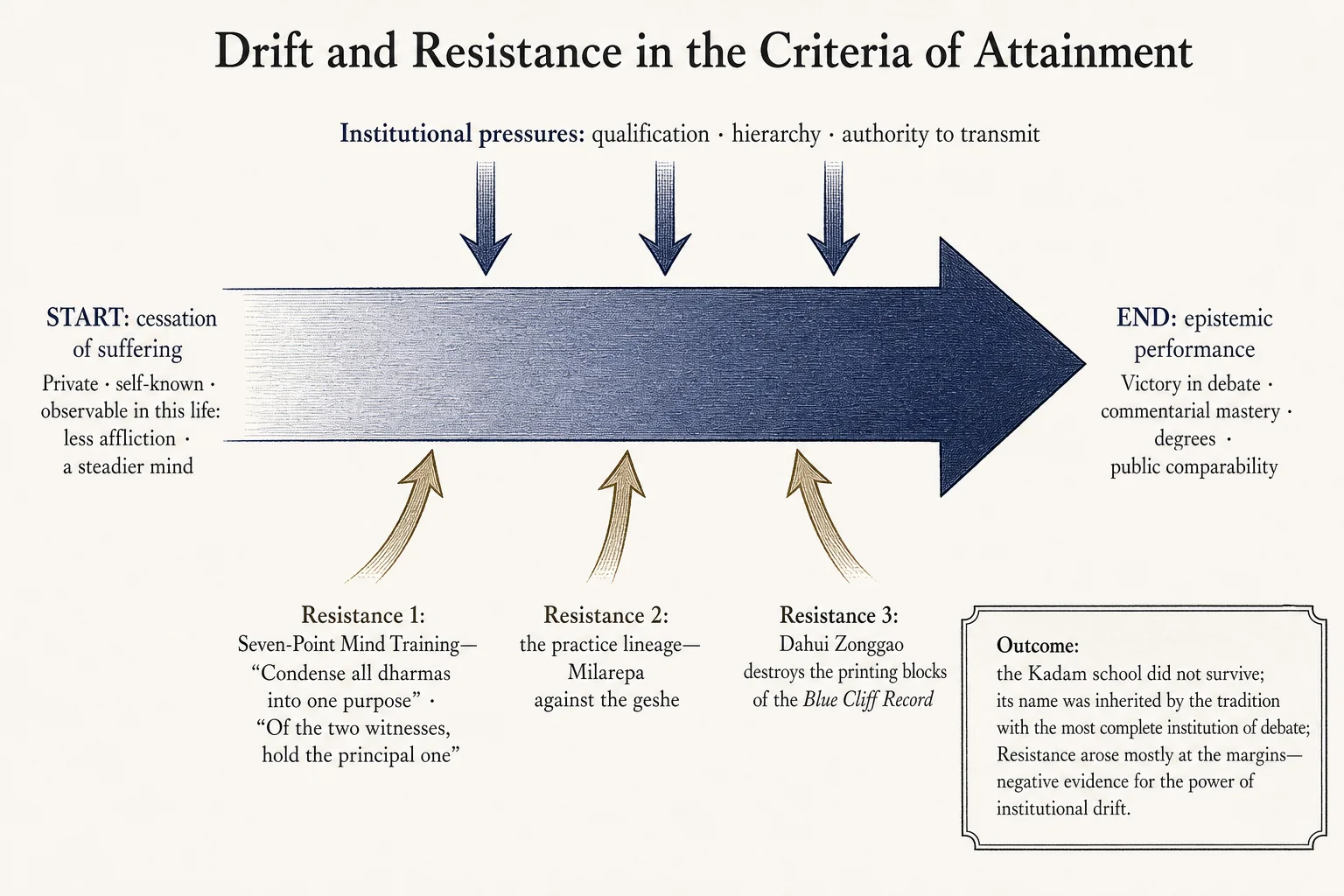
The drift has not gone unresisted within the tradition. Traces of resistance are themselves testimony. The Kadam mind-training tradition established two instructions directly relevant to this chapter in the Seven-Point Mind Training. First, “Condense all dharmas into one point”: every teaching is reduced to a single test, whether self-grasping has diminished. Commentators explicitly call it the scale that weighs a practitioner. Second, “Of the two witnesses, rely on the principal one”: of others’ confirmation and examination of one’s own mind, give primacy to one’s own mind.3 Together the two instructions almost reestablish in Tibet the early criterion that can be tested in this life—reduced affliction, loosened grasping, and reliance on transformation discernible to the person concerned. They directly resist drift toward reliance on scholarly performance and others’ recognition. The same resistance appears in the enduring tension between practice lineages and scholastic lineages. Several confrontations between Milarepa and geshes in his biography contrast victory on the debating ground with assurance at death as two criteria of accomplishment. China offers an even more forceful example. Seeing students memorize the striking exchanges in the Blue Cliff Record and pass them off as states of awakening, Dahui Zonggao directly destroyed its printing blocks by fire. This was a lineage master’s institutional surgery upon “realization reduced to standard answers.” The existence of these forms of resistance shows that the tradition saw the drift. That they generally arose at the margins or required extreme gestures shows the power of the institutions producing it.
The fate of the Kadam school itself should also be recorded. It did not survive as an independent school. After the fifteenth century, its monasteries and lineages were gradually absorbed into Tsongkhapa’s lineage, and the Gelug school styled itself the “New Kadam.”4 The test represented by the two instructions diffused in mind-training literature across the schools and survives to the present. But the school that established it was inherited and renamed by the school possessing the most complete institutions of degrees and debate. A tradition that used the increase or decrease of affliction as its scale is now remembered mainly as the “old name” of a tradition that uses degrees and the debating ground as its scale. The power of the drift appears most completely in this outcome.
The boundary of the criticism
There is nothing inherently wrong with understanding doctrine as a necessary condition of practice. The question is whether “understanding doctrine correctly” is equated with “having practiced.” Striking replies and verses can serve as means of transmission and need not be self-display; the question is whether, when they become realizations recognized by the community, means of transmission become mechanisms of certification. For practitioners who genuinely meditate, debate training may help consolidate correct doctrinal understanding and thereby support meditation. The question is not there but in how a community recognizes the auxiliary method as realization.
The drift is structural and incremental, not a single decision by one person or era. It can recur in any tradition of practice that places a highly technical epistemological practice at its center. Awareness of the mechanism is a necessary condition of remaining lucid about one’s own tradition.
References
References
-
The standard formula for an arahant whose influxes are exhausted (“Birth is ended, the holy life has been lived, what had to be done has been done; I know there is no more of this state of being”) occurs throughout the Saṃyukta Āgama. The corresponding Pāli formula (khīṇā jāti, vusitaṃ brahmacariyaṃ, kataṃ karaṇīyaṃ, nāparaṃ itthattāyā) occurs throughout the four Nikāyas. ↩
-
The standard study of the geshe curriculum, the five major subjects, and debate examinations is Georges B. J. Dreyfus, The Sound of Two Hands Clapping: The Education of a Tibetan Buddhist Monk (Berkeley: University of California Press, 2003). Dreyfus was the first Westerner to earn a geshe degree. ↩
-
For the two instructions “Condense all dharmas into one point” and “Of the two witnesses, rely on the principal one” in Chekawa’s Seven-Point Mind Training (blo sbyong don bdun ma), see Jamgön Kongtrul’s commentary, The Great Path of Awakening, trans. Ken McLeod (Boston: Shambhala, 1987). For Milarepa’s confrontations with geshes, see Tsangnyön Heruka, The Life of Milarepa, trans. Andrew Quintman (New York: Penguin, 2010). The destruction of the printing blocks of the Blue Cliff Record by Dahui Zonggao is recorded in prefaces and postscripts to editions of that collection and in the chronological biography of Dahui; see also Volume I, 10.8, “Chan Buddhism.” ↩
-
The Kadam school (bka’ gdams pa) derives from Atiśa and Dromtön. After the fifteenth century it ceased to exist as an independent school, as its monasteries and lineages were gradually incorporated into Gelug. Tsongkhapa’s lineage called itself the “New Kadam” (bka’ gdams gsar ma). For the history of Kadam and its core texts, see Thupten Jinpa, trans., The Book of Kadam: The Core Texts (Boston: Wisdom, 2008; Library of Tibetan Classics), and Volume I, 11.2, “The Beginning of the Later Dissemination.” ↩