Part II, Chapter 7: Judgment of Attachment—Functional Clinging and Ultimate Truth
The preface gave one judgment concerning attachment for each of Madhyamaka, Yogācāra, and tathāgatagarbha. Madhyamaka’s was attachment to intellectual activity itself. The first six chapters of Part II located their criticisms respectively within the five questions of suffering, origin, cessation, path, and verification. This chapter addresses the final and most hidden point at the level of function: how a method devoted to destroying attachment cultivates a new attachment within itself. It supplies the mechanism behind the preface’s judgment.
Ultimate truth is a logical metaconstraint, not a level of reality
The starting point for understanding this chapter’s criticism is the correct location of “ultimate truth” (paramārtha-satya). A common misreading of the two truths within Madhyamaka understands ultimate truth as a “higher level of reality,” a domain of existence beyond ordinary experience in which things exist in a “true way”—empty and without intrinsic nature. This is a Vedānta-style reading. It turns Nāgārjuna’s framework into an ontological dualism consisting of an ordinary everyday world (conventional truth) and a more real metaphysical world (ultimate truth).
Nāgārjuna’s texts do not support this reading. In the Vigrahavyāvartanī, he expressly says that he holds no thesis (pratijñā) and that reductio is his entire operation. If ultimate truth were a content-rich level of reality, Nāgārjuna would possess positive propositions requiring active defense, directly contradicting his methodological self-positioning. In Nāgārjuna’s use, the exact function of ultimate truth is a logical metaconstraint on the form of propositions. It prohibits the propositional form that attributes intrinsic nature to anything: the mode of assertion “X has a fixed intrinsic nature” is invalid. It does not say “there is a world called the ultimate in which things exist emptily,” but “any proposition attributing intrinsic nature can be driven into internal contradiction.”
This interpretation gives the two truths a different structure. Conventional truth is the contextual level in which practice actually occurs—conditioned phenomena, causation, stages of practice, suffering, and the cessation of suffering all stand here. Ultimate truth is a critical metalevel that supplies no positive content but only constraints on the validity of propositional forms. Their relation is not “lower world” and “higher world,” but “object language” and “metalanguage.”1
The gap left by the “emptiness of emptiness”
Nāgārjuna explicitly warns against grasping emptiness as another real existent. Chapter 13 of the Mūlamadhyamakakārikā says: “The great sages taught the Dharma of emptiness in order to free us from all views. Those who again entertain a view of emptiness are declared incurable by the buddhas.”2 Emptiness is medicine established to free one from views. If the medicine itself is grasped as a view, no medicine remains to cure the illness. The later formula “the emptiness of emptiness,” the standardization of śūnyatā-śūnyatā among the eighteen emptinesses, says precisely this. The move is internally necessary. If emptiness itself possessed intrinsic nature, it would become an eternal and unchanging metaphysical entity, structurally identical to the entities asserted by the essentialists Nāgārjuna criticizes and differing only in name. The “emptiness of emptiness” closes the road to reifying emptiness and in principle prevents grasping emptiness as a position that must be defended.
Yet the “emptiness of emptiness” removes the conclusion’s metaphysical implications without constraining the argumentative method that produces the conclusion. Here lies a subtle but important gap: the metaconstraint’s output, the conclusion of emptiness, is demetaphysicalized, but the argumentative process that produces the metaconstraint (reductio, analysis of propositional form, and the epistemological tool called “Madhyamaka right view”) receives no corresponding constraint.
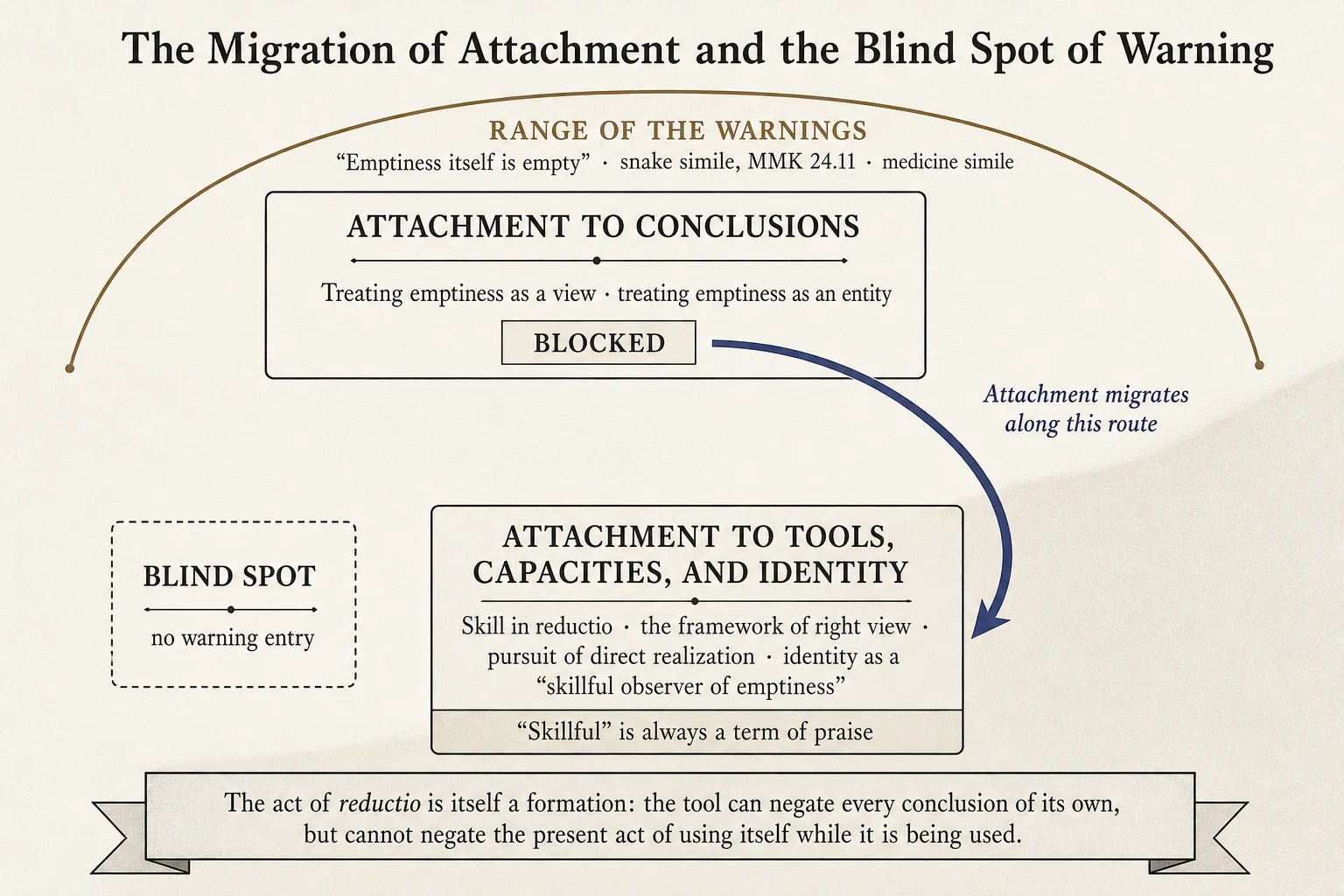
The practical result is that practitioners skilled in emptiness arguments can manage “not to grasp emptiness,” refusing to cling to emptiness as a metaphysical entity, while unconsciously grasping “what produces emptiness”: the ability to use reductio, sensitivity in identifying claims of intrinsic nature, the framework of “Madhyamaka right view” itself, and even the pursuit of direct realization of emptiness. Grasping these things appears phenomenally quite different from grasping emptiness, so the “emptiness of emptiness” does not directly encompass it.
This is a functional attachment. Its object is not a conclusion asserted to be true, but the tools, methods, and framework that produce that conclusion. Someone may sincerely claim, “I do not grasp the doctrinal content of emptiness,” while deeply grasping “the ability to use this doctrinal framework” and “the way of reasoning within it.” The latter is a more hidden attachment and more difficult to notice in oneself precisely because it operates under the banner of “destroying attachment.”
The mechanism of functional attachment
The mechanism by which functional attachment forms is not mysterious. Every complex skill requiring long training produces deep identification with that skill in the person who acquires it. A chess player trained for years identifies with being a chess player, not only with a few brilliant moves. The point became especially clear with the arrival of artificial intelligence. When Go programs successively defeated the strongest professional players, the players experienced far more than “losing a few games.” The position of “the strongest,” toward which a lifetime of training had been directed, suddenly disappeared. Some openly said that their future effort had lost its former meaning and even left competition for that reason.3 Not one part of their skill had been taken away; what was shaken was the identity attached to the skill. Painting shows the same structure. The most common criticism contemporary artists direct at AI art is that “AI paintings have no soul.” The sentence describes less about a painting than it guards a mode of existence. Artists find meaning in painting and locate identity in mastery of their craft; the word “soul” guards precisely that location. Public disputes among programmers over so-called vibe coding (a mode of programming centered on AI generation) place the same structure openly into a sequence of discourse. The self-imposed boundary of this volume must first be stated: the following diagnoses a structure of discourse, not anyone’s psychology, as Chapter 1 of the Introduction specified. This paragraph was written in 2026; the examples will age, but the structure will not. Discourse observable on forums and social platforms generally unfolds in a fixed sequence. It begins with defense of identity and skill in equally thorough forms at both ends: one side takes pride in insisting on purely manual programming, while the other fears being left behind and pursues every new AI technique one by one. Only the object being defended changes from old skill to new. Once the defense is frustrated, discourse turns into a list of charges against AI: hallucinations, bugs, and architectural defects are repeatedly enumerated, followed by wholesale denial of technological progress and even total rejection. The charges then spill over into ridicule of other people, such as attacks on an imaginary “humanities-major vibe coder.” Every step of the sequence can be found in public texts, and not one requires the speaker to hold a mistaken “philosophical view.”
The skilled content of Madhyamaka practice (use of reductive reasoning, mastery of the two truths, and pursuit of direct realization of emptiness) can form the same deep identification in the course of training. Within a theory of practice, this identification is precisely a form of grasping. It fixes “I am someone who can analyze problems through Madhyamaka right view” at the center of self-understanding, and that very fixation is a transformed form of self-view (ātma-dṛṣṭi).
Can Nāgārjuna’s system identify this problem? In principle it can. Because the “I” is empty, the identity “Madhyamaka practitioner” also lacks intrinsic nature, and reductio can destroy this attachment too. The problem is precisely that applying the instrument of destruction to itself is exceedingly difficult in practice. Destroying attachment to reductio by means of reductio requires using reductio while not treating reductio as something that can be grasped. Psychologically, this is a reflexive operation that can scarcely be maintained with stability.
A positional insight must be made explicit here: the act of reductio is itself a “formation.” View is produced by formations; each reductio, each act of discernment, and each pursuit of direct realization is a mental construction belonging to the aggregate of formations. Recall what Madhyamaka refutes: it refutes the result of formations, the view that has congealed. The constructing activity that produces view lies exactly at the boundary its method may be unable to destroy. The tool can negate every conclusion it produces but cannot negate its own use while being used. This is highly isomorphic with the discoveries of the preceding chapters. The chapter on the truth of suffering saw suffering moved from formations into view. The chapter on the truth of origin saw diagnosis land at the reflective level. Here, the same event appears within the method itself: formations come first, and suffering is already present; striking the result of formations (view) can at most change the direction in which formations flow. Formations continue constructing, and suffering may remain. Functional attachment is hardest to notice in oneself precisely because it does not reside in any proposition susceptible to reductio; it resides in the act of reductio itself.
Nāgārjuna’s metaphor of illusory people and its gap
Nāgārjuna was not wholly unaware of the tension. In the Vigrahavyāvartanī, he uses the metaphor of an illusory person (māyā-puruṣa, a magically created warrior) knocking down another illusory person to answer a sharp objection: “If your own words are empty, how can they effectively refute other theses?” Nāgārjuna’s answer is that one illusory person can knock down another. Their both being illusions does not prevent the strike from actually working. Likewise, empty words can refute empty propositions without needing intrinsic nature in the words themselves.4
The metaphor has a function. It shows that causal relations among empty things actually occur at the level of conventional truth and require no foundation of intrinsic nature. But it leaves a question Nāgārjuna does not adequately answer. When illusory person one knocks down illusory person two, we need some criterion by which “the striking force of the first is in some sense greater than the second’s resistance.” Otherwise “knocking down” is only a word and not an actual differential relation. Nāgārjuna does not explain why his kind of “illusion” (Madhyamaka reductio) can serve as the standard for judging another kind of “illusion”—an essentialist proposition.
If “all discourse is empty,” the efficacy of Madhyamaka reductio is also empty. If Madhyamaka reductio possesses a special methodological efficacy (it can expose internal contradictions in the opponent’s presuppositions, while those presuppositions cannot expose an internal contradiction in Madhyamaka method), then that special efficacy is itself a position requiring explanation, a position Nāgārjuna says he does not hold. This is the deepest fissure Madhyamaka methodology encounters when applied to itself.
Candrakīrti’s refutation of Svātantrika and his treatment of “conventional valid cognition alone” are the most important answer to this fissure. Candrakīrti’s strategy assigns methodological efficacy wholly to conventional valid cognition at the level of conventional truth, eliminating the need for any privileged status at the ultimate level. As already explained in Part I, Chapter 3 and Part II, Chapter 5, however, this reply has its own internal tension. Why conventional valid cognition can distinguish valid use of Madhyamaka reductio from valid use of essentialist argument is not self-evident at the conventional level.
Warnings within the tradition and their blind spot
The tradition was not entirely without warnings about this danger, but the place of those warnings precisely delineates their blind spot. Nāgārjuna himself warns in the “Examination of the Four Noble Truths” that those who observe emptiness badly are like people who catch a poisonous snake or practice an incantation badly and are harmed by it.5 In commenting on chapter 13 of the Mūlamadhyamakakārikā, Candrakīrti quotes two famous metaphors from the Kāśyapa chapter of the Ratnakūṭa Sūtra and takes the warning to its limit. Emptiness is a purgative medicine: when the illness has left, the medicine too should be expelled; if it remains in the stomach, the disease is more serious. Therefore, “It would be better to entertain a view of self as great as Mount Sumeru than a view of emptiness as small as a mustard seed.” These warnings show that the tradition deeply understood the danger of grasping emptiness and guarded against it with its strongest rhetoric. But examine what the warnings cover. The snake and medicine metaphors both target the danger of grasping emptiness as a view or conclusion—the level covered by the “emptiness of emptiness.” The warning system has no corresponding item for grasping tools and abilities: the method of catching snakes, the skill of preparing medicine, or the identity “one who skillfully contemplates emptiness.” On the contrary, “skill” remains an unqualified term of praise throughout the treatise tradition. The functional attachment identified here grows precisely in the region the warnings do not cover.
Conclusion: the philosophical significance of the gap
Together, functional attachment and the gap in the metaphor of illusory people reveal a deep structural problem in Madhyamaka methodology: every philosophical system that tries to remove objects of attachment completely generates attachment to its own method in the act of using philosophical method, and this attachment is the part the system finds most difficult to dissolve by itself. This dilemma is not unique to Madhyamaka; every deconstructive philosophical tradition faces it. But for a tradition that locates liberation’s core mechanism in “destroying attachment,” the gap possesses special soteriological importance.
Madhyamaka’s two self-correcting mechanisms (the “emptiness of emptiness” and the metaphor of illusory people) both touch the problem but do not fully solve it at the methodological level. Recognizing this is both a fair assessment of Madhyamaka’s philosophical achievement (it saw the problem more lucidly than any other tradition) and an examination of its soteriological proposal as it is.
Return, then, to the preface’s judgment: Madhyamaka’s attachment is attachment to intellectual activity itself. This chapter has supplied its mechanism. After attachment to conclusions is blocked by the “emptiness of emptiness,” attachment transfers to the level of tools and abilities. That level operates under the name of “destroying attachment” and is therefore hardest to notice in oneself. This judgment at the level of function will be joined with the conclusions of the preceding chapters in the next chapter’s overall examination.
References
References
-
This chapter’s “metaconstraint” reading is adjacent to the semantic interpretation in contemporary scholarship, organized around the claim that ultimate truth is “that there is no ultimate truth.” See the chapters on Madhyamaka in Mark Siderits, Buddhism as Philosophy, 2nd ed. (Indianapolis: Hackett, 2021). For the similarities, differences, and a positive response, see Part VII. ↩
-
The final verse of chapter 13, “Examination of Formations,” in Kumārajīva’s translation of the Mūlamadhyamakakārikā; Sanskrit MMK 13.8: śūnyatā sarvadṛṣṭīnāṃ proktā niḥsaraṇaṃ jinaiḥ, yeṣāṃ tu śūnyatādṛṣṭis tān asādhyān babhāṣire. The “emptiness of emptiness” is śūnyatā-śūnyatā among the eighteen emptinesses; see the Mahāprajñāpāramitāśāstra’s explanation of the eighteen. ↩
-
Lee Sedol announced his retirement in November 2019, saying that even if one became number one, “there is an entity that cannot be defeated.” See his retirement interview with Yonhap News Agency on November 27, 2019. ↩
-
For the metaphor of an illusory person, see verse 23 of Nāgārjuna’s Vigrahavyāvartanī and its autocommentary. For translation and study, see Jan Westerhoff, The Dispeller of Disputes: Nāgārjuna’s Vigrahavyāvartanī (New York: Oxford University Press, 2010). ↩
-
For the snake metaphor, see verse 24.11 of the “Examination of the Four Noble Truths” in the Mūlamadhyamakakārikā: “Those of dull faculties who cannot correctly contemplate emptiness harm themselves, like one who practices an incantation badly or catches a poisonous snake badly,” in Kumārajīva’s translation. For the medicine metaphor and the statement “It would be better to entertain a view of self as great as Mount Sumeru than a view of emptiness as small as a mustard seed,” quoted by Candrakīrti from the Kāśyapaparivarta when commenting on chapter 13 of the Mūlamadhyamakakārikā, see the corresponding Chinese text in the Mahāratnakūṭa Sūtra, “Assembly of the Bodhisattva Universal Illumination” (T no. 310[43]). For an English translation of the relevant Prasannapadā passage, see Mervyn Sprung, trans., Lucid Exposition of the Middle Way (Boulder: Prajñā Press, 1979). ↩