Part II, Chapter 8: Overall Assessment—Claim and Function
The three chapters of Part I stated Madhyamaka soteriology in its strongest form through the five questions, and the first seven chapters of Part II criticized it truth by truth. This chapter gathers the judgments. Following the method established in Chapter 1 of the Introduction, it separates the level of claim from the level of function and examines Madhyamaka’s answers question by question. The arguments supporting the judgments appear in the chapters indicated and will not be repeated. The same concluding format will be used for the systems that follow.
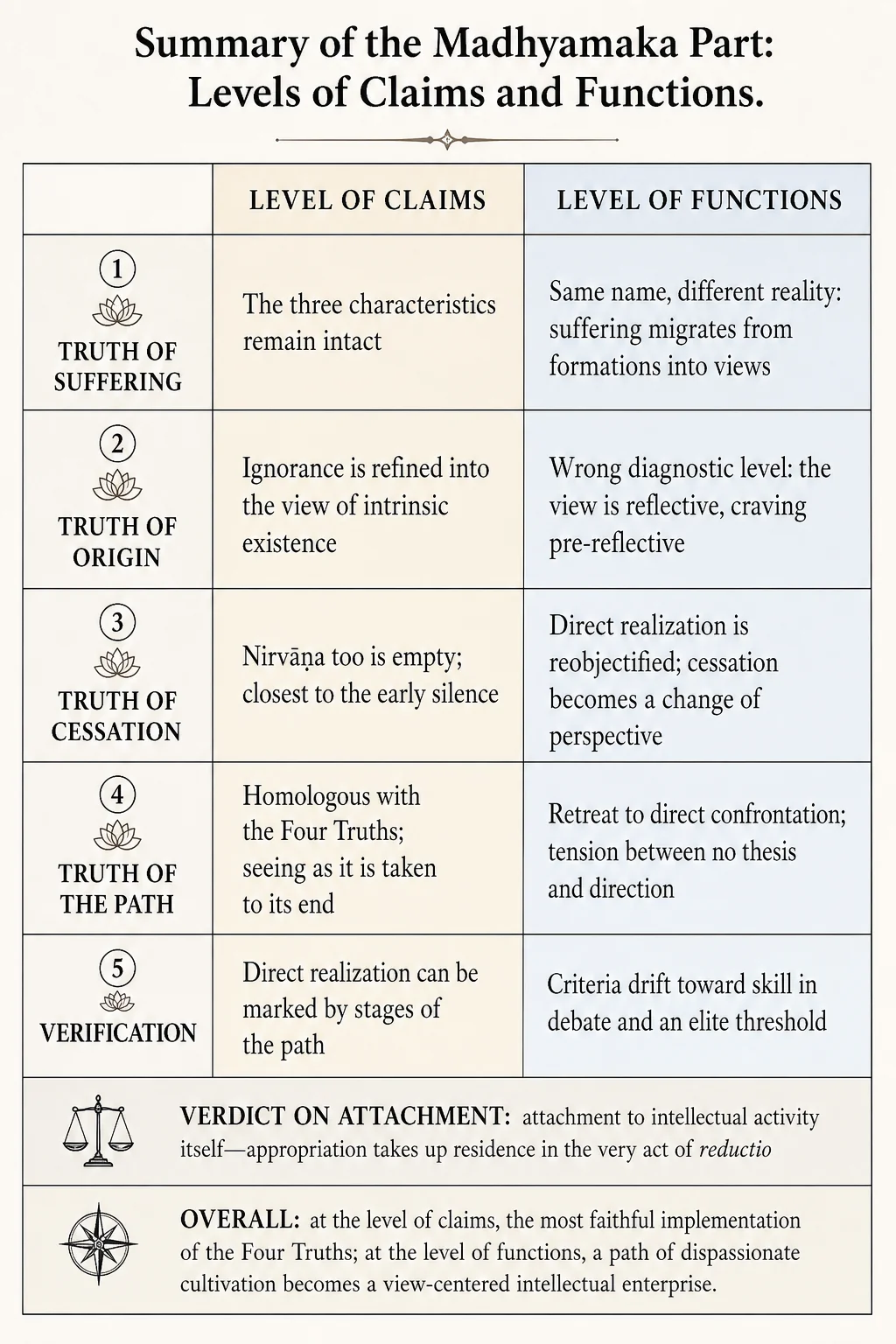
The truth of suffering
At the level of claim: the truth of suffering remains unchanged. The three characteristics of suffering, impermanence, and non-self remain intact, and suffering is still something that must cease, as Part I, Chapter 1 stated. At the level of function: the test in Part II, Chapter 1 showed that this “unchanged” truth is the same in name but different in reality. The location of suffering moves from formations into view. The level at which “the continuation of the aggregates is itself suffering” is silently deleted (in the baseline’s terms, nirvāṇa without remainder loses its soteriological necessity), and suffering is redefined as a product imposed on the stream of experience by the view of real existence. The nonduality of saṃsāra and nirvāṇa, the bodhisattva’s long dwelling in saṃsāra, and the demotion of arahantship into an intermediate station all depend structurally on that move. Liberation’s center of gravity thereby shifts from transformation of the stream of experience to completion of right view. The problems at every later link can be traced to this step, and the step is never argued.
The truth of origin
At the level of claim: ignorance is specified as the view of real existence. This is Madhyamaka’s most ambitious contribution to the early diagnosis and genuinely a philosophical achievement. At the level of function: the test in Part II, Chapter 2 showed that the view of real existence resides at the reflective level, while the craving and appropriation diagnosed by the baseline operate at the pre-reflective level. Three test cases (infants, animals, and people who lose reflective capacity) show that the pre-reflective sense of self does not depend on post-reflective self-grasping. In becoming more precise, diagnosis also moves away from the level at which suffering actually operates. Locating the cause of illness in a reflective judgment and moving the truth of suffering are two sides of one act.
The truth of cessation
At the level of claim: conceptual proliferation ceases, nirvāṇa too is empty, and saṃsāra and nirvāṇa are nondual. Here the judgment most favorable to Madhyamaka in this volume must be recorded; for the complete argument, see Part II, Chapter 3. Early Buddhism remains silent on “what nirvāṇa is.” By denying the grasping expressed in “nirvāṇa is a real object that can be attained,” Madhyamaka may in its own self-understanding come closer to that silence than any later positive description of nirvāṇa. The tendency to objectify nirvāṇa is genuinely later; at the level of claim, Madhyamaka resists rather than advances it. But the judgment has a boundary. “The nonduality of saṃsāra and nirvāṇa” proves at most that any nirvāṇa established as a concept and saṃsāra both lack intrinsic nature. The nirvāṇa guarded through silence and never objectified, the non-continuation of the aggregates, lies beyond the scope of its argument. And “both lack intrinsic nature” does not itself cancel the conventional distinction that conventional valid cognition has the authority to establish, as Part II, Chapter 3 showed.
At the level of function, objectification returns through another door, as Part II, Chapter 3 explained. “Directly realizing emptiness” becomes an achievement to be pursued, calibrated, and certified. What is objectified is no longer nirvāṇa but the event of “seeing emptiness.” The operational content of the truth of cessation is substituted: “cessation” becomes “direct realization.” Together with the move in the truth of suffering, this changes the nature of cessation. Once the stream of formations is no longer called suffering, cessation is no longer the ending of that stream but another way of seeing it. In later circulation, the nonduality of saṃsāra and nirvāṇa is conventionalized into an identity reading, “saṃsāra is nirvāṇa.” Volume I analyzed in a dedicated chapter how this dissolves the motivation to practice; see Volume I, 5.6, “The Argumentative Slide in Perfection of Wisdom and Madhyamaka Texts.”
The truth of the path
At the level of claim: the mechanism is isomorphic with the Four Truths, using right view to dispel ignorance and thereby remove the conditions of suffering. Madhyamaka sees itself as following the old road of “knowledge and vision as they are” more thoroughly than the disciple path, as Part I, Chapter 1 stated. At the level of function, three difficulties arise. First, the direction of effort moves from indirect cultivation back toward direct confrontation, while cultivational content is largely borrowed and its effects cannot be attributed to the view of emptiness itself, as Part II, Chapter 4 argued. Second, tension exists between “no thesis” and the normativity of practical direction, as Part II, Chapter 5 showed. The defense from conventional valid cognition makes the problem more sophisticated but does not eliminate it. Third, success of the entire mechanism depends on one epistemological act, while that act is separated from the actual level of suffering by the displacement identified in Part II, Chapter 2.
Verification
At the level of claim: the path of seeing can be calibrated through an architecture of direct realization and stages of the path; the tradition is also aware of its internal disagreement over direct perception and inference, as Part I, Chapter 1 explained. At the level of function: throughout history, standards of recognition drift toward argumentative skill, the quality of commentarial writing, and demonstrations of learning, as Part II, Chapter 6 showed. The threshold for recognition becomes increasingly elitist and specialized with systematization. Ultimately, the answer to “Who is qualified to recognize that emptiness has been seen?” points increasingly toward scholastic institutions rather than suffering’s cessation itself.
Attachment
The preface’s judgment was that Madhyamaka’s attachment is attachment to intellectual activity itself. Part II, Chapter 7 supplied the mechanism. Once the “emptiness of emptiness” blocks attachment to conclusions, attachment transfers to the level of tools and abilities. Skill in reductio, the framework of right view, and pursuit of direct realization can all become new objects of appropriation, and they are most difficult to perceive precisely because they operate under the name of “destroying attachment.” One defense of Madhyamaka must be made here. Among the five systems, it is most aware of this danger. The emptiness of emptiness and the self-defense through illusory people both show that it saw the problem. But seeing does not equal immunity. Placing the whole weight of liberation on an epistemological act simultaneously yields new territory for attachment to epistemological activity.
Overall judgment
At the level of claim, Madhyamaka is the most faithful implementation of the Four Truths. Every line remains with dependent arising, every point declares itself isomorphic with the Four Truths, and its truth of cessation even comes closer to early silence than those of later systems. At the level of function, it transforms a cultivational road directed toward dispassion into an intellectual enterprise centered on view. The cessation of suffering is not abandoned, but its place moves from every step of the road to a position behind an epistemological achievement. The furthest upstream step making all this possible is the move of suffering from formations into view.
This is not corruption but a structural shift of emphasis. The paradigm it creates (one philosophical insight governing the whole of soteriology) will recur throughout the systems that follow, though the insight’s content differs. Yogācāra takes up the paradigm through analysis of consciousness; tathāgatagarbha takes it up through faith in buddha-nature. What happens as each system receives the paradigm is the question of the parts ahead.
References
(For the bases of this chapter’s judgments, see Part II, Chapters 1 through 7 and Volume I, 5.6. No additional notes are supplied.)