Part II, Chapter 5: The Truth of the Path II—The Tension Between Having No Thesis and Practice
Part I, Chapter 3 foreshadowed the problem. Prāsaṅgika grounds practice in conventional valid cognition, giving only a preliminary answer to the question, “If Madhyamaka holds no thesis of its own, on what basis do practitioners follow its direction?” The preceding chapter examined the direction of effort in the truth of the path. This chapter examines the source of its normativity and addresses that question directly.1
Madhyamaka’s declaration of “no thesis”
Nāgārjuna makes a programmatic statement in the Vigrahavyāvartanī: he claims to have no proposition (pratijñā), no thesis. This is not modesty but a central methodological position. Madhyamaka argues through reductio, deriving internal contradictions from an opponent’s presuppositions rather than positively establishing a proposition that needs proof. If a Madhyamaka philosopher advanced a proposition, an independently valid support would be required. Any such support would presuppose a means of valid cognition (pramāṇa) independent of context and thereby move epistemologically in the direction of intrinsic nature. The methodology of “no thesis” is therefore an internal requirement of Madhyamaka’s entire project, not an incidental expression of humility.2
Candrakīrti develops the position further in the Madhyamakāvatāra and Prasannapadā. Prāsaṅgika’s core claim is that a Madhyamaka philosopher needs no autonomous means of proof; reductio is methodologically self-sufficient. At the practical level, Candrakīrti similarly claims that conventional valid cognition (effective cognition at the level of conventional truth) is sufficient to ground practice, and that no thesis need be established at the level of ultimate truth.3
The resulting tension
The philosophical position is quite clear, but it creates a serious dilemma for the theory of practice. If Madhyamaka truly holds no position whatever, what exactly is a practitioner doing when “following Madhyamaka’s instructions”?
Practice requires direction. Choosing to cultivate the view of emptiness, generate bodhicitta, and destroy self-view through reductio presupposes some judgment about “which direction is correct.” Even when a Madhyamaka philosopher formulates it as “only a judgment at the level of conventional truth,” it remains a judgment. It asserts that cultivating the view of emptiness lies closer to liberation than strengthening the self, that bodhicitta better accords with the path than indifference, and that reductio destroys self-view more effectively than dogmatic proof. These assertions are not entirely neutral. They are substantive normative claims, not “no thesis.”
In other words, “no thesis” may be maintainable at the level of ultimate truth. But a theory of practice is normative by nature: it says that some directions of practice are better than others. However carefully normative claims are wrapped in the framework of “conventional truth,” their normative content does not automatically disappear.
The Gelug reply: the power of conventional valid cognition
Tsongkhapa recognized the tension and gave it the tradition’s most systematic answer in the Great Treatise on the Stages of the Path to Enlightenment and Essence of True Eloquence.4 His central position is that conventional valid cognition is genuinely effective at the level of conventional truth. Knowledge and norms established by conventional valid cognition possess objective force within the scope of conventional truth and require no endorsement from ultimate truth. When practitioners “follow Madhyamaka’s instructions,” they do not execute an absolute command from ultimate truth. They follow at the conventional level a direction of practice revealed by conventional valid cognition. That direction possesses sufficient epistemological support within the framework of conventional truth and is therefore practically workable.
Tsongkhapa further distinguishes two meanings of “thesis.” Madhyamaka denies theses at the level of ultimate truth—assertions that something possesses intrinsic nature. Theses at the level of conventional truth—judgments concerning the direction of practice within the scope of conventional valid cognition—are entirely legitimate. When Candrakīrti says Madhyamaka “has no thesis,” he means the former, not the latter. Practitioners may fully “establish theses” at the conventional level so long as those theses do not cross into the discourse of ultimate truth.
Is Tsongkhapa’s reply sufficient?
Tsongkhapa’s reply is the most sophisticated treatment of this tension within the Madhyamaka tradition to date. This book nevertheless considers it insufficient for the following reasons.
First, the definition of “conventional valid cognition” itself needs explanation. Tsongkhapa claims that such cognition is effective at the level of conventional truth, but on what basis is its “effectiveness” established? If we say that “judgments of ordinary experience are warranted by conventional valid cognition,” how do we distinguish “ordinary experience supports cultivating the view of emptiness” from “ordinary experience supports belief in a permanent self”? At the level of everyday experience, does intuition not most naturally indicate that a continuously existing “I” is present? Tsongkhapa of course has a distinction: the “conventional self” accepted by conventional valid cognition differs from the “permanent self” of non-Buddhist schools; the former lacks intrinsic nature, while the latter possesses it. But making that distinction already requires introducing the perspective of ultimate truth, because the two are difficult to distinguish phenomenally at the conventional level.
Second, it is doubtful whether conventional valid cognition alone can support a complete theory of the path. Such a theory does not merely “select the right direction of practice.” It also evaluates progress, certifies realization, and judges practitioners’ internal states. If these judgments are to have objective force, they require an epistemological basis more precise than “conventional valid cognition at the level of conventional truth.” They must distinguish genuine progress from the illusion of progress, and genuine direct realization of emptiness from a conceptual simulation of it. This distinction is exceedingly difficult at the level of conventional valid cognition alone, because conceptual simulation and genuine realization can appear almost identical in verbal expression.
The testimony of reception history: two eruptions
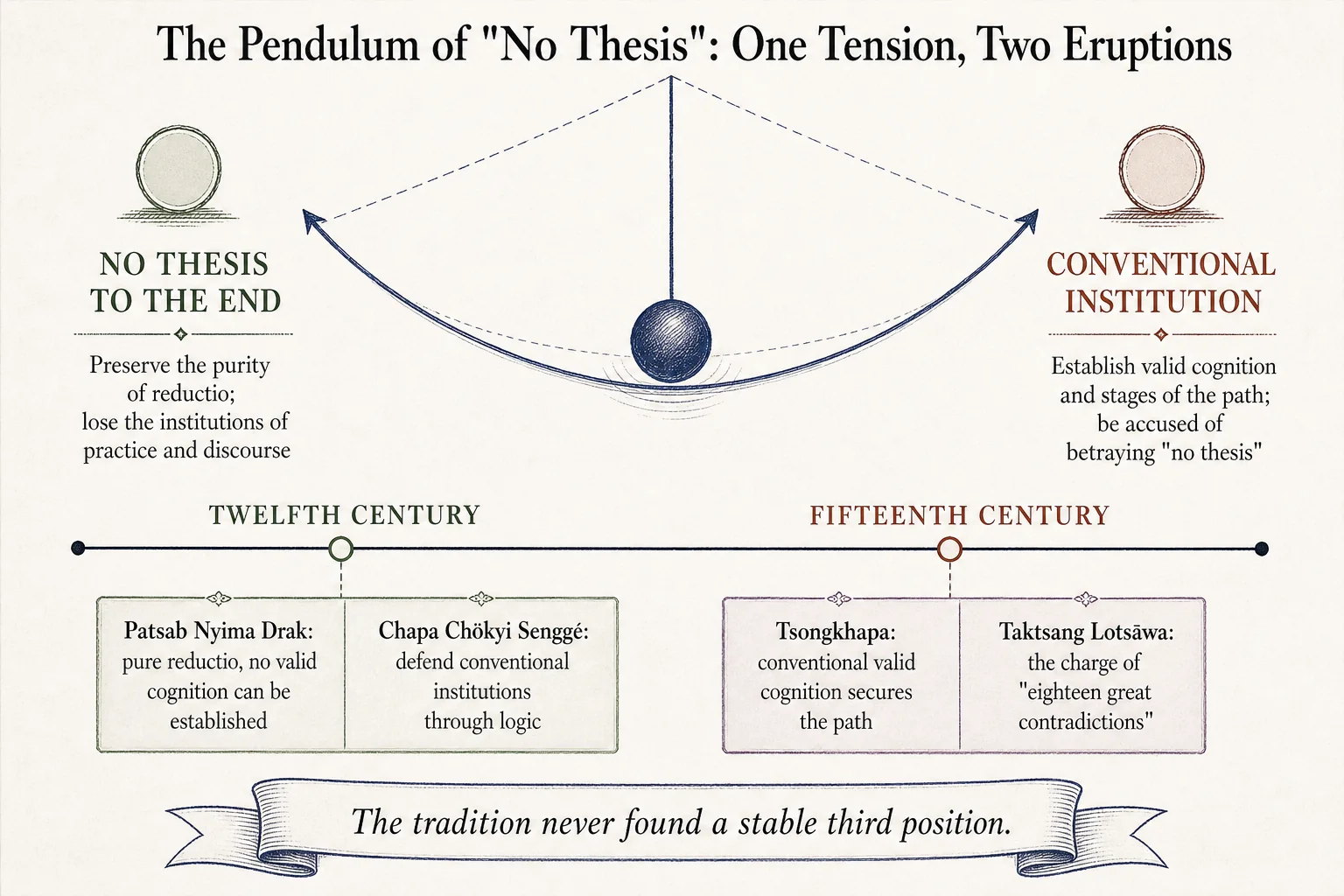
The tension erupts repeatedly in Tibetan reception history, and two rounds deserve to be recorded. The first occurred in the twelfth century. Patsab Nyima Drak’s lineage, which translated Candrakīrti into Tibetan, directly read Prāsaṅgika as a pure reductive method that establishes no thesis and no means of valid cognition whatever. Chapa Chökyi Senggé of Sangpu Monastery opposed it, defending epistemology as a conventional institution and charging that a position with no standpoint destroys discourse itself. In its first step toward establishment in Tibet, Prāsaṅgika already split into these two irreconcilable readings. The second round occurred in the fifteenth century. After Tsongkhapa settled the issue through conventional valid cognition, Taktsang Lotsāwa Sherab Rinchen accused him in return of “eighteen great contradictions.” One central charge was exactly this: to adhere to Prāsaṅgika’s absence of any thesis of its own while comprehensively deploying epistemology within conventional discourse is self-contradictory. Gelug thinkers wrote defenses in response, and the debate continued into modern times.5 The two disputes have astonishingly similar forms. If one side preserves “no thesis” to the end, it cannot preserve the institutions of practice and discourse. If the other builds those institutions, it is accused of betraying “no thesis.” The tradition never develops a stable third position. Its history corroborates the judgment of this chapter.
Difference in practice: Prāsaṅgika and Svātantrika practitioners
From the perspective of actual practice, do the philosophical differences between Prāsaṅgika (Candrakīrti and Tsongkhapa) and Svātantrika (Bhāvaviveka and Kamalaśīla) produce observable differences in meditation? The question is more difficult to answer than the philosophical discussion but equally important.
In theory, Svātantrika practitioners must first establish emptiness through independent inference and then meditate on that basis. Prāsaṅgika practitioners need not establish an independent argument in advance. They can directly destroy self-view through reductio and then rest in the “absence of anything grasped” that follows. The historical record does not clearly show how much difference these two paths make in actual meditation. In fact, a considerable gray area exists between the Tibetan Gelug tradition’s practical methods and its doctrinal declaration that “Prāsaṅgika is our system.” Techniques used in actual meditation (body scanning, the union of tranquility and insight, Mahāmudrā, and Dzogchen) cannot be neatly allocated along the philosophical boundary between Prāsaṅgika and Svātantrika.6
The gray area is itself evidence: the philosophical distinction between “no thesis” and “having a thesis” lands far more ambiguously in meditation practice than doctrinal debate suggests.
The deeper meaning of the tension
The tension between “no thesis” and practice ultimately points to a more fundamental question. Is Madhyamaka’s theory of practice an internally self-sufficient system of liberation, or a philosophical framework that must be embedded within a broader tradition of practice before it can function completely? If the former, it must provide a complete account of practical direction from within its own methodology, which the position of “no thesis” makes logically very difficult. If the latter, Madhyamaka philosophy’s central contribution is to give existing practices a more correct epistemological basis, not independently to supply a complete path of liberation. The latter position is more modest and perhaps more honest, but it stands in tension with the Madhyamaka tradition’s frequent soteriological claim that “right view is the root of liberation, and the view of emptiness is the core of right view.”
This book holds that traces of oscillation between the two positions appear in different periods and representatives of the Madhyamaka tradition. The theoretical cost of that oscillation is precisely what this chapter seeks to reveal.
References
References
-
The problem of “no thesis” has its own contemporary scholarly traditions of defense and criticism, with which this chapter is in implicit dialogue. See Tom J. F. Tillemans, How Do Mādhyamikas Think? And Other Essays on the Buddhist Philosophy of the Middle (Boston: Wisdom, 2016); and Jan Westerhoff, Nāgārjuna’s Madhyamaka: A Philosophical Introduction (New York: Oxford University Press, 2009), especially the discussion of having no position. For a positive response to this literature, see Part VII. ↩
-
The programmatic declaration of “no thesis” appears in verse 29 of the Vigrahavyāvartanī: “If I had any thesis, that defect would be mine. Since I have no thesis, I alone am free of defect.” The criticism of means of valid cognition (if one pramāṇa must be established by another, an infinite regress follows; if it establishes itself, it ceases to be a pramāṇa) appears in verse 31 and following. For translation and study, see Jan Westerhoff, The Dispeller of Disputes: Nāgārjuna’s Vigrahavyāvartanī (New York: Oxford University Press, 2010). ↩
-
For Candrakīrti’s refutation of autonomous inference, see chapter 1 of the Prasannapadā and the citation in Part I, Chapter 3. In the same place, Candrakīrti criticizes Dignāga-style epistemological construction while accepting that perception, inference, analogy, and authoritative testimony function as four means of valid cognition in conventional discourse because they are commonly accepted in the world. For a systematic study of Candrakīrti’s epistemology, see Dan Arnold, Buddhists, Brahmins, and Belief: Epistemology in South Asian Philosophy of Religion (New York: Columbia University Press, 2005). ↩
-
For an English translation of the vipaśyanā chapter of the Great Treatise, see Tsong-kha-pa, The Great Treatise on the Stages of the Path to Enlightenment, vol. 3, trans. Lamrim Chenmo Translation Committee (Ithaca: Snow Lion, 2002). For the Essence of True Eloquence, see Robert A. F. Thurman, Tsong Khapa’s Speech of Gold in the Essence of True Eloquence (Princeton: Princeton University Press, 1984). On Tsongkhapa’s treatment of conventional valid cognition and the two truths, see also Thupten Jinpa, Self, Reality and Reason in Tibetan Philosophy: Tsongkhapa’s Quest for the Middle Way (London: RoutledgeCurzon, 2002). ↩
-
On the confrontation between Patsab Nyima Drak and Chapa Chökyi Senggé over readings of Prāsaṅgika, see Kevin A. Vose, Resurrecting Candrakīrti: Disputes in the Tibetan Creation of Prāsaṅgika (Boston: Wisdom, 2009). For Taktsang Lotsāwa Sherab Rinchen’s charge of “eighteen great contradictions” against Tsongkhapa and Gelug responses, including Jamyang Chöjé’s, see Sonam Thakchoe, “Prāsaṅgika Epistemology: A Reply to Stag tsang’s Charge Against Tsongkhapa’s Uses of Pramāṇa in Candrakīrti’s Philosophy,” Journal of Indian Philosophy 41 (2013). ↩
-
The most conspicuous example of the gray area between Gelug practical traditions and Prāsaṅgika doctrine is the “Gelug-Kagyü Mahāmudrā” transmitted by the First Paṇchen Lama, Lobsang Chökyi Gyaltsen. For its root verses and instructions, see H. H. the Dalai Lama and Alexander Berzin, The Gelug/Kagyü Tradition of Mahamudra (Ithaca: Snow Lion, 1997). ↩