Part II, Chapter 4: The Truth of the Path I—From Indirect Cultivation Back to Direct Confrontation
Chapter 2 of the Introduction identified a counterintuitive feature in the early mechanism of liberation. Although its diagnosis locates the roots of suffering in craving and ignorance, the Eightfold Path does not attack them frontally. It works through the long cultivation of ethical discipline, concentration, and wisdom, allowing craving and ignorance to lose the soil in which they grow as the mind becomes steadily clearer. That chapter also established a standard: many later systems return precisely to the framework of “direct confrontation,” and this volume will measure them against the cultivational path. The preceding three chapters examined suffering’s location, diagnosis’s level, and the definition of the endpoint. This chapter returns to the truth of the path and examines where it directs effort. On which side of the standard does this theory of practice fall?
1. The same counteractive goals, an opposite direction of effort
Part I, Chapter 2 showed that the first eight chapters of Āryadeva’s Catuḥśataka take up early Buddhism’s oldest counteractive goals: the four inversions of permanence, bliss, self, and purity. In terms of their objects, they begin in strong continuity with the baseline. But the same chapter also showed that Āryadeva addresses these subjects by using verses to argue and persuade people to break attachment. Chapter 1 gives various reasons concerning death to persuade the reader that grasping at permanence is absurd; chapter 3 uses the body’s impurities to persuade the reader that grasping at purity has no basis. This attacks the inversion itself directly and frontally.
When Chapter 2 of the Introduction distinguished two senses of “counteraction,” it used mindfulness of the body as an example. The practice is directed against attachment by placing the mind in observation of the body as it is, allowing attachment to loosen on its own under clear vision. It does not argue that the body is impure, still less require practitioners to be persuaded of a conclusion. The object is the same, but effort moves in two directions: observation allows attachment to loosen by itself; argument attempts to refute attachment. Āryadeva’s first eight chapters fall overall on the latter side. This is not a question of persuasiveness (the Catuḥśataka’s exhortations are powerful), but of the level on which “being persuaded” occurs. The chapter on the truth of origin, Part II, Chapter 2, supplied the answer. Argument can directly change judgment at the reflective level, while attachment operates ordinarily at the pre-reflective level.
2. Dissolving self-view through speculative thought: a path anticipated in the baseline
Chapter 2 of the Introduction imagined what directly dissolving self-view would look like: “The probable methods are repeatedly persuading oneself that ‘there is no self,’ or seeking through speculation or ritual a state in which subject and object both disappear.” It observed that self-view does not genuinely loosen simply because it is repeatedly denied. Madhyamaka is of course far more precise than “self-persuasion.” Reductio does not repeat a negative slogan but derives a contradiction from the opponent’s presuppositions. It understands itself as producing insight rather than inculcating belief. That difference must be acknowledged.
Structurally, however, “repeatedly thinking through emptiness in order to dissolve the view of real existence” shares the same form as the direct confrontation described by the baseline. It confronts self-view frontally on the terrain of concepts, judgments, and positions. Each victory won by reductio is a position defeated at the reflective level. The automatic pre-reflective operation that appropriates everything as “mine” never appears to contest the argument and therefore cannot be defeated by it. Madhyamaka has a response. Parts I, Chapters 2 and 3 presented it: right view must be habituated before it transforms; the path of cultivation remains after the path of seeing. This shifts the burden to “habituation.” Part II, Chapter 2, section 4 already examined what the effective element in that habituation might be and need not be repeated. Only one point must be added. When habituation itself still consists in “repeatedly contemplating emptiness,” it remains inside the framework of direct confrontation; the confrontation has only moved from debate into meditation.
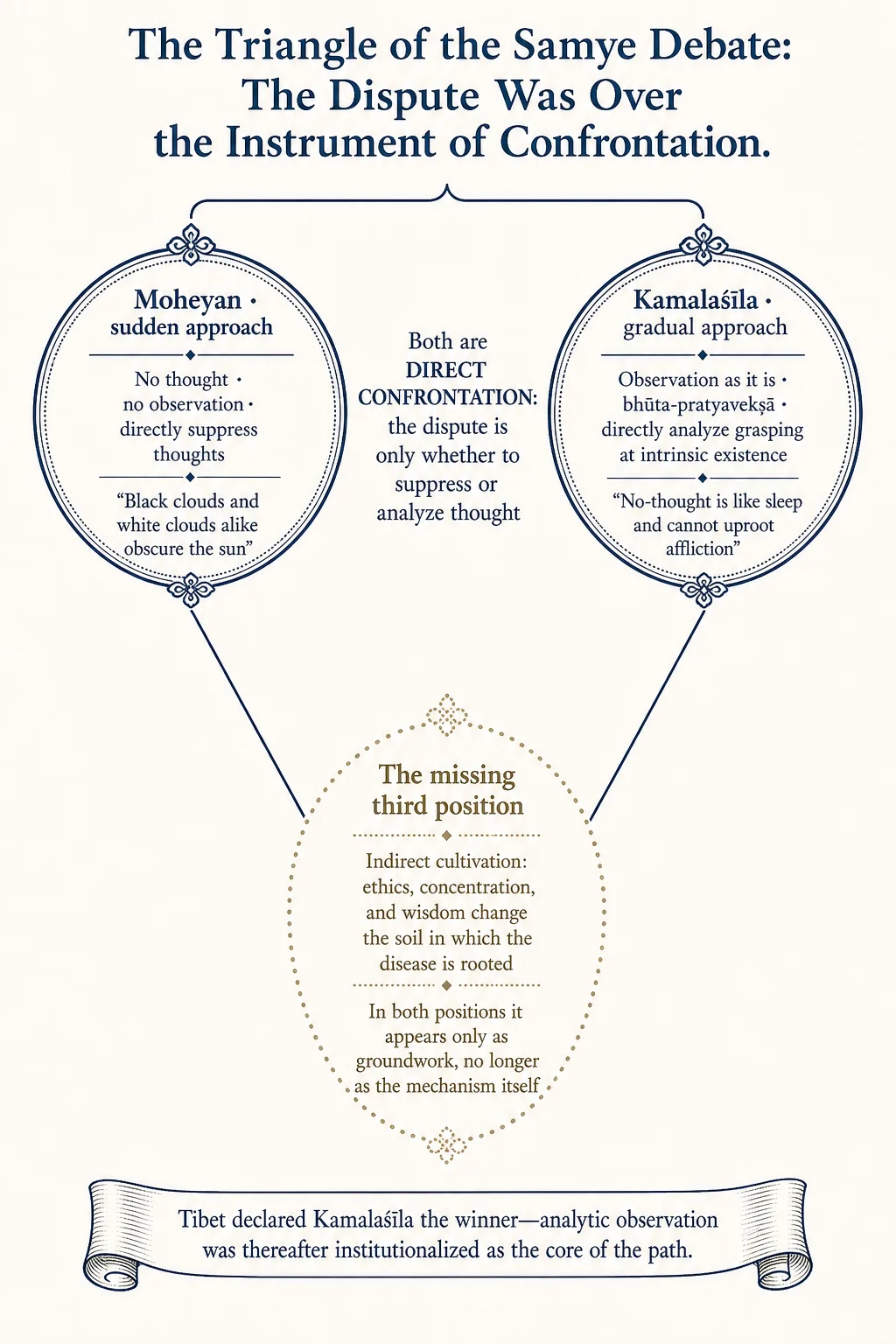
This approach provoked a famous direct conflict within the tradition: the Samyé debate at the end of the eighth century. The Chinese Chan teacher Moheyan advocated not thinking and not observing, immediately leaving conceptual distinctions behind. His reason resembles this chapter’s criticism in form: wholesome and unwholesome thoughts are equally fetters, just as black and white clouds both obscure the sun. Kamalaśīla’s response, in the three Bhāvanākrama treatises, defended analysis. Mere nonthought resembles stupor and deep sleep: it suppresses thoughts without uprooting affliction. Only discerning wisdom born from examining things as they are (bhūta-pratyavekṣā), together with tranquility accomplished in advance, can abandon affliction. He further insisted that gradual cultivation of ethical discipline and concentration is the necessary foundation for insight.1 The significance of the dispute here is that it shows the tradition continually circling within the framework of “direct confrontation.” Moheyan makes direct suppression of thought the path; Kamalaśīla makes direct analysis of grasping at real existence the path. They disagree about the instrument of confrontation—stopping thought or analyzing it. The early route that avoids frontal assault and changes the soil of the illness through the three trainings appears in both positions only as foundation work. Kamalaśīla preserves the stages of discipline and concentration, which makes him closer to the baseline than his opponent, but they are no longer the mechanism itself. Tibetan tradition judged Kamalaśīla the winner and thereafter institutionalized analytical observation as the core of the path, fixing the direction criticized in this chapter.
After this institutionalization, the Gelug school developed an ingenious bridging device that must be recorded on its behalf: alternation between analytical meditation and stabilizing meditation. When meditating on emptiness, practitioners first perform analytical meditation. Once analysis produces a definite experiential conviction, they shift immediately into stabilizing meditation, allowing the mind to merge with what has arisen and remain undistracted. When the experience fades, analysis resumes, and the alternation continues, as established in the vipaśyanā chapter of the Great Treatise. The device’s existence itself shows that Gelug thinkers clearly understand that analysis does not transform by itself: analysis must be entrusted to attention and stabilization before it becomes effective. This is a substantive concession to the baseline’s tools. Yet what is entrusted remains an understanding of emptiness produced by argument. The device changes the carrier but not the content’s source. It makes direct confrontation more cultivable. Whether it thereby turns confrontation into cultivation is open to debate. This chapter makes only one point: the existence of the bridge already acknowledges the river.
3. The absence of cultivational content and the difficulty of attribution
In contrast to the abundance on the side of direct confrontation, cultivational content in Madhyamaka’s theory of practice is sparse. Nāgārjuna’s principal works give almost no concrete meditation instructions. The Mūlamadhyamakakārikā is philosophical argument, the Vigrahavyāvartanī a methodological defense, and the Yuktiṣaṣṭikā a verse expression of emptiness. The Ratnāvalī contains exhortations to practice but falls far short of operational meditation guidance. The conclusion of the section “What Kind of Practice?” in Part I, Chapter 2, acquires weight here. The early Madhyamaka practice committed to writing centers on counteraction and accumulation. The early Buddhist cultivational program grounded in concentration and rising from concentration into insight is almost entirely absent from their writings.
The historical consequence is that Madhyamaka meditation practices long depended on integration with other traditions: with Yogācāra contemplative systems in India, and with Dzogchen and Mahāmudrā in Tibet. These integrations sometimes work very well, but they create a difficulty of attribution. When an integrated practice produces effects, one cannot distinguish whether the effects come from Madhyamaka’s view of emptiness or from the other tradition’s own cultivational methods—bodily awareness, mindfulness of breathing, and the cultivation of concentration. This inseparability makes it difficult for meditative experience to give independent support to the claim “the view of emptiness is liberation’s core mechanism.” Put differently, most elements proprietary to Madhyamaka’s theory of practice lie on the side of direct confrontation; most cultivational elements are borrowed. Fairness requires acknowledging that the baseline also faces a difficulty of attribution. Within ethical discipline, concentration, and wisdom as a whole, the contribution of each component cannot be independently isolated and tested. The difference lies in the systems’ claims. The baseline never claims that one link of the chain works alone; its claim is precisely that the whole chain works. Madhyamaka claims that seeing emptiness is the core mechanism and everything else ancillary. Difficulty of attribution does not harm the claim “the whole chain is effective,” but it is fatal to a claim of “one load-bearing point.” This is the other face of the asymmetrical license described in the chapter on the truth of origin.
4. Boundary and summary
Two boundaries must be stated. First, early Buddhism does contain counteractive meditation subjects. Contemplation of impurity counters lust, and loving-kindness counters aversion; these are ancient arrangements. But in the early framework, such counteractions are local prescriptions tailored to a person and placed inside an entire cultivational process founded on ethical discipline, embodied in concentration, and directed toward wisdom.2 Their tools are observation and cultivation, not argument. In Madhyamaka, counteraction becomes the main structure, cultivation recedes into the background, and the instrument of counteraction changes into speculative thought. Second, this chapter does not assert that Madhyamaka practitioners never cultivated concentration and wisdom; historically they plainly did. It asserts that the distinctive portion Madhyamaka writes, teaches, and presents as its own theory of practice directs effort toward direct confrontation.
In summary, measured by the standard of Chapter 2 of the Introduction, Madhyamaka’s theory of practice shifts in its direction of effort from indirect cultivation back toward direct confrontation. This shift corroborates the displacement of levels identified in the chapter on the truth of origin, and both have a common root. Once the root of suffering is diagnosed as an erroneous judgment at the reflective level, directly destroying it through argument appears entirely natural. The diagnostic displacement provides direct confrontation with its theoretical justification. Beyond these two difficulties of mechanism (level and direction), Madhyamaka creates a further problem for itself: it claims to hold no thesis but must give practice a direction. That is the subject of the next chapter.
References
References
-
The Samyé debate, around 792–794: for the Sanskrit and Tibetan texts and studies of Kamalaśīla’s three Bhāvanākrama treatises, see Giuseppe Tucci, Minor Buddhist Texts, parts II–III (Rome: IsMEO, 1958–1971). For the Dunhuang text associated with Moheyan’s side, see Paul Demiéville, Le concile de Lhasa (Paris: Imprimerie Nationale, 1952). For philosophical analysis of the dispute, see David Seyfort Ruegg, Buddha-nature, Mind and the Problem of Gradualism (London: SOAS, 1989). For the historical event, see also Volume I, 11.1, “The Early Dissemination and the Samyé Debate.” ↩
-
For the place of counteractive meditation subjects in early and Southern traditions, see the Visuddhimagga’s arrangement of forty meditation subjects by disposition (contemplation of impurity for those of lustful temperament, loving-kindness for those of aversive temperament, and so forth), and Volume I, 9.2, “Buddhaghosa and the Commentarial Tradition.” Counteractive subjects use observation and concentration as tools and are embedded in the complete threefold training; this differs from persuading attachment to retreat through argument. For the structure of the first eight chapters of Āryadeva’s Catuḥśataka, see Part I, Chapter 2 and the study by Karen C. Lang cited there. ↩