Part II, Chapter 2: The Truth of Origin—Which Level Does Madhyamaka’s Diagnosis Strike?
The preceding chapter tested the truth of suffering and concluded that beneath the claim “the truth of suffering remains unchanged,” Madhyamaka moves the location of suffering from formations into view. This chapter follows that move to the next link, the truth of origin. The question can be put in one sentence. Madhyamaka diagnoses the root of suffering as the view of real existence, an erroneous judgment at the epistemological level. Does that diagnosis identify the level at which suffering actually occurs? If not, then however precise the attack on the view of real existence, it does not logically guarantee suffering’s cessation.
1. Madhyamaka texts are epistemological projects that strike “post-reflective self-grasping”
What is the principal content of the Mūlamadhyamakakārikā, Yuktiṣaṣṭikā, Vigrahavyāvartanī, and Candrakīrti’s Madhyamakāvatāra and Prasannapadā? They test concepts analytically (motion, time, causation, self, perception, language), and show that any concept generates internal contradictions once intrinsic nature is attributed to it, thereby arguing that phenomena lack intrinsic nature. This is a highly abstract project of conceptual analysis. It presupposes a subject capable of philosophical reflection, possessing concepts such as “self,” “phenomenon,” “intrinsic nature,” “permanent,” and “one,” and attributing intrinsic nature to them at the reflective level.
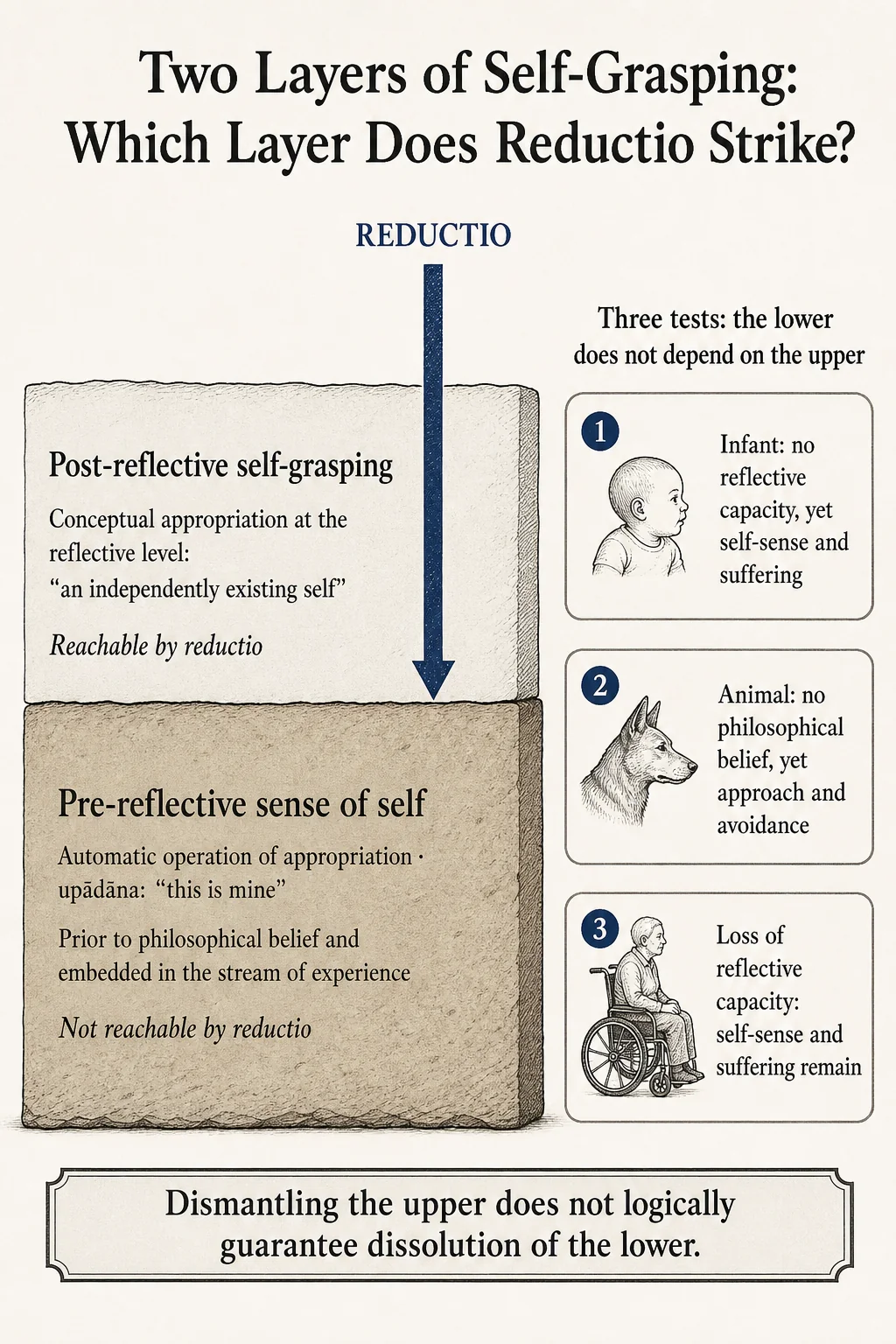
What Madhyamaka attacks is post-reflective self-grasping: a cognitively reflective subject reifies the “self” in the course of reflection, forms a judgment such as “there is an independently self-subsisting and unchanging self,” and organizes cognition and values around it. This kind of self-grasping is formed at the reflective level and can therefore in principle be shaken by arguments at that level. It is itself a product of reflection, and reflection can test and revise its own products.
This feature explains why Madhyamaka arguments are philosophically so precise. Their opponent is conceptual attachment formed by a reflective cognitive subject; defeating that opponent requires stronger arguments at the same reflective level. Reductio works because it derives contradictions from within the opponent’s reflective framework, making the original position impossible to maintain on its own terms.
2. The “self” of the early discourses is pre-reflective
The early Nikāyas, however, do not direct their treatment of “self-grasping” primarily at reflective conceptual attachment, but at a more immediate level of experience: a pre-reflective psychological tendency.
The phenomenological description of this tendency is a persistently appearing “self-relevance”: this event concerns me; this object is mine; I am the one experiencing this feeling. It is an automatic operation that immediately appropriates the contents appearing in the stream of experience as “mine.” Such appropriation (upādāna) can operate vigorously without any explicit philosophical belief that “an eternal self exists.” Indeed, it is more immediate than any explicit philosophical belief, prior to reflection, and more deeply embedded in the basic structure of experience.
The central operation of the Anattalakkhaṇa Sutta is to test every component of the five aggregates directly in experience: form, feeling, perception, formations, and consciousness, observing each as “This is not mine, this I am not, this is not my self.”1 This directly intervenes through observation in the stream of experience itself and presupposes no philosophical reflection or conceptual analysis. Someone entirely ignorant of theories of intrinsic nature and emptiness can follow the instruction and observe. The four establishments of mindfulness likewise directly observe body, feelings, mind, and phenomena in experience; their efficacy does not depend on accepting any philosophical proposition.
The difference is structural. The early discourses direct practice toward observing and loosening an appropriative tendency operating automatically at the pre-reflective level, using the present awareness of mindfulness rather than conceptual analysis. Madhyamaka directs practice toward identifying and overturning conceptual attachment at the reflective level, using reductio and the view of emptiness. The two traditions confront different levels of “self-grasping”: one precedes reflection, the other lies within it.
3. The separation between cognitive understanding and affective reaction
One might reply that even if the levels differ, right view at the reflective level can still penetrate downward and alter pre-reflective operations. That claim faces an empirical difficulty: a structural separation exists between cognitive understanding and habitual patterns at the affective and behavioral levels.
Our craving for something does not arise only because we cognitively hold the mistaken judgment “this object can bring lasting fulfillment.” Even when we clearly know that satisfaction is temporary and repeated craving brings more suffering, this knowledge often fails to stop craving from actually arising. People with addictions can understand the harms of addiction perfectly well at a rational level; that understanding does not automatically produce withdrawal. Chronically irritable people may accurately analyze after an episode that their anger was disproportionate; the analysis does not prevent the next outburst. People with chronic anxiety may understand anxiety’s irrational sources clearly and still suffer another episode, as Chapter 2 of the Introduction noted when discussing “direct confrontation.” This separation is not an incidental exception but a structural feature of human psychology. Neuroscientific research offers corroborating evidence: the neural bases of affective response, subcortical structures such as the amygdala, possess substantial functional independence from higher cognition in the prefrontal cortex.2 Knowing at the reflective level does not equal ceasing to react through old patterns at the pre-reflective level.
Place this structure in a Madhyamaka setting. A practitioner studies Nāgārjuna’s arguments for years and becomes intellectually convinced that phenomena lack intrinsic nature. Has self-grasping therefore been eliminated? In a calm discussion, the practitioner may fluently say, “All phenomena are empty; self-grasping is delusive.” But if publicly humiliated, if a loved one is harmed, or if reputation is damaged by false accusations, that practitioner’s immediate reaction may differ in no fundamental way from the reaction of someone who has never encountered Madhyamaka philosophy. Intellectually “knowing non-self” and pre-reflectively “no longer operating in a self-centered way” are two different things. The former is propositional knowledge; the latter is a mode of existence pervading the entire personality structure and its immediate reactions. Philosophical argument can effectively produce the former. Whether the latter follows is an independent question.
4. The incorporation of “innate self-grasping” and the questions it raises
The Madhyamaka tradition has not failed to notice this difference of levels. The Gelug school, especially Tsongkhapa, responds by introducing a distinction between “innate self-grasping” and “conceptually acquired self-grasping.” Conceptually acquired self-grasping consists of mistaken views acquired by accepting a philosophical or religious doctrine and can be destroyed by philosophical analysis. Innate self-grasping is an inborn tendency independent of philosophical education, possessed by infants and animals, and is a deeper root of suffering.3 Madhyamaka holds that both kinds must be destroyed. Destroying innate self-grasping requires combining the Madhyamaka view with meditation and habituating oneself over a long period (bhāvanā), so that right view deeply influences the pre-reflective level of the mental continuum.
This distinction correctly identifies the direction of the problem. This book’s question is not about the distinction itself, but whether it solves the problem or merely gives it a new name.
What exactly is the effective element in “habituating oneself to the Madhyamaka view in order to destroy innate self-grasping”? If the effective element is tranquility and insight themselves, independent of the Madhyamaka view’s distinctive content, then any tradition capable of producing deep tranquility and insight (early Buddhism’s four establishments of mindfulness, Southern Buddhism’s mindfulness of breathing, and even practices of concentration and observation in other traditions) will be equally effective, and whether the Madhyamaka view is necessary becomes questionable. If the Madhyamaka view is indispensable, then a concrete mechanism must be supplied: how does right view at the reflective level change automatic operation at the pre-reflective level? The Gelug name for the mechanism is clear: repeatedly habituating and conditioning oneself through right view, which gradually penetrates the deeper levels of the mental continuum. But the direction of this psychological mechanism (changing the pre-reflective level downward from the reflective) is not obviously effective in practice. Extensive experience shows that a person may maintain reflective beliefs contrary to pre-reflective automatic patterns for years while those automatic patterns persist stubbornly. This is not merely a problem of willpower but the structural fact of relative functional independence between the two levels described above.
It is worth adding that the tradition itself long ago recorded the phenomenon of “residue remaining after cognitive eradication” and gave it a name. Disciples who have completely abandoned the afflictions still retain habitual tendencies (vāsanā). The Mahāprajñāpāramitāśāstra gives the example of Pilindavaccha. Years after his influxes were exhausted, he still involuntarily called the goddess of the Ganges a “little slave girl”: the affliction of pride had been eliminated, but the habitual tendency of pride continued to operate in speech.4 Mahāyāna systematizes this residue as the two obstructions. Disciples’ path can abandon the afflictive obstruction, but only buddhahood completely abandons the cognitive obstruction (which Gelug Prāsaṅgika doctrine directly explains as habitual tendencies of grasping at real existence and the confusion of dual appearance), and the latter requires bodhisattva practice across immeasurable eons. This doctrinal construction amounts to an internal acknowledgment that direct realization cannot immediately uproot one level of the problem; it can be worn down only through extremely long-term conduct and habituation. The traditional solution assigns this residue to three incalculable eons. This chapter merely moves the question one step forward: if a level that even direct realization on the path of seeing cannot uproot must be treated through billions of eons of “action,” was the emphasis misplaced from the beginning when “view” was made the center of the mechanism?
A fair objection should be answered here. The baseline’s own causal chain (observation, weakened craving, cessation of suffering) is equally coarse-grained. Why demand a mechanism from Madhyamaka alone? There are two answers. First, granularity is not the point; the level of operation is. The baseline’s tool is mindful attention, which works directly within the stream of experience—the pre-reflective level itself. Madhyamaka’s tool is reductive reasoning, which works upon propositions and judgments—the reflective level. Madhyamaka owes an account of the move “from reflective to pre-reflective” because its tool and target are separated by one level. The baseline’s tool and target are not separated, so it does not owe the same account. Second, the distribution of weight is asymmetrical. The baseline distributes liberation across a chain of three trainings and never claims that one component bears the burden alone. Madhyamaka expressly places the whole burden upon the single component of “view,” as Part I, Chapter 1 explained. A theory that concentrates the load at one point incurs the duty to explain the mechanism of that point. The asymmetry of the inquiry is produced by the systems’ own claims, not partiality in this volume.
5. Three tests: infants, animals, and people who lose reflective capacity
The following three cases press the preceding question into its sharpest form.
First, infants. An infant several months old has no post-reflective self-grasping. It lacks the capacity for philosophical reflection and cannot form a philosophical judgment that “a self exists.” By the distinction between innate and conceptually acquired self-grasping, it possesses only innate self-grasping. Yet infants clearly have a pre-reflective sense of self, strong reactions that approach pleasure and avoid pain, and actual suffering—hunger, pain, heat, and cold. If the path that destroys innate self-grasping depends entirely on the capacity for philosophical reflection—first hearing and thinking about the right view of emptiness, then habituating oneself to it—an explanation is needed for how that path can affect a being incapable of reflection.
Second, animals. Insects and ordinary animals entirely lack post-reflective self-grasping but possess a conspicuous pre-reflective sense of self. Their automatic patterns of seeking advantage and avoiding harm show that some “self-relevance” is operating. They live within the experiential stream of suffering. This case shows still more simply that the existence and operation of a pre-reflective sense of self do not depend on post-reflective self-grasping.
Third, people whose brain injuries have removed conceptual reflective capacity. Some brain injuries, such as severe frontal-lobe damage, cause patients to lose the capacity for higher conceptual reflection. They cannot perform philosophical reasoning, form conceptual judgments about “what the self is,” or learn Madhyamaka doctrine. Yet their pre-reflective sense of self does not disappear, nor does their suffering cease; some injuries instead diminish their ability to regulate distress. This case is particularly forceful. It does not describe a person who “has not studied Madhyamaka philosophy,” but one neurologically incapable of forming post-reflective self-grasping, while both pre-reflective self-sense and suffering remain.
The three cases jointly show that the existence of a pre-reflective sense of self does not depend on the existence of post-reflective self-grasping. Destroying the latter therefore does not logically guarantee dissolution of the former. Madhyamaka arguments strike self-grasping at the post-reflective level, while suffering arises at least in part, and perhaps fundamentally, from the pre-reflective sense of self and tendency to appropriate. Destruction of the former level does not equal loosening at the latter.
6. Two possible Madhyamaka replies and their costs
Confronted with these three cases, the Madhyamaka tradition can answer in two directions.
The first is to concede that Madhyamaka soteriology applies only to people with reflective capacity. The suffering of infants, animals, and people who lose that capacity receives other treatment, such as dedication motivated by compassion. The cost is explicit acknowledgment that Madhyamaka soteriology is not universal. It is a path designed for people capable of philosophical reflection, while the deeper root of suffering, the pre-reflective sense of self, is not directly treated within its framework.
The second is to introduce beginningless seeds or habitual tendencies (vāsanā), explaining the pre-reflective sense of self in infants and animals as the continuation of conditioning from past lives and thereby placing it within a framework of rebirth, karma, and practice. The cost of this direction is a further explanatory debt: habitual tendencies need somewhere to reside. The most readily available support is the storehouse consciousness (ālaya-vijñāna). But Prāsaṅgika Madhyamaka in Candrakīrti explicitly refuses to grant the storehouse consciousness ontological standing, treating it as an unnecessary addition to conventional truth. Introducing it to explain the pre-reflective sense of self would make a methodological concession contrary to the school’s own position. Madhyamaka has alternatives. The principle of non-destruction (avipraṇāśa), presented in chapter 17 of the Mūlamadhyamakakārikā through the simile of karma persisting like a bond, and Candrakīrti’s lineage’s route of placing karmic results within a nominally designated continuum are both options that do not appeal to the storehouse consciousness. But Nāgārjuna presents the former without deciding it, while the latter places the entire explanatory burden on the conventional designation “continuum.” Each incurs costs of its own. Options exist; cost-free options do not.
7. The boundary of the criticism
This chapter’s criticism has explicit boundaries. First, it does not say that philosophical understanding has no value. Erroneous views do reinforce harmful patterns, and correct views do help establish different dispositions to react. The question is how much philosophical understanding can accomplish, not whether it is useful. Second, it does not say that the Madhyamaka tradition neglects meditation. Madhyamaka has historically been combined with meditative practice. The question is whether Madhyamaka’s own theoretical framework explains the effective mechanism of that combination. Third, it does not presuppose a shortcut to liberation that bypasses all cognitive change. It points out only that the bridge between cognitive change and change in pre-reflective patterns requires a more concrete account of mechanism than Madhyamaka texts provide.
The scope of this chapter’s conclusion is narrow but weighty. Madhyamaka’s specification of ignorance as the view of real existence is a philosophical achievement. But the view of real existence resides at the reflective level, while the craving and appropriation diagnosed by the baseline operate at the pre-reflective level. In becoming more precise, the diagnosis also moves away from the level on which suffering actually operates. This displacement is the root of every criticism of mechanism in the chapters that follow. Whether Madhyamaka soteriology’s epistemological optimism, identified in Part I, Chapter 1, can stand faces its second checkpoint here, after the preceding chapter’s relocation of the truth of suffering.
References
References
-
The Anattalakkhaṇa Sutta (Saṃyutta Nikāya 22.59) contemplates each of the five aggregates as “This is not mine, this I am not, this is not my self” (n’etaṃ mama, n’eso’ham asmi, na m’eso attā). For the canonical basis of the four establishments of mindfulness, see the Mahāsatipaṭṭhāna Sutta (Dīgha Nikāya 22) and Satipaṭṭhāna Sutta (Majjhima Nikāya 10). ↩
-
For a classic account of the relative independence between affective responses and higher cognition in neural mechanisms, see Joseph LeDoux, The Emotional Brain: The Mysterious Underpinnings of Emotional Life (New York: Simon & Schuster, 1996). Subsequent research, including LeDoux’s own revision of the language of “fear circuits” in Anxious: Using the Brain to Understand and Treat Fear and Anxiety (New York: Viking, 2015), has complicated the earlier dual-route picture. This chapter adopts only its weakest claim: cognitive appraisal and affective response can be separated, and the latter does not automatically update with the former. The reference is conceptual, not a claim of historical influence. ↩
-
For the distinction between innate self-grasping (sahaja-ātmagrāha) and conceptually acquired self-grasping (parikalpita-ātmagrāha), and the route of “destroying innate grasping through habituation to right view,” see the vipaśyanā chapter of Tsongkhapa’s Great Treatise on the Stages of the Path to Enlightenment. ↩
-
For the story in which Pilindavaccha calls the goddess of the Ganges a “little slave girl,” and the Buddha judges this to be the habitual tendency rather than the affliction of pride, see fascicle 2 of the Mahāprajñāpāramitāśāstra (T no. 1509). The distinction between afflictive and cognitive obstructions was standardized in Yogācāra treatises. Gelug Prāsaṅgika doctrine treats grasping at real existence and its seeds as the afflictive obstruction and the habitual tendencies of that grasping, together with confused dual appearance, as the cognitive obstruction. Disciple arahants abandon the former but not the latter. See Tsongkhapa’s commentary on the Madhyamakāvatāra and Gelug doxographical works. ↩