Part I, Chapter 1: Emptiness and Liberation—The Core Claim
This is the first chapter of the part on Madhyamaka, and it has only one task: to state Madhyamaka soteriology clearly in its strongest form, without explicit criticism for the moment. We must first understand where Madhyamaka itself thinks suffering comes from, what liberation is, how it is attained, and how its attainment is recognized.
The framework used is the standard established in Chapters 1 and 2 of the Introduction, the five questions modeled on the Four Noble Truths: the prior premise (what suffering is); diagnosis (where suffering comes from); goal (what liberation is); mechanism (how liberation occurs); and verification—how one knows the destination has been reached, also called recognition. Madhyamaka is especially well suited to measurement by this standard for a distinctive reason: it claims not to be a new doctrine at all, but merely to explain fully the Buddha’s dependent arising and the Four Truths. If this claim is true, Madhyamaka should fit perfectly within a standard itself taken from the Four Truths. This chapter presents Madhyamaka’s own answers in the order of the five questions. Whether name and reality correspond in those answers is the business of Part II.
Nāgārjuna’s self-positioning: clarifying dependent arising, not establishing a new doctrine
In Nāgārjuna’s own understanding, around the second century, he was not founding a new doctrine but clarifying the original meaning of the Buddha’s teaching. The dedicatory verses at the opening of the Mūlamadhyamakakārikā expressly state this position: the Buddha taught dependent arising (pratītyasamutpāda) and thereby brought conceptual proliferation (prapañca) to cessation; all of Nāgārjuna’s arguments do no more than carry the meaning of dependent arising through to its conclusion.1 Emptiness (śūnyatā) was not his invention but a direct logical consequence of dependent arising: whatever arises dependently lacks intrinsic nature; whatever lacks intrinsic nature is empty. “Emptiness” and “dependent arising” are thus two aspects of the same fact, one stated negatively as the absence of intrinsic nature and the other positively as arising in dependence on conditions. His target is the Abhidharma reading that analyzes phenomena (dharmas) into minimal real units and gives each an intrinsic nature (svabhāva). In his view, something with intrinsic nature would not need to arise dependent on conditions, while something that arises dependent on conditions cannot have intrinsic nature. Abhidharma’s real existence of dharmas is therefore a fundamental misunderstanding of dependent arising.
Madhyamaka accordingly declares that it remains entirely within the Four Truths. Chapter 24 of the Mūlamadhyamakakārikā directly answers an imagined opponent’s objection: “If everything is empty, the Four Truths cannot stand.” Nāgārjuna reverses the objection. Precisely because everything arises dependently and is empty, the Four Truths can stand. If all phenomena possessed their own intrinsic natures and causal relations could not operate, the Four Truths would instead become empty words. This step carries great soteriological weight. It means that understanding emptiness is not the first of two steps—“first understand a metaphysics, then practice.” “Understanding emptiness” is itself presented as correct insight into suffering’s root. Let us follow the five questions to see how this account unfolds.
The truth of suffering: the same point of departure, but non-self generalized
At the level of the truth of suffering, Madhyamaka basically inherits early Buddhism. The three characteristics of suffering, impermanence, and non-self remain, and suffering is still something that must cease. Its distinctive move is not to rewrite the truth of suffering but to extend “non-self” through analysis. In a common Mahāyāna account, early Buddhism taught primarily the “non-self of the person” (pudgala-nairātmya): no permanent, autonomous “self” can be found within or outside the five aggregates. Madhyamaka attempts to apply the same insight to the aggregates themselves and proposes the “non-self of phenomena” (dharma-nairātmya): not only the “self,” but also the psychological and material elements (dharmas) that constitute it lack intrinsic nature.
Nāgārjuna states the point comparatively clearly in the Ratnāvalī: disciple arahants realize the non-self of persons but not necessarily the non-self of phenomena, while the bodhisattva path requires realization of both.2 Within the Madhyamaka framework, this step is natural, but it produces a striking structural consequence: the disciple’s arahantship is demoted to “incomplete liberation.” Suffering has ceased, but subtle grasping at dharmas remains, making the arahant path an initial stage of the bodhisattva path. This is how Madhyamaka situates the relation between early Buddhism and Mahāyāna, and it is precisely what later chapters will seriously examine. For the present chapter, only this needs to be remembered: at the level of its claim, Madhyamaka does not alter the truth of suffering. It expressly advances only the direction of “non-self,” and that advance directly rewrites the next link, diagnosis. Whether this claim corresponds to its actual function, and whether suffering still occupies its original place within the Madhyamaka framework, will be tested in Chapter 1 of Part II.
The truth of origin: the root of suffering is the view of real existence
Where does suffering come from? Madhyamaka’s diagnosis can be stated in one phrase: the view of real existence (svabhāva-dṛṣṭi), which grasps what lacks intrinsic nature as possessing intrinsic nature. The diagnosis can be understood as a causal chain. The deep root of all suffering is the dual grasping at self and phenomena, treating both “self” and “dharmas” as existents with fixed intrinsic natures. This grasping is in turn the epistemological basis of the three poisons of greed, aversion, and delusion. Only after presupposing a “self” with intrinsic nature can greed for “my benefit,” aversion toward “what threatens me,” and delusion that fails to see this mechanism arise. The three poisons drive the production of karma, and karma drives the reproduction of suffering. Diagnosis therefore lands on the furthest upstream point: the view of real existence.
Madhyamaka’s repositioning of “ignorance” must be noted here. Early Buddhism defines ignorance as not knowing the Four Noble Truths, as Chapter 2 of the Introduction explained. Madhyamaka identifies ignorance’s central content as the view of real existence—the mistaken recognition that phenomena possess intrinsic nature. It does not present this as an overthrow of the earlier diagnosis but as a more exact account of “what ignorance gets wrong”: ignorance is ignorance precisely because it reads dependently arisen phenomena as phenomena with intrinsic natures. Whether this specification remains faithful to the early truths of suffering and origin will be investigated later. For now, we simply record Madhyamaka’s answer.
Nāgārjuna’s arguments refuting intrinsic nature support this diagnosis. Volume I already devoted a chapter to their concrete forms, such as the tetralemma of non-arising, so they will not be repeated here; see Volume I, 5.3, “Madhyamaka’s Methods of Argument.” For present purposes, only their import need be retained. They do not positively prove that “a thing called emptiness exists.” They use reductio (prasaṅga) to expose the self-contradiction in the opponent’s presupposition that “phenomena possess intrinsic nature.” Madhyamaka establishes no thesis of its own but merely shows that the opponent’s position cannot cohere.
The truth of cessation: the cessation of conceptual proliferation, and even nirvāṇa is empty
What is liberation? In Madhyamaka, the positive content of the truth of cessation is the cessation of conceptual proliferation (prapañca). Once the view of real existence is seen through, the conceptual imposition of intrinsic nature upon the world subsides, and the mind no longer turns fruitlessly within categories built for intrinsic natures—“existence/nonexistence, identity/difference, coming/going.” The “pacification of conceptual proliferation” praised in the dedicatory verses of the Mūlamadhyamakakārikā is this endpoint.
One distinctive feature of Madhyamaka’s truth of cessation must be made explicit: it judges even nirvāṇa to be empty. Chapter 25 of the Mūlamadhyamakakārikā is devoted to nirvāṇa and concludes that nirvāṇa too lacks intrinsic nature. Insofar as both lack intrinsic nature, nirvāṇa and saṃsāra are undifferentiated—the nonduality of saṃsāra and nirvāṇa. This differs from early Buddhism’s silence on “what nirvāṇa is,” discussed in Chapter 2 of the Introduction. Early Buddhism offers no positive description; Madhyamaka goes further and expressly denies that nirvāṇa has any graspable intrinsic nature, even denying the grasping expressed in the idea that “nirvāṇa is something that can be realized.”3 In its self-understanding, this does not reduce nirvāṇa to nothingness, which would fall into the annihilationist view that Madhyamaka works hard to avoid. It rewrites “nirvāṇa” from a real goal waiting to be reached into the non-attainment that follows the complete loosening of grasping. Once the goal is set in these terms, it locks tightly into the next link, mechanism: if the endpoint is “no longer grasping anything as possessing intrinsic nature,” the road to it is naturally “seeing through every intrinsic nature.”
The truth of the path: destroying both graspings by seeing emptiness
How does liberation occur? Madhyamaka’s mechanism can be condensed into one statement: seeing (darśana) that phenomena lack intrinsic nature destroys the epistemological basis of grasping at both self and phenomena. Once the absence of intrinsic nature is seen as it is, the view of real existence loses its foundation, the three poisons lose their purchase, karmic production stops, and the reproduction of suffering is interrupted. This mechanism precisely corresponds to its diagnosis: diagnosis locates the root illness in the view of real existence, and the mechanism uses “seeing emptiness” to dispel that very view. The correspondence is point for point. Such a fit between diagnosis and mechanism is one standard established in Chapter 2 of the Introduction for measuring the systems, and on the surface Madhyamaka fits it quite tightly.
Two points should be supplied on Madhyamaka’s behalf to avoid oversimplification. First, how does “seeing emptiness” equal “destroying self-grasping”? Nāgārjuna’s answer is that self-grasping is essentially an erroneous judgment with epistemological content: it judges something lacking intrinsic nature to possess it. It is not simply an emotion but a judgment that argument can overturn. Once reductio refutes that judgment, grasping loses its epistemological support. Second, Nāgārjuna does not suppose that “intellectually making sense of emptiness” completes liberation. His texts repeatedly emphasize that this is a process requiring long cultivation (bhāvanā). The right view reached through argument is only the point of departure. Meditation must turn it from an accepted proposition into a vision presently manifest.
This is the skeleton of Madhyamaka soteriology and its strongest self-defense. It claims that its mechanism is isomorphic with early Buddhism’s: both “use right view to dispel ignorance and thereby remove the conditions of suffering.” Madhyamaka merely attempts to define ignorance’s content precisely as the view of real existence and right view’s content precisely as the view of emptiness. If this claim stands, Madhyamaka has not built a new furnace but carried the old early Buddhist road of “knowledge and vision as they are” further toward its conclusion. This epistemological optimism (the belief that correct cognition can penetrate and change the mechanism that produces suffering) is the load-bearing wall of the entire Madhyamaka soteriology. Whether it can stand is the central problem of Part II.
Verification and recognition: is seeing emptiness direct realization or correct inferential view?
The final question is how one recognizes that “seeing emptiness” has occurred, and who is qualified to recognize it. This is precisely where the Madhyamaka tradition continues to dispute internally and is the problem of verification on which this volume places special emphasis.
The focus of the dispute is the nature of the “seeing” that realizes emptiness. Is it direct perception (pratyakṣa), a direct realization in the perceptual sense, or inference (anumāna), a correct view obtained through argument? Both alternatives face difficulties. If seeing emptiness is merely a correct inferential view, it is formally no different from understanding a principle of physics. It is only intellectual acceptance whose cogency depends entirely on the quality of the chain of argument. It then becomes difficult to explain how such acceptance can produce a deep transformation like liberation. If seeing emptiness is direct perception, the question becomes “directly perceiving what?” Emptiness is not an object; how can it be directly experienced? The Abhisamayālaṃkāra attempts to build a systematic architecture for this direct realization, correlating stages of the path one by one with the bodhisattva grounds (bodhisattva-bhūmi). In doing so, however, it develops “direct realization” into an exceedingly elaborate theory of the path of seeing (darśana-mārga). Its relation to actual meditative experience remains disputed within Tibetan Buddhism today.4
The disagreement extends to the question of “how to arrive at right view.” Bhāvaviveka’s Svātantrika, around the sixth century, holds that right view must be established through a valid, independent syllogism and then deepened in meditation. Candrakīrti’s Prāsaṅgika, around the seventh century, holds that reductio alone is sufficient and no independent proof need be established. Tsongkhapa, in the fourteenth and fifteenth centuries, synthesizes these positions in favor of Prāsaṅgika while emphasizing that “conventional valid cognition” (cognition effective at the conventional level) is indispensable to the stages of the path.5 On the surface, these disagreements concern argumentative method. Underneath lies the same problem of verification: between a proposition that has persuaded one through argument and a vision genuinely manifest in experience, how is the intervening step crossed, and who confirms that it has been crossed? Later this volume will show that precisely at this link, Madhyamaka’s verification standard displays a tendency toward elitism and specialization. That comes later; for now, the problem has only been set out.
Summary: a soteriology that claims to be isomorphic with the Four Truths
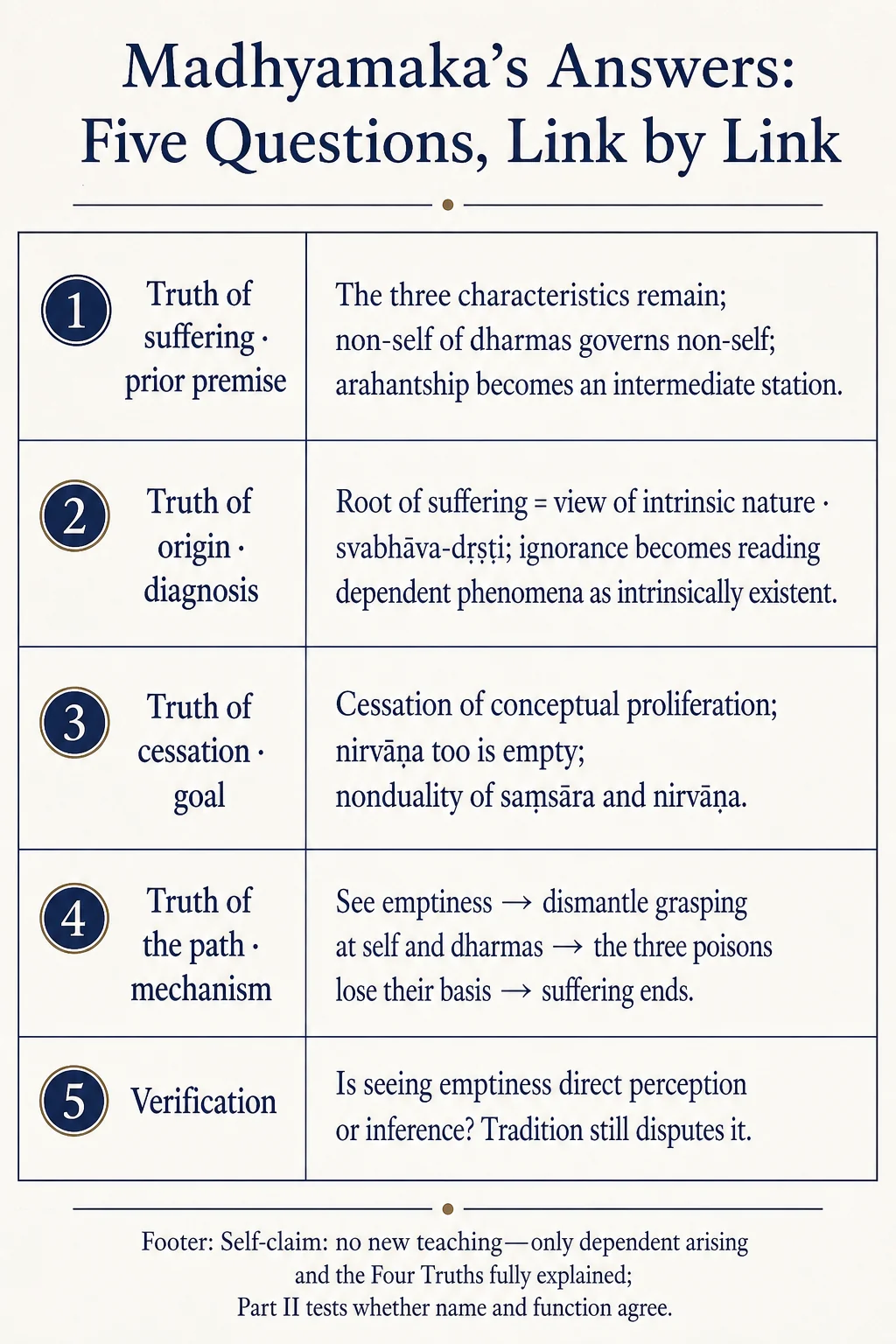
Taken together, Madhyamaka gives the following answers to the five questions. The truth of suffering remains unchanged, but Madhyamaka attempts to use the “non-self of phenomena” to encompass and govern “non-self.” The truth of origin locates the root of suffering in the view of real existence. The truth of cessation makes the cessation of conceptual proliferation and the emptiness of nirvāṇa the endpoint. The truth of the path uses seeing emptiness to destroy the view of real existence and thereby remove the conditions of suffering. Verification rests on the still unresolved dispute over whether seeing emptiness is direct realization or inference. At each link, Madhyamaka claims only to carry early Buddhism’s “knowledge and vision as they are” through to the end; its structure is therefore isomorphic with the Four Truths and supposedly more thorough even than the disciple path.
This chapter’s task ends here: to present the claim faithfully in its strongest form without explicit judgment. The weight of the claim can nonetheless be noted in advance. Madhyamaka places almost the entire burden of liberation on the single epistemological act of “seeing through intrinsic nature.” The effect of that transformation on soteriology is immeasurable. It not only allows Madhyamaka to reconstruct soteriology comprehensively, but creates a paradigm for later transformations of liberation theory.
References
References
-
Nāgārjuna, Mūlamadhyamakakārikā. For the dedicatory verses and the pacification of conceptual proliferation, see the opening; for the tetralemma of non-arising (arising neither from self, from other, from both, nor without cause), see chapter 1, “Examination of Conditions”; for the objection “if everything is empty, the Four Truths cannot stand” and its answer, see chapter 24, “Examination of the Four Noble Truths”; for nirvāṇa’s lack of intrinsic nature and the nonduality of saṃsāra and nirvāṇa, see chapter 25, “Examination of Nirvāṇa.” For English translations and analysis, see Jay L. Garfield, The Fundamental Wisdom of the Middle Way: Nāgārjuna’s Mūlamadhyamakakārikā (New York: Oxford University Press, 1995), and Mark Siderits and Shōryū Katsura, Nāgārjuna’s Middle Way: Mūlamadhyamakakārikā (Boston: Wisdom, 2013). ↩
-
Readers may wish to keep one question in mind and weigh it against the discussion that follows. If nirvāṇa cannot be expressed in language and early Buddhism remains silent on “what it is,” as Chapter 2 of the Introduction explained, did early Buddhism truly teach people to “realize nirvāṇa” as an object? Or did it only ever indicate “the cessation of suffering,” while language in which one “attains nirvāṇa” and treats nirvāṇa as something that can be approached and realized already represents a later objectification? When Madhyamaka denies the grasping expressed in “nirvāṇa can be realized,” does it depart from the early teaching, or does it come closer to that silence? The question deserves to remain suspended as we read onward. Chapter 3 of Part II will return to it. ↩
-
The Abhisamayālaṃkāra systematizes direct realization of prajñā in relation to the bodhisattva grounds and the stages of the path of seeing. For an English translation, see Edward Conze, trans., Abhisamayālaṅkāra (Rome: IsMEO, 1954), and Gareth Sparham, trans., Abhisamayālaṃkāra with Vṛtti and Ālokā, 4 vols. (Fremont: Jain Publishing, 2006–2012). ↩
-
For the distinction between Svātantrika and Prāsaṅgika and Candrakīrti’s Prāsaṅgika position, see Candrakīrti’s Madhyamakāvatāra and Prasannapadā; for Tsongkhapa’s synthesis, see the chapter on vipaśyanā in his Great Treatise on the Stages of the Path to Enlightenment. For overviews, see Paul Williams, Mahāyāna Buddhism: The Doctrinal Foundations, 2nd ed. (London: Routledge, 2009), chap. 3; and C. W. Huntington Jr., The Emptiness of Emptiness: An Introduction to Early Indian Mādhyamika (Honolulu: University of Hawai‘i Press, 1989). ↩