Part I, Chapter 2: Early Madhyamaka’s Theory of Practice—Nāgārjuna and Āryadeva
The preceding chapter presented Madhyamaka soteriology’s core claims through the framework of five questions. On the truth of the path (mechanism), it stated only the principle: seeing emptiness destroys the view of real existence and thereby removes the conditions of suffering. This chapter brings that link into closer focus and asks a more concrete question. What does this road of “ending suffering by seeing emptiness” look like in actual practice? What kind of theory of practice does early Madhyamaka provide?
Why Nāgārjuna and Āryadeva must be considered together
If we look at Nāgārjuna alone, around the second century, the question immediately encounters a well-known asymmetry: his philosophical arguments are exceedingly precise, but his practical instructions exceedingly scarce. Almost every one of the twenty-seven chapters of the Mūlamadhyamakakārikā performs conceptual analysis and reductio, while explanations of meditation methods, stages of practice, and psychological processes are few. The Vigrahavyāvartanī restates Madhyamaka methodology in a more compact form, but is likewise a philosophical defense rather than a manual of practice. This asymmetry does not necessarily mean that Nāgārjuna’s writings were unrelated to practice. A more likely explanation is that they presupposed a living background of practice transmitted orally within the monastic community and therefore did not need to write it into philosophical treatises. For later readers, however, reconstructing a theory of practice solely from the Mūlamadhyamakakārikā is like confronting an architectural theorist who left almost no construction drawings.
This chapter therefore includes Āryadeva, around the third century and Nāgārjuna’s direct successor, and writes of “early Madhyamaka” rather than Nāgārjuna alone. This is not merely convenient for obtaining material but closer to historical fact. Nāgārjuna and Āryadeva form the founding pair of Madhyamaka, as Volume I explained in 5.1 and 5.2. Textually, the materials they supply for a theory of practice complement each other. Nāgārjuna’s discussions of practice occur mainly outside the Mūlamadhyamakakārikā, scattered through his more ethical and exhortatory writings, especially the Ratnāvalī and the Suhṛllekha, a verse letter to a friendly ruler. Āryadeva left a work genuinely structured around practice, the Catuḥśataka. Only by bringing these materials together can a substantial early Madhyamaka theory of practice be assembled. Even then, it retains the character of “counteracting errors and breaking attachment” rather than constituting a complete manual of tranquility and insight. A truly systematic progression of the path was built only gradually after Nāgārjuna, and belongs to the next chapter.
First clarifying a word: what kind of “practice”?
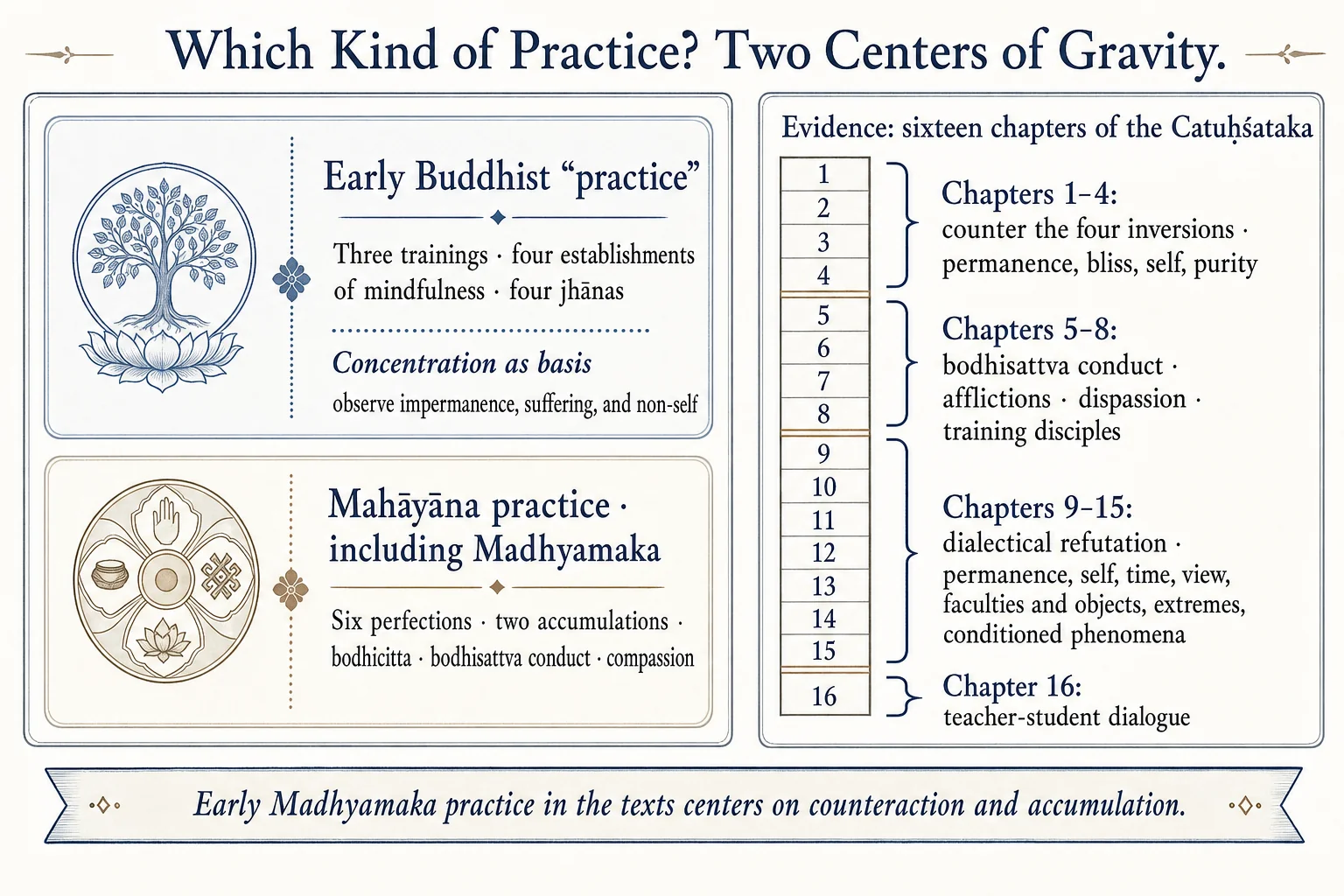
One word must be clarified before proceeding, or the claim that these texts “presupposed a living background of practice” will pass over an ambiguity. The word is “practice.” Different traditions do not imagine the same thing when they see it. In early Buddhism, practice centers on the three trainings in ethical discipline, concentration, and wisdom, especially the experiential cultivation of tranquility and insight along the lines of the four establishments of mindfulness and the four jhānas: concentration provides the foundation, and insight directly sees impermanence, suffering, and non-self, as Chapter 2 of the Introduction explained. In Mahāyāna, including Madhyamaka, practice often has a different center of gravity: the six perfections, accumulation of the two provisions of merit and wisdom, generation of bodhicitta, performance of the bodhisattva conduct, and cultivation of loving-kindness and compassion toward sentient beings. The two are not mutually exclusive and historically interweave, but their emphases clearly differ. When we say that “early Madhyamaka presupposed a living background of practice,” we must therefore ask: which kind of practice?
An honest observation is that the portion of early Madhyamaka practice actually committed to writing clearly emphasizes the latter. Nāgārjuna’s practical materials in the Ratnāvalī and Suhṛllekha discuss the two provisions, perfections, bodhisattva conduct, and ethical exhortation. The first eight chapters of Āryadeva’s Catuḥśataka elaborate contemplations directly counteracting inversions, bodhisattva conduct, abandonment of affliction, and a disciple’s training. The detailed levels of tranquility (jhāna) and the sequential abandonment of fetters at each stage in early Buddhism are almost entirely absent from their writings. Mindfulness of death, contemplation of the body as impure, and contemplation of suffering are certainly meditations, but they are direct counteractive contemplations rather than the tranquility of deep concentration. Placed together with the bodhisattva’s provisions, they shift the “practice” described in early Madhyamaka toward counteraction and accumulation. The method of that counteraction must also be noticed: it attacks the inversion itself frontally and directly. Mindfulness of death destroys grasping at permanence; contemplation of the body’s impurity destroys grasping at purity. This contrasts with the early Eightfold Path described in Chapter 2 of the Introduction, which does not assault the symptoms directly but cultivates ethical discipline, concentration, and wisdom indirectly.
This raises a doubt that should neither be evaded nor treated as settled: the “living background” presupposed by early Madhyamaka may not have been early Buddhism’s experiential cultivation of concentration and wisdom. It may more likely have been a culture of practice already centered on counteraction, accumulation, and bodhisattva conduct. This book does not declare that conclusion final; oral transmission is inherently difficult to reconstruct. But readers should not complete early Madhyamaka’s theory of practice by merely assuming “concentration and wisdom were already present but left unwritten.” What the texts do write points toward another center of practice. This distinction must be clarified before we can later assess whether Madhyamaka preserves the early mechanism for ending suffering.
Āryadeva’s Catuḥśataka: a gradual path counteracting inversions
The early Madhyamaka text closest to a “manual of the path” is Āryadeva’s Catuḥśataka. Its two halves correspond precisely to Madhyamaka’s two faces. Of the last eight chapters, chapters 9 through 15 perform refutational dialectics of the same kind as the Mūlamadhyamakakārikā: refuting permanence, self, time, views, faculties and objects, adherence to extremes, and the characteristics of conditioned phenomena. Chapter 16 concludes with a dialogue between teacher and disciple, returning to an admonitory voice that echoes chapter 8 of the first half. The first eight chapters form a gradual path focused on counteracting inversions and have traditionally been read within Madhyamaka as preparatory stages for entering the path.1
The skeleton of the first eight chapters is “counteracting the four inversions.” The four inversions (viparyāsa) are ordinary beings’ four fundamental misrecognitions: grasping impermanent things as permanent, suffering as happiness, the impure as pure, and non-self as self. Chapters 1 through 4 of the Catuḥśataka attempt to counteract them one by one. Chapter 1 uses mindfulness of death against grasping at permanence; chapter 2 contemplates suffering against grasping at happiness; chapter 3 contemplates the body as impure against grasping at purity; and chapter 4 destroys pride of self against self-grasping. Chapter 5 then discusses bodhisattva conduct, chapter 6 the abandonment of afflictions, chapter 7 the counteraction of sensual desire, and chapter 8 the attitude a disciple should bring to training. From the coarsest delusions of permanence, bliss, self, and purity through the bodhisattva’s daily conduct, the chapters form a ladder of counteraction that proceeds from shallow to deep.
This point deserves to be made clear on early Madhyamaka’s behalf, but with due limits. Counteracting the four inversions of permanence, bliss, self, and purity is the old subject matter of early Buddhism’s four establishments of mindfulness—contemplating the body as impure, feelings as suffering, mind as impermanent, and phenomena as non-self. Āryadeva does not begin from a new foundation. He takes up the oldest counteractive goals and makes them preparations and rungs leading toward the view of emptiness. In terms of the object (what one contemplates), early Madhyamaka’s point of departure is highly continuous with this book’s baseline. A distinction must immediately follow, however. Āryadeva handles these subjects through verses that argue and exhort people to break attachment, not by teaching them how to enter concentration and how to rise from concentration into insight. The subject is old, but the method has become exhortation rather than the experiential cultivation of concentration and wisdom. This will become especially important later. Chapter 2 of the Introduction explained that the characteristics of impermanence and non-self close the door to “permanence, bliss, self, and purity.” The first four chapters of Āryadeva do exactly the same thing, counteracting and dismantling those four one by one. In subject matter, early Madhyamaka remains close to the early teaching; in method of practice, it already possesses a different emphasis.
Nāgārjuna’s two provisions: practice is not pure epistemological intellectualism
On Nāgārjuna’s side, the Ratnāvalī contains his richest account of practice. Addressing a ruler, he sets out the overall structure of the path. The bodhisattva path must accumulate two kinds of provisions (sambhāra): the provision of wisdom (jñāna-sambhāra) and the provision of merit (puṇya-sambhāra). The provision of wisdom means understanding and directly realizing emptiness. The provision of merit means practicing perfections (pāramitā) such as generosity, ethical discipline, and patience, together with compassion (karuṇā) for all sentient beings. The letter known as the Suhṛllekha offers ethical and gradual instruction along largely the same lines: renounce what is harmful, keep ethical discipline, cultivate concentration, generate compassion, and move toward liberation.2
The two-track structure of the provisions carries an important implication for the theory of practice: early Madhyamaka does not claim that “obtaining the correct view of emptiness is enough.” Practice must simultaneously transform affect and conduct. Wisdom destroys the epistemological foundation of grasping at self and phenomena; merit accumulates within the mental continuum the conditions that make practice possible and supplies the soil in which bodhicitta arises and becomes stable. The two depend on each other. Without the provision of wisdom, the accumulation of merit lacks correct direction and may be only mundane wholesome karma. Without the provision of merit, even a conceptual understanding of emptiness can fall into “dry wisdom,” an empty rotation that understands but possesses no power to transform. At least in Nāgārjuna’s own conception, the Madhyamaka path is not purely intellectual.
The emptiness of emptiness: even the tools of practice must be relinquished
One feature distinguishes early Madhyamaka’s theory of practice from an ordinary gradual path: it applies “emptiness” to the tools of practice themselves. Nāgārjuna does not systematically distinguish conventional bodhicitta (saṃvṛti-bodhicitta) from ultimate bodhicitta (paramārtha-bodhicitta) as the later Bodhicaryāvatāra does, but the logic of that distinction is already present in his framework of the two truths. Conventional bodhicitta is the vow “may I attain buddhahood in order to save sentient beings,” a conditioned phenomenon belonging to conventional truth. Ultimate bodhicitta is understanding the emptiness of bodhicitta itself. Bodhicitta too is empty and lacks intrinsic nature, so it should not be grasped as a real object.
This step carries great weight in the theory of practice. If practitioners hold only conventional bodhicitta without understanding its emptiness, bodhicitta can readily become a vehicle for a subtler self-grasping. The “I” that wants to “attain buddhahood and save sentient beings” may be only the view of intrinsic nature dressed in compassionate clothing. Understanding ultimate bodhicitta guards precisely against this subtle grasping. It does not cancel bodhicitta’s efficacy in practice but prevents it from becoming a new bond. This corresponds exactly at the practical level to the Mūlamadhyamakakārikā’s “emptiness of emptiness”: even emptiness cannot be grasped as truly existent. The tools of practice must themselves be empty, or the means become new objects of attachment. Early Madhyamaka’s theory of practice therefore has a self-dissolving character. It demands that, even while walking the road, practitioners see the road itself as empty.
Tranquility and insight: permeated by the view of emptiness, but harder to verify
The coordination of tranquility (śamatha) and insight (vipaśyanā) is another thread in early Madhyamaka’s theory of practice. Nāgārjuna occasionally touches on them in verses in works such as the Yuktiṣaṣṭikā, but his discussion is brief. Later tradition usually summarizes his position as follows: tranquility steadies the mind and makes it capable of powerful concentration on an object, while insight directly sees emptiness. Nāgārjuna does not, however, subdivide the levels of jhāna, specify the fetters (saṃyojana) abandoned at each, or give concrete objects and procedures of contemplation in the manner of Abhidharma.
Judged from the surviving texts, early Madhyamaka’s understanding of tranquility and insight is strongly colored by prajñā. The crucial point is not that the quality of insight is determined by the depth of tranquility (the particular jhāna attained), but whether right view of emptiness permeates the entire process. On the level of conventional truth, cultivation of tranquility and insight continues to follow traditional methods: restraining the faculties, regulating body and breath, and focusing attention. At the ultimate level, however, the answer to “what is contemplated?” is the direct realization of emptiness, not a fixed visualization of some fixed object. This makes early Madhyamaka’s framework of tranquility and insight operationally more open than Abhidharma’s, but also more difficult to verify clearly. That openness will leave consequences for the question of verification, and Part II, especially its chapter on verification, will return to it.
A clear direction without systematic stages of the path
Taken together, these materials describe early Madhyamaka’s theory of practice as follows. It has a clear main structure: Āryadeva’s stages for counteracting the four inversions, Nāgārjuna’s two tracks of provisions, the dialectic of ultimate and conventional bodhicitta, and tranquility and insight permeated by the view of emptiness. But it lacks a systematic and detailed progression of the path. It tells practitioners fairly clearly which direction to walk while saying little about each concrete step.
This absence contrasts sharply with the abundance of contemporary Abhidharma. Sarvāstivāda, for example, has an exceedingly systematic theory of practice. Its five stages (the paths of provisions, preparation, seeing, cultivation, and no-more-learning) are arranged in orderly sequence. Every stage has definite mental events, classes of affliction to be abandoned, and observable functional changes. The path of seeing centers on direct realization of the Four Truths in sixteen moments of mind. The path of cultivation progresses through the gradual abandonment of nine grades of afflictions. Every step bears a sign of “attaining the fruit.” Early Madhyamaka offers no map of comparable detail. This does not mean it is shallower than Sarvāstivāda. Nāgārjuna’s criticism is precisely that Sarvāstivāda analyzed dharmas lacking intrinsic nature into atoms possessing intrinsic nature, building the entire edifice of the path on a mistaken ontological foundation. Even so, the criticized party does possess construction drawings, while the critic’s replacement plans are far sparser.
Integrating the view of emptiness with a complete system of stages (especially correlating the ten bodhisattva grounds of the Daśabhūmika Sūtra step by step with the view of emptiness and compassion) was a project gradually completed after Nāgārjuna and Āryadeva, principally by systematizers in the lineage of Candrakīrti’s Madhyamakāvatāra. That lies beyond the scope of “early Madhyamaka” and is reserved for the next chapter. For now, remember only this: early Madhyamaka supplies a philosophical core and a ladder of counteraction. Later thinkers built the complete system of practice within that core, sometimes by extending or revising it.
Summary and preview
Stated in its strongest form, early Madhyamaka’s theory of practice follows this road. It begins with Āryadeva’s gradual counteraction of the four inversions, continues on Nāgārjuna’s twin tracks of merit and wisdom, fills them with bodhisattva conduct and compassion, and makes the direct realization of emptiness that permeates the entire path its final destination. It further requires that the tools themselves (including the “view of emptiness” and “bodhicitta”) be seen as empty, leaving no new attachment. In its point of departure, it is highly continuous with early Buddhism’s counteractive path. In its destination, it places the entire weight on the move of “seeing emptiness.”
This chapter’s task remains faithful presentation without explicit judgment. One point for later investigation can nonetheless be identified. This theory of practice is clear in direction but thin in concrete stages, while making success depend upon an epistemological achievement—direct realization of emptiness. Does a road centered on “seeing everything as empty and then seeing the tool of that vision as empty” move toward cessation, or toward an increasingly subtle exercise of speculative thought? The chapters of Part II will test precisely that question.
References
References
-
Āryadeva’s Catuḥśataka divides into a first set of eight chapters devoted to counteraction and exhortation and a second set of eight. In the latter, chapters 9 through 15 perform refutational dialectics of the same kind as the Mūlamadhyamakakārikā, while chapter 16 consists of a dialogue between teacher and disciple (an admonition to the disciple) that echoes chapter 8 of the first half. The first eight counteract the four inversions of permanence, happiness, purity, and self, and address bodhisattva conduct, abandonment of affliction, and disciples’ training. For translation and study, see Karen C. Lang, Āryadeva’s Catuḥśataka: On the Bodhisattva’s Cultivation of Merit and Knowledge (Copenhagen: Akademisk Forlag, 1986). For the latter eight chapters together with commentaries by Dharmapāla and Candrakīrti, see Tom J. F. Tillemans, Materials for the Study of Āryadeva, Dharmapāla and Candrakīrti, 2 vols. (Vienna: Arbeitskreis für Tibetische und Buddhistische Studien, 1990). For Āryadeva’s life and early Madhyamaka, see Volume I, 5.2. ↩