Part I, Chapter 3: Candrakīrti and the Prāsaṅgika Path of Liberation
The preceding chapter stopped at an unfinished project. The theory of practice offered by early Madhyamaka, Nāgārjuna and Āryadeva, was clear in direction but incomplete in stages. It pointed toward destroying the view of real existence by seeing emptiness but did not lay out that direction as a path that could be followed level by level and checked step by step. Correlating the view of emptiness with complete stages of the path, especially integrating the ten bodhisattva grounds of the Daśabhūmika Sūtra with emptiness and compassion ground by ground, was accomplished only gradually after Nāgārjuna and Āryadeva. This chapter addresses the most important heir to that project: Candrakīrti, around the seventh century, and the Prāsaṅgika path of liberation that he represents.
This chapter continues the method of the preceding two, presenting the strongest form of the position without yet developing the criticism. It will, however, note which link of the five questions each addition completes and which unresolved problems it makes more acute. There are really two questions. How did later thinkers supply the systematic stages that early Madhyamaka lacked? Did the resulting system alter the central assumption identified in Chapter 1, the epistemological optimism expressed in “seeing emptiness is liberation”?
The dual identity of the Madhyamakāvatāra: commentary and systematization
Within the Madhyamaka tradition, Candrakīrti is both commentator and systematizer. The Prasannapadā is the most important commentary on Nāgārjuna’s Mūlamadhyamakakārikā and the principal arena for Candrakīrti’s methodological position, Prāsaṅgika. The Madhyamakāvatāra uses the ten bodhisattva grounds of the Daśabhūmika Sūtra as its framework and unfolds the Madhyamaka view of emptiness into a progression of practice.1 These two undertakings are different faces of one project. His methodological criticism of Bhāvaviveka clears a sound foundation for his theory of practice, while that theory is meant to prove that a Prāsaṅgika position that “establishes no thesis of its own” remains complete and practicable. In other words, Candrakīrti answers both “How should Madhyamaka argue?” and “How should Madhyamaka be practiced?” and insists that the two answers must agree.
Systematization I: stages of the path through the ten grounds and six perfections
This is precisely the correlation that the previous chapter deferred. The Madhyamakāvatāra makes the six perfections (ṣaṭ-pāramitā) the basic structure of practice and associates them with the ten bodhisattva grounds. Each of the first six grounds makes one perfection primary: generosity, ethical discipline, patience, effort, meditative concentration, and wisdom. The sixth ground, the Manifest, centers on wisdom’s direct realization of emptiness, and the seventh and higher grounds deepen that realization. Candrakīrti did not invent the framework of ten grounds and six perfections; it comes from the Daśabhūmika Sūtra and the Perfection of Wisdom corpus. His contribution is to bind cultivation of the perfections tightly to a deepening view of emptiness at every ground, specifying in sequence which perfection is practiced, which principle is seen, and which obstruction is abandoned.
In terms of the five questions, this supplies an operational progression for the truth of the path—the link of mechanism. In Chapter 1, Madhyamaka’s mechanism was only a principle: seeing emptiness destroys the view of real existence. Early Madhyamaka in Chapter 2 unfolded that principle into a road of counteraction and accumulation, but still lacked verifiable stages. When Candrakīrti’s lineage takes over, the “construction drawing” missing from early Madhyamaka gains a comparatively complete outline for the first time: ground, perfection cultivated, principle seen, and affliction abandoned are all arranged in sequence. In systematic terms, these stages can finally be compared with the Abhidharma theory of practice that Madhyamaka once criticized, such as Sarvāstivāda’s five paths discussed in Chapter 2. The critic arrives several centuries late but at last delivers plans that are no longer sparse.
Systematization II: conventional valid cognition grounds practice
Systematization must do more than supply stages. It must answer a methodological problem left by early Madhyamaka: if Madhyamaka “establishes no thesis of its own,” what entitles practitioners to follow the direction it indicates? Candrakīrti’s answer emerges from his famous disagreement with Bhāvaviveka.
Bhāvaviveka argues that, to refute an opponent’s view of intrinsic nature, a Madhyamaka philosopher must use an autonomous inference (svatantra-anumāna)—a syllogism capable of standing independently under epistemic standards shared by both parties to the debate. Merely using reductio—Nāgārjuna and Candrakīrti’s prasaṅga—to negate the opponent is insufficient to establish right view. Candrakīrti objects that an autonomous inference could stand only if both parties “saw” the object under discussion in the same way. Yet the proponent of intrinsic nature and the Madhyamaka philosopher see precisely different things: one sees the object as truly existing through its own characteristic, the other sees it as lacking intrinsic nature. There is no common ground of the required kind. To insist that such ground exists would make Madhyamaka first concede an independently real epistemological basis—the very thing it seeks to dismantle. Madhyamaka can therefore use only reductio: it borrows premises already accepted by the opponent and derives contradictions from them, without establishing an independent thesis of its own.2
The premises borrowed by reductio are forms of cognition “commonly accepted in the world” (loka-prasiddha) at the conventional level: inferring fire from smoke and making ordinary judgments about colors, sounds, smells, and tastes. These operate normally and effectively within conventional truth without metaphysical guarantees. Tsongkhapa later calls this level “conventional valid cognition,” as Chapter 1 noted: cognition that is effective conventionally without implicating intrinsic nature.
This move has considerable importance for the theory of practice. It supplies a foundation for practice within conventional truth. Cultivating the six perfections, generating bodhicitta, and responding compassionately to the suffering of sentient beings are all activities at the level of conventional truth. Their efficacy is warranted by what is commonly accepted in the world (conventional valid cognition), and need not await direct realization of emptiness. Before directly realizing emptiness, practitioners can rely on correct understanding of conventional truth to cultivate the six perfections and accumulate the two provisions. The question “If Madhyamaka has no thesis of its own, why should practitioners follow its path?” thus receives a preliminary answer. The basis is not some Madhyamaka “thesis” at the level of ultimate truth, but the direction guaranteed at the conventional level by conventional valid cognition. Whether this answer truly stands will be examined in Chapter 5 of Part II, “The Tension Between Having No Thesis and Practice.” Here we simply record the Prāsaṅgika answer.
The nonduality of the two truths: conventional truth is not an illusion to be transcended
Behind conventional valid cognition’s ability to ground practice lies Candrakīrti’s judgment about the relation between the two truths. Conventional truth is not an inferior layer of illusion that must be transcended to arrive at ultimate truth. It is the field in which practice actually occurs. Nor is ultimate truth a higher reality layered over conventional truth. It describes only the empty nature of the same conventional things. Viewed through conventional truth, one and the same process of practice has steps, content, and effects. Viewed through ultimate truth, nothing within it possesses fixed intrinsic nature. The two are not two worlds but two readings of the same event.
This judgment carries an important soteriological consequence. Progress in practice does not require repeated switching of perspectives between the two truths—“now view it conventionally, now switch to viewing it ultimately.” The two descriptions of the same experience always coexist. The more clearly bodhisattvas see the operations of conventional truth, the more deeply they understand its empty nature. The two directions support rather than exclude one another. This follows the same logic as Madhyamaka’s truth of cessation identified in Chapter 1. Since nirvāṇa too lacks intrinsic nature and saṃsāra and nirvāṇa are nondual, liberation does not reside in some ultimate world elsewhere. It occurs when this present conventional world is seen through as it is.
The union of compassion and wisdom: great compassion’s pivotal position
The most conspicuous feature of Candrakīrti’s theory of practice at the affective level is the pivotal place occupied by great compassion (mahā-karuṇā). The opening of the Madhyamakāvatāra presents three causes of the bodhisattva: great compassion, nondual wisdom (advaya-jñāna), and bodhicitta, placing great compassion first. The order is intentional. The Mahāyāna path does not begin from revulsion toward one’s own suffering but from a response directed toward the suffering of all sentient beings. Compassion is not an accessory emotion of practice but the motive force driving the entire path.
Great compassion is central at two levels. Epistemologically, it is seeing the suffering of sentient beings as it is, but with an affective quality: seeing suffering, seeing its cause (ignorance), and seeing sentient beings revolve within ignorance. This is not detached philosophical observation but a unity of compassion and wisdom. Soteriologically, the bodhicitta generated from great compassion is the structural force preventing practitioners from falling midway into a disciple-style extinction and impelling them to continue dedicating their efforts to sentient beings. Candrakīrti expressly states that without great compassion, bodhisattvas who see emptiness might turn from suffering, enter cessation directly, and cease dedicating themselves to others. Great compassion stabilizes the bodhisattva path in an altruistic direction.
This returns to a point foreshadowed in Chapter 1. Under the truth of suffering, Madhyamaka demotes the disciple’s arahantship to “incomplete liberation” (realizing the non-self of persons but not the non-self of phenomena), and arranges the disciple path as an initial stage of the bodhisattva path. With Candrakīrti, that arrangement receives a dynamic explanation. Disciples do not stop halfway because their realization is insufficient, but because they lack great compassion as a motive force and therefore enter cessation. Bodhisattvas go farther because compassion continues to propel them. In this respect, Candrakīrti supplies not only the stages of the path but an explanation of why the road “cannot stop short of buddhahood.”
Summary: the system of practice is completed, but its central assumption is unchanged
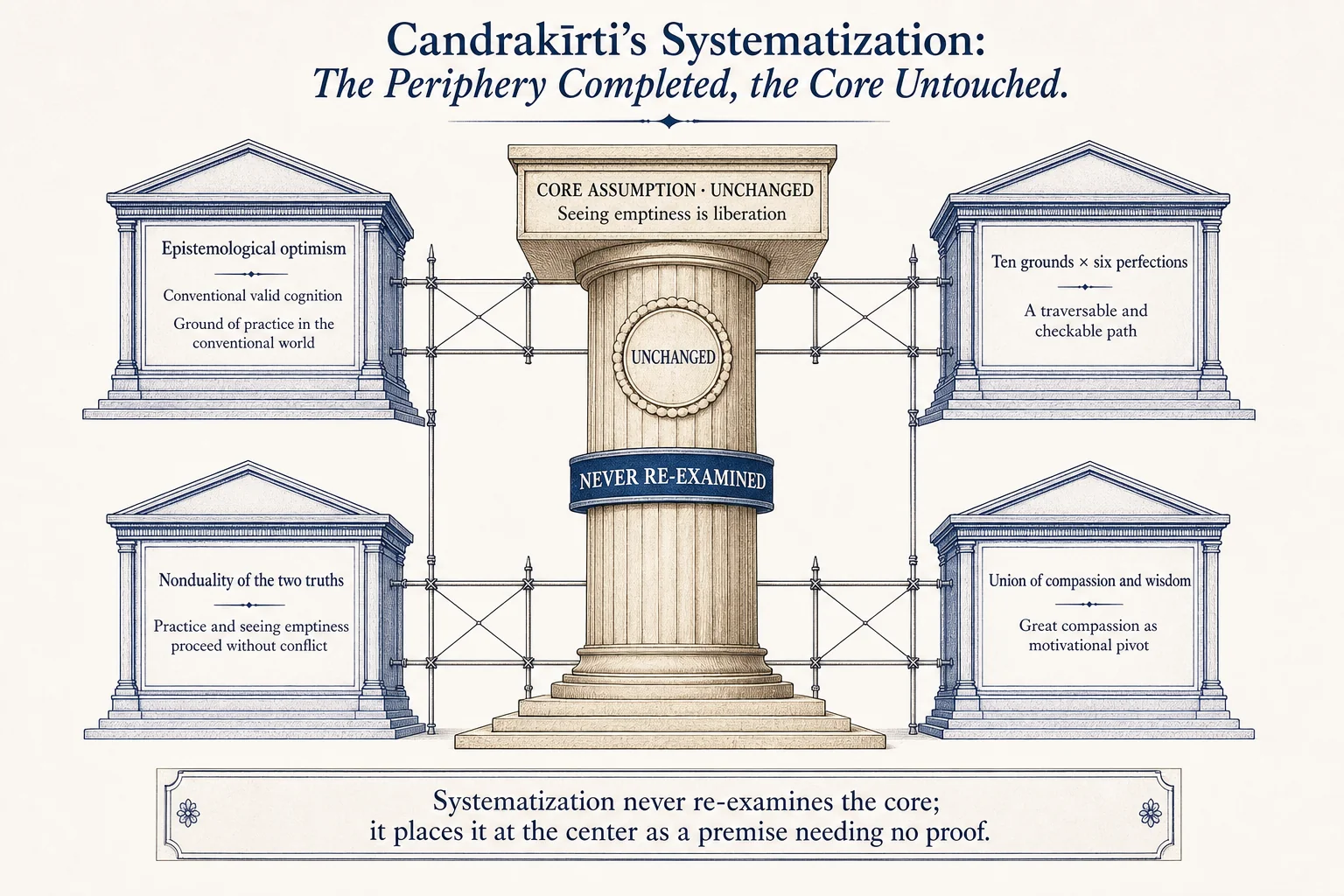
Taken together, Candrakīrti’s lineage supplies early Madhyamaka with what it most lacked: a complete system of practice that can be followed and checked. The ten grounds and six perfections give sequential stages; conventional valid cognition gives practice a conventional foundation; the nonduality of the two truths resolves the perspectival problem of “how practice and contemplation of emptiness proceed together”; and the union of compassion and wisdom supplies a dynamic structure that maintains the bodhisattva orientation. In theoretical precision and coherence, this is a far more complete proposal than early Madhyamaka.
One point must nevertheless be seen clearly. Everything Candrakīrti completes belongs to the road and procedures leading to liberation. The central assumption underlying them all remains entirely unchanged. Chapter 1 identified Madhyamaka soteriology’s success or failure as depending on a single epistemological act: see emptiness, destroy both forms of grasping, and thereby remove the conditions of suffering. Everything Candrakīrti does unfolds the road toward this act more completely, sequentially, and practicably. He does not and has no intention of altering the central assumption. Far from reexamining it, systematization treats it as a premise requiring no proof and places it at the center of the whole structure.
For precisely this reason, two questions left by early Madhyamaka become not less but more acute after systematization. First, if Madhyamaka “has no thesis of its own” but nevertheless directs practitioners along a path, can conventional valid cognition alone truly reconcile the tension? This is the subject of Chapter 5 in Part II. Second, is the pivotal “seeing emptiness” direct perception or a correct inferential view, and who recognizes that direct realization has occurred—the question of verification from Chapter 1? Once Candrakīrti locates the path of seeing within the ten grounds and depends heavily on argument, the threshold for that recognition can only become higher and more specialized. Chapter 6 of Part II, “The Drift in Certifying Realization,” will return to it.
This chapter remains presentational to the end. It has set out systematized Madhyamaka practice in its strongest form, together with the central assumption that systematization never touches. Judgment is reserved for the chapters that follow.
References
References
-
Candrakīrti’s Madhyamakāvatāra takes the ten bodhisattva grounds as its framework and correlates the six perfections with the first six grounds. The sixth, the Manifest, centers on wisdom’s direct realization of emptiness. Its opening identifies great compassion, nondual wisdom, and bodhicitta as the bodhisattva’s three causes and places compassion first. For translation and study, see Padmakara Translation Group, Introduction to the Middle Way: Candrakīrti’s Madhyamakāvatāra with Commentary by Jamgön Mipham (Boston: Shambhala, 2002); for the first six grounds, see also C. W. Huntington Jr., The Emptiness of Emptiness: An Introduction to Early Indian Mādhyamika (Honolulu: University of Hawai‘i Press, 1989). The scriptural basis for the ten bodhisattva grounds is the Daśabhūmika Sūtra. ↩
-
For the debate over autonomous inference (svatantra) and reductio (prasaṅga), see Candrakīrti’s criticism of Bhāvaviveka’s autonomous inference in chapter 1 of the Prasannapadā. Candrakīrti’s central reason is that the two parties lack a common “seeing” of the object under dispute (the advocate of intrinsic nature sees it as truly existing through its own characteristic, while the Madhyamaka philosopher sees it as lacking intrinsic nature), so the shared ground required by autonomous inference does not exist. Madhyamaka can use only conventional premises “commonly accepted in the world” (loka-prasiddha) for reductio. Tsongkhapa follows Prāsaṅgika and carries this level forward as “conventional valid cognition”; see the vipaśyanā chapter of his Great Treatise on the Stages of the Path to Enlightenment. For a specialized study, see Kodo Yotsuya, The Critique of Svatantra Reasoning by Candrakīrti and Tsong-kha-pa (Stuttgart: Franz Steiner, 1999); for an overview, see Paul Williams, Mahāyāna Buddhism: The Doctrinal Foundations, 2nd ed. (London: Routledge, 2009), chap. 3. On the relation of the Svātantrika–Prāsaṅgika distinction to this volume’s problem of verification, see Chapter 1 of this part. ↩