Chapter 4: An Overview of the Transformation of Mahāyāna Soteriology
This chapter surveys how five Mahāyāna systems (Madhyamaka, Yogācāra, tathāgatagarbha, Esoteric Buddhism, and Pure Land) each reconstruct soteriology: what they change, what they add, and how they relate to the early teaching. It serves as the master map for the parts that follow.
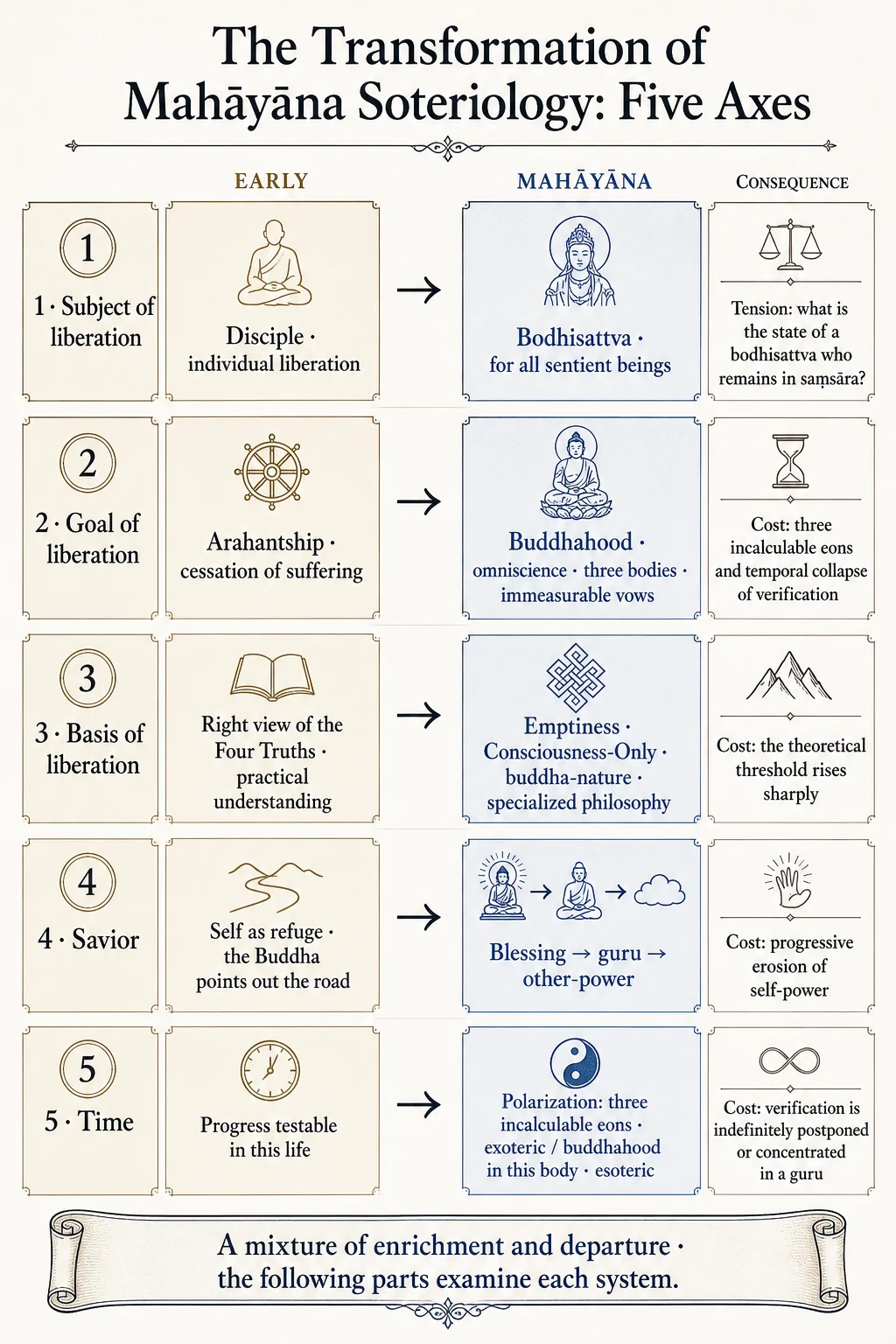
From disciple to bodhisattva: the expansion of the subject of liberation
Early Buddhist soteriology centers on the individual’s liberation from suffering. A disciple (śrāvaka) hears the Buddha’s teaching, practices the Noble Eightfold Path, and moves toward individual liberation—the fruit of arahantship (arhatva). Within this framework, liberation is fundamentally a personal undertaking: I liberate myself from my suffering; you liberate yourself from yours. The Buddha reveals the path, but each person must walk it to the end.
One of the Mahāyāna movement’s most conspicuous soteriological changes was its establishment of the bodhisattva ideal. A distinction from Volume I must first be recalled. In early usage, “bodhisattva” referred to an individual practitioner headed toward buddhahood, whose prototype was the Buddha himself across his many lifetimes of bodhisattva practice. Vowing to follow this path, vastly longer than the arahant path, was originally a heroic personal choice made by a minority rather than a universal destiny prescribed for everyone; see Volume I, 4.3. Mahāyāna gradually universalized that minority path as an ideal to be adopted. Bodhicitta is fundamentally the aspiration to attain buddhahood for the benefit of all sentient beings. Some scriptures and vows go further and speak of not taking an individual final nirvāṇa until beings have been delivered, but this is not the single formula shared by every Mahāyāna text. Later accounts of non-abiding nirvāṇa explain how buddhahood and continuing activity for others can be compatible.1 Liberation is thereby placed in the horizon of benefit for all sentient beings rather than treated only as a personal matter.
This expansion possesses powerful moral appeal. Some Mahāyāna texts disparage the image of a disciple attaining liberation alone as the “Lesser Vehicle”: what they criticize is not wisdom itself but the scope of concern. By contrast, the bodhisattva ideal appears vast and sublime. A serious soteriological problem nevertheless arises in texts or explanatory models that frame the path as “postponing nirvāṇa.” If nirvāṇa is the complete cessation of suffering and the bodhisattva remains engaged with saṃsāra to aid beings, what is the bodhisattva’s mode of existence? Is the bodhisattva within suffering, or in a special state that transcends suffering without abandoning it? Doctrines of non-abiding nirvāṇa, buddha bodies, and continuing activity answer this question in different ways. Not every Mahāyāna system bears the tension in the same form, but it helped drive a redefinition of liberation.
From arahantship to buddhahood: upgrading the goal of liberation
The expansion of the subject accompanies a dramatic elevation of the goal. The aim of early Buddhist practice is arahantship: the complete cessation of suffering, the total ending of craving, and the termination of rebirth. Mahāyāna sets buddhahood (buddhatva) as the goal of practice: perfect wisdom (prajñā), unlimited compassionate resolve (karuṇā), and care for and salvation of every sentient being at every time.
The scale of this upgrade is astonishing. Arahantship is a bounded goal that can be achieved within the course of an individual life. Buddhahood is an almost limitless ideal requiring practitioners to accumulate merit and wisdom over three incalculable eons (asaṃkhyeya-kalpa, immeasurable units of time). The upgraded goal fundamentally lengthens the temporal dimension. Exoteric Mahāyāna practice is not an undertaking of this life but an enterprise spanning countless eons. This makes the verification of liberation extremely difficult in temporal terms. Yet Mahāyāna practitioners often confidently declare that their present practice points toward buddhahood. That confidence is itself a subject worthy of examination.
The upgrade also increases soteriology’s theoretical burden. Early Buddhism’s arahantship has clear defining criteria: the severance of the ten fetters (saṃyojana) and the sequence of four fruits. These criteria are not easy to realize, but they are theoretically clear and offer progress that can be traced in practice. The content of buddhahood—omniscience (sarvajñatā), immeasurable compassionate vows, the three bodies (trikāya), and so forth—involves extensive additional metaphysical theory.2 What perfect buddhahood is like, and how one can say it has been attained, increasingly depend on the elaborate theoretical framework of each system rather than any comparatively simple indicator of progress in practice.
Deepening the basis of liberation: from right view to emptiness, Consciousness-Only, and buddha-nature
Early Buddhist soteriology makes right view (sammā-diṭṭhi) the primary condition of the path of liberation. Right view means correctly understanding the Four Noble Truths. This is a practical understanding and does not require highly complex metaphysical theory. A person with little literacy and limited philosophical education who can genuinely understand and experience suffering, origin, cessation, and path possesses the cognitive basis of liberation. It is often remarked in some small Southern circles that the Buddha’s first generation of disciples were frequently scarcely literate and knew nothing of metaphysics, yet still attained the fruits.
The Mahāyāna systems change this point significantly. Madhyamaka holds that the crucial condition of liberation is a correct understanding of emptiness (śūnyatā): all phenomena, including the “self,” lack intrinsic nature (svabhāva). This understanding requires systematic philosophical training and a gradual dismantling of the view of real existence through analyses by reductio (prasaṅga). Yogācāra holds that liberation depends on realizing “representation-only” (vijñapti-mātra): the supposed external world is only a transformation of consciousness, and true liberation is a transformation of the basis (āśraya-parāvṛtti), in which the defiled storehouse consciousness (ālayavijñāna) is transformed into the four purified cognitions, including mirror-like wisdom. Tathāgatagarbha systems go further and claim that sentient beings originally possess buddha-nature (buddha-dhātu). Liberation does not acquire a new state but reveals the pure nature of mind already present. Chan takes this idea to its limit: suddenly awaken and see one’s nature; it is present immediately, with no need for gradual cultivation.3
Each of these theories possesses its own soteriological logic, and the parts that follow will analyze them individually. This chapter wishes only to identify a structural tendency: the theoretical basis on which liberation rests becomes increasingly complex and increasingly requires systematic philosophical training and an associated lineage system to master. Soteriology gradually changes from a practical and relatively accessible framework into a specialized body of knowledge that can be entered only with extensive theoretical preparation. The transformation has intellectual achievements, but it also exacts a cost: in theory, liberation becomes more and more distant for ordinary practitioners who lack philosophical training.
The gradual appearance of a savior: from self-refuge to other-power
Early Buddhism expressly excludes the place of an external savior. The Buddha points out the road but does not save; practitioners must walk the road through their own effort. This principle of self-reliance undergoes a series of erosions in the development of Mahāyāna.
First appear the compassionate vows and blessings of buddhas and bodhisattvas. In Mahāyāna contexts, awakened bodhisattvas not only practice themselves but help other sentient beings in many ways: protecting them with supernormal powers, guiding them through teachings, and alleviating their suffering through sympathetic compassion. This introduces an external factor into the theory of practice but still preserves the necessity of the practitioner’s own effort.
Guru yoga then raises the teacher to a decisive place in liberation within Vajrayāna traditions. Without a guru’s empowerment (abhiṣeka) and lineage, practitioners cannot enter the higher practices; the guru’s blessing is held to be a necessary condition of accomplishment. This is an important development of the savior figure: an external authority not only points out the path but in some sense becomes a conditioning factor in the practitioner’s transformation.
Pure Land Buddhism carries the tendency to its extreme and, in some forms, especially Japan’s Jōdo Shinshū, ultimately develops a complete doctrine of other-power (tariki). Sentient beings are utterly incapable of saving themselves; only the power of Amitābha’s fundamental vow (pūrvapraṇidhāna) can receive them into rebirth. The practitioner’s task is not to eliminate affliction through personal effort but to open oneself through faith (śraddhā) and aspiration (praṇidhāna) to receive this other-power.4 In this version the structure of soteriology changes at its root. It is no longer an account of how the causes of suffering, craving and ignorance, are directly treated, but of how practitioners correctly receive salvation from an external power.
The trajectory from self-reliance to other-power is neither strictly linear nor free of intersections and dialectical relations among the systems. As an overall tendency, however, it is real and must be seriously confronted by a critique of soteriology.
The polarization of time: three incalculable eons and buddhahood in this very body
Mahāyāna soteriology exhibits a curious polarization in its temporal dimension: exoteric Buddhism stretches time without limit, while Vajrayāna compresses it without limit.
Exoteric Mahāyāna, especially the complete cultivation of the bodhisattva path, requires accumulation across three incalculable eons. This timescale exceeds the range of human imagination. It turns soteriology’s temporal promise into a pure object of belief rather than something verifiable within finite time. Mahāyāna can of course answer that every lifetime of practice forms part of the bodhisattva path, and that present practice has value even if the final fruit lies infinitely far away. This does not eliminate the soteriological difficulty: the credibility of a promise that requires countless eons to verify faces a fundamental epistemological challenge.
In sharp contrast stands Vajrayāna’s claim of “attaining buddhahood in this very body,” conventionally described in Tibetan Buddhism as “accomplishing it in a single lifetime.” Through particular empowerments, deity yoga (iṣṭadevatā-yoga), guru yoga, and pointing-out instructions in Dzogchen (rDzogs-chen) or Mahāmudrā, practitioners can achieve ultimate liberation in this very life and even attain buddhahood through diligent cultivation within one lifetime.5 This dramatically reverses exoteric Buddhism’s immense timescale. The compression has its internal logic. If the problem is failure to recognize one’s own original awareness (the idea that one is originally a buddha), then once that awareness is directly pointed out and one learns to abide in it steadily, no accumulation through time is required. Recognition is immediate, and awakening is immediate.
Yet this compression brings its own difficulties of verification. If buddhahood in this very body is possible, how should practitioners who have already attained buddhahood be recognized? In Vajrayāna traditions, authority over that recognition is concentrated in the guru and lineage system. Structurally, this closely connects with the problem of certifying realization that concerns the critique of soteriology.
The historical and macroscopic forces behind these transformations
The series of transformations in Mahāyāna soteriology did not arise without causes. The present subject is their historical and macroscopic impetus: external conditions in institutional and social history that promoted the transformations. As the preface to this volume explains, the internal impetus behind each system’s transformation is a diagnosis at the level of psychodynamics—the particular form of attachment concealed within each. The two must not be confused. Why a system’s soteriology arose historically, what it psychologically clings to, and whether it philosophically stands are three different questions.
The rise of the bodhisattva ideal was partly a reaction against Buddhism’s excessive scholasticization in the Abhidharma age. Abhidharma analyzed dharmas into seventy-five categories in Sarvāstivāda or eighty-two in the Southern tradition and constructed extremely precise metaphysical systems, but those systems increasingly lost the vitality of the early Buddhist teaching in their emotional appeal and popular accessibility. With its generous moral appeal and vast cosmic concern, the bodhisattva ideal rekindled religious passion.
The rise of the doctrine of emptiness was partly a philosophical reaction against Abhidharma dharma realism. If dharmas possess fixed intrinsic natures, how could grasping at dharmas themselves (and not only at “self”) lead to liberation? By thoroughly deconstructing the concept of intrinsic nature, Nāgārjuna’s doctrine of emptiness offered a philosophically more consistent path of criticism.
The rise of tathāgatagarbha theory and Pure Land Buddhism had a broader social and religious background. Lay believers and ordinary practitioners found highly scholastic philosophical Buddhism difficult to enter and needed a more direct and intimate soteriology. “You are originally a buddha” and “Amitābha Buddha will come to receive you” were both powerful calls to ordinary people in this context.
The parts that follow will analyze each system in its particulars and show how its soteriology diverges from the early teaching.
References
This chapter is a synoptic overview and identifies each system’s transformations only at the broadest level. Detailed doctrine, scriptural evidence, and specialized literature for each system appear in its respective part. The following notes give general sources only for the key factual claims in the overview.
References
-
On the bodhisattva ideal, the several forms of bodhicitta, and the oversimplification produced by treating “all bodhisattvas postpone nirvāṇa” as a uniform doctrine, see Paul Williams, Mahāyāna Buddhism: The Doctrinal Foundations, 2nd ed. (London: Routledge, 2009), Chapters 2–5. On the early bodhisattva path as a minority ideal directed toward buddhahood, see Jan Nattier, A Few Good Men: The Bodhisattva Path according to the Inquiry of Ugra (Honolulu: University of Hawai‘i Press, 2003), and Volume I, 4.3. On buddhahood, non-abiding nirvāṇa, and continuing salvific activity, see John J. Makransky, Buddhahood Embodied: Sources of Controversy in India and Tibet (Albany: SUNY Press, 1997). ↩
-
For the content of buddhahood (omniscience and compassionate vows), and the doctrine of the three bodies (trikāya), see chapter 8 of Williams cited above; for a specialized study of the three-body doctrine, see John J. Makransky, Buddhahood Embodied: Sources of Controversy in India and Tibet (Albany: SUNY Press, 1997). The accumulation of merit and wisdom on the bodhisattva path across three incalculable eons (asaṃkhyeya-kalpa) is a settled teaching shared by Mahāyāna and the Abhidharmakośa and appears in the Bodhisattvabhūmi, Mahāprajñāpāramitāśāstra, and other texts. ↩
-
Emptiness and the refutation of intrinsic nature in Madhyamaka, representation-only and transformation of the basis in Yogācāra (the transformation of the storehouse consciousness into the four wisdoms), the original purity of buddha-nature in tathāgatagarbha, and sudden awakening and seeing one’s nature in Chan are only summarized here. Detailed discussion and scriptural evidence appear in Parts II through IV of this volume. For an overview, see the relevant chapters of Williams cited above; on Madhyamaka, see Jay L. Garfield, The Fundamental Wisdom of the Middle Way (New York: Oxford University Press, 1995). For the Abhidharma counts of seventy-five and eighty-two dharmas, see Volume I, 2.5, 3.1, and 3.4. ↩
-
For the structure of Amitābha’s fundamental vow and rebirth in the Pure Land, see the forty-eight vows in fascicle 1 of the Infinite Life Sūtra, especially the eighteenth: “If, when I attain buddhahood, sentient beings of the ten directions who with sincere and trusting minds wish to be born in my land and think of me even ten times should not be born there, may I not attain perfect enlightenment” (trans. Saṅghavarman, Taishō Tripiṭaka, vol. 12, no. 360). For the doctrine of complete other-power (tariki), see Shinran’s Kyōgyōshinshō, Chapter on Practice: “other-power is the power of the Tathāgata’s fundamental vow”; the same chapter cites Tanluan’s Commentary on the Treatise on Rebirth: “were it not for the Buddha’s power, the forty-eight vows would have been set up in vain.” For the detailed discussion see Part VI of this volume. ↩
-
Buddhahood in this very body, empowerment, deity yoga, guru yoga, and the pointing-out instructions of Dzogchen and Mahāmudrā are only summarized here; see Part V of this volume for detailed treatment. For an overview, see the chapter on Esoteric Buddhism (Tantric Buddhism/Mantranaya) in Paul Williams, Anthony Tribe, and Alexander Wynne, Buddhist Thought: A Complete Introduction to the Indian Tradition, 2nd ed. (London: Routledge, 2012). ↩